Jira Premium Pricing 2025: Annual vs Monthly Costs for 201–300 Users
Need Atlassian Jira Premium pricing 201-300 users annual monthly 2025? Compare costs, plan accurately, and avoid budget surprises—read now!
Planning Jira Premium for 201–300 people can feel deceptively simple. You multiply a per-user number by headcount, approve the budget, and move on. Then the billing model complicates everything.
Monthly billing can change with active seats, while annual billing usually uses a user tier. Add taxes, currency conversion, marketplace apps, and occasional price changes, and your forecast can miss by thousands of dollars.
But here's the truth: you can build a reliable 2025 estimate before requesting a quote. This guide explains the annual tier, monthly equivalent, seat assumptions, hidden budget factors, and practical alternatives for teams comparing total ownership cost.
Jira Premium Pricing for 201–300 Users: Annual and Monthly Estimates
For 201–300 users, Jira Premium planning usually means comparing an annual tier of roughly $42,000 per year with a monthly equivalent near $3,500 per month. Treat these figures as budgeting estimates rather than a final invoice.
Atlassian can adjust pricing, billing rules, regional taxes, currency conversion, and seat calculations. Your exact total may also differ when your organization has fewer than 300 active users.
| Billing view |
Planning estimate |
What it means |
| Annual Premium tier |
Approximately $42,000 per year |
A tier-based commitment for an organization with 201–300 seats |
| Monthly equivalent |
Approximately $3,500 per month |
The annual estimate divided across 12 months |
| Monthly billing budget range |
Plan for roughly $3,300–$4,000 per month |
The final amount can change with active seats and progressive pricing |
| Additional costs |
Variable |
Taxes, marketplace apps, support options, and connected products may increase spend |
Annual and monthly totals are not always interchangeable. Annual billing normally maps to a user band, while monthly billing may calculate charges progressively across seat ranges.
Quick cost comparison
Suppose your team has 250 licensed users. An annual quote near $42,000 equals $168 per user each year, or about $14 per user per month.
A monthly plan near $3,500 produces the same annualized figure. However, monthly billing gives you more flexibility if headcount changes, while annual billing can simplify procurement and forecasting.
- Choose annual billing when your team expects stable headcount and values predictable budgeting.
- Choose monthly billing when contractors, acquisitions, seasonal work, or restructuring may change seat usage.
- Request a current quote when the difference affects approval, because regional pricing and billing terms can change the final amount.
How the 201–300 User Tier Affects Your Budget
The 201–300 range is a pricing band, rather than a promise that every seat has the same marginal cost. That distinction matters when you compare monthly and annual invoices.
Annual billing usually uses a committed tier
With annual billing, you generally select a user tier that covers your expected maximum licensed population. A company with 201 users and a company with 300 users may therefore pay within the same tier.
That creates a useful planning question: how likely are you to reach the top of the band? Paying for 300 seats may be reasonable if hiring plans are firm. It may be inefficient if your team will remain near 205.
Monthly billing follows actual seat movement more closely
Monthly plans can suit organizations with changing headcount. For example, a software company may have 220 employees in January, 245 in June, and 280 during a product launch.
That flexibility can reduce unused capacity. It can also make monthly invoices harder to predict, especially when administrators add temporary users and forget to remove them.
Premium features can increase adoption
Premium is often selected for advanced administration, higher operational capacity, automation, and broader governance needs. Those features can create value across multiple teams.
They can also encourage more people to join the platform. A larger active population increases the importance of access reviews, role controls, and license cleanup.
What You Actually Pay Beyond the Subscription
The subscription is only one part of the ownership calculation. A realistic estimate includes adjacent services, internal administration, and the time required to maintain a large workspace.
| Cost area |
Example impact |
Planning question |
| Marketplace apps |
Time tracking, reporting, testing, or portfolio tools can add recurring fees |
Which teams require third-party capabilities? |
| Administration |
Dedicated platform ownership may require regular maintenance |
Who manages permissions, workflows, and automation? |
| Migration and training |
New teams may need onboarding and process redesign |
How many hours will adoption require? |
| External integrations |
Identity, development, support, and communication systems may involve separate charges |
Which connections are essential for daily work? |
| Taxes and currency |
Regional tax treatment can alter the amount paid |
Which legal entity will receive the invoice? |
Here's why: a platform that looks affordable at $42,000 annually can become much more expensive after apps and administration are included.
For example, three paid apps at $5,000 each add $15,000 annually before internal labor. Your effective platform budget then approaches $57,000.
Annual or Monthly: Which Billing Model Fits Your Team?
The right choice depends on predictability, procurement rules, and how quickly your seat count changes. Price alone does not settle the decision.
Annual billing works well for stable organizations
Annual billing offers a clear commitment. Finance teams can allocate the expected amount once, and administrators can avoid monthly seat fluctuations.
It may also simplify approval for organizations with formal procurement cycles. The trade-off is reduced flexibility if your workforce shrinks soon after renewal.
Monthly billing fits changing headcount
Monthly billing can help when your organization regularly adds contractors, integrates acquisitions, or operates through short-term delivery teams.
Consider a consultancy with 230 internal staff and 50 rotating contractors. Monthly billing may track actual participation more closely than an annual commitment.
Use a break-even test
Compare your expected annual monthly spend with the annual tier. If monthly billing costs $3,500 for most of the year, annual billing may offer simpler administration.
If your monthly average falls to $3,000 because seat usage drops, flexibility could matter more than the annual commitment. Write down both scenarios before choosing.
- Estimate the lowest realistic seat count.
- Estimate the expected average seat count.
- Estimate the highest likely seat count.
- Multiply the monthly scenarios by 12.
- Compare the results with the annual tier and include extra services.
How to Build a More Accurate 2025 Estimate
A good estimate uses your actual operating pattern. Start with a seat audit rather than your employee total.
Separate employees, contractors, and occasional collaborators
Count people who need regular access. Then identify accounts that exist for occasional reviews, temporary work, or inactive projects.
For instance, 260 employees may translate into 225 regular contributors, 20 managers, and 15 occasional collaborators. Those groups may have different access needs.
Model growth and turnover
Include planned hiring, expected departures, and seasonal work. A team growing from 205 to 290 users may approach the top of the annual band quickly.
A team fluctuating between 201 and 215 users may prefer monthly flexibility, depending on the quoted difference.
Review app dependency
List every paid extension connected to your work management environment. Record its price, renewal date, purpose, and owner.
Then ask whether Premium features already cover the same need. Removing redundant extensions can improve cost control and reduce maintenance effort.
Create three budget scenarios
| Scenario |
Seat assumption |
Budget purpose |
| Low |
201–220 users |
Shows the cost if hiring slows or inactive accounts are removed |
| Expected |
230–260 users |
Supports the main finance request |
| High |
270–300 users |
Protects against growth and temporary project staffing |
The best part? A three-scenario forecast gives decision-makers useful boundaries instead of one fragile number.
Jira Premium Features That Matter at This Scale
At 201–300 users, administration becomes a daily operating concern. Small inconsistencies can spread across teams, projects, and permission groups.
Advanced project governance
Premium capabilities can support standardized workflows, project controls, and organization-wide administration. That matters when several departments use different delivery methods.
A product team may use sprints, while a legal operations team follows approvals. Shared governance can reduce unnecessary variation without forcing every team into one process.
Automation and reporting
Automation can remove repetitive actions such as assigning work, updating statuses, or notifying stakeholders. Reporting can help leaders compare delivery patterns across teams.
However, automation needs ownership. An old rule that updates hundreds of issues can create confusion when nobody reviews it.
Capacity and performance considerations
Larger environments often contain more projects, workflows, custom fields, and integrations. Premium planning should therefore include configuration quality and administration time.
Think of the platform as a busy airport. More passengers require better signs, clearer lanes, and active control. More seats alone do not create a smooth operating model.
Jira Premium Alternative: ONES.com
Value Proposition
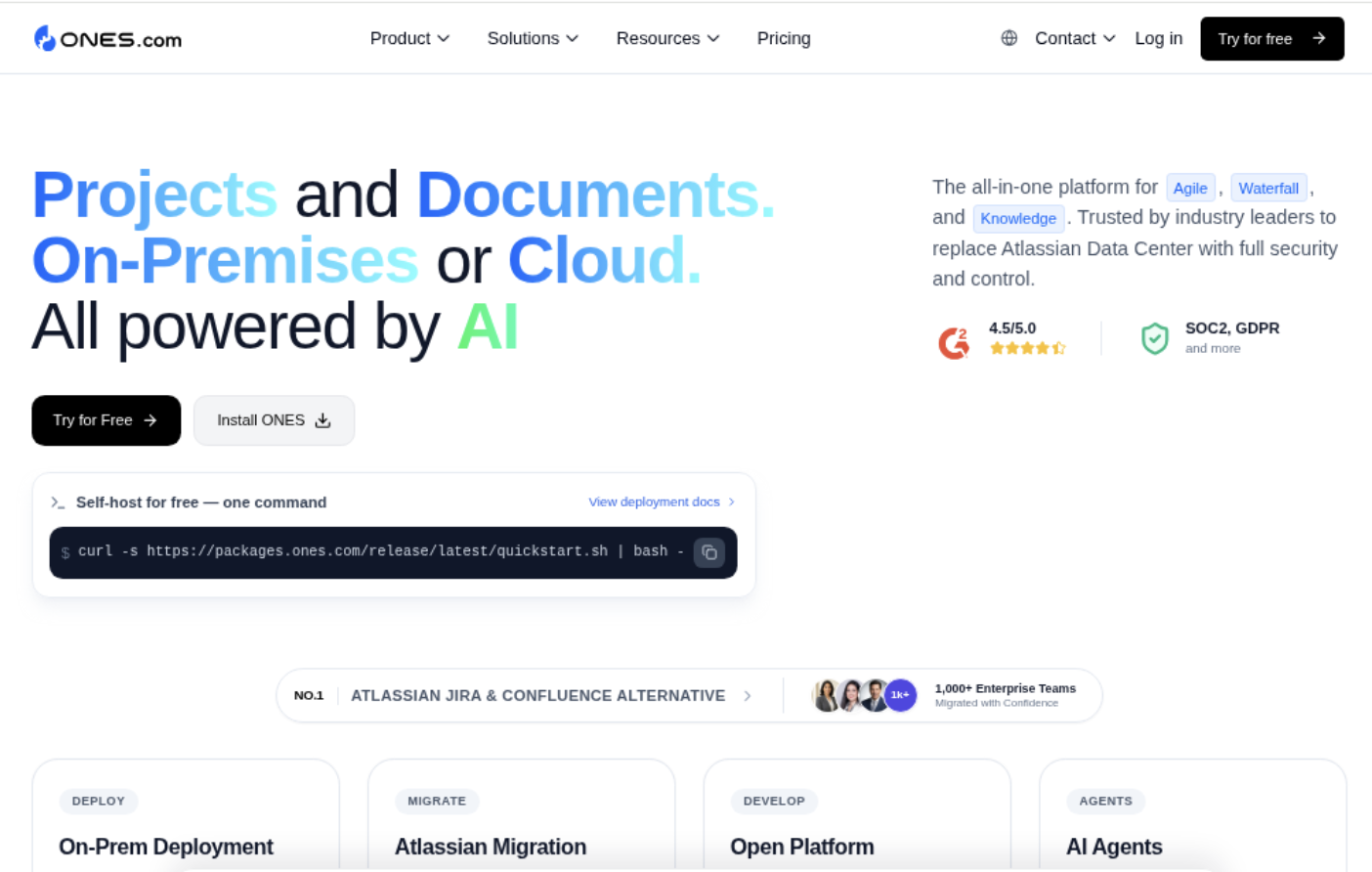
ONES.com combines project management and knowledge management in one platform powered by ONES Assistant. ONES Project works as a Jira alternative, while ONES Wiki provides a Confluence alternative, and each product is sold separately.
It can suit teams that want native project and knowledge capabilities, fewer plugins, and deployment options that include on-premise or air-gapped environments.
Core Capabilities
1. Fragmented project workflows → Jira-compatible workflows → easier process migration
Teams moving away from Jira often worry about rebuilding familiar delivery practices. ONES Project supports Jira-compatible workflows, helping teams preserve recognizable issue and approval patterns.
2. Scattered project context → ONES Wiki knowledge management → clearer team reference material
When planning details and team guidance live in separate systems, people spend time searching. ONES Wiki gives teams a dedicated knowledge management environment alongside project work.
3. Too many extensions → native reporting and workflow features → lower plugin dependence
Extra extensions can increase administration and renewal work. Built-in reporting, custom workflows, custom fields, sprint management, and automation cover common delivery needs within ONES Project.
4. Strict hosting requirements → on-premise, private cloud, or air-gapped deployment → stronger infrastructure alignment
Some organizations cannot place project information in a shared public cloud. ONES.com supports Cloud, On-Premise, Private Cloud, and Air-gapped deployment models.
5. Hosting differences → feature parity across cloud and self-hosted versions → fewer deployment compromises
Self-hosted teams often worry that they will lose capabilities. ONES.com provides full feature parity between its cloud and self-hosted versions.
6. Limited trial capacity → free plan for up to 30 seats → lower-risk early evaluation
Teams can begin with up to 30 seats on the free plan. That gives a small pilot group room to test workflows before a broader rollout.
7. Separate work and knowledge experiences → unified platform option → fewer context switches
Product planning, delivery tracking, and internal guidance can become easier to connect when they operate within one platform family.
8. Growing AI interest → ONES Assistant → practical AI support within project work
ONES Assistant adds AI-powered support for teams exploring smarter project and knowledge workflows. Adoption can begin with focused tasks before expanding across departments.
Application Scenarios
Software organization with restricted infrastructure: A regulated engineering group can run project management in an air-gapped environment while keeping workflows and reporting aligned with its internal controls.
Distributed product teams: Product managers, engineers, and support teams can use ONES Project for delivery tracking and ONES Wiki for shared operating guidance.
Plugin-heavy Jira environment: A company reviewing recurring app fees can compare native workflows, fields, sprint management, automation, and reporting before renewing several extensions.
Common Challenges When Budgeting for 201–300 Seats
Challenge: confusing active seats with employee headcount
Solution: Review account activity, project membership, and contractor access. Build your estimate around required access instead of the total payroll number.
Challenge: treating the annual tier as a simple monthly multiplication
Solution: Compare the annual tier with progressive monthly calculations and show both the average monthly cost and total yearly commitment.
Challenge: overlooking extensions and connected services
Solution: Create a renewal inventory. Include every paid app, integration, support package, and service required for normal operations.
Challenge: ignoring administration effort
Solution: Estimate time for permission reviews, workflow changes, automation maintenance, onboarding, and reporting support.
Challenge: using one forecast for an uncertain year
Solution: Present low, expected, and high seat scenarios. Explain which hiring or restructuring events would move the organization between them.
FAQs
How much does Jira Premium cost for 201–300 users in 2025?
A practical planning estimate is approximately $42,000 annually, equal to about $3,500 per month when divided across 12 months. The final amount can vary with the selected user tier, billing region, taxes, currency, and current Atlassian pricing. Confirm the live quote before approval, especially when the budget depends on a small difference between annual and monthly billing.
Is annual Jira Premium cheaper than monthly billing?
Annual billing can be more predictable and may provide a better effective rate for a stable team. Monthly billing can be more flexible when seat counts change frequently. Compare the annual commitment with the total monthly cost across your expected low, average, and high seat counts. A slightly higher monthly rate may be worthwhile if your organization expects major headcount changes.
Does the 201–300 tier mean I must license exactly 300 people?
No. The tier generally represents the maximum licensed population covered by that annual band. A company with 220 seats may still select the 201–300 range. Ask how the current billing structure treats your exact count, because annual tiers and monthly seat calculations can work differently.
What extra costs should I include in the budget?
Include marketplace apps, connected services, taxes, currency conversion, support options, migration work, training, and administration time. For example, reporting and time-tracking extensions can add recurring charges beyond the core subscription. Also review inactive accounts and temporary access, because unused licenses can remain part of the effective cost.
When should I consider a Jira alternative?
Consider alternatives when plugin costs are rising, hosting restrictions are becoming important, or teams need project and knowledge capabilities in a more unified environment. Compare workflow compatibility, reporting, automation, deployment choices, migration effort, user limits, and long-term administration. A lower subscription price alone does not prove a better fit.
Can ONES.com support self-hosted teams?
Yes. ONES.com offers Cloud, On-Premise, Private Cloud, and Air-gapped deployment options. It also provides feature parity between cloud and self-hosted versions. ONES Project supports project management capabilities such as custom workflows, custom fields, sprint management, automation, and reporting. Teams should evaluate the deployment model, migration requirements, governance needs, and commercial terms for their environment.
Conclusion
For 201–300 users, plan around approximately $42,000 per year for Jira Premium, or roughly $3,500 per month as an annualized estimate. Use that figure as a starting point, then validate the current quote and billing rules.
Annual billing favors stable headcount and predictable procurement. Monthly billing favors organizations with changing staffing patterns. Your real budget should also include extensions, integrations, taxes, administration, and adoption work.
But here's the truth: the cheapest-looking subscription can become expensive when unused seats and add-ons accumulate. Audit access, model three staffing scenarios, and compare the complete operating cost.
If plugin dependence, hosting control, or connected knowledge management is shaping your decision, evaluate ONES.com alongside Jira Premium. The right platform is the one that supports your workflows, infrastructure, and budget over the full planning year.