Jira Premium Pricing for 201–250 Users: Annual vs. Monthly
Comparing atlassian jira software premium pricing 201-250 users annual monthly? See tier, seat, tax, and add-on costs—click to budget accurately.
Planning Jira Premium for 201–250 people can feel deceptively simple. You choose Premium, multiply users by a monthly rate, and expect a clear total. Then the quote changes because annual plans use user bands, monthly plans can respond to active seats, and taxes or add-ons may sit outside the headline price.
That uncertainty makes budgeting difficult. A small change in headcount can move you into another annual tier, while unused monthly seats can quietly increase your yearly spend. Finance teams may also compare totals that use different billing assumptions.
Here’s the practical answer: compare the official annual tier for 201–250 users with twelve months of monthly billing at your expected seat count. Then check storage, apps, taxes, discounts, and renewal terms before choosing.
How Jira Premium Pricing Works for 201–250 Users
Atlassian Jira Software Premium pricing for 201–250 users depends on the billing model, the number of billable seats, and the current regional rate. Annual billing usually uses a fixed user tier, while monthly billing generally adjusts to the number of active users during each billing period.
The exact amount can change over time. Atlassian may update list prices, regional currency conversions, taxes, or plan rules. Use the Atlassian pricing calculator or your organization’s quote for the final figure.
Annual billing
An annual Jira Premium subscription for this range commonly maps to a 201–250 user tier. You pay for the tier for the full subscription period, even if your average headcount sits below the upper limit.
For example, a team with 214 users may still pay at the 201–250 tier. Adding six more people may create no immediate annual price change if the team remains within that band.
Annual billing can suit organizations with predictable staffing and an approved yearly budget. It also gives finance teams one primary renewal event to manage.
Monthly billing
Monthly billing is useful when your seat count changes often. The charge generally follows the number of users assigned to Jira during each billing cycle, subject to Atlassian’s billing rules.
A team that moves between 205 and 238 users may prefer monthly billing when it expects contraction, seasonal staffing, or frequent project changes. The trade-off is a less predictable yearly total.
What Premium adds to the comparison
Premium pricing reflects more than a larger user allowance. It can include higher service limits, advanced administration features, stronger availability commitments, and additional operational controls.
Check the current plan comparison before calculating value. A lower plan may cover basic issue tracking, while Premium may become more relevant when multiple teams need advanced controls and higher capacity.
A quick annual-versus-monthly comparison
| Factor |
Annual billing |
Monthly billing |
| Payment pattern |
Usually one annual commitment |
Recurring monthly charges |
| User calculation |
Typically tied to a selected annual tier |
Typically follows monthly billable seats |
| Budget predictability |
Higher when headcount is stable |
Lower when staffing changes |
| Flexibility |
Lower during the commitment period |
Higher for fluctuating teams |
| Best fit |
Stable teams with planned growth |
Variable teams with changing capacity |
How to Calculate the Real Cost
The safest method is to calculate both models separately. Do not compare an annual quote with one month of monthly pricing.
- Confirm the billable population. Count every person who needs Jira access, including contractors, administrators, and occasional contributors.
- Identify the plan. Confirm that you need Jira Software Premium rather than Standard or Enterprise.
- Check the annual tier. See whether 201–250 users is the applicable band for your account and region.
- Record the monthly rate. Capture the rate shown for your expected user count, currency, and billing location.
- Calculate twelve monthly cycles. Multiply the expected monthly charge by twelve, then adjust for likely staffing changes.
- Add related costs. Include marketplace apps, migration services, support arrangements, taxes, and currency conversion effects.
- Compare the totals. Place the annual commitment beside the expected monthly range rather than comparing only one point estimate.
- Test headcount scenarios. Run examples for 201, 225, 250, and your likely year-end count.
Use this simple model:
Annual estimate = annual tier price + recurring add-ons + applicable taxes.
Monthly estimate = sum of each month’s billable-seat charge + recurring add-ons + applicable taxes.
Here’s why scenario testing matters: a team averaging 220 users can have a different monthly total from a team that begins at 201 and reaches 250 by the final quarter.
Illustrative calculation
Imagine a company expects 215 users for six months and 242 users for six months. Its monthly estimate should use those two seat levels separately:
- Six months at the rate for approximately 215 users.
- Six months at the rate for approximately 242 users.
- Any app, tax, or service charge applied across the period.
This illustration shows the method only. It does not represent an Atlassian quote.
Annual or Monthly: Which Option Fits Your Team?
The better billing cycle depends on how your organization hires, budgets, and governs access. Price alone rarely answers the question.
Choose annual billing when headcount is stable
Annual billing often makes sense when your team expects to remain within the same user band. A product group with 230 permanent employees can value predictable renewal planning.
It can also simplify procurement. Finance approves one planned commitment, while administrators avoid monthly fluctuations caused by short-term access changes.
Choose monthly billing when seats fluctuate
Monthly billing may fit consulting teams, agencies, and organizations with seasonal delivery groups. You can align spending more closely with active access needs.
That flexibility has a management cost. Someone should review inactive accounts, temporary access, and departing staff before each billing cycle.
Consider the cost of unused capacity
Suppose an annual tier supports up to 250 people, but your team rarely exceeds 205. The unused capacity may be worthwhile if growth is likely and administrative simplicity matters.
If your headcount may fall to 170, monthly billing deserves closer attention. A lower average seat count can offset the inconvenience of recurring reconciliation.
Consider procurement and cash flow
Annual billing can require more cash at the beginning of the term. Monthly billing spreads payments across the year, which may help organizations managing tighter monthly budgets.
However, monthly payment flexibility does not automatically mean lower total cost. Compare the full twelve-month estimate under realistic staffing conditions.
Costs That Can Change Your Jira Budget
The subscription rate is only one part of the planning exercise. Several surrounding costs can affect the final amount.
Marketplace applications
Teams often add testing, reporting, time tracking, automation, or security applications. Each app may use its own pricing model and user calculation.
An app priced for 250 users can materially change the annual total. Review every active integration before approving a renewal.
Taxes and regional currency
Your checkout total may include local taxes or a currency conversion. The amount shown in a public pricing calculator may differ from the final invoice.
Ask finance to compare like-for-like figures using the same currency and tax treatment.
Inactive accounts and access controls
Former employees, contractors, and occasional collaborators can remain assigned to Jira. Those accounts may affect your billable population or create security concerns.
Set a regular access review. For example, a monthly review can remove departed staff, suspend temporary accounts, and identify unused seats.
Plan changes during the term
A growing team may cross an annual tier during renewal, while a monthly team may see charges change sooner. Record your expected hiring schedule before choosing a commitment.
A simple forecast with quarterly headcount estimates gives you a clearer picture than today’s user count alone.
Ways to Reduce Uncertainty Before Buying
You can make the decision more reliable with a short procurement checklist. The goal is to align price, usage, and operational needs.
- Confirm the current Premium rate for your billing region.
- Ask whether the 201–250 annual band uses a fixed commitment.
- Clarify how monthly active users are counted.
- List every marketplace application and its separate charge.
- Check whether taxes appear at checkout or on the invoice.
- Model growth, contraction, contractors, and temporary project teams.
- Review renewal timing and any available commercial terms.
- Record the quote date because public rates can change.
Keep the calculation understandable. A finance reviewer should be able to see the user count, rate, billing period, add-ons, and assumptions without reconstructing your reasoning.
The best part? You do not need a complicated financial model. Four scenarios—201, 225, 250, and expected year-end users—usually reveal the main difference between the two billing choices.
Jira Premium Pricing Alternative: ONES.com
Value Proposition
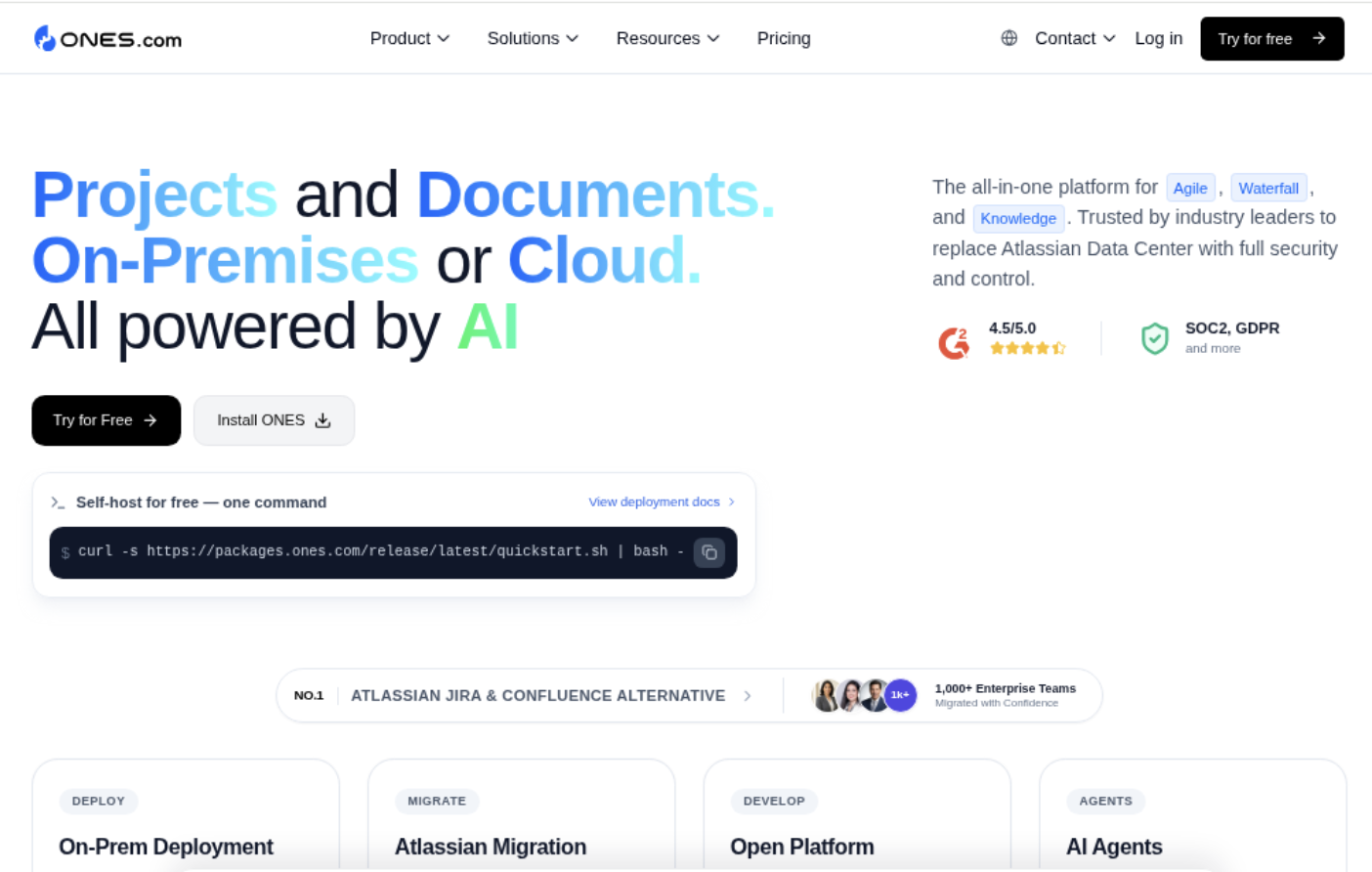
ONES.com combines project management and knowledge management in one platform. ONES Project provides Jira-compatible project workflows, while ONES Wiki supports structured team knowledge management.
ONES Project is sold separately from ONES Wiki. The platform offers Cloud, On-Premise, Private Cloud, and Air-gapped deployments, with full feature parity between cloud and self-hosted versions.
Core Capabilities
Scattered project tracking → ONES Project → teams manage planning, execution, and delivery work in a unified project environment.
Complex Jira migration concerns → Jira-compatible workflows → familiar issue structures and working patterns can reduce disruption during evaluation or transition.
Plugin-heavy reporting → Built-in reporting → teams can review delivery progress and project health without depending on as many separate extensions.
Rigid process design → Custom workflows and fields → administrators can adapt statuses, fields, and approval paths to different teams.
Manual sprint coordination → Sprint management → agile teams can organize sprint scope, monitor progress, and connect daily work with delivery goals.
Repeated administrative actions → Automation → routine transitions and notifications can follow defined rules, reducing repetitive coordination.
Restricted network requirements → On-Premise, Private Cloud, and Air-gapped deployments → organizations can select an environment that matches their security and infrastructure constraints.
Separate knowledge and project contexts → ONES Wiki alongside ONES Project → teams can connect project work with requirements, procedures, and internal guidance when both products are adopted.
Uncertain initial commitment → Free plan for up to 30 seats → smaller groups can evaluate core workflows before planning a broader rollout.
Application Scenarios
A software company comparing Jira Premium alternatives could test ONES Project with its product, engineering, and quality teams. It could recreate sprint planning, approval steps, custom fields, and reporting requirements before making a broader decision.
An organization with restricted infrastructure could evaluate the self-hosted options. Air-gapped deployment may be relevant when systems must remain separated from external networks.
A growing company could begin with ONES Project for delivery management and add ONES Wiki when teams need a connected knowledge environment. Because the products are sold separately, the organization can match adoption to its priorities.
Common Challenges When Comparing Plans
Challenge: confusing a user tier with actual usage
Solution: Separate the annual tier from monthly active-seat behavior. Record both the maximum expected count and the average expected count.
Challenge: comparing different currencies
Solution: Convert every figure into one reporting currency using a stated exchange-rate assumption. Keep taxes separate until the final comparison.
Challenge: overlooking add-ons
Solution: Create a complete subscription inventory. Include marketplace apps, premium support, migration assistance, and any service charges.
Challenge: carrying inactive accounts
Solution: Assign ownership for access reviews. A clear offboarding process can prevent former staff and temporary collaborators from inflating the billable count.
Challenge: relying on an old quote
Solution: Record the date, region, currency, user band, and plan details for every estimate. Recheck the figures before procurement approval.
FAQs
Is the 201–250 user range an exact Jira Premium price?
The range usually identifies an annual user tier rather than a universal price. Your final amount can vary by region, currency, taxes, plan changes, and commercial terms. Monthly billing may calculate charges differently from annual billing. Confirm the current amount in Atlassian’s pricing calculator or your account quote, then record the date and assumptions used for your comparison.
Is annual billing cheaper than monthly billing for 201–250 users?
It can be, depending on the applicable annual and monthly rates. Annual billing may provide better value when your organization stays within the same tier for the full term. Monthly billing can be financially sensible when your seat count falls often. Calculate twelve months using your expected monthly headcount instead of assuming either option always costs less.
What happens if my team grows beyond 250 users?
The account may move into a higher pricing band or require a revised commercial arrangement, depending on the billing model and current Atlassian rules. Include likely hiring in your forecast. If growth is close to the upper limit, ask how a tier change affects the current term, renewal, and any related applications.
Do Jira marketplace apps form part of the Premium subscription?
Marketplace apps generally have their own pricing and may calculate users differently. A reporting app, testing app, or time-tracking app can add a meaningful amount to the annual budget. List every application connected to Jira, check its pricing model, and include taxes or regional charges in the final comparison.
Should a fluctuating team choose monthly billing?
Monthly billing may suit a team with seasonal workers, contractors, or frequent project changes. It can align spending more closely with active access. You still need regular account reviews because unused or unnecessary access can increase charges. Compare the expected twelve-month total with the annual tier before deciding.
Conclusion
For Jira Premium teams in the 201–250 range, the key decision is the relationship between predictable annual capacity and flexible monthly usage.
Annual billing can support stable headcount, simpler procurement, and predictable planning. Monthly billing can suit organizations that expect meaningful movement in active seats.
But here’s the truth: the winning option depends on your complete twelve-month picture. Include users, growth, inactive accounts, apps, taxes, currency, and renewal terms.
Run four headcount scenarios, verify the current regional quote, and compare the full totals. If your project workflows, deployment requirements, or plugin overhead create additional concerns, evaluate a Jira alternative such as ONES Project alongside the pricing exercise.