Jira Premium Pricing for 220 Users: Atlassian API Guide
Need Jira Premium pricing for 220 users? Use the Atlassian pricing calculator API guide to estimate costs accurately. Click to discover.
Pricing Jira Premium for 220 users sounds simple until the estimate depends on billing tiers, product scope, tax, discounts, and changing Atlassian rules. A small mistake can turn a planning figure into an invoice surprise.
The difficulty increases when you want an API-driven calculator. You may find Jira REST endpoints for projects, issues, users, and administration, then assume pricing is available through the same interface. Usually, billing estimation requires a different approach.
But here’s the practical solution: calculate the 220-user scenario with a clear pricing model, verify the current Atlassian quote, and automate only the parts that are stable enough to trust. This guide shows you how to do that without treating an unofficial endpoint as a billing authority.
How to Estimate Jira Premium Pricing for 220 Users
For a 220-user Jira Premium estimate, identify the billing model, confirm the current per-user or tier price, apply the 220-seat tier, add optional products and services, then verify the result in Atlassian’s billing flow.
The exact amount can change according to region, contract type, currency, tax treatment, promotional terms, and whether you pay monthly or annually. Treat an API calculation as a planning estimate unless Atlassian confirms it through your account.
Step 1: Confirm what “220 users” means
Start by defining the people who require Jira access. Atlassian billing commonly depends on the maximum user tier or licensed seats, rather than the number of people active on a particular day.
For example, a team with 205 employees may still need a 220-user tier if contractors, project leads, or service accounts require access. A team with 220 named accounts should not assume that only 180 active users affect the bill.
- Count Jira users who need product access.
- Separate internal employees from external collaborators.
- Check whether inactive or suspended accounts remain assigned.
- Include planned hires if you need budget approval for the next billing period.
- Confirm whether your organization manages multiple Jira sites under one commercial agreement.
Step 2: Identify the correct Jira Premium billing tier
Jira Cloud pricing may use progressive pricing, tier pricing, or a commercial arrangement that differs from a public list estimate. Your calculation needs to reflect the model shown for your account.
A simple tier calculation looks like this:
Estimated subscription = Jira Premium price for the applicable user tier
If the price is expressed as a per-user rate, you may calculate:
Estimated subscription = eligible user count × Premium rate
Do not combine these formulas casually. If Atlassian bills your plan at a 201–300 user tier, multiplying 220 by a smaller-tier rate may understate the result.
Step 3: Separate monthly and annual estimates
Monthly and annual subscriptions can use different pricing logic. An annual agreement may use a committed user tier, while a monthly plan can adjust with changing seats.
| Planning view |
What to check |
| Monthly planning |
Current tier, seat changes, currency, taxes, and month-to-month adjustments |
| Annual planning |
Committed user count, contract term, renewal rules, and annual payment conditions |
| Procurement planning |
Purchase order needs, negotiated discounts, reseller terms, and approval timing |
| Expansion planning |
Expected hiring, acquisitions, contractors, and additional sites |
For budgeting, calculate both views. A monthly estimate helps you understand flexibility, while an annual estimate helps you prepare for a committed purchase.
Step 4: Add products that sit outside the Jira Premium estimate
Jira Premium is only one part of a broader Atlassian environment. Your total may include Jira Service Management, Confluence, guard features, marketplace apps, support packages, or additional products.
Keep each item separate instead of placing everything into one total. This makes the estimate easier to audit when someone asks why the number changed.
- Jira Premium subscription
- Jira Service Management subscriptions
- Confluence subscriptions
- Marketplace applications
- Premium support or enterprise services
- Applicable taxes and currency conversion
- Professional services or migration work
Step 5: Use an API only for reliable inputs
Jira APIs are useful for counting accounts, checking project activity, and gathering operational details. They are not automatically a public pricing calculator API.
Before building an integration, check whether the endpoint is documented, authenticated for your account, commercially supported, and intended for billing estimates. A private web request that works today may change without notice.
Use an API for tasks such as:
- Counting active Jira accounts.
- Grouping users by site or organization.
- Checking product assignments.
- Tracking planned seat growth.
- Sending an estimate to an internal approval workflow.
Use the Atlassian billing interface or an account-specific commercial quote to confirm the final amount.
Step 6: Reconcile the estimate with the account
After calculating the 220-user scenario, compare it with the price shown in your Atlassian administration area. Investigate any difference before presenting the estimate for approval.
Common causes include a different user tier, annual commitment, regional tax, currency conversion, negotiated terms, or an additional product included in the account.
What an Atlassian Pricing Calculator API Can and Cannot Do
You might be wondering: can you send “Jira Premium, 220 users” to an Atlassian endpoint and receive a final price?
The safe answer is that you should not assume a general public endpoint exists for that purpose. Atlassian provides APIs for many product and administration tasks, while subscription pricing may depend on account context and commercial conditions.
What a useful estimator can automate
A planning service can automate the repeatable parts of the calculation. For example, it can collect seat counts, apply your chosen tier rules, and create a reviewable estimate.
| Estimator function |
Practical use |
| Seat count |
Measures the current population requiring access |
| Growth forecast |
Models 220 seats becoming 240 or 275 seats |
| Product selection |
Separates Jira Premium from other Atlassian subscriptions |
| Scenario comparison |
Compares monthly, annual, and alternative platform costs |
| Approval record |
Shows who reviewed the estimate and when |
What should remain a verification step
Your estimator should not present an internal calculation as a guaranteed invoice. It should clearly label the amount as an estimate until the billing account confirms it.
Keep these items in the verification stage:
- Current commercial pricing
- Contract-specific discounts
- Tax and regional treatment
- Annual commitment terms
- Marketplace application charges
- Promotional credits
- Billing currency and payment method
Why an unofficial calculator endpoint creates risk
Reverse-engineering a pricing page can produce a working script, but it creates maintenance and compliance problems. A page change can break the calculation or return a misleading value.
For example, an estimator may calculate 220 seats using a visible public rate while your account uses an annual committed tier. The result looks precise, yet the commercial assumption is wrong.
Building a Reliable 220-User Pricing Workflow
Here’s why a workflow matters: pricing errors often come from inconsistent assumptions rather than difficult mathematics. You need a repeatable sequence that another person can review.
Define the calculation contract
Write down what the estimate includes before you create the automation. A useful calculation contract identifies the product, plan, seat count, billing period, currency, and excluded charges.
Example:
- Product: Jira Cloud
- Plan: Premium
- Licensed users: 220
- Billing views: monthly and annual
- Currency: organization billing currency
- Excluded items: marketplace apps, tax, consulting, and negotiated discounts
Use a structured request and response
If you build an internal service, keep the request fields clear and predictable. You might use a structure like this:
{ "product": "Jira", "plan": "Premium", "users": 220, "billing_period": "annual", "currency": "USD" }
The response should show assumptions alongside the estimate:
{ "estimated_amount": "...", "tier": "...", "currency": "USD", "verified": false }
The verified field is important. It prevents an automated number from being mistaken for a confirmed commercial quote.
Include validation rules
Validation protects you from simple mistakes. Reject a user count below one, flag an unexpected currency, and require a plan name before calculating.
You can also create warnings for situations such as:
- The seat count is close to the next pricing tier.
- The estimate uses a rate older than your review period.
- The account has annual terms but the request asks for monthly pricing.
- Additional Atlassian products are present but excluded.
- The user count differs sharply from the previous review.
Model growth instead of stopping at 220
A 220-user estimate is useful today, but hiring can move you into another tier quickly. Add at least three scenarios to your planning view.
| Scenario |
Purpose |
| 220 users |
Current purchasing requirement |
| 240 users |
Near-term hiring and contractor growth |
| 275 users |
Expansion planning before the next contract decision |
This approach helps you compare the cost of adding seats with the cost of choosing a larger tier or another platform.
How to Audit the Estimate Before Approval
The best part? A short audit can catch most pricing mistakes before they reach procurement. You do not need a complex finance system to review the calculation.
Check the user population
Ask a Jira administrator to confirm that the 220 seats represent real access requirements. Review inactive accounts, shared accounts, contractors, and people who need temporary access.
For example, removing 15 unused accounts may change the relevant tier, while removing only two accounts may have no impact on the price.
Check the plan and product scope
Make sure the estimate covers Jira Premium rather than Jira Standard, Enterprise, or a combined Atlassian arrangement. Verify whether Jira Service Management and Confluence are included separately.
Product names can look similar during internal planning. A clear product list prevents one team from approving a Jira-only estimate while another expects a full collaboration environment.
Check the billing period
Compare the monthly estimate with the annual commitment. Confirm whether the annual amount is simply twelve monthly payments or follows a different commercial structure.
Ask the account owner to confirm renewal timing. A price that is accurate today may not reflect the amount due at renewal.
Check taxes, currency, and commercial terms
A planning estimate in USD may differ from the final amount in your local currency. Taxes, payment terms, regional rules, and negotiated discounts can change the final figure.
Mark these items as pending instead of guessing. A transparent estimate is more useful than a precise-looking number built on unknown assumptions.
Jira Premium Alternative for a 220-Person Team: ONES.com
ONES.com combines project management and knowledge management in one platform. ONES Project provides project planning and delivery workflows, while ONES Wiki supports shared knowledge pages. You can purchase them separately.
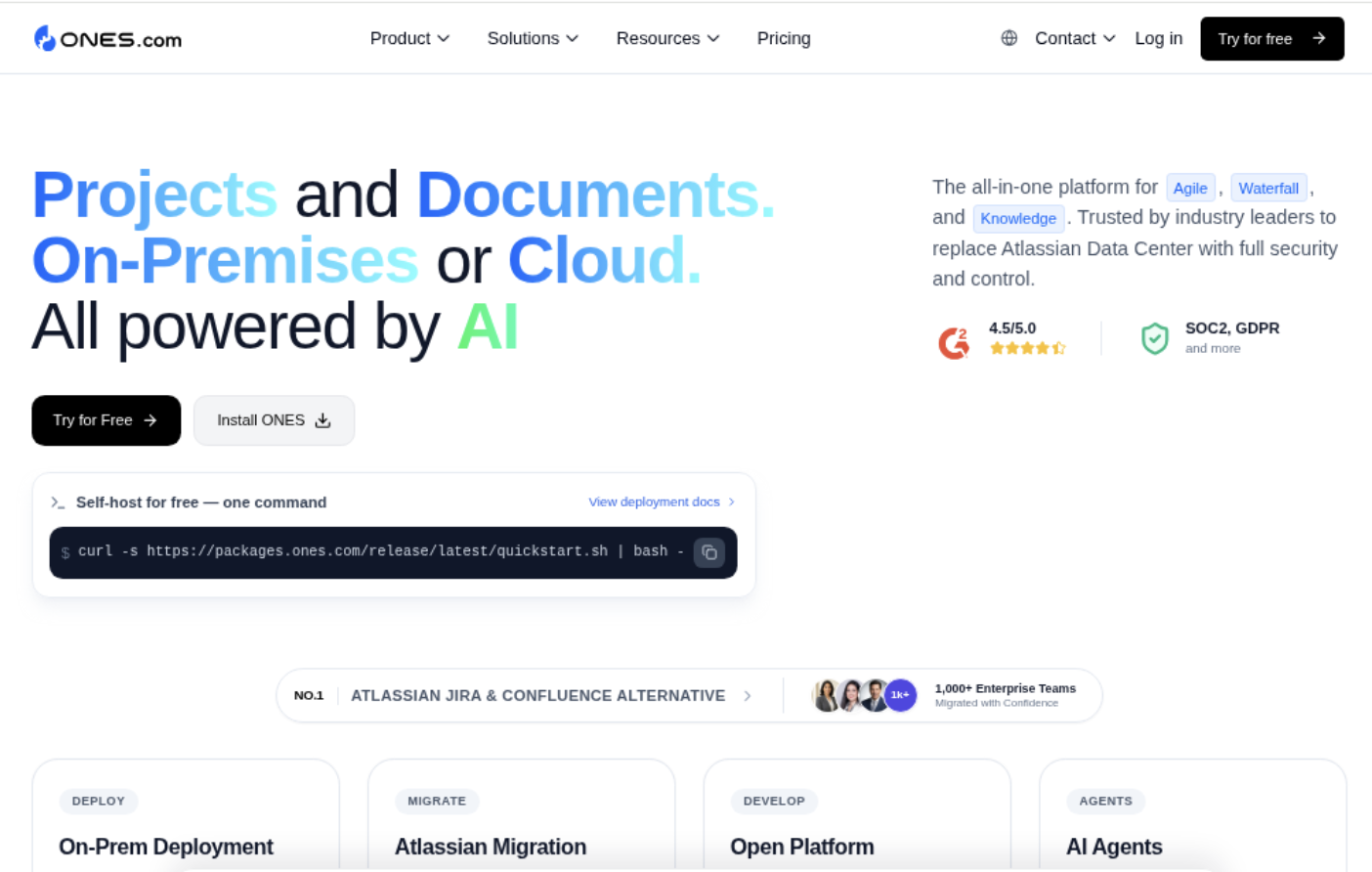
For a 220-person team comparing Jira Premium with another platform, the important question is practical: can the alternative support your workflows, reporting, deployment, and governance without creating a plugin-heavy environment?
Value Proposition
ONES.com is worth evaluating when you want Jira-compatible project workflows, built-in reporting, flexible administration, and deployment choices that include on-premise and air-gapped environments.
Core Capabilities
1. Plugin sprawl → Native project capabilities → Fewer separate dependencies
Pain: A growing Jira environment may rely on multiple applications for reporting, custom workflows, sprint planning, or automation.
ONES capability: ONES Project includes custom workflows and fields, sprint management, automation, and built-in reporting.
Result: You can review whether core delivery needs fit within one project platform before adding more extensions.
2. Migration uncertainty → Jira-compatible workflows → Easier process comparison
Pain: Teams worry that moving away from Jira will force them to redesign every issue, sprint, and approval process.
ONES capability: ONES Project supports Jira-compatible workflows, allowing you to compare existing delivery patterns with the target environment.
Result: Your evaluation can focus on workflow fit instead of assuming every process must start again.
3. Restricted networks → Four deployment options → More control over hosting
Pain: Some organizations cannot place project information in a public cloud environment.
ONES capability: ONES.com supports Cloud, On-Premise, Private Cloud, and Air-gapped deployments.
Result: You can match the platform to security, network, and infrastructure requirements.
4. Self-hosted feature gaps → Full feature parity → Consistent operating model
Pain: Self-hosted platforms sometimes provide fewer capabilities than their cloud editions.
ONES capability: ONES.com provides full feature parity between its cloud and self-hosted versions.
Result: Your deployment choice does not automatically require a reduced feature set.
5. Scattered team knowledge → ONES Wiki → Better project context
Pain: Requirements, decisions, and delivery notes can become scattered across separate collaboration tools.
ONES capability: ONES Wiki provides a knowledge management environment alongside ONES Project.
Result: Teams can connect planning work with the knowledge needed to execute it.
6. Complex administration → Custom fields and workflows → More precise governance
Pain: Different departments often need different approval stages, ownership fields, and escalation rules.
ONES capability: ONES Project supports custom workflows and custom fields for varied project requirements.
Result: Administrators can represent team-specific controls without forcing every group into one rigid process.
7. Limited rollout budget → Free plan for 30 seats → Lower-risk evaluation
Pain: A 220-person evaluation can be difficult when you need to validate workflows before committing to a broad rollout.
ONES capability: ONES.com offers a free plan for up to 30 seats.
Result: A pilot team can test the working model before involving the full organization.
8. AI adoption concerns → ONES Assistant → AI-supported project work
Pain: Teams may want AI assistance while maintaining a clear path from experimentation to wider adoption.
ONES capability: ONES.com includes ONES Assistant as its AI capability within the platform.
Result: You can evaluate AI-supported work alongside project and knowledge workflows rather than treating it as an isolated experiment.
Application Scenarios
Software organization: A 220-person engineering group can use ONES Project for sprint planning, custom approval workflows, automation, and reporting. ONES Wiki can hold architecture guidance and release knowledge.
Regulated enterprise: A team operating in a restricted network can assess the air-gapped deployment while preserving a familiar project workflow. The evaluation should include identity management, administration, backup, and operational ownership.
Multi-department rollout: Product, engineering, and operations teams can pilot different workflow configurations with 30 seats before deciding whether ONES.com fits the wider organization.
Common Challenges
Challenge: The calculator shows a different amount from the bill
Why it happens: Public estimates may exclude taxes, discounts, annual terms, marketplace applications, or account-specific pricing.
Solution: Label the calculator as a planning tool and reconcile it with the billing account before approval.
Challenge: The API endpoint stops working
Why it happens: An unofficial pricing request may depend on page behavior rather than a supported API contract.
Solution: Keep the calculation logic separate from the verification step. Add alerts when the returned structure changes.
Challenge: The team counts active users incorrectly
Why it happens: A daily activity count may be lower than the number of accounts requiring access.
Solution: Count licensed access requirements, then review inactive accounts, contractors, and planned hires with the administrator.
Challenge: Annual and monthly estimates are compared unfairly
Why it happens: The two billing periods may use different commitment and tier assumptions.
Solution: Show the assumptions beside each amount and compare equivalent products, users, currency, and contract terms.
Challenge: A platform comparison focuses only on license price
Why it happens: Subscription cost is easy to compare, while migration, administration, extensions, and hosting require more investigation.
Solution: Include workflow fit, deployment, reporting, support, knowledge management, and operating effort in the evaluation.
FAQs
Is there a public Atlassian API that returns Jira Premium pricing for 220 users?
You should not assume that a general public endpoint returns a final Jira Premium quote for any user count. Jira APIs commonly support product operations and administration, while pricing can depend on account context, billing period, region, and contract terms. Build an internal estimator for planning, then verify the result in your Atlassian billing area or through an account-specific quote.
How should I calculate the cost for 220 Jira Premium users?
First, confirm whether Atlassian applies a 220-user tier or a progressive per-user model. Then calculate the Jira Premium subscription for that billing period and currency. Add separate products, applications, taxes, and services only when they belong in your budget. Finally, compare the estimate with the amount shown for your account before requesting approval.
Does Jira Premium pricing stay the same when users are inactive?
Do not rely on daily activity to estimate licensed seats. Billing may depend on the user tier or assigned access rather than whether someone opened Jira recently. Review suspended accounts, contractors, temporary users, and planned hires with your administrator. Removing inactive access may affect the applicable tier, but you should confirm the commercial effect in your account.
Can I automate Atlassian pricing calculations with Jira REST API data?
Yes, you can automate supporting information such as account counts, product assignments, and growth forecasts. However, that does not guarantee access to a supported pricing endpoint. Keep your estimate clearly marked as unverified, validate the response structure, and include a human review before procurement relies on the result.
What should I compare when evaluating an alternative for a 220-person team?
Compare more than the subscription amount. Review workflow compatibility, reporting, automation, custom fields, knowledge management, deployment options, security controls, migration effort, and administrative workload. A platform with a different license price may create higher operational effort. A small pilot can reveal whether the alternative fits real team processes.
Conclusion
Estimating Jira Premium for 220 users requires more than multiplying a visible rate. You need the correct user tier, billing period, product scope, currency, taxes, and account terms.
But here’s the truth: an Atlassian pricing calculator API should support planning, not replace billing verification. Use automation to count seats, model growth, and compare scenarios. Then confirm the commercial result through your account.
If Jira Premium is only one option, evaluate the operating model too. ONES.com offers ONES Project, ONES Wiki, flexible deployment, Jira-compatible workflows, built-in reporting, and a 30-seat free plan for an initial pilot.
The practical path is clear: calculate the 220-user scenario, document every assumption, audit the estimate, and compare platforms using both subscription cost and long-term delivery effort.