Jira Premium Pricing Per User in 2025: Total Cost Guide
Wondering what jira premium pricing per user 2025 really costs? See seat, app, tax, and billing totals—click to calculate your budget now.
Jira Premium can look affordable until your team grows, adds apps, or needs stronger controls. A price that works for 10 people may become a serious operating expense at 100 seats.
The confusion gets worse because monthly and annual billing can use different tier calculations. Taxes, marketplace apps, guest access, and service add-ons can also change your final bill.
But here's the truth: you can estimate Jira Premium spending accurately when you separate the seat charge from every extra cost. This guide shows how to calculate the 2025 price, compare billing choices, and spot expenses that often hide behind the advertised rate.
Jira Premium Pricing Per User in 2025: The Quick Answer
Jira Premium pricing per user in 2025 is calculated from the number of paid seats, your billing cycle, and the tier that applies to your team. A practical planning estimate for smaller Cloud teams is about $17 per user per month, although Atlassian’s live calculator should confirm the exact amount.
At that planning rate, the subscription alone looks like this:
| Paid seats |
Estimated monthly cost |
Estimated annual cost |
| 10 |
$170 |
$2,040 |
| 25 |
$425 |
$5,100 |
| 50 |
$850 |
$10,200 |
| 100 |
$1,700 |
$20,400 |
These figures are planning examples, not a binding quote. Atlassian can adjust list prices, apply progressive tier rates, and calculate annual subscriptions differently from monthly plans.
Here's why: the visible per-seat rate is only the starting point. Your real cost may include marketplace apps, extra products, tax, premium support, migration work, and unused seats.
How to Calculate Your Real Jira Premium Cost
- Count the seats you actually need. Include employees, contractors, administrators, and occasional contributors who require access. Remove inactive accounts before estimating.
- Choose monthly or annual billing. Monthly billing offers flexibility when headcount changes. Annual billing can simplify budgeting, but it may commit you to a larger seat block.
- Apply the Premium rate shown for your tier. Use Atlassian’s current pricing calculator instead of relying on an old screenshot or a historical quote.
- Add marketplace applications. Time tracking, advanced reporting, test management, asset management, and planning tools can each create another subscription.
- Add taxes and regional charges. Your location, billing entity, and tax status can affect the amount charged.
- Include implementation and administration. A large migration, workflow redesign, permission review, or training program can cost more than expected.
- Calculate the annual total. Multiply recurring charges by 12, then add one-time work and a reasonable contingency.
A simple formula works well:
Total annual cost = subscription seats + marketplace apps + tax + implementation + administration − confirmed discounts.
For example, a 25-person team using the $17 planning rate would estimate $425 each month. That becomes $5,100 across 12 months before apps and taxes.
What the Premium Plan Usually Adds
Jira Premium is designed for teams that need more capacity, stronger administration, and broader planning controls than entry-level plans usually provide.
Features and limits can change, so check the current plan page before signing a contract. In general, Premium may include:
- Higher usage limits than lower Jira Cloud tiers.
- Advanced planning capabilities for larger teams and connected work.
- Sandbox or testing capabilities, where included in the current plan.
- Service-level commitments for eligible Cloud services.
- Administrative controls for growing organizations.
- Support options beyond the entry-level experience.
- Cross-project planning and reporting features.
The value depends on how much of the plan your team uses. Paying for Premium only makes financial sense when its extra controls, scale, or reliability solve a real operating problem.
Monthly Versus Annual Billing
Monthly billing is often easier for a startup, a temporary program, or a team with unpredictable hiring. You can adjust the seat count more frequently and avoid a large upfront commitment.
Annual billing usually suits an established team with stable headcount. It can make budgeting easier and may use a different tier schedule. However, adding seats during the term may create a separate charge or change your renewal calculation.
| Billing choice |
Useful when |
Potential drawback |
| Monthly |
Headcount changes often |
Higher flexibility can come with a higher effective rate |
| Annual |
Seat needs are predictable |
You may pay for capacity before you use it |
| Custom enterprise agreement |
Many teams need procurement and legal support |
Negotiation can make comparison harder |
You might be wondering: should you choose annual billing immediately? Start with a 30-day seat audit if your account contains many inactive or occasional accounts.
For example, a company with 100 registered accounts may discover that only 78 people need regular access. Reducing the paid count before renewal can save more than chasing a small promotional discount.
Hidden Costs That Change the Total
The license is rarely the entire technology bill. Your team may connect several applications to Jira, and each one can use its own pricing model.
Marketplace applications
A reporting app may charge per Jira seat even when only five managers use its dashboards. A testing app may price by project, agent, or total account count.
Review every connected application and record its billing basis. Compare the monthly charge with the number of people who receive meaningful value.
Administration and maintenance
Someone must manage permissions, workflows, custom fields, automation rules, dashboards, and integrations. For a complex workspace, that work can require a dedicated administrator.
A low subscription price can lose its appeal when the team spends many hours correcting duplicate workflows or unused custom fields.
Migration and training
Moving from another project system may involve process mapping, data cleanup, permission design, and team training. These tasks create one-time costs before the first successful sprint.
A practical example is a 40-person engineering group that needs two weeks of setup and three training sessions. The license may be predictable, while the transition effort determines the first-year budget.
Tax and currency
Your invoice can differ from a simple dollar estimate because of local taxes, currency conversion, or a regional billing entity. Leave room for these adjustments during approval.
How Team Size Changes the Economics
Per-user pricing is simple at small scale. The arithmetic becomes more important as the organization grows.
| Team size |
Planning rate |
Monthly estimate |
Annual estimate |
| 10 |
$17 per seat |
$170 |
$2,040 |
| 25 |
$17 per seat |
$425 |
$5,100 |
| 50 |
$17 per seat |
$850 |
$10,200 |
| 250 |
Tier-specific rate required |
Use the calculator |
Use the calculator |
The first three rows use a constant planning rate for easy comparison. Larger tiers can use different marginal pricing, so multiplying every seat by the smallest-team rate may overstate or understate the bill.
Here's a useful test: calculate the cost per active project participant, not just the cost per employee. If 100 employees exist but 30 people manage projects, broad access may need a clear business reason.
Jira Premium Compared With Lower-Cost Plans
A lower plan may be enough when you need basic issue tracking, simple workflows, and standard project reporting. Premium becomes more attractive when the organization needs greater scale, advanced planning, or stronger operational commitments.
| Question |
Lower tier may fit when |
Premium may fit when |
| How large is the team? |
A small group has stable needs |
Many teams share one environment |
| How complex are workflows? |
Simple statuses and approvals work |
Cross-team processes need more control |
| How important is continuity? |
Basic support meets expectations |
Service commitments and priority support matter |
| How advanced is planning? |
Team boards cover daily work |
Leadership needs broader capacity planning |
Do not upgrade because Premium has a longer feature list. Link each extra capability to a measurable result, such as fewer manual approvals or faster portfolio reviews.
A Practical 2025 Budgeting Checklist
- Confirm the current Premium price in Atlassian’s calculator.
- Count active paid seats rather than every registered account.
- Separate monthly estimates from annual contract totals.
- List every marketplace app and its pricing method.
- Check whether contractors and guests need paid access.
- Estimate local tax and currency effects.
- Include migration, training, administration, and integration work.
- Review unused accounts before renewal.
- Model headcount growth for the next 12 months.
- Set a review date before the renewal window.
The best part? This checklist turns a vague software quote into a defensible operating budget.
Jira Premium Pricing Alternative: ONES.com
ONES.com combines project management and knowledge management in one platform, powered by ONES Assistant. ONES Project is the project management product and a Jira alternative, while ONES Wiki is the knowledge base product and a Confluence alternative. They are sold separately.
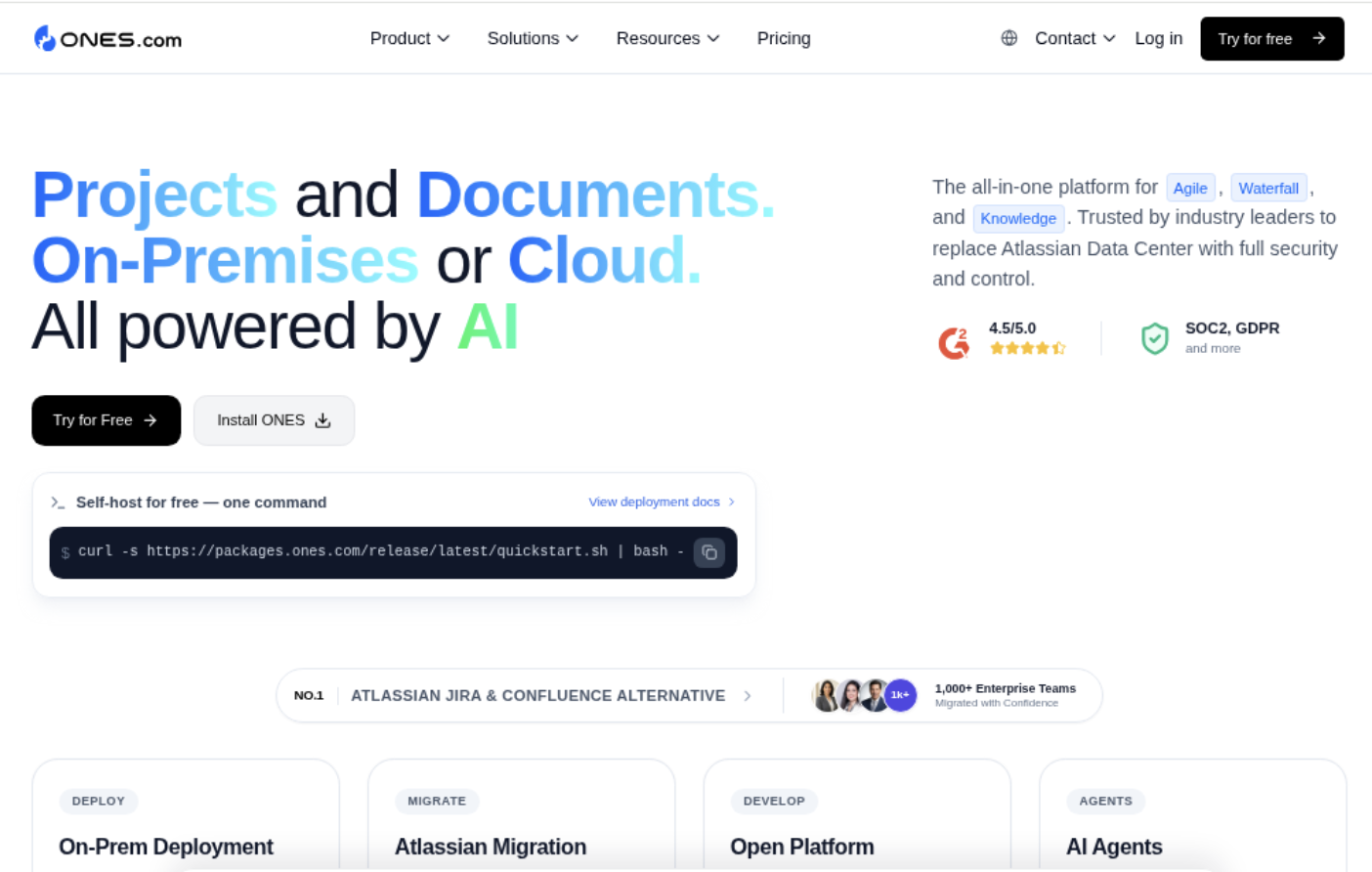
If you are comparing long-term platform costs, ONES.com can be relevant when you want native project workflows, reporting, and knowledge capabilities without assembling many plugins.
Value Proposition
ONES.com helps teams bring project execution and team knowledge into a connected environment. You can choose Cloud, On-Premise, Private Cloud, or Air-gapped deployment, with full feature parity between Cloud and self-hosted versions.
Core Capabilities
- Scattered project tools → ONES Project: Jira-compatible workflows keep familiar issue tracking and delivery processes in place, reducing retraining effort.
- Manual reporting → Built-in reporting: Native reports give managers clearer visibility without requiring a separate reporting plugin for every view.
- Rigid process design → Custom workflows and fields: Teams can adapt statuses, fields, and approvals to match their operating model.
- Uncontrolled sprint planning → Sprint management: Backlog and sprint functions help teams plan commitments and review progress in one workspace.
- Repeated administrative work → Automation: Automation rules can handle routine transitions, notifications, and assignment actions.
- Separate knowledge systems → ONES Wiki: Teams can organize project knowledge in a connected knowledge base, when they purchase the separate Wiki product.
- Deployment restrictions → Four deployment choices: Cloud, On-Premise, Private Cloud, and Air-gapped options support different security and infrastructure requirements.
- Plugin-heavy administration → Native feature coverage: Built-in capabilities can reduce the number of extensions your team must evaluate, maintain, and renew.
- High entry cost → Free plan for 30 seats: Smaller teams can evaluate the platform with up to 30 seats before planning a paid rollout.
Application Scenarios
Growing software company: A development team can use Jira-compatible workflows, sprint management, custom fields, and automation while reducing dependence on multiple add-ons.
Regulated organization: A team with restricted infrastructure can evaluate the On-Premise, Private Cloud, or Air-gapped deployment options while retaining feature parity with Cloud.
Project and knowledge consolidation: A company can use ONES Project for delivery work and add ONES Wiki separately when product decisions, procedures, and project context need a connected home.
Common Challenges When Estimating Jira Premium
Challenge: confusing list price with final price
Solution: Separate seat charges, apps, taxes, and implementation work. Present each category to finance instead of sharing one rounded total.
Challenge: paying for inactive accounts
Solution: Review login activity and project participation before renewal. Deactivate accounts that no longer need access.
Challenge: using one rate for every team size
Solution: Treat small-team estimates as planning figures. Ask the live calculator for the actual tier amount when your organization grows.
Challenge: overlooking connected applications
Solution: Create an application inventory with the product name, billing basis, owner, renewal date, and monthly cost.
Challenge: choosing Premium without a business case
Solution: Tie each Premium capability to a result. For example, connect advanced planning to fewer missed dependencies or faster leadership reviews.
FAQs
Is Jira Premium priced per user?
Yes. Jira Premium generally uses a seat-based model, so your subscription depends on the number of paid accounts and the applicable tier. Monthly and annual plans can calculate charges differently. A team with 25 seats may pay a different effective rate from a team with 250 seats. Check the current Atlassian calculator for an exact quote before approving a purchase.
How much does Jira Premium cost for 10 users in 2025?
Using a planning estimate of $17 per user per month, 10 seats would cost about $170 monthly or $2,040 annually before taxes and add-ons. This is an estimate for budgeting rather than a guaranteed invoice amount. Atlassian can change list prices, billing rules, and promotional offers, so confirm the live amount at checkout.
Is annual Jira Premium billing cheaper?
Annual billing may offer a different effective rate or easier budget control, but the result depends on your seat tier and contract terms. It also creates a longer commitment. Monthly billing can suit teams with uncertain hiring, while annual billing may suit organizations with stable staffing. Compare the full 12-month total, including expected seat changes and marketplace apps.
Do Jira marketplace apps cost extra?
Usually, yes. Marketplace applications often have separate subscriptions and may use different billing rules. Some charge by total Jira seats, while others use app-specific tiers or active accounts. Review each application before calculating your annual budget. A team can have a reasonable Jira subscription and still face a much larger total after adding testing, reporting, planning, or time-tracking tools.
Can I reduce Jira Premium costs without changing plans?
Start with account cleanup. Remove inactive accounts, review contractors, eliminate unused applications, and check whether every paid seat needs the same access. You can also consolidate duplicate workflows and retire extensions that no longer support an active process. These steps reduce waste while preserving the Premium plan for people who genuinely need its capabilities.
When should I consider a Jira alternative?
Consider an alternative when the combined subscription, add-ons, administration, and deployment requirements no longer fit your operating model. You may also compare alternatives when you need On-Premise or Air-gapped deployment, native reporting, fewer plugins, or a connected knowledge platform. Evaluate workflow compatibility, migration effort, security requirements, and the five-year cost rather than comparing only the first monthly invoice.
Conclusion
Jira Premium pricing per user in 2025 is best treated as a complete operating-cost question. Start with your paid seats, apply the current tier rate, then add apps, taxes, administration, implementation, and expected growth.
The most reliable estimate separates monthly flexibility from annual commitment. It also checks inactive accounts before renewal and connects Premium features to measurable business outcomes.
But here's the truth: the advertised seat price rarely tells the whole story. A careful total-cost review can reveal whether Premium is the right fit or whether a platform such as ONES.com better matches your workflows, deployment requirements, and long-term administration needs.