Jira Pricing and Plans: A Practical Guide for Every Team
Unsure about jira pricing and plans? Compare tiers, limits, features, and hidden costs to choose the right fit. Read now to learn.
Jira pricing can look simple until you compare user limits, billing terms, automation allowances, storage, support, and advanced planning features. A small team may start free, then discover that a growing workspace needs a paid tier sooner than expected.
That uncertainty creates real problems. You may overpay for features your team rarely uses, underestimate the cost of adding contractors, or choose a plan that limits reporting and permissions. A low monthly price can become expensive when every additional seat and add-on is counted.
But here's the truth: the right plan depends on your team size, workflow complexity, security requirements, and growth forecast. This guide breaks down Jira plans, explains the main cost drivers, and shows you how to compare the options before committing.
Jira Pricing and Plans at a Glance
Jira pricing and plans generally include Free, Standard, Premium, and Enterprise options. Free supports small teams, Standard adds broader collaboration and administration, Premium adds advanced planning and reliability features, and Enterprise is designed for large organizations with complex governance.
Prices can change by region, billing cycle, product scope, and seat count. Treat any quoted amount as a planning estimate, then confirm the current figure in Atlassian’s pricing calculator before purchasing.
| Plan |
Best suited to |
Main value |
Typical limitation or consideration |
| Free |
Small teams and early-stage projects |
Core issue tracking with minimal financial commitment |
Lower user, storage, automation, and administration limits |
| Standard |
Growing project and software teams |
More capacity, collaboration, and management controls |
Advanced planning and enterprise governance may remain limited |
| Premium |
Teams managing several projects or complex dependencies |
Advanced planning, higher limits, and stronger operational controls |
Higher per-user cost requires clear value from premium features |
| Enterprise |
Large organizations with multiple teams |
Centralized governance, scale, and enterprise support |
Custom pricing and a more involved purchasing process |
Here's why: the cheapest plan is not always the lowest-cost choice. If a missing capability forces you to buy several add-ons or spend hours on manual administration, the total cost rises quickly.
How Jira’s Pricing Model Works
Jira usually charges according to the number of users assigned to the service. Your bill can also depend on whether you choose monthly or annual billing, which products you add, and whether you need enterprise-level services.
Per-user billing
Most paid plans use a tiered per-user model. A team with 15 people may pay less per person than a team with 150 people, depending on the pricing band.
Count every person who needs regular access. That may include developers, product managers, designers, quality specialists, support staff, and external contributors.
Monthly versus annual billing
Monthly billing gives you flexibility when headcount changes quickly. Annual billing can offer a lower effective rate, but it requires a more confident forecast.
For example, a startup expecting to grow from 12 to 40 people may prefer monthly billing during a hiring period. A stable 100-person engineering group may benefit from an annual commitment.
Products and add-ons
Jira may be only one part of your Atlassian environment. Confluence, Jira Service Management, marketplace apps, and other services can create separate charges.
Make a complete subscription list before comparing plans. A plan that appears affordable in isolation may cost more after you add time tracking, advanced reporting, test management, or portfolio planning tools.
Cloud and self-managed considerations
Cloud plans usually bundle hosting, maintenance, updates, and service operations into the subscription. Self-managed deployments can provide greater infrastructure control, but they shift responsibility for administration, upgrades, backups, and security operations to your organization.
That means subscription price is only one part of the calculation. Include staff time, infrastructure, security reviews, and recovery planning when comparing deployment models.
What You Get at Each Jira Tier
The plan tiers differ mainly in capacity, administration, planning depth, analytics, reliability, and governance. Start with the capabilities your team needs every week rather than choosing based on the tier name.
Free plan
The Free plan can work well for a small team that needs backlog management, issue tracking, basic boards, and simple collaboration.
It becomes less comfortable when your team needs more users, extensive automation, detailed permissions, higher storage, or formal administration. A five-person product team may fit easily, while a 12-person department may reach limits quickly.
Standard plan
Standard is typically the practical starting point for a growing team. It offers more room for users, automation, administration, and collaboration than Free.
Choose it when Jira has become part of your daily operating rhythm. For example, a product group coordinating engineering, design, and quality work may need Standard to avoid tight limits.
Premium plan
Premium is designed for teams that manage more complex work across projects. Advanced planning, higher operating limits, dependency visibility, and stronger service controls can justify the additional cost.
It is most valuable when delays between teams create measurable business impact. If one release depends on six other teams, better planning visibility may save more time than the upgrade costs.
Enterprise plan
Enterprise is generally aimed at large organizations with many teams, strict governance needs, and centralized administration. Pricing is usually customized rather than displayed as one simple per-user figure.
Enterprise discussions often cover security, user management, support, compliance requirements, procurement, and organization-wide administration. Prepare an inventory of teams and requirements before requesting a quote.
Which Jira Plan Fits Your Team?
Use your operating requirements as the decision filter. The right plan should support your current workflow without forcing you to pay for capabilities you cannot yet use.
| Your situation |
Likely starting point |
What to verify first |
| Small team testing structured project tracking |
Free |
User limit, automation allowance, storage, and permissions |
| Growing team with several active projects |
Standard |
Administration, collaboration, reporting, and scaling costs |
| Multiple teams with cross-project dependencies |
Premium |
Advanced planning, capacity, reliability, and dependency management |
| Large organization with centralized governance |
Enterprise |
Security, identity management, support, compliance, and negotiated pricing |
You might be wondering: should you upgrade as soon as you reach a limit? Usually, first identify whether the limit affects a critical workflow or only an occasional convenience.
If automation limits prevent release notifications every week, upgrading may be sensible. If a limit affects a rarely used experiment, a process change may be cheaper.
Choose Free when simplicity matters most
Free makes sense when the team is small, the workflow is straightforward, and an administrator can operate within the plan’s boundaries.
Keep an eye on growth. Adding contractors, interns, or adjacent departments can change your requirements faster than expected.
Choose Standard when Jira becomes operational infrastructure
Standard is often appropriate when several groups rely on Jira for planning, delivery, and progress reporting.
For example, a 35-person software organization may need more automation and administration than Free provides, even if every person does not create issues daily.
Choose Premium when coordination is the expensive problem
Premium can pay off when planning across teams is difficult. Consider it when missed dependencies, release uncertainty, and manual coordination create recurring delays.
Compare the upgrade cost with the value of reducing one major release delay. That comparison is more useful than judging the plan by feature count alone.
Consider Enterprise when governance spans the organization
Enterprise is worth evaluating when many business units share a common platform and need consistent controls.
Central administration can reduce duplicated effort. It can also make access reviews, policy enforcement, and reporting more consistent across departments.
Hidden Costs That Affect Your Total Jira Budget
A subscription estimate rarely captures the complete cost of running a project platform. You also need to account for setup, administration, training, customization, integrations, and future growth.
Seat growth
Plan for the people you expect to add during the next 12 months. A platform that costs $500 per month today could cost substantially more after a hiring cycle.
Include occasional contributors in your forecast. A person who checks work twice a month may still require access under your chosen licensing model.
Marketplace applications
Teams often add applications for roadmaps, test management, time tracking, reporting, forms, or documentation. Each additional service can have its own pricing rules.
Before adding an app, check whether Jira already offers enough native capability. A small monthly charge multiplied across hundreds of users can become a major annual expense.
Administration time
Someone must manage workflows, permissions, custom fields, notifications, dashboards, and project templates. Poor administration creates clutter that slows every team.
Assign ownership early. Even two hours of weekly maintenance can become a meaningful annual cost when valued against an administrator’s time.
Training and adoption
New team members need guidance on issue quality, workflow states, priorities, and reporting conventions. Without training, people create duplicate work and inconsistent status updates.
A short onboarding session can prevent recurring confusion. Show a realistic request moving from intake to completion instead of explaining every menu.
Migration and integration work
Moving from another platform may require workflow mapping, permission design, integration changes, and historical record cleanup.
Estimate this effort separately from the subscription. A low license cost cannot compensate for a migration that disrupts delivery for several months.
How to Compare Plans Before You Buy
Compare plans using a repeatable evaluation process. This prevents a persuasive feature demo from replacing a careful cost decision.
- Count active and occasional contributors. Separate employees, contractors, managers, and external collaborators.
- List essential workflows. Include backlog planning, sprint execution, approvals, release management, reporting, and service handoffs.
- Mark hard limits. Review users, automation, storage, permissions, reporting, project count, and administrative controls.
- Estimate growth. Model current headcount, expected hiring, seasonal contributors, and possible team expansion.
- Calculate the wider subscription stack. Add related Atlassian services, marketplace applications, and integration charges.
- Estimate internal effort. Include setup, administration, training, support, and future configuration work.
- Run a realistic trial. Test one complete workflow with representative roles and reporting needs.
- Review the decision quarterly. Requirements change as teams, projects, and governance expectations evolve.
Here's the best comparison method: use one real project rather than a feature checklist. Track how long planning takes, how clearly work moves, and how much administrative effort each plan requires.
Jira Pricing Mistakes to Avoid
Many teams make avoidable mistakes because they focus on the advertised monthly amount. A better decision includes usage patterns, operational effort, and future constraints.
Choosing by price alone
The lowest price may look attractive, but missing automation or reporting can create manual work every week.
Calculate the recurring labor cost. If three people each spend 30 minutes weekly compensating for a plan limitation, the lost time may exceed the upgrade cost.
Ignoring non-developer contributors
Product, design, quality, support, security, and leadership teams often need visibility. Leaving them out of the initial count produces an unrealistic budget.
Buying Premium without a measurable need
Premium features can be useful, but the upgrade should solve a specific coordination or scale problem.
Write down the expected result. For example, “reduce weekly dependency review from four hours to one” gives you a basis for evaluating value.
Over-customizing the workspace
Custom fields and workflows can match local processes, but excessive complexity makes onboarding harder and reporting less reliable.
Start with a small number of statuses and required fields. Add complexity only when a clear operational need appears.
Failing to plan an exit or change path
Before committing annually, understand how you would reduce seats, export essential records, or move to another platform.
A clear change plan protects you from paying for unused capacity after a reorganization.
Jira Pricing and Plans Alternative: ONES.com
ONES.com combines project management and knowledge management in one platform powered by ONES Assistant. ONES Project is the project management product and a Jira alternative, while ONES Wiki is the knowledge management product and a Confluence alternative. They are sold separately.
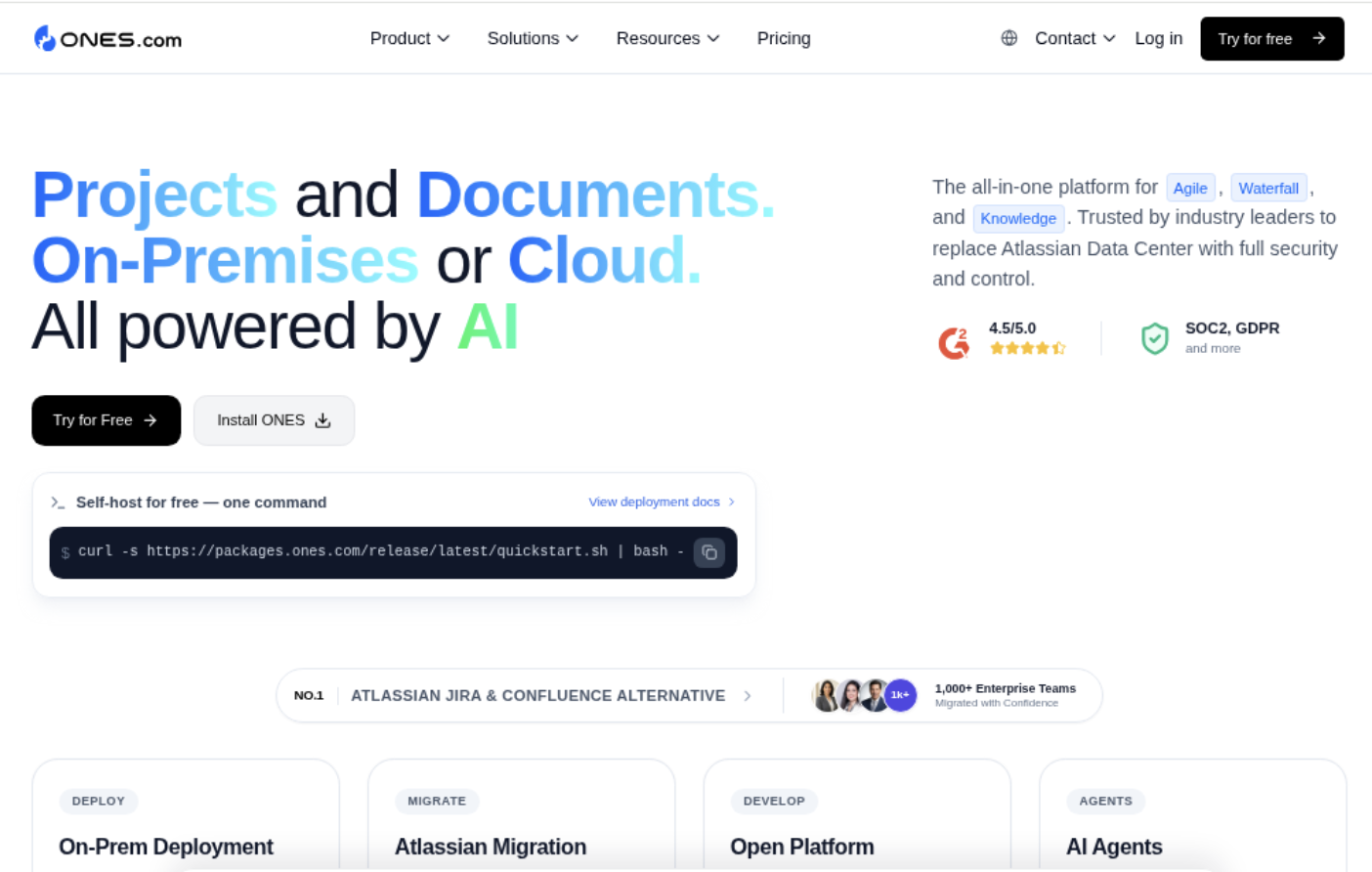
ONES.com offers a free plan for up to 30 seats and supports Cloud, On-Premise, Private Cloud, and Air-gapped deployments. The self-hosted versions provide feature parity with the cloud version, which can matter when security or infrastructure control affects your platform decision.
Core capabilities
1. Pain: Jira administration becomes fragmented across tools
ONES capability: ONES Project brings project tracking, sprint management, reporting, custom workflows, custom fields, and automation into one project environment.
Result: You can reduce dependence on multiple plugins and keep more delivery work inside a consistent workflow.
2. Pain: Teams need a Jira-compatible transition
ONES capability: ONES Project supports Jira-compatible workflows, making it easier to map familiar issue types, statuses, sprint practices, and delivery routines.
Result: Your team can preserve established habits while evaluating another platform.
3. Pain: Plugin costs make the total budget difficult to predict
ONES capability: Built-in reporting, workflow customization, fields, automation, and sprint management reduce the need for separate extensions.
Result: You can evaluate more capabilities within the main subscription instead of calculating several recurring add-on charges.
4. Pain: Cloud-only deployment conflicts with security requirements
ONES capability: ONES.com supports On-Premise, Private Cloud, and Air-gapped deployment options as well as Cloud deployment.
Result: You can align the project environment with restricted-network, infrastructure, or compliance requirements.
5. Pain: Self-hosting creates feature compromises
ONES capability: ONES.com maintains full feature parity between cloud and self-hosted versions.
Result: You can choose a deployment model for operational reasons without automatically giving up core capabilities.
6. Pain: Project information and team knowledge become disconnected
ONES capability: ONES.com includes ONES Wiki as a separate knowledge management product alongside ONES Project.
Result: Teams can connect delivery work with product guidance, operating procedures, and shared knowledge through a related platform family.
7. Pain: Small teams need to test a platform before paying
ONES capability: The free plan supports up to 30 seats.
Result: A small team can trial core project management workflows with more room than a typical small-team allowance.
8. Pain: Automation and reporting are handled manually
ONES capability: ONES Project includes automation and built-in reporting for recurring workflow actions and delivery visibility.
Result: You can spend less time updating status manually and more time resolving delivery risks.
Application scenarios
Growing software team: A 20-person engineering organization can use sprint management, custom workflows, reporting, and automation without immediately assembling several extensions. The team can compare its current Jira workflow against ONES Project during a controlled pilot.
Restricted-network environment: A company handling sensitive engineering work can evaluate an air-gapped or on-premise deployment. The team retains access to the same core feature set while meeting infrastructure requirements.
Project and knowledge coordination: A product organization can use ONES Project for delivery tracking and ONES Wiki for shared product knowledge. Since the products are sold separately, the organization can adopt each one according to its actual needs.
Common Challenges When Selecting a Jira Plan
Challenge: Your headcount changes every month
Solution: Build a 12-month seat forecast with low, expected, and high growth scenarios. Use monthly billing during volatile periods, then reassess once hiring stabilizes.
Challenge: You cannot tell which features are essential
Solution: Interview the people who plan, deliver, report, and administer work. Ask what they do every week and where manual effort causes delays.
Challenge: Several teams want different workflows
Solution: Define shared principles first, such as common priority meanings and completion criteria. Permit local variations only when they support a genuine business difference.
Challenge: Add-ons obscure the real cost
Solution: Create a complete annual estimate covering the core subscription, related services, marketplace applications, administration, training, and integration maintenance.
Challenge: Security requirements narrow your deployment choices
Solution: Decide whether Cloud, On-Premise, Private Cloud, or Air-gapped deployment is acceptable before comparing plan features. Deployment constraints can eliminate unsuitable options early.
FAQs About Jira Plans and Costs
Is Jira free for small teams?
Jira offers a Free plan for small teams, but it includes limits on areas such as users, automation, storage, and administration. Check whether your team needs occasional contributors, advanced permissions, or extensive integrations. A small team with a simple workflow may remain on Free for a long time. A rapidly growing team may outgrow it quickly.
What is the difference between Standard and Premium?
Standard generally provides the capacity and management features required by growing teams. Premium adds capabilities for more complex planning, cross-project coordination, higher limits, and stronger operational controls. The right choice depends on your workflow. If your main issue is basic collaboration, Standard may be enough. If dependency management and scale are major problems, Premium deserves closer evaluation.
Does Jira charge for every person who views a project?
Billing rules depend on the product and access model, so do not assume that occasional viewing is free. Count everyone who may need regular access, including managers, contractors, and partner teams. Review Atlassian’s current licensing terms before finalizing your estimate. This step helps prevent an unexpected seat increase after rollout.
Is annual Jira billing cheaper than monthly billing?
Annual billing can provide a lower effective rate in some situations, but the exact benefit depends on current pricing and your user tier. It also reduces flexibility when headcount changes. Compare the annual commitment with a 12-month monthly forecast. If your team is hiring quickly or reorganizing, flexibility may be worth more than a lower nominal rate.
Can I use Jira without buying every Atlassian product?
Yes, Jira can be evaluated as its own product. However, teams often add other Atlassian services or marketplace applications for knowledge management, service workflows, reporting, testing, or planning. Review each subscription separately and calculate the combined annual cost. You may find that a native capability already meets your need, which can reduce the number of additional services.
Is ONES.com a Jira alternative?
ONES Project is a Jira alternative with Jira-compatible workflows, sprint management, custom workflows and fields, automation, and built-in reporting. ONES.com also supports Cloud, On-Premise, Private Cloud, and Air-gapped deployments, with feature parity between cloud and self-hosted versions. ONES Wiki is a separate knowledge management product. Evaluate the platform against your workflows, deployment requirements, migration effort, and total operating cost.
Conclusion
Jira pricing and plans become easier to evaluate when you separate the advertised subscription from the total operating cost. Start with team size, essential workflows, automation needs, reporting, governance, deployment requirements, and expected growth.
But here's the truth: a plan can be affordable and still create expensive manual work. Compare one realistic project, include add-ons and administration, and test the limits that matter to your team.
If Jira’s structure does not match your needs, ONES Project gives you a Jira alternative with compatible workflows, built-in capabilities, and multiple deployment choices. The best decision is the platform that supports reliable work without creating unnecessary cost or complexity.