Jira Pricing FAQ: 9 Answers Before You Choose a Plan in 2026
Need clarity on Jira plans? This jira pricing faq answers 9 key questions on costs, seats, features, and 2026 plan choices. Read now!
Choosing a Jira plan can feel harder than managing the project itself. Pricing changes with team size, hosting preferences, automation needs, and advanced controls. A plan that looks affordable for five people may become expensive when your team reaches 50.
The confusing part is rarely the headline price. It is understanding what each tier includes, how billed seats work, and when Premium or Enterprise features become worthwhile.
But here’s the truth: you can narrow down the right option quickly by checking your user count, deployment requirements, collaboration needs, and expected growth. This Jira pricing FAQ answers nine practical questions, explains the main cost drivers, and shows how to compare Jira with another project management platform.
Jira Pricing FAQ: The Quick Overview
Jira pricing usually depends on your number of users, subscription tier, billing cycle, and hosting model. Most teams compare Free, Standard, Premium, and Enterprise plans before choosing a setup.
Exact rates can change by region, currency, promotions, and Atlassian’s current pricing structure. Treat the figures shown during checkout as the final authority before you commit.
- Free: Suitable for small teams testing Jira or running lightweight projects with limited administration needs.
- Standard: Designed for growing teams that need more users, collaboration controls, and operational capacity.
- Premium: Built for teams that need advanced planning, stronger automation capacity, and higher service expectations.
- Enterprise: Intended for large organizations managing multiple teams, sites, governance requirements, and procurement rules.
Here’s why the plan name alone does not tell you the real cost. Two companies may choose the same tier but pay very different amounts because one has 12 seats and the other has 600.
1. Is Jira free?
Yes, Jira offers a free plan for small teams. The free tier can work well when you are managing a few projects, testing agile workflows, or introducing issue tracking for the first time.
Free plans normally come with limits around users, storage, permissions, support, automation, or advanced administration. Those limits may be acceptable for a five-person product team but restrictive for a growing department.
For example, a startup might use the free tier to track feature requests and bugs. Once it adds contractors, separate teams, or more complex permissions, a paid plan may become practical.
2. What does Jira Standard include?
Jira Standard is generally the starting point for teams that have outgrown the free tier. It provides more room for users and projects, plus stronger collaboration and administrative controls.
This tier often suits software teams, marketing groups, operations departments, and agencies that need dependable issue tracking without the full complexity of enterprise administration.
Before choosing it, check the current limits for automation, storage, support, permissions, and user capacity. These details can affect your monthly cost more than the advertised plan label.
3. When is Jira Premium worth the extra cost?
Jira Premium can make sense when your team needs advanced planning, higher automation capacity, improved reliability commitments, or broader cross-team coordination.
The upgrade is easier to justify when Jira supports a critical business process. For example, a company coordinating 20 development squads may benefit from cross-project planning that saves several hours each week.
You might not need Premium if your team only manages a simple backlog, uses a small number of workflows, and rarely needs advanced reporting. Paying for unused capacity creates avoidable overhead.
4. What is Jira Enterprise pricing?
Jira Enterprise pricing is usually handled through a sales-led conversation rather than a simple public checkout. The final amount can depend on user volume, organizational structure, contract terms, security requirements, and related Atlassian products.
Enterprise buyers often need centralized administration across multiple sites. They may also require procurement support, identity management, compliance controls, dedicated service arrangements, or negotiated billing.
Ask for a written breakdown of license costs, support commitments, implementation services, renewal terms, and any required companion products. A low headline price can hide substantial rollout and administration expenses.
5. Does Jira charge per user?
Jira generally uses a user-based subscription model. Your bill usually reflects the number of users with access, although the exact treatment can depend on the plan and product configuration.
Some platforms use graduated pricing, where the cost per seat changes as your user count increases. Others place you into a user band, so adding one person can move you into a higher bracket.
For a realistic estimate, count employees, contractors, testers, managers, service accounts, and occasional collaborators. A team with 30 daily users may actually need 38 or more seats.
6. Is annual billing cheaper than monthly billing?
Annual billing may reduce the effective monthly rate, but it requires a larger commitment. Monthly billing provides flexibility when your headcount or project portfolio is changing quickly.
Consider a team that expects to hire 20 people within six months. Annual billing may offer a better rate, but the company should confirm how seat increases and plan changes work during the contract.
Monthly billing can be useful during a trial period. Once usage becomes predictable, compare the annual total, renewal conditions, and any minimum seat commitment.
7. Are Jira add-ons included in the subscription?
Many Jira-related capabilities come through separate marketplace apps or companion products. These extra subscriptions can materially change your total cost.
Common additions may include advanced roadmapping, time tracking, test management, portfolio planning, reporting, service management, or specialized integrations.
Here’s a simple example. A team may pay for Jira, a test management app, a time tracking app, and an integration service. Each individual charge may look small, yet the combined monthly bill can exceed the core subscription.
| Cost area |
Question to ask |
| Core Jira plan |
Which tier supports your required users and workflows? |
| Marketplace apps |
Do you need separate tools for testing, time, reporting, or planning? |
| Administration |
How much time will someone spend managing permissions and workflows? |
| Implementation |
Will you need migration, configuration, training, or consulting? |
| Renewal |
How might your bill change after the first contract period? |
8. Does hosting change Jira pricing?
Yes. Cloud, self-managed, and specialized deployment arrangements can have different pricing structures and operational costs.
Cloud hosting usually reduces infrastructure work because the provider manages much of the platform environment. Self-managed deployment can provide greater control, but your team may need to handle upgrades, availability, backups, security, and performance.
For regulated or restricted environments, deployment requirements can outweigh the subscription price. Compare the full operating effort rather than looking only at the license line.
9. How can you calculate the total Jira cost?
Start with the annual subscription, then add marketplace apps, implementation services, administration time, training, integrations, and expected seat growth.
Use this simple formula:
Total annual cost = subscription fees + add-ons + setup and migration + administration + training + expected growth.
For example, a 25-person team might choose a Standard plan, add a reporting app, pay for initial configuration, and reserve seats for five upcoming hires. That estimate is more useful than multiplying today’s seat count by a monthly price.
The best part? You can compare plans objectively when every option uses the same assumptions.
What Actually Drives Your Jira Bill?
Four variables usually deserve the closest attention: seat count, plan level, extra applications, and operational requirements.
Seat count is the easiest variable to underestimate. Include people who only review work occasionally if they still need access. Then model likely growth over the next 12 months.
Plan level matters because a higher tier may reduce the need for external applications. However, it may also introduce features your team never uses. Compare the capabilities you need with the capabilities you are buying.
Operational requirements can be less visible. A self-managed setup may involve infrastructure specialists, monitoring, patching, backup testing, and incident response. Those activities can become a significant part of the total cost.
How to Choose the Right Jira Tier
Use a short evaluation process instead of choosing the most popular plan.
- Count active and occasional users. Include contractors, reviewers, managers, and planned hires.
- List essential workflows. Write down the processes Jira must support, such as sprint planning, approvals, bug tracking, or release management.
- Identify administration needs. Consider permissions, multiple teams, audit requirements, identity management, and reporting.
- Review automation demand. Estimate how many rules will run daily and whether those rules affect critical operations.
- Price companion applications. Add testing, planning, time tracking, reporting, and integration costs.
- Compare three-year effort. Include subscription increases, migration work, training, administration, and platform maintenance.
Let me explain why this works. A team that needs only basic issue tracking may waste money on Premium. A larger organization with complex governance may waste time trying to stretch Standard beyond its practical limits.
A simple decision example
Imagine a 10-person product team with one backlog, two workflows, and limited reporting needs. Free or Standard may cover the essentials.
Now imagine a 150-person organization with several departments, shared planning, strict permissions, and hundreds of automation rules. Premium or Enterprise may be more suitable, especially if centralized governance matters.
Jira Cloud, Self-Managed, and Total Ownership
Cloud is often attractive when you want a quicker rollout and less infrastructure responsibility. Your team can focus on workflows while the provider handles much of the platform operation.
Self-managed deployment may appeal to organizations with strict network controls, specialized security policies, or internal hosting expertise. The trade-off is greater responsibility for maintenance and availability.
You might be wondering: which option is cheaper? The answer depends on who performs the work. If your infrastructure team already supports similar systems, self-managed deployment may fit naturally. If not, cloud can reduce hidden labor.
| Consideration |
Cloud |
Self-managed |
| Initial rollout |
Usually faster |
Often requires more preparation |
| Infrastructure work |
Lower internal responsibility |
Higher internal responsibility |
| Control |
Provider-managed environment |
Greater environment control |
| Restricted networks |
May not fit every requirement |
Can suit specific restrictions |
| Internal expertise |
Less specialized effort required |
More operational expertise required |
Jira Pricing Mistakes That Increase Costs
The first common mistake is counting only full-time employees. A contractor who needs access for six months can affect the pricing band just as much as a permanent employee.
The second is ignoring add-ons during the first estimate. If your team requires test management, reporting, or capacity planning, include those costs before selecting the core tier.
The third is choosing a plan because another department uses it. Different teams may have different needs. A development group with complex releases may require capabilities that a small marketing group does not.
The fourth is overlooking administration. A platform can appear affordable while requiring extensive manual work to maintain workflows, permissions, dashboards, and integrations.
The fifth is failing to review adoption. If only half your licensed users participate regularly, you may need to improve onboarding or remove unnecessary seats during renewal.
ONES.com combines project management and knowledge management in one platform. ONES Project is the project management product and can serve as a Jira alternative, while ONES Wiki supports team knowledge management.
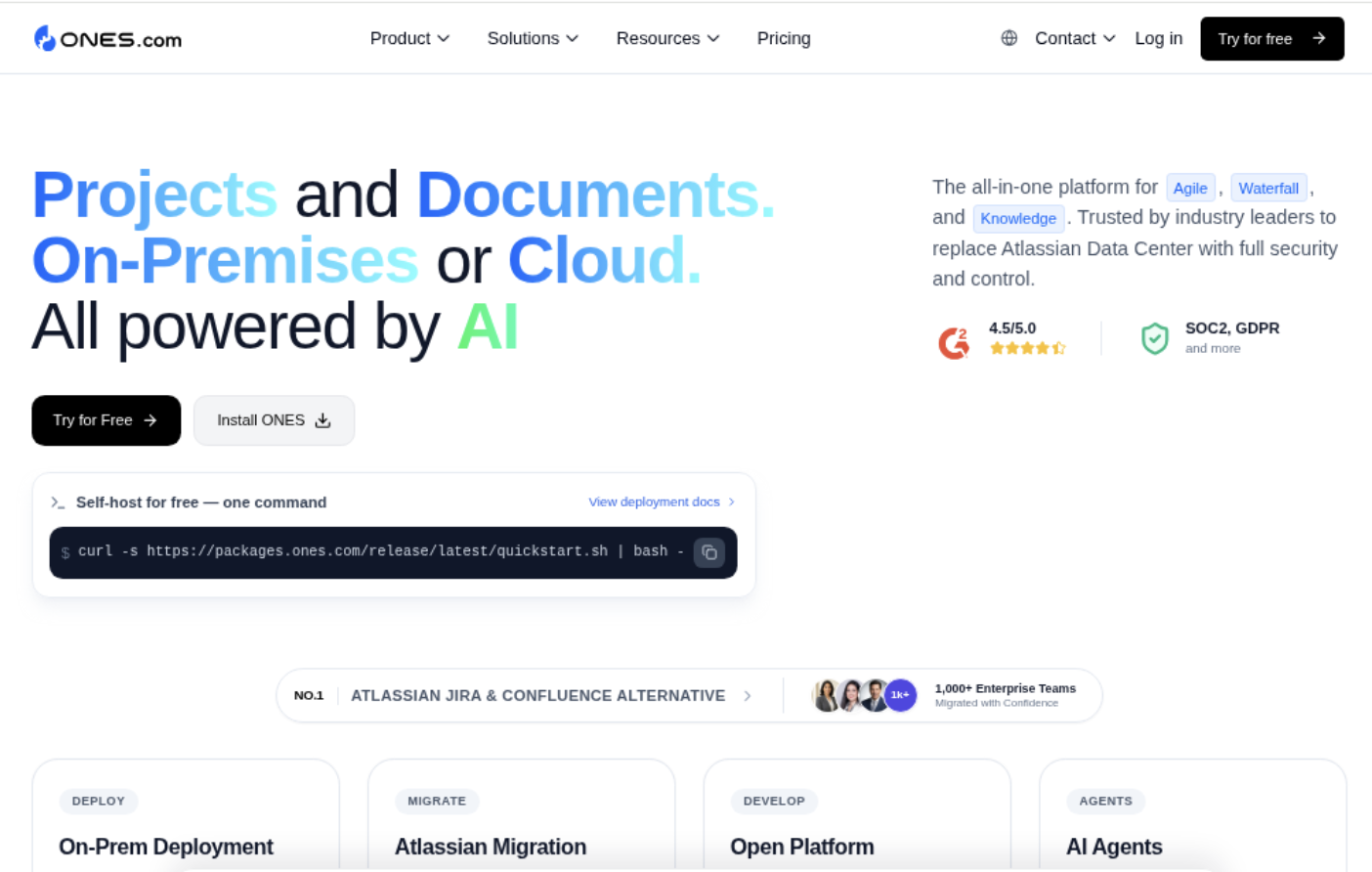
The products are sold separately, so you can choose only the capability your team needs. ONES.com supports Cloud, On-Premise, Private Cloud, and Air-gapped deployments, with full feature parity between cloud and self-hosted versions.
Value Proposition
If your team wants Jira-compatible workflows with fewer connected plugins, ONES Project provides a consolidated approach. It can also suit organizations that need on-premise or air-gapped deployment options.
Core Capabilities
1. Too many disconnected project tools
Pain: Project details, sprint activity, reports, and approvals may sit across several applications.
ONES capability: ONES Project brings project planning, issue tracking, sprint management, workflows, fields, automation, and reporting into one PM environment.
Result: Your team can reduce tool switching and keep delivery activity in a more consistent workspace.
2. Jira workflows need a familiar alternative
Pain: Teams may hesitate to change platforms because their issue types, statuses, and agile routines are already established.
ONES capability: ONES Project supports Jira-compatible workflows and common agile practices.
Result: You can preserve familiar delivery patterns while evaluating a different platform.
3. Custom processes do not fit standard templates
Pain: Approval-heavy or cross-functional work may require more than a basic task board.
ONES capability: Custom workflows and custom fields let you represent stages, ownership, approvals, risk levels, and specialized work types.
Result: Teams can adapt the platform to their process instead of forcing every process into the same template.
4. Sprint planning lacks enough context
Pain: A backlog alone may not show dependencies, workload, priorities, and delivery timing clearly.
ONES capability: Sprint management and built-in reporting help teams review planned work and progress in one environment.
Result: Product owners and delivery leads can make planning decisions with less manual reconciliation.
5. Repetitive updates consume team time
Pain: Reassigning work, updating statuses, and notifying stakeholders manually creates avoidable delays.
ONES capability: Automation can handle recurring actions triggered by workflow events or field changes.
Result: Your team can spend more time on delivery and less time maintaining routine updates.
6. Self-hosting is a requirement
Pain: Some organizations cannot place project information in a standard public cloud environment.
ONES capability: ONES.com supports On-Premise, Private Cloud, and Air-gapped deployments, alongside Cloud deployment.
Result: Teams with restricted-network requirements have more deployment flexibility.
7. Cloud and self-hosted capabilities differ
Pain: A self-hosted edition can become difficult to manage when important cloud features are unavailable.
ONES capability: ONES.com provides full feature parity between its cloud and self-hosted versions.
Result: Deployment decisions can focus more on security and operations than on losing core functionality.
8. Small teams need a low-risk starting point
Pain: A team may want to test a platform before committing to a broader rollout.
ONES capability: The free plan supports up to 30 seats.
Result: A small group can evaluate workflows, reporting, sprint management, and collaboration before expanding.
Application Scenarios
Software product team: A 20-person development group can use Jira-compatible workflows, custom fields, sprint management, and automation without assembling multiple plugins.
Restricted-network engineering group: An organization with isolated infrastructure can evaluate an air-gapped deployment while retaining the same core feature set available in the cloud edition.
Growing operations department: A team can begin with up to 30 seats, create approval workflows, and expand as more departments adopt the platform.
Common Challenges When Comparing Jira Plans
Challenge 1: The price changes after adding users
Problem: Your initial estimate uses today’s team size, but hiring plans quickly move you into another pricing band.
Solution: Build three scenarios: current headcount, expected headcount, and maximum likely headcount. Compare each scenario before signing an annual agreement.
Challenge 2: Add-ons make the comparison unclear
Problem: One plan appears cheaper until you add the applications required for testing, reporting, or planning.
Solution: Create a capability checklist. Price every platform against the same requirements instead of comparing subscription tiers alone.
Challenge 3: Teams pay for advanced features they rarely use
Problem: A higher tier may offer useful features, but your team might use only basic boards and issue tracking.
Solution: Review actual usage during a trial or pilot. Choose the tier that solves recurring problems, not the tier with the longest feature list.
Challenge 4: Migration costs are overlooked
Problem: Switching platforms involves workflow mapping, permissions, integrations, training, and data transfer.
Solution: Treat migration as a project with its own estimate, milestones, testing period, and rollback plan.
Frequently Asked Questions
Can a small team stay on Jira’s free plan?
Yes, if the team fits the plan’s user and capability limits. Free can work for a small backlog, basic sprint tracking, and simple collaboration. Review automation, permissions, storage, support, and administration limits before relying on it for a critical process. A free tier is most useful when your workflow is simple and your team size is stable.
Should I choose monthly or annual Jira billing?
Monthly billing offers flexibility when your team size or platform needs are uncertain. Annual billing may provide a lower effective rate, but it creates a longer commitment. Compare the total annual amount, seat adjustment rules, renewal terms, and expected growth. If your organization is still testing Jira, monthly billing can reduce commitment during evaluation.
Are Jira marketplace apps included?
Usually, marketplace applications have their own pricing. These tools may cover testing, time tracking, reporting, roadmapping, or specialized integrations. Add them to your total cost before choosing a plan. Also consider administration, support, and renewal management for each application. A platform with more native capabilities may have a higher subscription but a lower overall tool burden.
Is Jira Premium necessary for every large team?
No. Team size alone does not determine whether Premium is worthwhile. A large team with simple workflows may be comfortable on Standard, while a smaller organization with complex planning or automation needs may benefit from Premium. Compare the features you use every week with the extra cost. Pay particular attention to advanced planning, automation capacity, reliability requirements, and governance.
How should I compare Jira with another project management platform?
Use the same evaluation criteria for both platforms. Compare workflow flexibility, sprint management, reporting, automation, permissions, integrations, deployment choices, migration effort, and total three-year cost. Include the number of plugins required to reach your desired capability. A fair comparison measures the complete operating model rather than the advertised subscription alone.
Conclusion
Jira pricing becomes easier to understand when you separate the headline subscription from the full cost of ownership. Count every seat, include add-ons, examine deployment requirements, and model likely growth.
Start with the lowest tier that supports your essential workflows. Upgrade only when advanced planning, automation, governance, reliability, or scale creates a clear business benefit.
But here’s the truth: the cheapest plan is not always the lowest-cost choice. A platform that reduces plugins, administration, migration effort, or infrastructure work may deliver better long-term value.
Use these nine answers to compare Jira carefully, then evaluate alternatives such as ONES.com against the same practical requirements. That approach gives you a clearer decision before you choose a plan in 2026.