Jira Pricing in 2026: Plans, Costs, and Key Differences
Wondering about jira price in 2026? Compare plans, costs, features, and hosting options to choose the right tier. Click to discover!
Jira pricing can feel simple until you compare user limits, billing terms, plan features, and deployment options. A plan that looks affordable for five people may cost much more after your team grows, adds automation, or needs advanced administration.
That uncertainty creates a common problem: you choose a tier for today, then discover that essential controls sit behind a higher plan. Add marketplace apps, premium support, or self-hosting requirements, and your real project management cost can differ sharply from the advertised rate.
But here's the truth: Jira price depends on more than the monthly rate per user. You need to compare each plan’s limits, included capabilities, billing model, and long-term fit. This guide explains the main Jira plans, likely costs in 2026, and practical alternatives for teams that want predictable project management spending.
Jira Pricing in 2026: The Quick Answer
Jira price generally depends on the number of users, the subscription tier, the billing term, and whether you choose cloud or self-managed deployment. Jira Cloud commonly includes Free, Standard, Premium, and Enterprise plans.
| Plan |
Typical pricing structure |
Best suited to |
Main consideration |
| Free |
$0, with a limited user allowance |
Small teams testing Jira |
Lower limits and fewer administration features |
| Standard |
Often listed near $7.53 per user monthly at lower tiers |
Growing teams needing core planning and reporting |
Advanced controls remain limited |
| Premium |
Often listed near $13.53 per user monthly at lower tiers |
Teams needing scale, automation, and higher service commitments |
Higher recurring cost |
| Enterprise |
Custom quote |
Large organizations with complex governance |
Pricing requires a sales conversation |
These figures are useful planning estimates rather than guaranteed 2026 invoices. Atlassian can change list prices, billing rules, taxes, discounts, and user-band calculations.
Here's why: the displayed per-user amount usually applies to a particular user range. Your monthly total can change when you move into a larger pricing band, even if only a few people join.
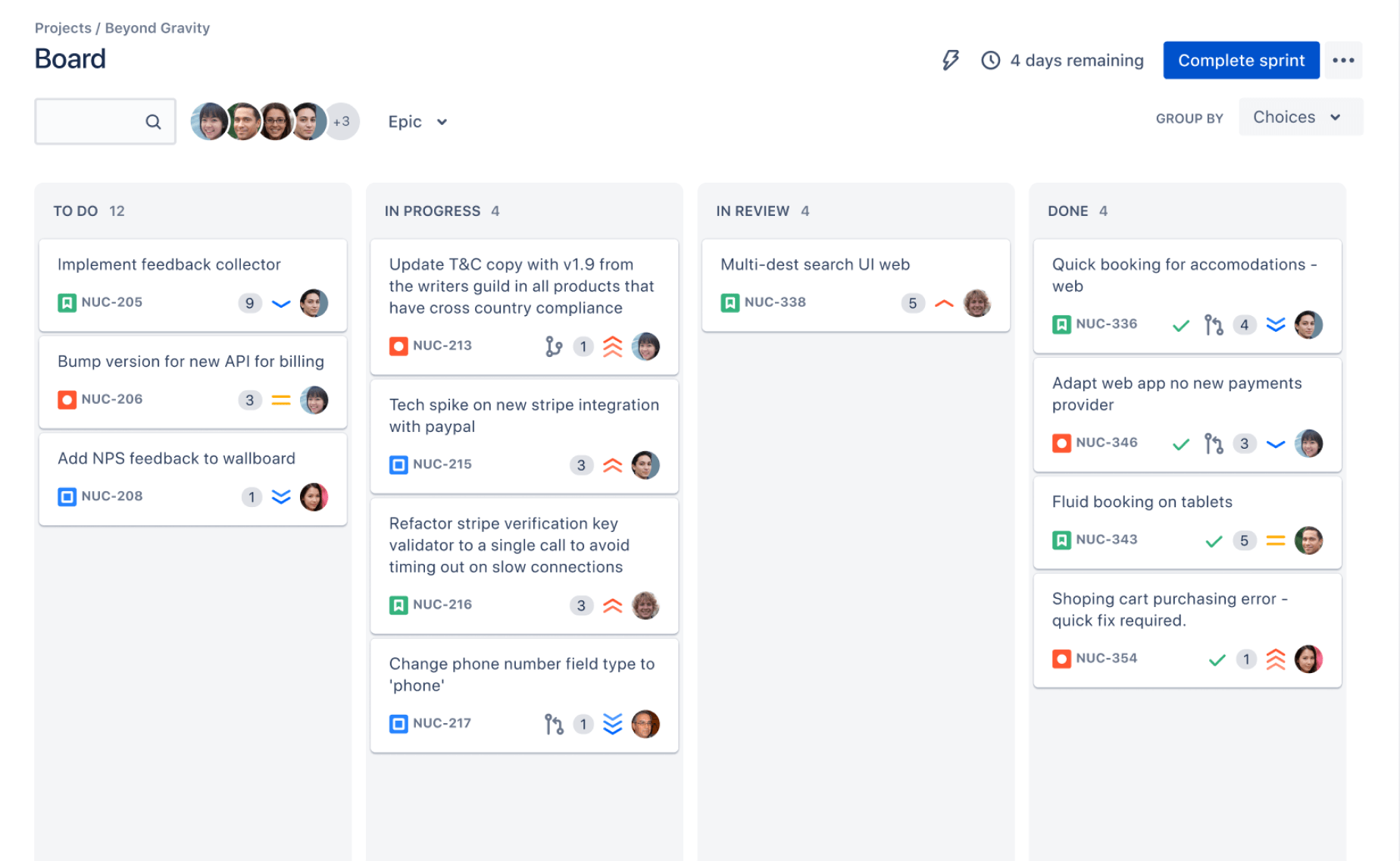
How Jira Plans Differ
Free plan
The Free plan is designed for small teams that need basic issue tracking and project coordination. It can help you test workflows before committing to a paid subscription.
You typically receive core planning features, limited storage, basic reporting, and a restricted number of users. Administration, permissions, audit controls, and service guarantees are more limited than on paid tiers.
For example, a five-person product team may use the Free plan to manage a small backlog, assign tasks, and track sprint work. A 15-person team may quickly outgrow its limits.
Standard plan
Standard is usually the practical starting point for teams that need Jira for everyday project delivery. It adds room for more users and stronger operational capabilities.
You can generally expect expanded user capacity, more storage, broader collaboration features, and improved administration compared with Free. The exact limits can vary as Atlassian updates its commercial packaging.
Standard often fits software teams, marketing groups, and operations departments that need structured work tracking without enterprise-wide governance.
Premium plan
Premium targets organizations that need more scale, higher automation capacity, advanced planning, and stronger service commitments. It is often the tier considered when Jira becomes important across several teams.
Features may include higher limits, advanced roadmapping, stronger automation capacity, project archiving, and a higher availability commitment. You should confirm which capabilities are included before purchasing.
The price difference can be significant. If 100 users pay an extra $6 per user each month to move from Standard to Premium, that change adds roughly $600 monthly before taxes and other services.
Enterprise plan
Enterprise is aimed at large organizations with complex identity management, centralized governance, multiple teams, and formal procurement requirements. Pricing is generally customized rather than displayed as a simple monthly rate.
An enterprise quote may consider user volume, products, support requirements, contract length, deployment needs, and commercial terms. This makes direct comparison more difficult.
You might need Enterprise if several business units require common controls. A single product team rarely needs it solely because it wants more project views.
What Determines Your Total Jira Cost?
User count and billing bands
Jira usually calculates cloud subscriptions by user quantity and pricing band. Your organization may pay for assigned users rather than active users, depending on the product and agreement.
Consider a team with 80 licensed users. If the company grows to 101 people, the new billing band may affect the entire subscription rather than only the latest hires.
Before approving a plan, count employees, contractors, occasional contributors, and administrators. A small user-count mistake can create a surprisingly large annual difference.
Monthly versus annual billing
Monthly billing offers flexibility. You can add or remove seats more frequently and avoid a large upfront commitment.
Annual billing can provide more predictable budgeting and may offer different commercial terms. However, an annual commitment can become expensive if your hiring plan changes.
Here's a simple comparison: a seasonal team may prefer monthly billing, while a stable 60-person engineering department may value an annual agreement.
Marketplace apps
Jira’s base subscription is only part of the potential cost. Many teams add applications for time tracking, test management, advanced roadmaps, portfolio planning, forms, dashboards, or specialized reporting.
Those applications may use their own pricing tiers and user calculations. Some charge according to your Jira user count, even when only a small group actively uses the app.
The best approach is to calculate the complete work stack. List each application, its licensed users, renewal date, and business purpose before comparing plans.
Automation and usage limits
Automation can reduce manual administration, but each tier may have different execution limits or rule permissions. A team that automates issue creation, notifications, approvals, and transitions needs enough capacity for its workload.
For example, a rule that runs once per sprint is unlikely to create pressure. A rule that processes thousands of issue changes every day may require a higher tier or careful optimization.
Taxes, currency, and discounts
Your final invoice may vary because of local taxes, currency conversion, partner agreements, nonprofit discounts, education pricing, or negotiated enterprise terms.
Use the checkout calculator or commercial quote for a final figure. Public list prices are useful for planning, but they should not replace a purchase estimate for your region.
Cloud, Data Center, and Self-Managed Costs
Jira Cloud is hosted by Atlassian. You pay a recurring subscription and Atlassian manages much of the infrastructure, maintenance, upgrades, and service operation.
That model reduces internal administration, but it gives you less control over hosting conditions and upgrade timing. It is often attractive for teams that want a faster deployment with fewer infrastructure responsibilities.
Jira Data Center is a self-managed option for organizations with strict hosting, security, or operational requirements. Its cost includes the Atlassian subscription plus infrastructure, administration, monitoring, backups, upgrades, and support.
A company might choose Data Center because it needs a controlled environment. However, the license price alone does not show the total ownership cost.
| Cost category |
Cloud |
Self-managed deployment |
| Subscription |
Recurring per-user or enterprise pricing |
Recurring platform subscription, often with enterprise terms |
| Infrastructure |
Generally included in the service model |
Paid and operated by your organization |
| Maintenance |
Mostly handled by the vendor |
Handled by internal teams or a service partner |
| Customization |
Constrained by cloud architecture and app support |
More control, with greater operational responsibility |
| Scaling |
Usually simpler to expand |
Requires capacity planning and technical work |
Atlassian’s self-managed product roadmap can change, so confirm current availability and commercial terms before planning a long-term deployment.
Hidden Costs to Include in Your Budget
Administration time
Someone must design workflows, manage permissions, maintain custom fields, review automation, and remove outdated projects. That work has a labor cost even when the subscription looks affordable.
Migration and configuration
Moving from another platform can require planning, cleanup, mapping, testing, and training. A complicated setup can delay adoption and create consulting expenses.
Training and change management
A team may need onboarding sessions, internal guidance, and role-specific training. Developers, project managers, executives, and occasional contributors often need different views of the same work.
Reporting and governance
Basic dashboards may be enough for one team. A large organization may need standardized workflows, ownership rules, audit reviews, naming conventions, and portfolio reporting.
Renewal risk
Subscription prices and product packaging can change. Review renewal dates, price protection, user growth, and unused applications at least once each year.
Let me explain: a low starting price does not guarantee a low five-year cost. The right comparison includes licensing, administration, integrations, training, and the cost of switching later.
A Practical Way to Compare Jira Plans
Start with the work your team must complete, then match that work to plan requirements. Avoid choosing a tier because another company uses it.
- Count every potential user. Include full-time staff, contractors, reviewers, and administrators.
- List essential capabilities. Mark needs such as sprint planning, automation, reporting, approvals, permissions, and compliance controls.
- Separate must-have and nice-to-have features. This prevents a premium tier from becoming the default answer.
- Estimate three-year cost. Include subscriptions, apps, administration, onboarding, and likely user growth.
- Test a realistic workflow. Build a sample project with your actual statuses, approvals, dashboards, and notifications.
- Review alternatives. Compare migration effort, hosting choices, native capabilities, and long-term administration.
You might be wondering: should you choose the cheapest tier first? That can work for a small experiment, but it becomes risky when your team depends on advanced controls or custom integrations.
Value Proposition
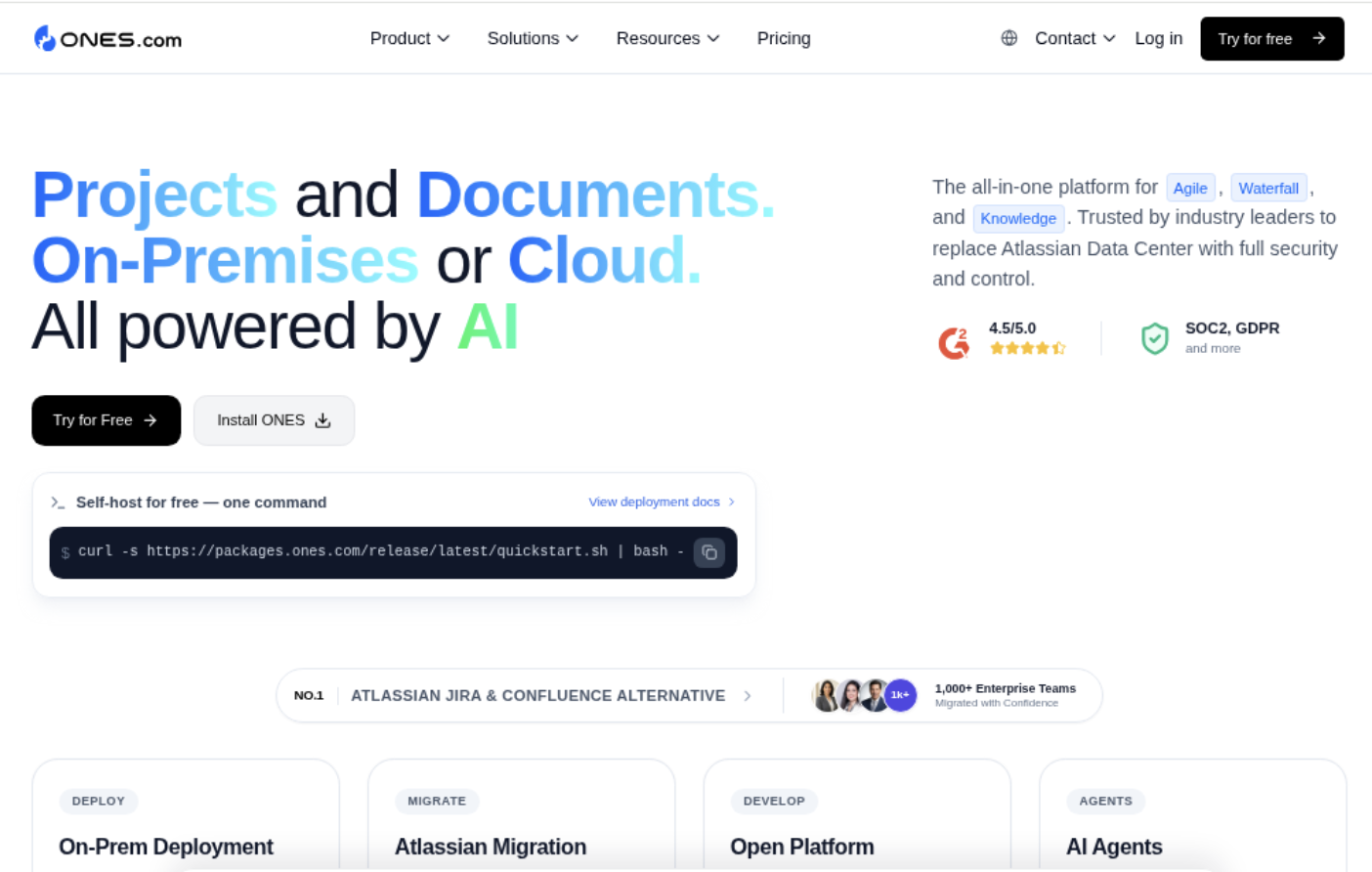
ONES.com is a unified platform for project management and knowledge management, powered by ONES Assistant. ONES Project provides project management capabilities as a Jira alternative, while ONES Wiki serves as a knowledge base alternative to Confluence. They can be sold separately.
For teams comparing Jira price, ONES.com offers another way to evaluate platform cost: consider how many separate tools, plugins, integrations, and administration tasks your workflow requires.
Core Capabilities
- Fragmented project and knowledge workflows: ONES.com combines project management and knowledge management in one platform, helping teams connect delivery work with shared guidance.
- Jira migration concerns: ONES Project supports Jira-compatible workflows, making it easier for teams familiar with issue-based planning to adapt their processes.
- Too many add-ons: Built-in reporting, custom workflows, custom fields, sprint management, and automation can reduce dependence on separate plugins.
- Limited deployment choices: ONES.com supports Cloud, On-Premise, Private Cloud, and Air-gapped deployments, giving organizations more control over hosting conditions.
- Different capabilities across hosting models: ONES.com provides full feature parity between its cloud and self-hosted versions, so deployment choice does not require giving up core functionality.
- Growing teams with a limited initial budget: The free plan supports up to 30 seats, giving smaller teams room to evaluate the platform before a paid rollout.
- Complex approval processes: Custom workflows and fields help teams reflect real approval paths instead of forcing every project into one rigid process.
- Restricted-network operations: Air-gapped deployment supports organizations that cannot place project information in a public cloud environment.
Application Scenarios
Software product team: A development group can use sprint planning, Jira-compatible workflows, custom fields, and built-in reporting without assembling several separate extensions.
Regulated organization: A company with strict hosting rules can evaluate On-Premise, Private Cloud, or Air-gapped deployment while keeping the same core feature set.
Growing cross-functional team: Product, engineering, and operations can coordinate delivery work through ONES Project and maintain related knowledge in ONES Wiki.
ONES.com should still be evaluated against your team’s migration needs, integrations, security requirements, and preferred working style. The right choice depends on the complete operating model rather than a single per-user figure.
Common Challenges When Evaluating Jira Costs
Challenge: The displayed rate does not match the invoice
Why it happens: Pricing bands, taxes, currency, discounts, and extra applications can change the final amount.
Practical response: Build a quote using your actual user count and region. Add every application your teams currently rely on.
Challenge: Your team cannot tell which tier it needs
Why it happens: Feature pages often describe capabilities without showing how they affect a specific workflow.
Practical response: Write three real scenarios, such as a sprint review, an approval request, and an executive report. Test each scenario against the available plans.
Challenge: Marketplace applications multiply costs
Why it happens: A small add-on can use a broad license band or become essential after teams build processes around it.
Practical response: Review application usage quarterly. Replace overlapping tools and calculate whether a platform with more native features lowers total administration.
Challenge: Self-hosting looks cheaper than it really is
Why it happens: Infrastructure, upgrades, monitoring, backup testing, and specialist labor are easy to omit.
Practical response: Add internal labor and infrastructure to the subscription estimate. Compare the three-year ownership cost with cloud alternatives.
Challenge: User growth creates an unexpected price jump
Why it happens: A new pricing band can affect the subscription when your organization crosses a threshold.
Practical response: Model current users, expected hires, contractors, and acquisitions. Ask for commercial guidance before signing a long commitment.
FAQs About Jira Pricing
Is Jira free in 2026?
Jira generally offers a Free plan for small teams, subject to user, storage, administration, and feature limits. Free access can be useful for testing basic issue tracking and team planning. It may not provide the controls required for larger organizations, advanced governance, or high-volume automation. Check the current user allowance and included capabilities before treating the Free plan as a long-term option.
How much does Jira cost per user?
The commonly advertised lower-tier rates are often around $7.53 per user monthly for Standard and $13.53 for Premium. These figures may vary by user band, billing term, region, taxes, discounts, and product changes. Enterprise pricing is usually customized. Treat public rates as planning estimates, then confirm the amount through the current pricing calculator or a commercial quote.
Which Jira plan is best for a small team?
A small team can begin with Free if it only needs basic project tracking and fits within the plan limits. Standard may be more suitable when the team needs greater capacity, stronger administration, or broader collaboration features. Premium is worth considering when advanced automation, higher limits, or sophisticated planning directly supports the team’s work. The best choice depends on required capabilities rather than headcount alone.
Are Jira Marketplace apps included in the subscription?
Marketplace applications are usually priced separately from the main Jira subscription. Each application may have its own user bands, billing terms, and renewal conditions. A team should list every required app before comparing plans. For example, time tracking, test management, advanced reporting, and portfolio planning can create substantial recurring costs when several applications are licensed for the full Jira user population.
Is Jira Cloud cheaper than Jira Data Center?
There is no universal answer. Cloud usually reduces infrastructure and maintenance responsibilities, while Data Center can suit organizations with strict hosting or operational requirements. Data Center may involve infrastructure, internal specialists, monitoring, backups, and upgrade work. Compare total ownership cost over several years, including labor and service operations, rather than comparing subscription rates alone.
What should I include in a Jira budget?
Include the base subscription, user growth, taxes, Marketplace applications, implementation, migration, training, administration, integrations, support, and renewal changes. Also estimate the cost of downtime or delayed adoption if the platform does not fit your workflow. A three-year estimate usually gives a clearer view than the first monthly invoice because it includes expansion and operational effort.
Conclusion
Jira pricing in 2026 depends on more than a Free, Standard, Premium, or Enterprise label. User bands, billing terms, applications, deployment choices, administration, and future growth all influence the amount your organization will actually spend.
But here's the practical takeaway: define your required workflows first, calculate the full ownership cost, and test realistic scenarios before committing. A low entry price can become expensive when your team needs add-ons, advanced controls, or a different deployment model.
If Jira fits your operating model, choose the tier that supports your next stage of growth. If the combination of tools and administration feels too complex, compare platforms such as ONES.com alongside the subscription, feature, hosting, and migration requirements that matter to your team.