Jira Pricing Model: Plans, Costs, and Best Value in 2026
Confused by the jira pricing model? Compare 2026 plans, costs, features, and best value by team size. Click to discover the right plan!
Choosing a Jira plan can feel harder than managing the project itself. You see user tiers, feature limits, billing options, service levels, and add-ons, then wonder what you will actually pay in 2026.
That uncertainty creates two expensive risks. You may overpay for premium features your team never uses, or choose a cheaper tier that slows delivery with missing controls and reporting.
Here’s the practical solution: compare Jira plans by team size, workflow complexity, administration needs, and total operating cost. The headline price matters, but it rarely tells the whole story.
This guide explains the Jira pricing model in plain English. You will see how the plans differ, which costs deserve attention, and how to identify the best value for your team.
Jira Pricing Model: Plans, Costs, and Key Features
The Jira pricing model is a tiered subscription system that usually separates plans by team size, feature depth, administration, security, support, and deployment requirements.
For Jira Cloud, the main editions are generally Free, Standard, Premium, and Enterprise. Your final cost depends on the number of users, billing frequency, selected products, and any connected services.
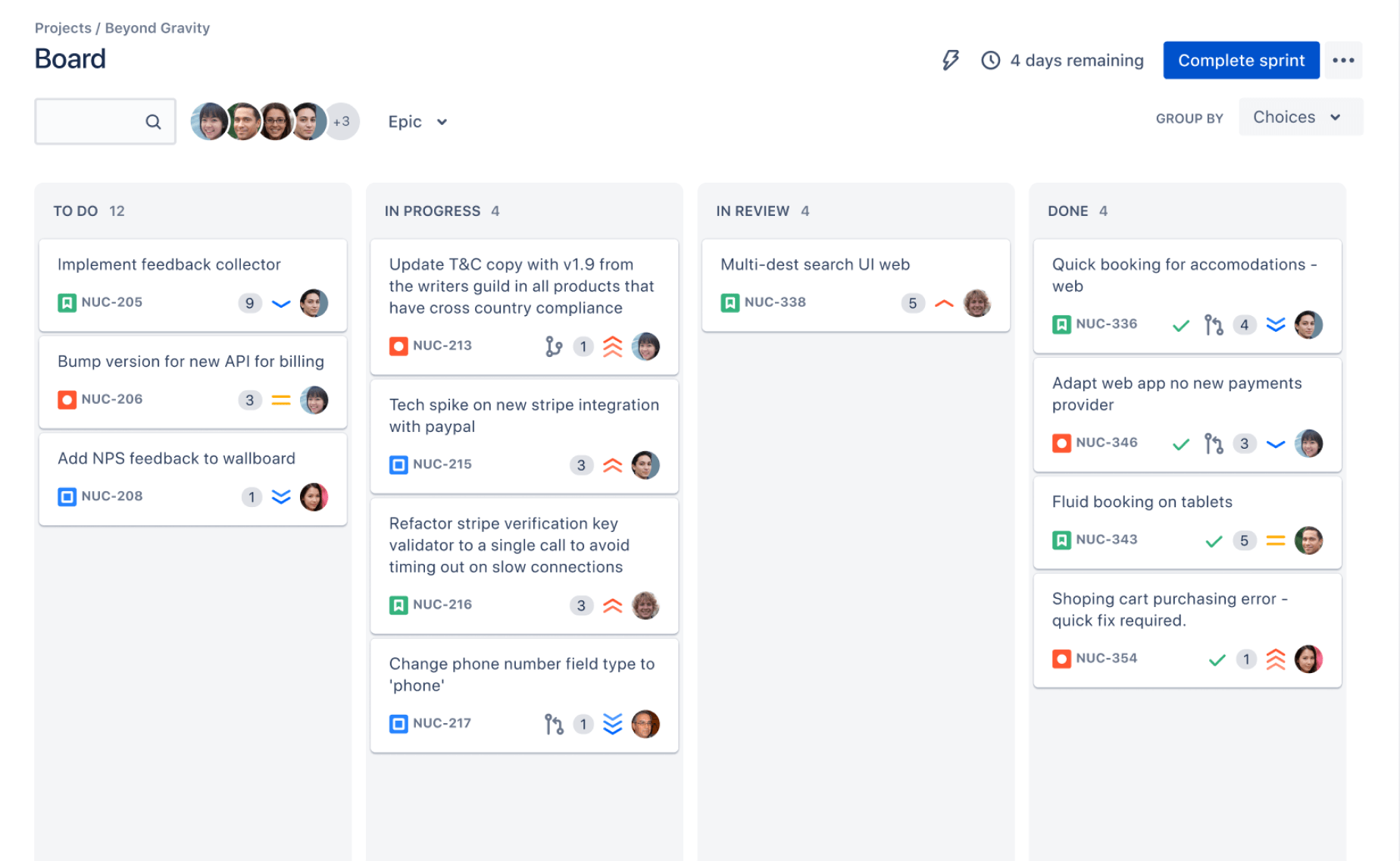
Jira plan overview
| Plan |
Best suited to |
Typical advantages |
Main consideration |
| Free |
Small teams testing Jira |
Core planning, issue tracking, and basic collaboration |
Lower limits and fewer administration controls |
| Standard |
Growing teams running regular projects |
More users, expanded permissions, automation, and reporting |
Advanced governance and resilience features remain limited |
| Premium |
Teams managing complex or business-critical work |
Advanced planning, higher service commitments, and stronger scale |
Higher subscription cost requires clear operational value |
| Enterprise |
Large organizations with multiple teams |
Centralized governance, enterprise administration, and broader support |
Usually requires a tailored commercial agreement |
What determines your real monthly cost?
The visible per-user price is only one part of the calculation. You should also consider the number of paid seats, billing term, additional Atlassian products, marketplace apps, implementation work, and administration time.
For example, a 12-person team may fit the Free plan during early experimentation. Once the team needs stronger permissions, automation, and reliable reporting, Standard may deliver better value than staying on Free and adding workarounds.
Here’s why: a low subscription can still become expensive when people spend hours maintaining manual reports or resolving access problems.
Illustrative Jira Cloud pricing ranges
Jira prices can change by region, currency, user tier, and billing arrangement. Treat the ranges below as planning guidance rather than a final quote.
| Plan |
Common pricing pattern |
How to evaluate it |
| Free |
No subscription charge within the current user and storage limits |
Check whether team size, permissions, and automation limits fit |
| Standard |
Per-user subscription with lower unit cost at larger seat counts |
Compare the plan’s controls with your daily delivery needs |
| Premium |
Higher per-user subscription for advanced planning and service capabilities |
Measure the cost against risk reduction and productivity gains |
| Enterprise |
Custom pricing and commercial terms |
Request a quote that reflects users, products, regions, and governance |
Before approving a budget, check the official checkout experience for your country and user count. The payable amount can differ from simple online examples.
How Jira Plans Differ in Everyday Work
The clearest way to compare Jira editions is to connect each feature to a practical team problem. A plan matters when it changes how people plan, deliver, report, or govern work.
Free: useful for small experiments
Free can work well for a small software team, student project, or early-stage group that needs basic issue tracking. You can create work items, organize a board, and try common agile practices.
Imagine six developers planning a two-week sprint. If they only need a backlog, board, basic statuses, and simple collaboration, Free may cover the essentials.
However, limits become important as the team grows. Restrictions around users, storage, permissions, automation, support, and administration can affect the experience.
Standard: the usual starting point for growing teams
Standard often fits teams that have moved beyond experimentation. It typically offers a broader operating environment, more room for users, and stronger controls for regular project delivery.
A 35-person product team might use Standard for sprint planning, defect tracking, release coordination, and routine reporting. The plan becomes more useful when several groups share one workspace.
The best part? Standard often provides the balance many teams seek: enough capability for disciplined delivery without paying for every advanced control.
Premium: designed for complexity and scale
Premium makes more sense when planning spans multiple teams, delivery risks are high, or the organization needs advanced service capabilities. Cross-team planning, stronger resilience, and higher operational expectations can justify the added cost.
Consider a company coordinating engineering, security, compliance, and customer launches. A Premium plan may reduce coordination friction by giving leaders a wider view of dependencies and delivery timing.
You should still measure the benefit. Premium is poor value when your team only uses a backlog, board, and basic reports.
Enterprise: governance across a larger organization
Enterprise pricing usually reflects a broader relationship than a simple per-user upgrade. Large organizations may need centralized administration, multiple business units, stronger governance, and tailored commercial terms.
For example, a global organization may need consistent policies across regional teams while preserving local project ownership. Enterprise features can support that structure, although the commercial evaluation usually requires a detailed review.
How Billing and User Counts Affect the Total
Your Jira bill can change even when the feature set stays the same. Billing frequency, active seats, user tiers, and product combinations all influence the final amount.
Monthly billing versus annual billing
Monthly billing provides flexibility. It suits a temporary project, a pilot, or a team with unpredictable staffing. You can adjust seats more frequently and avoid a long commitment.
Annual billing may offer a lower effective rate or more predictable budgeting. It becomes attractive when your team has stable headcount and expects to use Jira throughout the year.
Here’s a simple example. A 50-person team with steady staffing may prefer an annual commitment. A consultancy with fluctuating client teams may value monthly flexibility, even if the unit rate is higher.
Paid seats and occasional collaborators
Review who genuinely needs a paid seat. Engineers, product managers, testers, and delivery leads usually require regular access. Occasional viewers may have different access options depending on the plan and product setup.
Run a quarterly access review. Remove people who have left, adjust inactive accounts, and confirm that temporary contractors still need access.
A small amount of seat maintenance can prevent recurring waste. For a 100-seat team, removing ten unused seats can create meaningful annual savings.
Multiple Atlassian products
Many teams use Jira alongside other Atlassian products. A complete budget should include every subscription that supports your workflow, rather than evaluating Jira in isolation.
For example, a delivery team may pair Jira with a knowledge platform, service management product, or collaboration tool. Each addition can improve coordination, though each also affects administration and total spend.
Marketplace apps and integration costs
Apps can add time tracking, advanced reporting, test management, portfolio planning, or specialized automation. They can also introduce separate licensing, renewal dates, permissions, and support requirements.
Before installing an app, ask whether Jira already covers the need through native configuration. If an app remains necessary, include its fee and maintenance effort in your comparison.
How to Find the Best Value for Your Team
The best-value Jira plan is the lowest tier that supports your required workflow without creating avoidable manual work or operational risk.
Start with essential capabilities
Write down the work your team performs every week. Include backlog management, sprint planning, approvals, release tracking, reporting, access control, and automation.
Then separate essential capabilities from preferences. A team may prefer advanced planning, but it may only require basic sprint boards and dependable reporting.
Measure the cost of workarounds
A cheaper plan can create hidden labor. Suppose three project leads spend two hours each week rebuilding reports manually. At an internal labor rate of $60 per hour, that workaround costs about $1,440 per year.
That figure changes the comparison. A higher subscription may deliver better value if it removes repetitive work and improves decision-making.
Compare risk, not only features
Ask what happens when the platform reaches its limits. Could a missing permission model expose sensitive work? Could weak reporting delay a launch? Could limited automation increase missed handoffs?
A regulated team may value governance more than a small team that only needs task tracking. The right plan depends on consequences, not feature volume.
Use a simple value scorecard
| Evaluation area |
Question to ask |
Warning sign |
| Workflow fit |
Can the plan support your current delivery process? |
People rely on manual status updates |
| Team scale |
Will user and automation limits support expected growth? |
You approach plan limits within a few months |
| Governance |
Can you control access and maintain consistent practices? |
Every team configures work differently |
| Reporting |
Can leaders see progress without manual reconstruction? |
Reports require repeated copying and cleanup |
| Total cost |
What will subscriptions, apps, and administration cost together? |
The budget includes only the headline license |
Jira is a strong choice for many agile and software teams. Still, your organization may want a different balance between project management, knowledge management, deployment control, and platform simplicity.
You might be wondering: what should you compare when the issue is broader than price?
Look at workflow flexibility, native reporting, plugin dependence, hosting choices, knowledge sharing, permissions, migration effort, and long-term administration.
Compare the operating model
A platform that requires many add-ons may create separate renewal dates and configuration work. A platform with more native capabilities can simplify the environment, provided it still supports your required process.
For instance, a product organization may want project planning and an internal knowledge hub under one broader platform. That can reduce context switching between delivery work and team guidance.
Consider hosting and control requirements
Cloud hosting works well for teams that want quick access and minimal infrastructure responsibility. Other organizations need on-premise, private cloud, or air-gapped deployment because of security, compliance, or network restrictions.
Those requirements can eliminate otherwise attractive cloud-only options. Hosting flexibility belongs in the value discussion from the beginning.
Natural Jira Pricing Model Solution: ONES.com
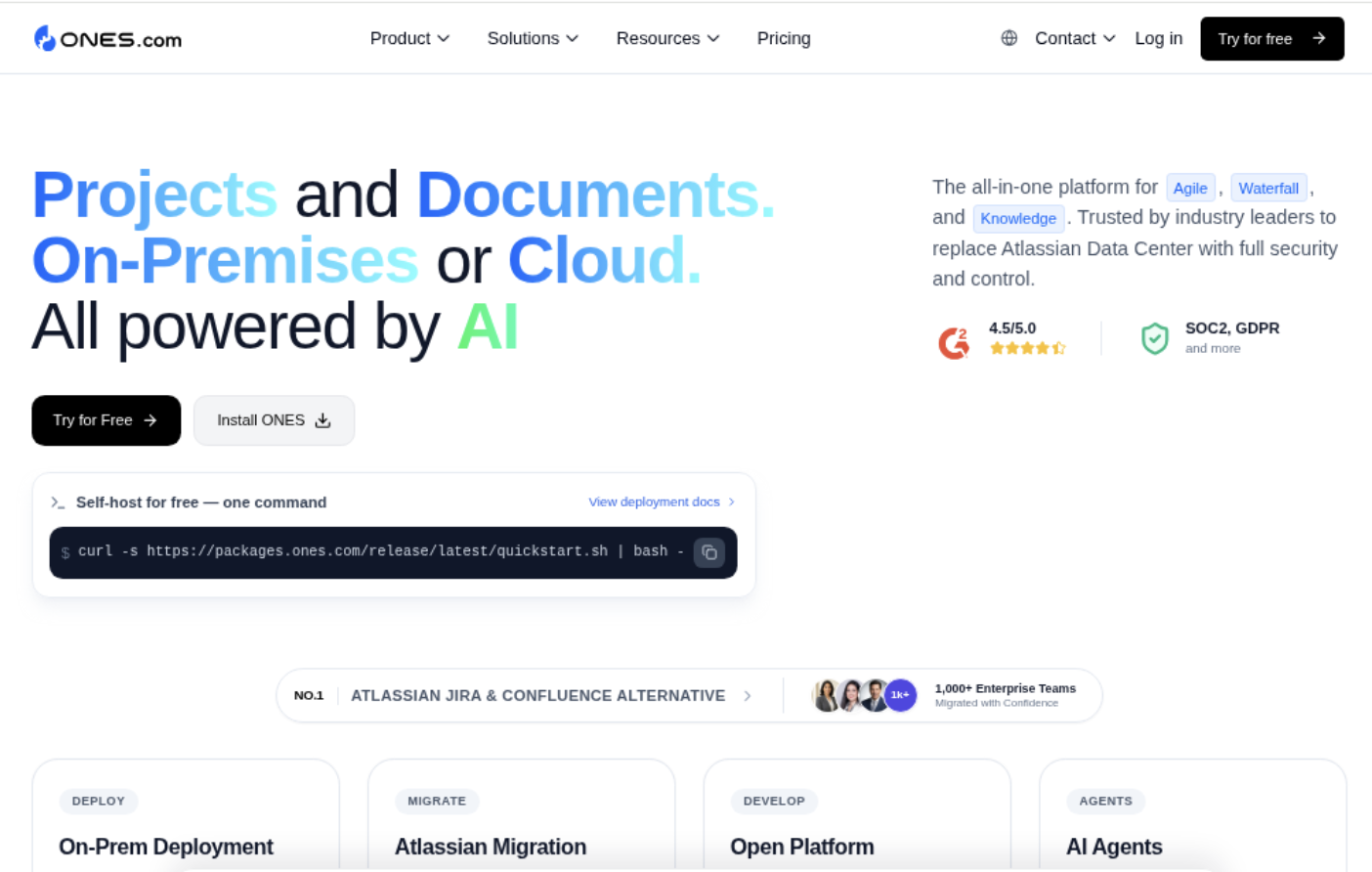
Value Proposition
ONES.com combines project management and knowledge management in one unified platform. ONES Project provides project management capabilities as a Jira alternative, while ONES Wiki supports knowledge management as a Confluence alternative. They are sold separately.
The platform offers Cloud, On-Premise, Private Cloud, and Air-gapped deployments, with full feature parity between cloud and self-hosted versions. A free plan supports up to 30 seats.
Core Capabilities
- Plugin sprawl: Teams often add several extensions for common needs. ONES capability: Built-in reporting, custom workflows, custom fields, sprint management, and automation cover core delivery tasks natively. Result: You can reduce reliance on separate plugins and simplify administration.
- Rigid processes: Different teams may need different approval or delivery paths. ONES capability: Custom workflows and fields let you reflect team-specific processes. Result: Work can match the organization without forcing every group into one pattern.
- Scattered project knowledge: Guidance and delivery activity may live in separate places. ONES capability: ONES.com brings project management and knowledge management into one platform family. Result: Teams can connect execution with the information needed to complete work.
- Hosting restrictions: Some organizations cannot place operational work in a public cloud. ONES capability: Cloud, On-Premise, Private Cloud, and Air-gapped options support different control requirements. Result: Restricted environments can still run a modern project workflow.
- Migration concerns: Teams may hesitate to leave familiar agile processes. ONES capability: Jira-compatible workflows help teams preserve recognizable planning and tracking patterns. Result: Adoption can involve less process disruption.
- Limited visibility: Leaders may lack consistent views of delivery progress. ONES capability: Built-in reporting provides project and team visibility without requiring every report to be assembled externally. Result: Planning conversations can use more consistent information.
- Growing team size: Small teams need a low-barrier starting point. ONES capability: The free plan supports up to 30 seats. Result: A team can evaluate the platform before making a larger commitment.
- Cloud and self-hosted differences: Some vendors limit features outside their cloud edition. ONES capability: ONES.com maintains feature parity between cloud and self-hosted versions. Result: Deployment choice does not automatically mean sacrificing core functionality.
Application Scenarios
A restricted-network engineering team: A security-sensitive team can use an air-gapped deployment for sprint planning, custom workflows, and reporting. Its network controls remain part of the operating model.
A growing product organization: A 20-person team can start within the free seat allowance, establish Jira-compatible workflows, and expand its project and knowledge practices as coordination becomes more complex.
A multi-team delivery group: Teams can use sprint management, automation, and custom fields for delivery work while maintaining related guidance through ONES Wiki. This approach can reduce context switching between planning and knowledge sharing.
Common Challenges When Choosing a Jira Plan
Challenge: comparing headline prices only
Problem: A per-user figure hides app fees, administration time, implementation work, and unused seats.
Solution: Build a 12-month total-cost estimate. Include subscriptions, connected products, marketplace apps, migration, training, and recurring administration.
Challenge: upgrading before proving the need
Problem: Teams sometimes choose Premium because it sounds safer, even though they use only basic planning features.
Solution: List the exact capabilities that justify the upgrade. If you cannot connect a feature to a recurring business need, postpone the increase.
Challenge: staying on a low tier despite operational pain
Problem: Teams may tolerate manual reporting, inconsistent permissions, and repeated workarounds to avoid a higher subscription.
Solution: Quantify the wasted hours and delivery risks. Compare that amount with the additional plan cost.
Challenge: overlooking future growth
Problem: A plan that works for 15 people may become restrictive at 40 people, especially when several teams share workflows.
Solution: Forecast users, projects, automation rules, reporting needs, and governance requirements for the next 12 months.
Challenge: choosing a cloud plan despite deployment restrictions
Problem: Security or compliance requirements may prevent a public-cloud deployment.
Solution: Confirm hosting requirements before comparing feature tiers. Include self-hosted platforms such as ONES.com when on-premise, private cloud, or air-gapped operation matters.
FAQs About Jira Plans and Costs
Is Jira free for small teams?
Jira generally offers a Free plan for small teams, with limits around users, storage, permissions, automation, and administration. It can work for a basic backlog and board. Check the current eligibility rules for your region and team size before planning a long-term rollout. A free tier is most suitable when your process remains simple and your team does not need advanced governance.
Which Jira plan is best for a growing team?
Standard is often the practical starting point for a growing team that needs regular project delivery, broader access, and stronger controls than Free provides. Premium may be more appropriate when several teams coordinate dependencies, delivery risk is high, or advanced planning and service capabilities matter. Compare actual weekly requirements rather than selecting a tier by company size alone.
Does Jira charge per user?
Jira Cloud generally uses a per-user subscription model, with pricing affected by user tiers and billing terms. The amount can change when seats are added, removed, or moved between products. Review active accounts regularly and include related products and apps in your budget. Your final checkout amount may differ from a simple per-user multiplication.
Is annual Jira billing cheaper than monthly billing?
Annual billing may provide a lower effective rate or more predictable budgeting, depending on the plan and commercial terms. Monthly billing offers more flexibility for temporary teams and changing headcounts. Compare both options using your expected seat count, staffing stability, and cancellation needs. A lower annual rate may lose its advantage if many seats will remain unused.
When should a team choose Premium?
Premium becomes easier to justify when advanced planning, cross-team coordination, higher service expectations, or stronger resilience can reduce meaningful operational risk. It is less compelling for a small team that only needs basic issue tracking and sprint boards. Identify the specific Premium capabilities your team will use, then estimate the hours or risks they could eliminate.
What should I compare before choosing a Jira alternative?
Compare workflow compatibility, reporting, automation, permissions, migration effort, hosting choices, knowledge management, plugin dependence, and total cost. A platform may offer a lower subscription while requiring more extensions or administration. ONES.com is one option to evaluate when you want a Jira alternative with Jira-compatible workflows, native project capabilities, multiple deployment choices, and a connected knowledge management product.
Conclusion
The Jira pricing model becomes easier to understand when you separate plan features from total operating cost. Free suits limited experimentation, Standard often fits growing teams, Premium supports greater complexity, and Enterprise addresses broad organizational governance.
But here's the truth: the cheapest subscription is not always the best value. Count seats, apps, administration, manual reporting, implementation work, and the cost of operational risk.
Start with your essential workflow, test the lowest suitable tier, and upgrade only when a clear requirement supports the decision. If hosting flexibility, native capabilities, or reduced plugin dependence matter, compare Jira with platforms such as ONES.com.
The right choice should make delivery easier to manage, easier to measure, and easier to scale without paying for capabilities your team does not need.