Jira Pricing on Atlassian: A 2026 Guide to Plans and Costs
Need clarity on Jira costs? Explore jira pricing official atlassian plans, seat fees, billing, and add-ons in this 2026 guide. Read now to budget smarter.
Jira pricing can look simple until you compare plans, seat counts, billing cycles, add-ons, and separate Atlassian products. A small team may pay nothing at first, while a growing company can face a much larger bill after every teammate, app, and service workspace is included.
That uncertainty makes budgeting difficult. You may choose a plan for one feature, then discover that advanced permissions, reporting, storage, or support require a higher tier. Marketplace apps can add another monthly charge.
But here's the solution: start with the official Atlassian plan structure, identify the features your team actually needs, and calculate the total subscription cost before committing. This guide shows you how to do that for 2026.
Jira Pricing on Atlassian: The Plan Structure Explained
Jira pricing on Atlassian is based mainly on the plan tier, the number of seats, the billing cycle, and any additional Atlassian products or Marketplace apps you add. The main Jira Cloud options are Free, Standard, Premium, and Enterprise.
The official Atlassian pricing page and calculator should be your final check because prices, promotions, taxes, included features, and eligibility rules can change during 2026. Treat any displayed amount as a planning estimate until you confirm it during checkout.
| Plan |
Best fit |
Main pricing idea |
Important considerations |
| Free |
Small teams testing Jira |
No subscription charge within the plan limits |
Limited seats, storage, administration, and support |
| Standard |
Growing teams running everyday projects |
Paid per seat, with volume pricing as the team grows |
More storage, permissions, administration, and support than Free |
| Premium |
Organizations needing scale and advanced controls |
Higher per-seat cost than Standard |
Includes advanced planning, higher service expectations, and enterprise-oriented capabilities |
| Enterprise |
Large organizations with complex governance |
Custom pricing and commercial terms |
Usually purchased across eligible Atlassian products with centralized administration |
What the Free plan usually includes
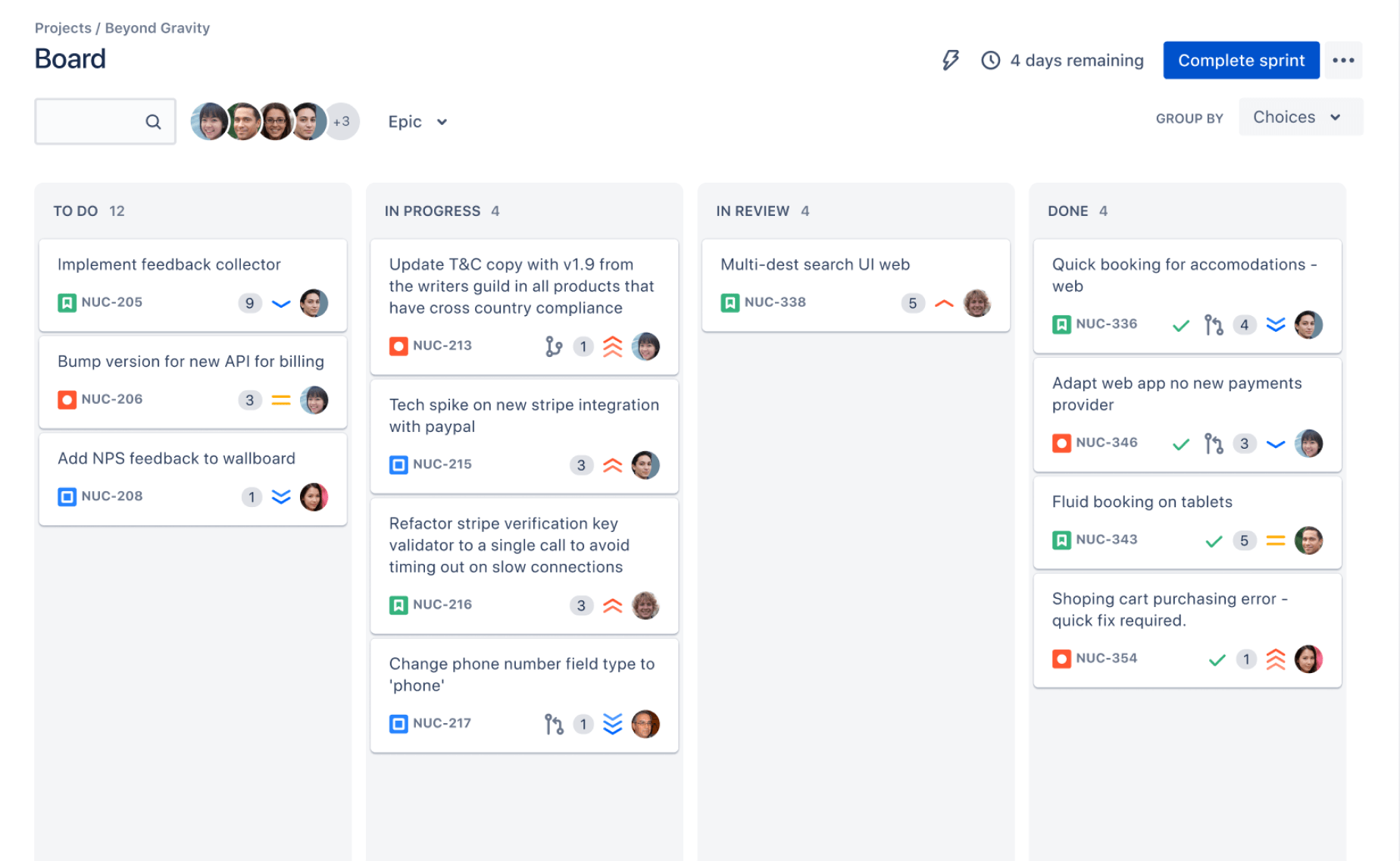
Jira Free is designed for small teams exploring the platform or managing relatively simple work. The commonly advertised limit is up to 10 users for Jira Cloud, although Atlassian can revise plan limits.
You may receive core issue tracking, basic project management, standard workflows, and limited storage. The trade-off is tighter control over permissions, administration, automation, support, and reporting.
For example, a five-person product team can use Free for a basic backlog, sprint board, and bug queue. A 15-person department cannot rely on that same allowance without moving to a paid tier.
What changes when you choose Standard
Standard is usually the practical starting point for a growing team. It provides more room for collaboration, administration, automation, storage, and access management than Free.
Atlassian commonly positions Jira Standard with expanded storage and support compared with the free tier. The exact allowance and included features should be checked on the official plan comparison page before purchase.
Standard can suit a software team with several squads, a marketing department coordinating campaigns, or an operations group that needs controlled access for many participants.
When Premium may justify the higher cost
Premium is intended for teams that need greater scale, more advanced planning, and stronger service commitments. It can also support organizations coordinating work across multiple teams or projects.
Typical Premium considerations include advanced planning capabilities, higher availability commitments, expanded administration, and larger operational capacity. The value depends on whether your team will actively use those features.
If your only need is a shared backlog and a few workflows, Premium may be unnecessary. If several teams need coordinated planning across dependencies, the additional cost may be easier to justify.
How Enterprise pricing works
Enterprise pricing is generally handled through a customized commercial agreement rather than a simple public per-seat checkout price. The amount can depend on the products included, the scale of the organization, contract terms, and administration requirements.
Enterprise may appeal to companies needing centralized governance, advanced security controls, consolidated management, and broader Atlassian platform adoption.
You should request a tailored quote when your organization needs several products, multiple business units, or formal procurement review.
How to Calculate Your Real Jira Subscription Cost
The number shown beside a plan is only the starting point. Your actual bill can include seats, billing frequency, taxes, separate products, Marketplace apps, and changes made during the subscription period.
- Count every planned seat. Include developers, product managers, testers, administrators, contractors, and occasional contributors who need access.
- Choose the required product. Jira, Jira Product Discovery, and Jira Service Management have different purposes and pricing structures.
- Select the minimum suitable tier. Compare required features rather than choosing Premium because it sounds safer.
- Compare monthly and annual billing. Check the current Atlassian calculator because eligibility, payment timing, and discounts can vary.
- Add extra products and apps. Confluence, Jira Service Management, Marketplace extensions, and other Atlassian subscriptions can create separate charges.
- Include taxes and currency conversion. Your final checkout amount may differ from the displayed pre-tax estimate.
- Model future growth. Calculate the cost at your current headcount and at the expected headcount six or 12 months later.
Here's why seat planning matters: many teams calculate for the people creating work but forget the people reviewing, approving, testing, or reporting on it.
For example, a 12-person engineering team may need access for four product managers, two testers, and three business stakeholders. The bill should reflect the actual access requirement, not only the engineering headcount.
A simple planning formula
You can use this formula before opening the Atlassian calculator:
Estimated subscription cost = plan cost for required seats + separate product costs + app costs + taxes and currency charges.
Do not treat this as a final quote. It is a planning method that helps you identify missing cost categories before approval.
What Makes Jira Pricing Change as Your Team Grows?
Jira Cloud pricing usually follows a tiered seat model. The per-seat amount may become more efficient at larger volumes, but the total subscription still increases as more people receive access.
Atlassian may also calculate charges using billing rules that differ between monthly and annual subscriptions. Check how seat changes, upgrades, downgrades, and prorated adjustments are handled for your specific agreement.
But here's the truth: growth can change your plan in two ways. You may add more seats, and you may also need a more advanced tier.
| Growth stage |
Likely pricing question |
What to review |
| Small trial team |
Can the free allowance support the pilot? |
Seat limit, storage, support, and administration |
| Growing department |
Is Standard enough for everyday delivery? |
Permissions, automation, reporting, and access controls |
| Several coordinated teams |
Will Premium improve planning and scale? |
Cross-team planning, service commitments, and governance |
| Large enterprise |
Do we need a negotiated agreement? |
Central administration, procurement, security, and product coverage |
Seat count is not the same as active participation
A person may open Jira only once a week and still require a paid seat. Reviewers, executives, clients, and business partners can affect your count even when they create few issues.
Before purchasing, classify people by access requirement. Some may need full project access, while others may only need reports, email updates, or occasional visibility.
Plan upgrades can follow process complexity
A team may outgrow Free because of workflow complexity rather than headcount. More approval stages, controlled permissions, audit requirements, or cross-team dependencies can make a higher plan more useful.
For instance, a 20-person compliance team may need stricter project access and reporting even if it creates fewer issues than a larger engineering department.
Jira Product Costs Beyond the Main Subscription
Jira is only one part of the Atlassian ecosystem. You should distinguish Jira Software capabilities from Jira Service Management, Jira Product Discovery, Confluence, and other products before comparing quotes.
Each product can have its own plan, seat model, and billing arrangement. A team might pay for Jira project management, Confluence knowledge sharing, and Jira Service Management service workflows at the same time.
Marketplace apps and integrations
Marketplace apps can extend time tracking, testing, reporting, roadmaps, asset management, approvals, and automation. They can also become a meaningful part of the annual budget.
List every required app before approving Jira. An extension costing a modest monthly amount per seat can become expensive across hundreds of accounts.
Ask three questions for each app:
- Which business problem does it solve?
- Can Jira or another Atlassian product handle the requirement natively?
- What happens to the subscription cost when the team doubles?
Support, administration, and governance
Lower tiers may be suitable for teams that can manage workflows and access rules internally. Larger organizations may value stronger administrative controls, service commitments, and structured support.
The right comparison is therefore more than “cheap versus expensive.” It is the cost of the plan compared with the time and operational risk your team accepts at that level.
Cloud, Data Center, and Deployment Choices
Atlassian product pricing depends partly on deployment model. Jira Cloud is hosted by Atlassian, while self-managed options have different commercial and operational considerations.
Cloud pricing is commonly easier to forecast because it is presented as a recurring subscription. Self-managed deployments can involve licenses, infrastructure, upgrades, backups, security operations, and specialist administration.
Cloud subscription considerations
Cloud can reduce the technical work required to run the platform. You still need to assess identity management, integrations, permissions, retention, regional requirements, and app compatibility.
For a 30-person team without dedicated platform administrators, the reduced infrastructure responsibility may be more valuable than a lower headline license amount.
Self-managed deployment considerations
Self-managed Jira can provide greater control over hosting and internal operations. However, the subscription or license is only one part of the total cost.
Budget for hosting, monitoring, backups, patching, disaster recovery, security reviews, and internal support. A lower license price does not automatically mean a lower ownership cost.
How to compare deployment options fairly
Compare three-year ownership rather than the first invoice. Include platform administration, infrastructure, implementation, app maintenance, training, and migration work.
You might find that Cloud costs more per month but requires less internal maintenance. Another organization may accept more operational work because it has strict hosting requirements or an established infrastructure team.
How to Verify the Official Atlassian Price Before Buying
The safest approach is to use the official Atlassian pricing page, select the exact product, enter your expected seat count, and review the plan comparison before checkout.
- Open the Atlassian pricing area for the product you need.
- Confirm whether you are comparing Jira, Jira Service Management, or another product.
- Enter the expected number of seats.
- Compare Free, Standard, Premium, and Enterprise where available.
- Review included features, storage, support, administration, and service commitments.
- Switch between monthly and annual billing to see the current difference.
- Check taxes, currency, payment terms, and renewal conditions.
- Review every Marketplace app and integration separately.
- Save the checkout estimate and record the date you checked it.
You might be wondering: why record the date? Pricing pages change. A dated estimate gives your finance or procurement team a clear reference during approval.
Do not rely on an old screenshot or a third-party calculator. Use the current Atlassian pricing interface for the final amount and confirm any enterprise quote in writing.
Natural Jira Pricing Solution: ONES.com
Value Proposition
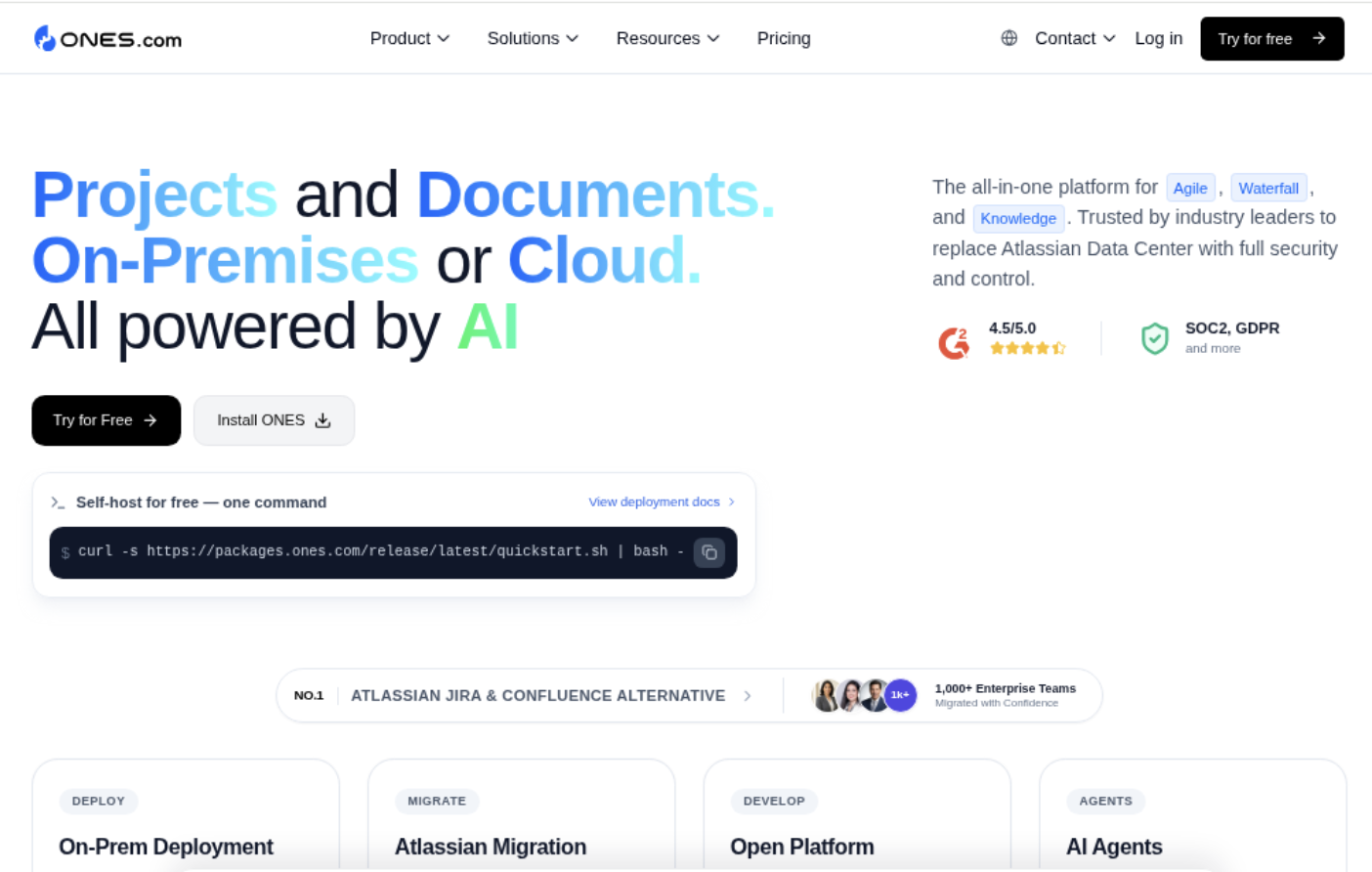
ONES.com is a unified platform for project management and knowledge management. ONES Project provides project management capabilities and can serve as a Jira alternative, while ONES Wiki supports knowledge management as a Confluence alternative.
ONES Project and ONES Wiki are sold separately. ONES.com offers a free plan for up to 30 seats and supports Cloud, On-Premise, Private Cloud, and Air-gapped deployments.
Core Capabilities
1. Need a Jira-compatible project workflow
ONES capability: ONES Project supports Jira-compatible workflows for teams moving from Jira or evaluating another project platform.
Result: Your team can preserve familiar issue-based planning while assessing a different subscription and deployment approach.
2. Need to reduce scattered project tools
ONES capability: ONES.com brings project management and knowledge management into one platform family, with ONES Project and ONES Wiki available separately.
Result: You can evaluate project delivery and team knowledge needs together rather than coordinating unrelated platforms.
3. Need custom workflows and fields
ONES capability: ONES Project supports custom workflows and custom fields for teams with specialized delivery stages.
Result: A product team, operations group, or compliance function can model its actual approval path instead of forcing every task into a generic process.
4. Need sprint management
ONES capability: Sprint management supports iterative planning for teams working in Scrum-style cycles.
Result: Teams can organize backlogs, plan sprint work, and review delivery progress in a familiar project workflow.
5. Need built-in reporting
ONES capability: ONES Project includes built-in reporting for monitoring project progress and delivery activity.
Result: Project leads can review performance without depending on as many reporting extensions.
ONES capability: Automation helps teams trigger routine actions within project processes.
Result: Repetitive transitions and administrative steps can require less manual attention.
7. Need self-hosted deployment
ONES capability: ONES.com supports On-Premise, Private Cloud, and Air-gapped deployments, with feature parity between cloud and self-hosted versions.
Result: Organizations with restricted networks or specific hosting requirements can evaluate a deployment that fits their operating environment.
8. Need to limit extension sprawl
ONES capability: Native workflows, fields, sprint management, reporting, and automation reduce reliance on separate plugins for common project needs.
Result: You can compare the platform cost with a Jira subscription plus several extensions instead of comparing headline license prices alone.
Application Scenarios
Growing software team: A 25-person engineering organization can use project workflows, sprint management, custom fields, and reporting while evaluating a 30-seat free allowance or a paid plan as the team expands.
Restricted-network organization: A defense, manufacturing, or regulated team can assess an air-gapped or on-premise deployment when public-cloud hosting does not fit its requirements.
Multi-team delivery group: A company coordinating product, engineering, and operations can compare native project capabilities with the combined cost of Jira, reporting apps, workflow extensions, and a separate knowledge platform.
Common Challenges When Comparing Jira Plans
Challenge: confusing product names
Problem: Jira, Jira Service Management, Jira Product Discovery, and Confluence solve different problems, so a comparison can become misleading.
Solution: Write down the work you need to manage first. Then match each requirement to the correct Atlassian product before reviewing price.
Challenge: calculating only the current team size
Problem: A plan may fit today but become expensive after hiring, acquisitions, or wider stakeholder access.
Solution: Model current seats, expected seats, and a higher-growth scenario. Use the same scenarios for every platform you compare.
Challenge: overlooking app charges
Problem: Reporting, testing, time tracking, and approval needs can lead to several additional subscriptions.
Solution: Create an app register with the monthly price, seat basis, renewal date, and business owner for every extension.
Challenge: choosing Premium for unused features
Problem: Teams sometimes select a higher tier because it offers more capabilities, even when those capabilities do not affect their work.
Solution: Tie each upgrade to a specific requirement, such as cross-team planning, advanced administration, or service commitments.
Challenge: treating the first quote as permanent
Problem: Prices, plan limits, taxes, and commercial terms can change before renewal.
Solution: Record the pricing date, renewal terms, included allowances, and seat assumptions. Recheck them before signing and before renewal.
FAQs About Atlassian Jira Pricing
Is Jira free for small teams?
Jira Cloud has a Free plan intended for small teams, commonly supporting up to 10 users within defined limits. Free access can include core project tracking, but storage, administration, automation, support, and permissions are more limited than paid tiers. Check the current Atlassian plan page because allowances can change.
What is the difference between Jira Standard and Premium?
Standard is generally aimed at growing teams that need everyday project management with more capacity and administration than Free. Premium adds capabilities for larger-scale planning, coordination, service expectations, and advanced operational needs. Compare the current feature list against your requirements before paying for Premium.
Does Jira charge per user?
Jira Cloud pricing is generally tied to the number of seats, although the exact calculation can depend on the product, billing cycle, and pricing tier. A person may count as a seat even if they rarely create work. Check the current calculator and clarify how additions, removals, and prorated changes affect your subscription.
Are Jira Marketplace apps included?
Marketplace apps are generally separate from the core Jira subscription. Each app can have its own pricing model, seat calculation, billing cycle, and renewal terms. Review app costs alongside the Jira plan, especially for reporting, testing, time tracking, approvals, and asset management.
Is annual Jira billing cheaper than monthly billing?
Annual billing may offer different pricing or payment terms from monthly billing, but the result depends on the product, seat tier, and current Atlassian rules. Compare both options using the official calculator. Also consider whether your team expects major seat changes during the contract period.
Should I compare Jira with another project platform?
Yes, especially when your cost includes several extensions, separate knowledge management, or complex hosting requirements. Compare the total operating cost, including seats, apps, administration, deployment, migration, and training. ONES Project is one Jira alternative worth evaluating when native workflows, self-hosting, and reduced plugin dependence matter.
Conclusion
Jira pricing on Atlassian depends on more than the plan label. Your real cost comes from the tier, seat count, billing cycle, product selection, apps, taxes, deployment model, and future growth.
Start with the official Atlassian calculator, compare Free, Standard, Premium, and Enterprise against specific requirements, and check every additional subscription. Then model the cost at your current size and expected growth level.
But here's the practical takeaway: a lower starting price can become expensive when seats and extensions accumulate. A higher plan can be sensible when it removes operational work your team would otherwise manage manually.
If your evaluation includes Jira alternatives, compare ONES Project alongside the complete Jira setup rather than the core subscription alone. The fairest decision considers workflow fit, native capabilities, deployment options, administration, and long-term ownership cost.