Jira Pricing Options Explained: A Clear Guide for Teams
Confused by jira pricing options? Compare plans, user bands, billing, and features to choose the right fit for your team. Click to discover!
Jira can look affordable at first glance, then become harder to budget as your team grows. Different plans, user bands, billing cycles, and product editions can change the final amount.
That uncertainty creates real problems. You might compare only the advertised starting price and miss automation limits, advanced reporting, administration controls, or the cost of extra products.
But here's the truth: the right Jira pricing option depends on how your team works, how many people need access, and which controls your projects require.
This guide explains Jira’s main plans, hidden cost drivers, billing choices, and practical alternatives. You’ll see how to estimate your total spend before committing.
Jira Pricing Options at a Glance
Jira generally offers Free, Standard, Premium, and Enterprise plans. Your total cost depends on the product, number of users, billing cycle, and advanced features you need.
- Free: Suitable for small teams testing Jira or managing simple projects.
- Standard: Designed for growing teams that need more users, permissions, support, and administration.
- Premium: Built for organizations needing stronger planning, scale, reliability, and advanced controls.
- Enterprise: Intended for large organizations with complex governance, multiple teams, and centralized administration.
Jira pricing can also differ between Jira Software, Jira Service Management, and other Atlassian products. Each product has its own plans and usage rules.
Here's why: a team may use Jira Software for product development and Jira Service Management for internal support. Those subscriptions can create separate charges.
What Each Plan Usually Includes
| Plan |
Best fit |
Typical reason to choose it |
| Free |
Small teams and trials |
Basic project tracking with limited administration and usage thresholds |
| Standard |
Growing project teams |
Higher limits, broader permissions, and more dependable team administration |
| Premium |
Complex or large-scale teams |
Advanced planning, higher capacity, stronger service commitments, and additional controls |
| Enterprise |
Large organizations |
Organization-wide governance, centralized management, and commercial flexibility |
Feature availability and limits can change over time. Check the current Atlassian pricing page before signing a contract or approving a budget.
How to Calculate Your Real Jira Cost
-
Choose the Jira product you actually need
Start by identifying the work you want to manage. Jira Software supports development and product workflows. Jira Service Management focuses on requests, incidents, changes, and support operations.
A software team may need sprint planning and release tracking. An IT team may need request portals, service queues, and incident workflows.
-
Count every person who needs access
Estimate licensed users rather than counting only full-time employees. Include contractors, product managers, testers, service agents, and occasional contributors.
For example, a 20-person engineering group might also include five product specialists and ten support staff. Your actual licensing needs could exceed the engineering headcount.
-
Compare monthly and annual billing
Monthly billing gives you flexibility when team size changes. Annual billing can simplify forecasting and may provide different commercial terms.
Calculate both options using your expected user count. A small monthly saving can become meaningful across several products and hundreds of seats.
-
Match features to your operating model
List the capabilities your team needs before selecting a plan. Consider automation, permissions, audit controls, reporting, planning, support, and administrative visibility.
A small team may manage comfortably with basic workflows. A regulated organization may need advanced governance and stronger administrative controls.
-
Include connected products and services
Jira may sit alongside Confluence, Jira Service Management, marketplace apps, identity services, and collaboration tools.
Review each subscription separately. An inexpensive Jira plan can become costly when several paid extensions are added for essential functions.
-
Model future growth
Estimate your likely users six and twelve months ahead. Moving between tiers can affect workflows, permissions, training, and administration.
For instance, a team with 40 users today may reach 90 users after a new product launch. Choose a plan that remains practical during that expansion.
Jira Free Plan: When It Makes Sense
The Free plan is useful when you are exploring Jira, managing a small group, or coordinating a straightforward project with limited administration needs.
You can use it to test issue tracking, basic workflows, backlog management, and team collaboration. It also gives decision-makers a practical way to evaluate Jira before purchasing.
Good use cases for the free tier
- A startup with a small product team
- A student or community project
- A temporary planning group
- A pilot before wider adoption
- A simple backlog with limited workflow complexity
But here's the catch: free plans often include limits around users, storage, permissions, support, automation, or administration. Those limits may become visible only after your team’s process grows.
Imagine a team that starts with ten people and one workflow. Six months later, it needs multiple project roles, approval rules, and detailed reporting. The free tier may no longer support that operating model comfortably.
Standard Jira Pricing for Growing Teams
Standard plans usually fit teams that have moved beyond experimentation. They often provide more room for users, permissions, administration, and daily project operations.
This tier can work well for a product organization with several squads, a marketing department with recurring campaigns, or an operations group coordinating cross-functional work.
What to evaluate before choosing Standard
- How many users can the plan support?
- Does it provide the permissions your project roles require?
- Are automation limits sufficient for routine work?
- Can administrators manage several projects efficiently?
- Does reporting cover your leadership needs?
- What support channels are included?
Here's an example. A team may automate status updates, assign reviewers, and notify stakeholders. If those rules consume a monthly automation allowance, the team must understand that limit before relying on them.
Standard is often the practical middle ground. It provides more structure without requiring every team to adopt enterprise-level administration.
Premium and Enterprise Plans Compared
Premium and Enterprise plans target organizations with greater scale, stronger governance, or more demanding operational requirements.
When Premium becomes relevant
Premium may suit teams that need advanced planning, higher capacity, improved reliability, or additional tools for managing complex work across projects.
A product organization coordinating several releases may value cross-team planning. A global operations group may prioritize service commitments and stronger controls.
When Enterprise becomes relevant
Enterprise usually fits organizations managing many teams, business units, or geographic regions. Central administrators may need consistent policies across a large Jira environment.
Enterprise discussions often involve commercial terms, identity management, governance, security reviews, procurement, and organization-wide administration.
| Question |
Premium consideration |
Enterprise consideration |
| Team structure |
Several connected teams or projects |
Many departments and business units |
| Administration |
Advanced controls for larger operations |
Centralized governance across the organization |
| Planning |
More advanced coordination and capacity needs |
Portfolio-level visibility across major groups |
| Commercial process |
Usually straightforward subscription management |
May involve negotiated agreements and procurement review |
You might be wondering: do you need Enterprise simply because your company is large? Not necessarily. Your operating complexity matters more than headcount alone.
Cloud, Data Center, and Self-Hosted Cost Differences
Jira Cloud uses a recurring subscription managed through Atlassian’s hosted environment. Data Center involves self-managed deployment and different infrastructure responsibilities.
Cloud pricing is easier to forecast because hosting and much of the platform maintenance sit within the subscription. Self-hosted deployment requires you to consider infrastructure, administration, upgrades, backups, and security operations.
Questions for a deployment comparison
- Who will maintain the environment?
- Does your organization require internal hosting?
- How much engineering time will upgrades consume?
- What availability and recovery standards apply?
- Will your security team approve a hosted environment?
A cloud subscription might appear more expensive than a license viewed alone. However, internal maintenance can add labor and infrastructure costs to a self-hosted deployment.
Conversely, a self-managed environment may make sense when regulatory obligations, network restrictions, or internal control requirements are especially strict.
Common Costs That Change Your Jira Budget
The advertised plan price is only one part of your calculation. Several practical factors can move the final budget.
User growth
Many subscription plans use progressive user bands. Adding a few people can move your organization into a higher pricing bracket.
Marketplace applications
Teams often add testing, time tracking, reporting, planning, or workflow applications. Each application can have its own pricing model and user calculation.
Multiple products
Jira Software and Jira Service Management solve different problems. Using both can make the overall Atlassian subscription substantially larger.
Administration and migration
Implementation may require consulting, workflow redesign, migration support, training, and ongoing administration. These expenses may sit outside the subscription itself.
Premium capabilities
Advanced planning, stronger governance, higher limits, and expanded controls can justify a higher tier. They also need to solve a real operational problem.
The best part? You can reduce surprises by creating three estimates: today’s cost, expected cost after growth, and cost with the applications your team considers essential.
How to Compare Jira With Other Project Platforms
A useful comparison looks beyond the monthly subscription. Consider workflow flexibility, reporting, administration, deployment choices, integration needs, and the time required to maintain the system.
For example, a platform with a lower license price may require several add-ons. Another platform may include more capabilities natively, reducing integration work and administrative overhead.
| Comparison area |
Questions to ask |
| Core planning |
Can teams manage backlogs, sprints, milestones, and dependencies? |
| Workflow design |
Can you create the approval and status paths your teams actually use? |
| Reporting |
Are useful dashboards and reports available without extra purchases? |
| Administration |
Can a small administrative team manage users, roles, and projects? |
| Deployment |
Does the platform support cloud, private hosting, or restricted environments? |
| Total ownership |
What will licenses, applications, maintenance, training, and migration cost together? |
Use a weighted comparison when several factors matter. Give security, workflow fit, and administration higher scores if they affect business continuity.
ONES.com combines project management and knowledge management through separate products. ONES Project supports project planning and execution, while ONES Wiki supports team knowledge management.
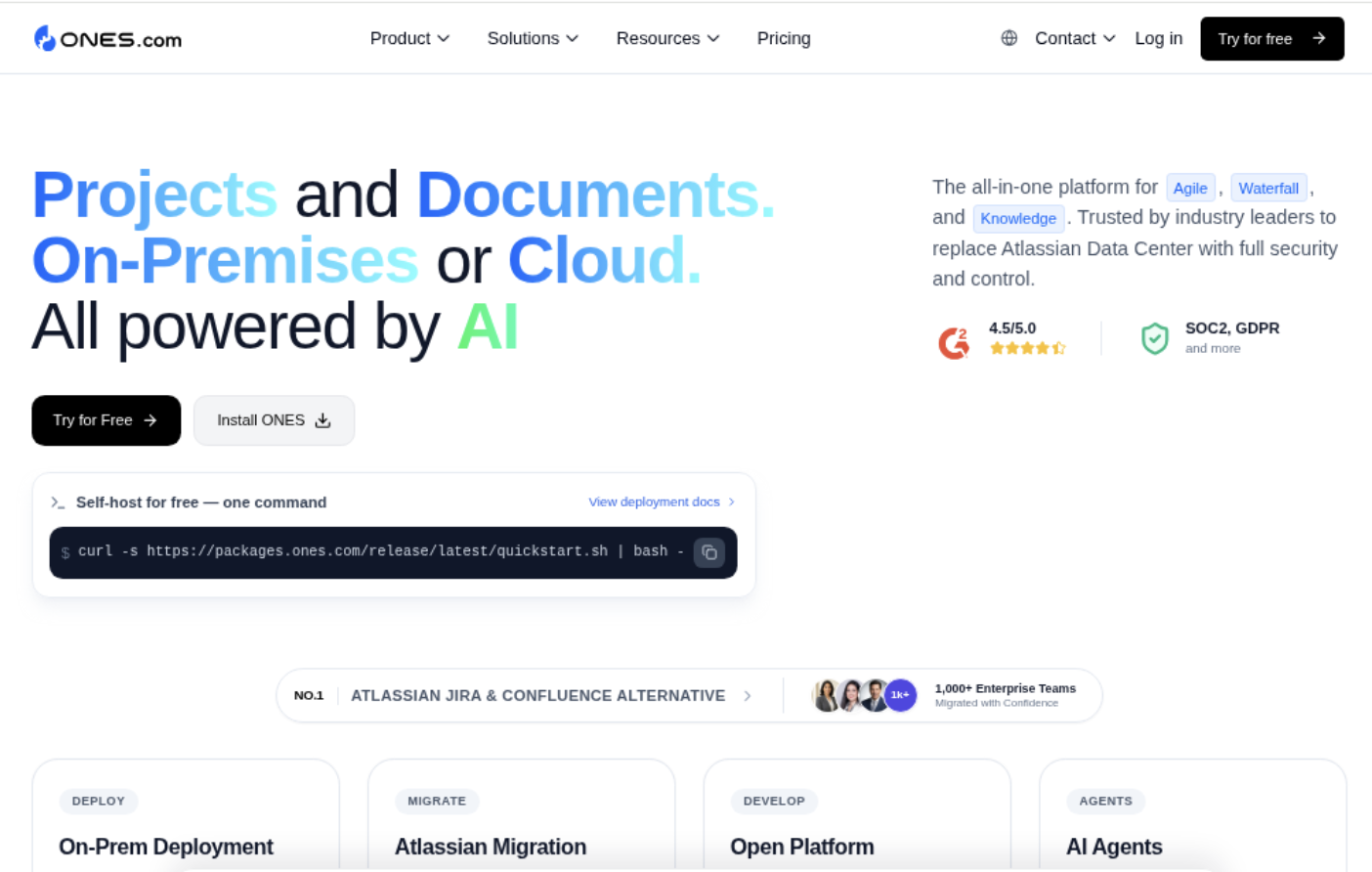
For teams evaluating a Jira alternative, ONES Project offers Jira-compatible workflows, reporting, custom fields, sprint management, and automation. You can deploy ONES.com in the cloud, on-premise, private cloud, or air-gapped environments.
Value Proposition
ONES.com can help teams reduce platform sprawl when they need structured project work, shared knowledge, and flexible deployment options. ONES Project and ONES Wiki are sold separately, allowing you to select the product that matches your immediate needs.
Core Capabilities
- Complex workflow pain: ONES Project provides custom workflows and fields. Teams can reflect approval paths, development stages, and operational responsibilities more accurately.
- Limited planning visibility: Sprint management and built-in reporting help teams connect daily work with milestones, progress, and delivery trends.
- Plugin dependency: Native project capabilities can reduce the number of separate extensions needed for common planning and reporting requirements.
- Restricted network requirements: Air-gapped, on-premise, and private cloud deployment options support environments with strict network or control requirements.
- Migration concerns: Jira-compatible workflows can make it easier for teams familiar with Jira practices to evaluate a transition.
- Inconsistent access controls: Custom administration options help organizations align project access with team roles and responsibilities.
- Scattered team knowledge: ONES Wiki provides a knowledge management environment for procedures, guidance, and internal reference material.
- Separate deployment expectations: ONES.com maintains feature parity between cloud and self-hosted versions, giving teams more flexibility when selecting an environment.
- Early-stage budget pressure: The free offering supports up to 30 seats, giving smaller teams room to assess the platform before wider adoption.
Application Scenarios
Software product team: A development group can use ONES Project for backlog planning, sprint execution, custom workflows, and reporting. Product guidance can live in ONES Wiki when that separate product is selected.
Regulated engineering organization: A team with strict network controls can evaluate an on-premise or air-gapped deployment. This approach keeps the operating environment aligned with internal security requirements.
Growing delivery organization: Several squads can standardize workflows and reporting while administrators manage access across projects. The organization can begin with up to 30 free seats and review broader adoption later.
Common Challenges When Choosing a Jira Plan
Challenge: estimating the wrong user count
Teams often count only employees who create issues. They later add managers, reviewers, contractors, or support contributors.
Solution: Map each role to the access it needs. Separate full contributors from people who only require limited visibility or approval access.
Challenge: overlooking add-on costs
An application may solve an important problem, yet several additions can change your total budget quickly.
Solution: Build an application register before selecting a plan. Record each tool’s pricing model, user calculation, renewal date, and business owner.
Challenge: upgrading for features nobody uses
Teams sometimes choose Premium or Enterprise because the plan sounds safer. Unused capabilities then add recurring expense without improving delivery.
Solution: Link every advanced feature to a measurable need. For example, choose advanced planning because several teams need dependency visibility.
Challenge: ignoring administrative effort
A platform can meet feature requirements while creating significant work for administrators.
Solution: Estimate time for access reviews, workflow maintenance, training, reporting, and support. Include that effort in your ownership comparison.
Challenge: treating current needs as permanent
Your team structure, project volume, and compliance requirements can change during the subscription period.
Solution: Review your plan quarterly. Track user growth, automation consumption, application usage, and workflow complexity.
FAQs About Jira Pricing
Is Jira free for small teams?
Jira offers a Free plan for eligible small teams. The plan can support basic project tracking and early evaluation, though limits may apply to users, storage, automation, administration, and support. Review the current terms before relying on it for a long-term operating model. A growing team may eventually need Standard or a higher tier.
What is the difference between Jira Standard and Premium?
Standard generally supports regular project management for growing teams. Premium adds capabilities for more complex planning, scale, reliability, or administration. The right choice depends on your workflows and operating requirements. Compare the features and limits that affect your team directly, rather than choosing a tier only because it has a higher label.
Does Jira charge per user?
Jira subscriptions commonly use user-based pricing, with the final amount affected by plan, product, user band, and billing cycle. Some products can apply different rules, especially service-focused offerings. Count everyone who needs access, including occasional contributors and administrators. Then model how the cost changes when your team reaches its expected growth level.
Are Jira marketplace apps included?
Marketplace applications are generally separate subscriptions. They may use their own pricing, user bands, billing terms, and feature limits. Before adding an application, calculate its recurring charge and assess whether Jira already provides a native capability. Several small additions can create a meaningful annual expense when combined across a large team.
Should I choose monthly or annual Jira billing?
Monthly billing can suit teams with uncertain headcount or short projects. Annual billing may simplify procurement and forecasting when your user count is stable. Compare both options using realistic growth assumptions. Include every related product and application, because the billing decision can affect your broader collaboration environment rather than one Jira subscription alone.
Conclusion
Jira pricing options become easier to evaluate when you separate product choice, user count, plan features, deployment, applications, and growth.
Start with the Free plan for a small trial, consider Standard for everyday team operations, and evaluate Premium or Enterprise when scale and governance justify them.
But here's the truth: the cheapest subscription is not always the lowest-cost operating choice. Add-ons, administration, migration, and maintenance can change the outcome.
Use a three-stage estimate, compare the full ownership picture, and test each requirement against a real team scenario. If Jira’s structure or deployment model does not fit, evaluate alternatives such as ONES.com and ONES Project through the same practical lens.