Jira Pricing Plans: A Practical Cost Guide for Teams [2026]
Wondering which jira pricing plan fits your team? Compare 2026 costs, tiers, and real-world estimates—click to find the best value.
Choosing a Jira pricing plan can look simple until you add real teammates, contractors, automation, storage, support, and multiple projects. A plan that seems affordable for five people may cost much more when your team reaches 50.
The confusion grows because Jira pricing depends on user count, billing frequency, product edition, and advanced features. Premium capabilities can also change how much value you receive from each seat.
But here's the truth: you can estimate your likely Jira cost before committing. This guide explains the main plans, shows practical calculations, and highlights the hidden costs that often affect project teams.
Jira Pricing Plans at a Glance
A Jira pricing plan is a subscription tier that determines which Jira features your team receives and how much you pay for access. Jira generally offers Free, Standard, Premium, and Enterprise options.
| Plan |
Best for |
Typical characteristics |
Pricing approach |
| Free |
Small teams and trial projects |
Core issue tracking, limited users, basic collaboration |
No subscription charge within the plan limits |
| Standard |
Growing teams |
More users, permissions, administration, and collaboration controls |
Per-user subscription |
| Premium |
Teams managing complex delivery |
Advanced planning, automation capacity, reporting, and reliability features |
Higher per-user subscription |
| Enterprise |
Large organizations |
Central administration, governance, scale, and enterprise support |
Custom quote |
Jira prices can change by region, billing term, product configuration, and commercial updates. Treat published examples as planning figures, then confirm the amount in Atlassian’s current pricing calculator before purchasing.
Free plan
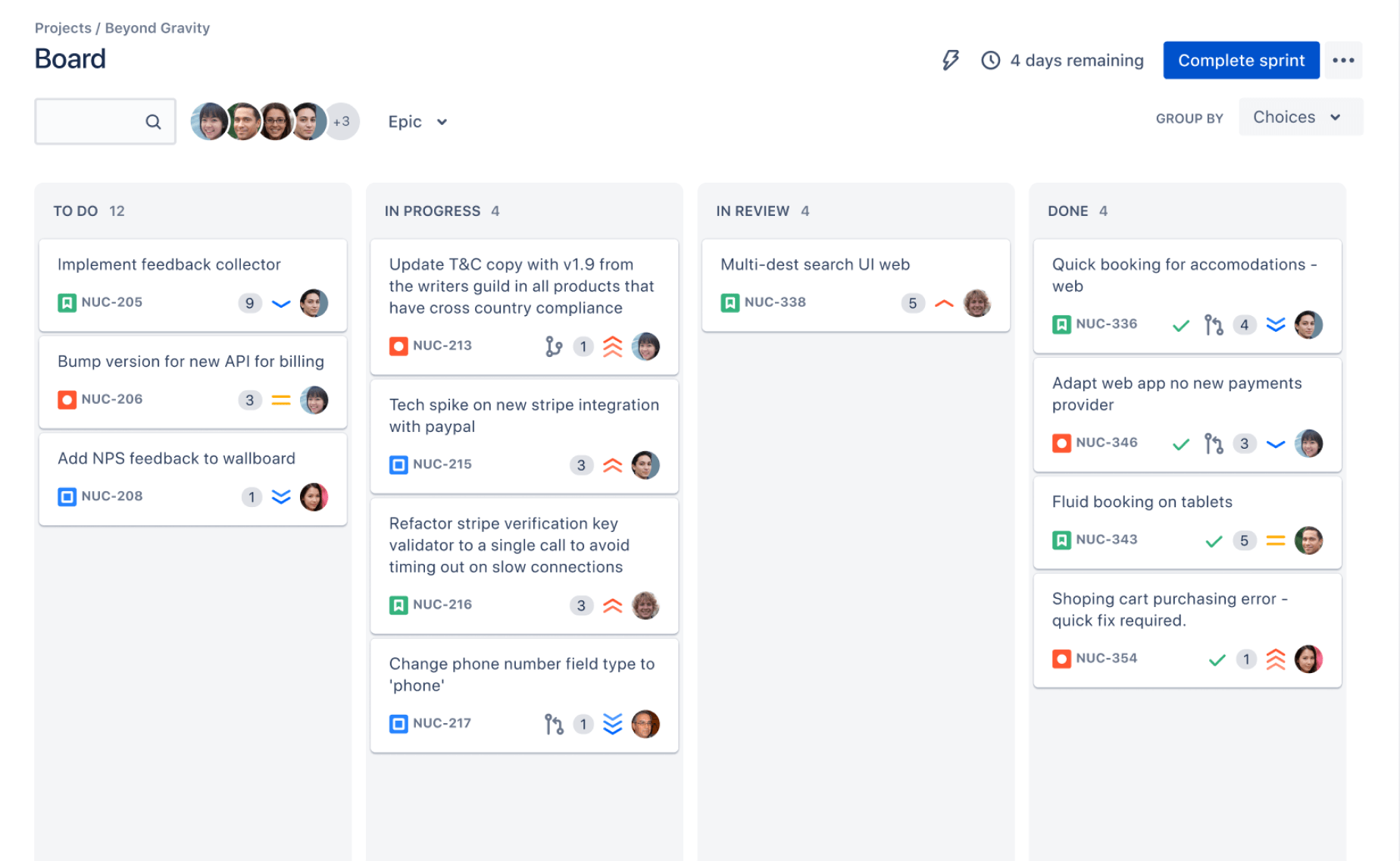
The Free plan usually suits small teams that need basic task and issue tracking. It can support a simple product backlog, sprint board, workflow, and team discussion.
For example, a five-person startup could use Free while validating its working process. The plan becomes restrictive when you need more users, advanced controls, higher automation capacity, or stronger administration.
Standard plan
Standard is often the practical starting point for an established team. It typically adds broader collaboration, permission controls, administrative features, and higher operating limits.
A 20-person software team may prefer Standard because the monthly cost remains manageable while the team gains more room for projects, workflows, and integrations.
Premium plan
Premium targets teams that need more scale and advanced delivery capabilities. Depending on the product configuration, this tier can include advanced planning, increased automation, enhanced reliability, and stronger operational controls.
A product organization running several releases at once may value Premium because coordination costs can exceed the subscription difference between Standard and Premium.
Enterprise plan
Enterprise is designed for large organizations with complex governance, multiple departments, and substantial administration needs. Pricing is usually customized rather than displayed as one public per-user figure.
Enterprise pricing may reflect user volume, product coverage, support requirements, security expectations, and commercial terms. You should request a tailored estimate when several business units share one environment.
How Jira Costs Are Calculated
Your bill usually depends on more than the label of the plan. Start with the number of billable users, then consider the subscription term, product combination, add-ons, and any additional services.
The basic calculation
Use this simple formula:
Estimated subscription cost = plan price per user × billable users × billing period
Imagine a team of 25 people paying an illustrative $8 per user each month. The monthly estimate would be $200, and the annual estimate would be $2,400 before taxes, discounts, or other products.
This example shows why headcount matters. Adding 10 people at the same rate creates another $80 in monthly subscription cost.
Monthly versus annual billing
Monthly billing gives you flexibility when team size changes frequently. It can suit a startup, a temporary program, or a team still testing Jira.
Annual billing can offer easier budgeting and sometimes a different commercial rate. It also creates a longer commitment, so estimate your likely headcount for the full term.
You might be wondering: should you count every person in the company? Usually, you should count people who need access to the Jira environment. Occasional viewers may still require a licensed role, depending on the setup.
Tiered pricing and user bands
Some cloud subscriptions use user bands instead of a perfectly linear per-person calculation. A team near a pricing threshold could pay differently after adding one person.
For example, moving from 10 to 11 users may place you in a new band. Check the current calculator rather than multiplying an old per-user figure.
Practical Jira Cost Examples
Concrete scenarios make the plan differences easier to understand. The figures below are planning illustrations, not guaranteed quotes.
| Team profile |
Likely starting point |
Main cost question |
What to test |
| 5-person startup |
Free or Standard |
Will the team exceed free limits soon? |
Permissions, automation, and growth capacity |
| 20-person product team |
Standard |
Are advanced planning features necessary? |
Cross-team planning and reporting |
| 75-person engineering organization |
Standard or Premium |
Does Premium reduce coordination work? |
Automation, release planning, and administration |
| 1,000-person enterprise |
Enterprise |
How should governance work across departments? |
Security, support, administration, and scale |
Example: a small startup
Five people may begin with Free while they create a backlog and test sprint routines. If the team adds outside specialists, the access limit may become the first pressure point.
Moving to Standard makes sense when permissions, administration, or collaboration limits start slowing delivery. The right decision depends on expected growth, not only today’s headcount.
Example: a 30-person product group
A 30-person group may include engineers, product managers, designers, testers, and delivery leaders. If everyone needs access, seats can become the largest cost component.
At this size, compare Standard and Premium using workload examples. Calculate the time saved through better planning, automation, and visibility. A higher subscription can be reasonable when it removes repeated coordination work.
Example: a distributed enterprise
An enterprise may have several teams with different workflows, permission models, and reporting requirements. The subscription cost is only one part of the financial decision.
Administration time, onboarding effort, governance, support, integrations, and migration work can influence the total cost more than a small plan difference.
Features That Change the Value of Each Plan
Price matters, but capability determines whether the subscription helps your team. Compare the work you need to perform rather than comparing plan labels alone.
Automation capacity
Automation can assign issues, update fields, send notifications, and move work through a workflow. Higher limits matter when many projects run rules every day.
For example, a team that automatically routes 500 incoming requests needs more capacity than a team using two simple reminders.
Planning and portfolio visibility
Basic boards can support one team. Larger organizations often need planning across products, releases, dependencies, and multiple delivery groups.
Premium becomes more valuable when leaders need a consolidated view without asking every team for a separate status update.
Permissions and administration
As more people join, access control becomes important. You may need different roles for engineers, contractors, business stakeholders, and administrators.
Clear permissions reduce accidental changes and help people see the work relevant to their responsibilities.
Reporting and dashboards
Reporting helps you inspect cycle time, backlog health, throughput, sprint performance, and delivery risks. A dashboard becomes useful when it answers a recurring question.
For example, a release manager may need to see unresolved high-priority issues, blocked work, and progress toward a launch date in one place.
Reliability and support expectations
Teams with customer-facing systems may place a high value on reliability commitments and support options. A lower subscription can become expensive when interruptions delay a release.
Compare the operational consequences of each plan before choosing based only on the monthly amount.
Hidden Costs to Include in Your Budget
The subscription is easy to see. The surrounding work is easier to overlook. A realistic budget includes both direct charges and the effort required to operate the environment.
Add-ons and integrations
Teams often connect Jira with testing, reporting, time tracking, design, communication, or deployment tools. Each integration can introduce another subscription, maintenance task, or permission model.
List every connected service before approving a plan. A low Jira price may lose its advantage when several paid extensions are required.
Administration and configuration
Someone must maintain workflows, custom fields, screens, permissions, automation rules, and project templates. Large environments can require a dedicated administrator.
If configuration takes 20 hours each month, multiply those hours by the responsible person’s internal cost. That figure belongs in your technology budget.
Migration and onboarding
Moving existing work into Jira takes planning. Teams may need to redesign workflows, map fields, train contributors, and test permissions.
Onboarding also creates recurring effort. A simple template and short training session can reduce the cost of adding every new teammate.
Unused seats
Inactive accounts can quietly inflate your bill. Review access regularly and remove people who no longer need a license.
Keep a small buffer for expected hiring, but avoid paying indefinitely for seats assigned to former contractors or inactive projects.
How to Choose the Right Tier
Choose the lowest tier that supports your required work today and your near-term growth. Then check whether the next tier removes a meaningful operational problem.
- Count active contributors. Include employees, contractors, and stakeholders who need regular access.
- List essential capabilities. Mark automation, advanced planning, reporting, permissions, support, and reliability requirements.
- Estimate 12-month growth. Include planned hiring, acquisitions, contractors, and department expansion.
- Calculate the full cost. Add subscriptions, integrations, administration, training, migration, and support.
- Test realistic workflows. Build a sample project with your actual roles, approvals, reports, and automation.
- Review the decision quarterly. Headcount, project complexity, and operating needs can change quickly.
Here's why this process works: it connects the plan to measurable work. You can explain why a tier is necessary instead of defending a vague preference.
Jira Cloud, Data Center, and Deployment Considerations
Jira Cloud typically offers a hosted subscription with vendor-managed infrastructure. It can reduce internal maintenance and make rollout easier for distributed teams.
Self-managed deployment can provide greater control over hosting, network boundaries, and operational policies. It may also require more internal expertise, infrastructure, patching, monitoring, and recovery planning.
When cloud is practical
Cloud can suit teams that want faster setup and fewer infrastructure responsibilities. A remote product group can invite contributors without preparing its own environment.
Cloud also makes monthly budgeting straightforward. However, confirm regional requirements, identity controls, integrations, and retention policies before migrating.
When self-managed deployment is practical
Self-managed deployment may suit organizations with strict network requirements, specialized operational controls, or internal hosting standards.
The subscription is only part of the decision. Include infrastructure, administrators, upgrades, backups, monitoring, and recovery exercises in the comparison.
Natural Jira Pricing Solution: ONES.com
Value Proposition
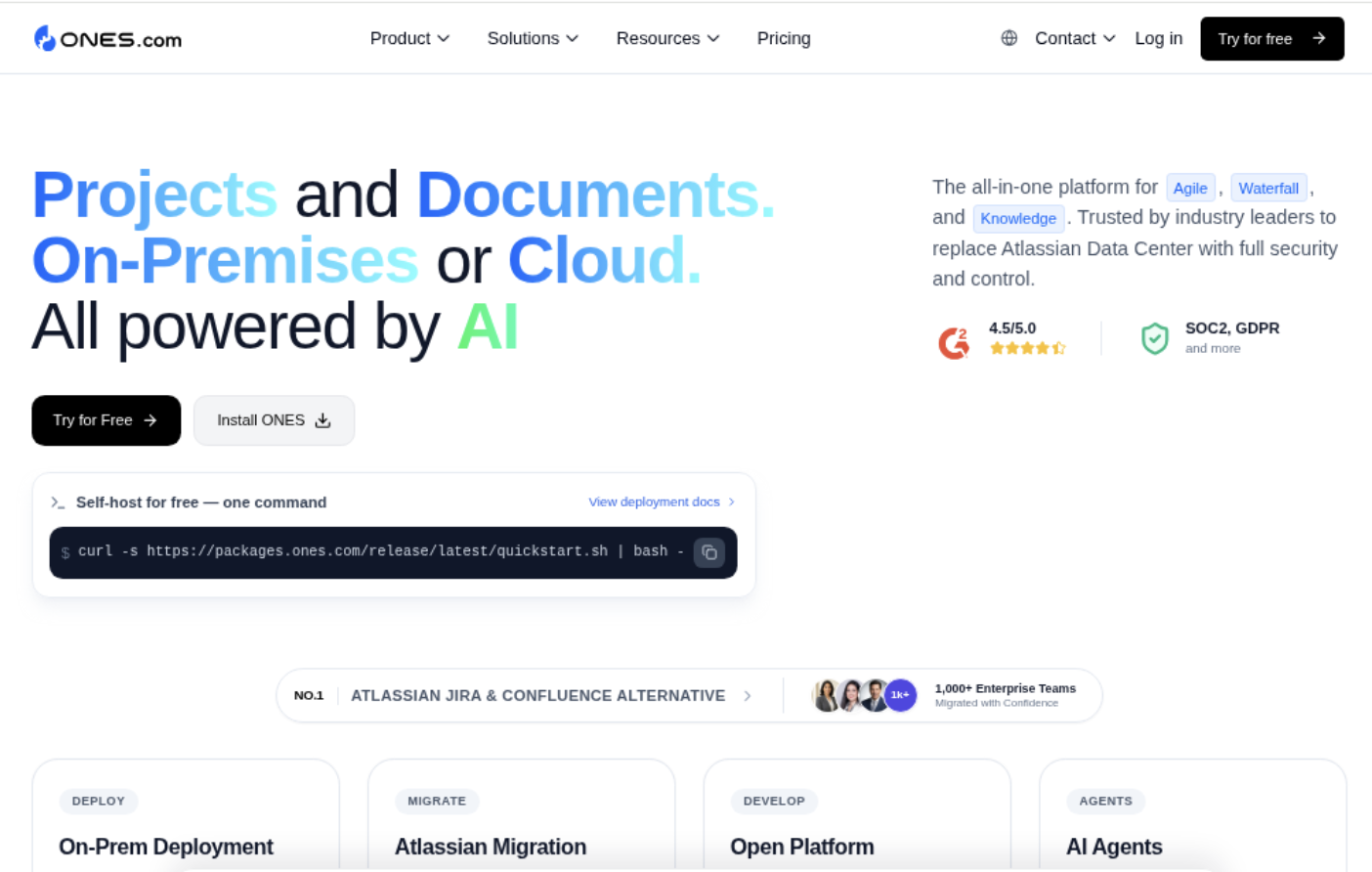
ONES.com combines project management and knowledge management in one platform, powered by ONES Assistant. ONES Project works as a Jira alternative, while ONES Wiki serves as a Confluence alternative; each product is sold separately.
It can suit teams that want native project and knowledge capabilities, fewer plugins, and deployment flexibility across Cloud, On-Premise, Private Cloud, or Air-gapped environments.
Core Capabilities
Rising plugin costs → native project capabilities → fewer separate subscriptions
Jira teams often add extensions for reporting, workflows, planning, and knowledge sharing. ONES Project includes built-in reporting, custom workflows, custom fields, sprint management, and automation.
This can reduce the number of separate tools you need to evaluate and maintain.
Complex workflow rules → custom workflows and fields → clearer process control
When teams adapt their process to rigid settings, approvals become harder to track. ONES Project supports Jira-compatible workflows while allowing custom workflows and fields.
A product team can represent discovery, development, testing, approval, and release stages without relying on one generic process.
Scattered team knowledge → ONES Wiki → easier project context
Project decisions can become difficult to find when planning and knowledge live in disconnected systems. ONES Wiki provides a knowledge management environment for team information.
Teams can keep project context closer to their delivery work and reduce repeated explanations.
Limited deployment choices → four deployment models → better infrastructure fit
Some organizations cannot place project work in a public cloud. ONES.com supports Cloud, On-Premise, Private Cloud, and Air-gapped deployment.
This gives regulated, security-sensitive, and restricted-network teams more options when selecting an environment.
Feature gaps between hosted and self-managed editions → native parity → more consistent administration
Teams sometimes choose hosting based on capability gaps rather than operational needs. ONES.com provides full feature parity between its cloud and self-hosted versions.
You can focus the deployment decision on security, control, and maintenance preferences.
Growing team costs → free access for up to 30 seats → lower barrier to evaluation
Small teams often need to validate a workflow before making a broader commitment. ONES.com offers a free option for up to 30 seats.
A 12-person team can test project structure, sprint routines, and collaboration before planning a wider rollout.
AI experimentation that becomes regular work → ONES Assistant → a clearer adoption path
When AI moves from occasional testing into daily project work, teams need predictable usage controls. ONES.com provides ONES Assistant with a three-layer AI usage model.
The basic allowance supports trying core AI features and handling limited requests. Assistant Credit provides 3,000 credits per user per month in addition to the basic allowance.
Extra Credit is a team-shared pool used when personal credits are insufficient. It costs USD 10 per 1,000 credits, with a minimum order of 5,000 credits.
This structure supports a progression from low-barrier individual experimentation to stable personal use and then team-scale adoption. It also helps keep AI-supported work running when individual allowances are insufficient.
Application Scenarios
Restricted-network engineering: An organization with air-gapped infrastructure can deploy ONES.com in an air-gapped environment. The team can maintain project workflows without moving work into a public cloud.
Plugin-heavy product delivery: A 40-person product group can compare the cost of several Jira extensions with ONES Project’s built-in workflows, reporting, sprint management, and automation.
Project and knowledge alignment: A growing software company can use ONES Project for delivery and ONES Wiki for knowledge management. Keeping both capabilities within the ONES.com ecosystem can simplify tool planning.
Common Challenges
Challenge: your team size keeps changing
Solution: Create a monthly access review. Identify active contributors, inactive accounts, contractors, and upcoming hires before renewing or changing tiers.
Challenge: the Free plan works until an urgent project arrives
Solution: Test your highest-volume workflow early. Check automation, permissions, reporting, and collaboration limits before a major release depends on them.
Challenge: Premium appears expensive in isolation
Solution: Compare the cost with the time saved through planning, automation, reporting, and fewer manual status updates. Use one release cycle as your measurement period.
Challenge: add-ons create an unclear total bill
Solution: Build a tool inventory. Record each integration, its owner, its monthly charge, and the problem it solves. Remove overlapping capabilities.
Challenge: self-managed hosting looks cheaper at first
Solution: Include infrastructure, administration, upgrades, monitoring, backups, and recovery work. Compare the complete operating cost with hosted pricing.
FAQs
What is the cheapest Jira pricing option?
The Free plan is generally the cheapest option because it does not carry a subscription charge within its limits. It can suit a small team with basic issue tracking needs.
Before choosing it, check user limits, automation capacity, permissions, reporting, and collaboration requirements. A free plan becomes expensive in practice when your team spends excessive time working around restrictions.
Is Jira Standard or Premium better for a growing team?
Standard usually fits a growing team that needs broader collaboration and administration without advanced scale requirements. Premium can be worthwhile when your team needs stronger planning, higher automation capacity, enhanced reliability, or more advanced operational controls.
Compare both tiers against one real release cycle. Measure coordination time, manual reporting, workflow complexity, and the number of projects you manage.
How many Jira users should I budget for?
Budget for every person who needs regular access, including engineers, product managers, testers, designers, contractors, and selected stakeholders. Add expected hiring and project expansion for the next 12 months.
Review the list monthly or quarterly. Removing inactive accounts can prevent unnecessary subscription growth while preserving access for active contributors.
Does Jira offer an Enterprise plan?
Yes, Jira generally offers an Enterprise option for large organizations with complex governance, administration, security, support, and scale requirements.
Enterprise pricing is usually customized. Your estimate may depend on user volume, product coverage, deployment expectations, commercial terms, and support needs. Request a tailored quote when several departments share the environment.
Should I compare Jira with other project management platforms?
Yes, especially when your team needs on-premise or air-gapped deployment, native knowledge management, fewer plugins, or a different cost structure.
Compare workflow compatibility, reporting, automation, deployment choices, administration, migration effort, and total operating cost. A lower seat price alone does not guarantee a lower overall cost.
Conclusion
The right Jira tier depends on team size, required capabilities, deployment preferences, and the work surrounding the subscription. Start with active seats, then calculate growth, add-ons, administration, and operational effort.
But here's the truth: choosing the cheapest plan without testing real workflows can create avoidable costs later. A practical comparison should include automation, reporting, permissions, planning, support, and the effort required to operate the environment.
If Jira’s pricing or plugin structure no longer fits your team, evaluate a Jira alternative such as ONES Project. With ONES.com, you can also compare native project and knowledge management, multiple deployment models, and a free option for up to 30 seats.