Jira Program Planning: A Step-by-Step Guide for Your Team
Struggling to align teams and dependencies? Learn program Jira planning step by step to improve visibility, manage risks, and deliver on time. Read now!
Jira can track individual projects well, yet program planning becomes harder when several teams share milestones, risks, dependencies, and leadership goals. Without a clear structure, updates scatter across boards, deadlines compete, and small delays spread quietly across the program.
That creates a familiar problem: every team appears busy, while nobody has a reliable view of progress. Leaders may discover a dependency only after it blocks a launch. Teams may also spend more time preparing status updates than solving delivery risks.
But here's the truth: Jira can support program planning when you organize the work above the individual project level. This guide shows you how to create a practical program structure, connect team plans, monitor dependencies, and keep decisions visible.
How to Plan a Program in Jira
Jira program planning works best when you connect strategic outcomes with coordinated projects, shared milestones, dependencies, and review routines. You can build that structure in seven steps.
- Define the program outcome. Start with the business result your program must achieve. For example, “launch the new customer billing experience in three regions by September” gives teams a clearer direction than “improve billing.”
- List the projects and workstreams. Break the outcome into major areas of work, such as payment services, customer interface, compliance, analytics, and rollout operations. Each area can have its own Jira project or workstream.
- Set a common hierarchy. Use a consistent relationship between the program, major initiatives, epics, stories, and tasks. A simple structure might look like this:
- Program: regional billing modernization
- Initiative: payment processing upgrade
- Epic: support recurring payments
- Story: allow customers to update payment details
- Task: add validation for expired cards
- Create shared milestones. Add milestones that matter across teams, such as architecture approval, pilot readiness, security review, or production launch. These checkpoints help you evaluate program progress without reading every ticket.
- Map cross-team dependencies. Record which team must finish work before another team can continue. For example, the mobile team may depend on the API team completing authentication changes.
- Build a program view. Combine project timelines, sprint progress, risks, and milestone status in a dashboard or planning view. Your goal is a quick answer to three questions: what is moving, what is blocked, and what needs a decision?
- Establish a review rhythm. Hold weekly delivery reviews for active risks and dependencies. Hold monthly program reviews for scope, budget, benefits, and major decisions. Jira provides the visibility, while your meeting rhythm turns visibility into action.
Here's why: program planning is less about adding more tickets and more about creating useful connections between existing work. If a leadership goal cannot be traced to active work, you have a planning gap.
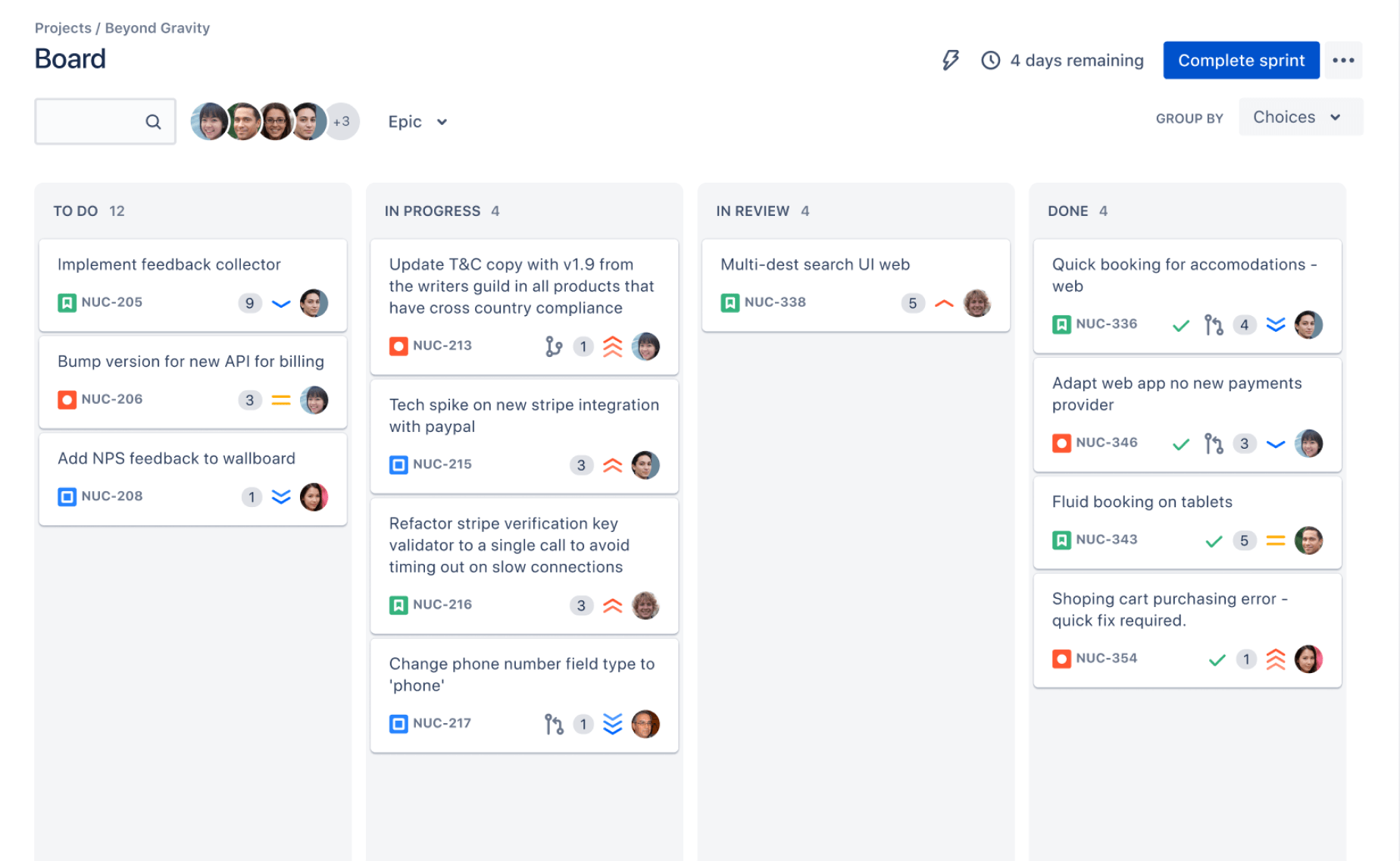
Start with a program brief
Create a short brief before configuring dashboards. Include the outcome, target date, business owner, delivery owner, scope boundaries, success measures, and major assumptions.
For example, a program brief could define success as a 20% reduction in payment failures, deployment across three regions, and no critical compliance findings. These measures give teams a way to judge trade-offs.
Choose the right Jira structure
Jira gives you several ways to organize work. A company-managed project can provide consistent workflows across teams, while team-managed projects may give individual teams more autonomy.
Choose the structure according to your governance needs. If the program needs shared fields, common statuses, and consistent reporting, centralized configuration may be more suitable. If teams work independently, lighter coordination may reduce administrative effort.
Connect work without overcomplicating it
Use links and relationships for meaningful connections. A dependency should explain why one item affects another, such as “blocked by API contract approval.” Avoid creating relationships for every possible connection.
A useful rule is simple: if a relationship would change a delivery decision, capture it. If it only adds visual clutter, leave it out.
Designing a Jira Program Hierarchy
A program hierarchy helps you move between strategic intent and daily execution. It should make work easier to understand at different levels, rather than force every stakeholder into the same view.
At the highest level, show the program outcome. Under it, group major initiatives or workstreams. Then connect those initiatives to epics, stories, and tasks managed by delivery teams.
| Planning level |
Purpose |
| Program |
Defines the combined business outcome and overall direction. |
| Initiative |
Groups a significant area of change or investment. |
| Epic |
Represents a substantial body of related delivery work. |
| Story or task |
Describes work a team can plan, estimate, and complete. |
| Milestone |
Marks an important decision, approval, or delivery checkpoint. |
Let me explain: senior leaders usually need outcome, timing, risk, and investment information. Team members need acceptance criteria, ownership, and sequencing. A strong hierarchy gives each audience the right level of detail.
Use consistent naming
Give initiatives and epics names that describe the result or capability. “Recurring payments” is more useful than “Phase 2 work.” Consistent naming also improves searches, reports, and review conversations.
Separate outcomes from activities
An outcome describes what changes for the business or customer. An activity describes what the team does. “Reduce checkout failures” is an outcome; “rewrite payment validation” is an activity.
Keeping both visible prevents a common planning problem: teams complete many activities without confirming whether the intended result is improving.
Managing Dependencies Across Jira Projects
Dependencies are a major reason program plans need more coordination than single-project plans. One team’s delay can change another team’s scope, sequence, or launch date.
Imagine a retail platform program with three teams. The identity team must finish single sign-on, the storefront team must integrate the new login flow, and the support team must update help content. The launch depends on all three streams.
Use issue links, shared milestones, labels, or dedicated dependency fields to make those relationships visible. Include an owner, expected resolution date, and current status for each important dependency.
Classify the dependency
Different dependency types require different responses. A technical dependency may involve an API or environment. A business dependency may require a policy decision. A resource dependency may occur when two teams need the same specialist.
Classifying the issue helps you send it to the right person. A technical blocker may need an engineering decision, while a policy blocker may need product or legal review.
Track risk before it becomes a blocker
Risk describes a possible problem. A blocker is already stopping progress. If a security review has not started, it is a risk. If the review has rejected the design and work cannot continue, it is a blocker.
Review high-impact risks during every program meeting. Record the response, owner, due date, and escalation path. This keeps the conversation focused on action rather than status descriptions.
Building Program Dashboards and Reports
A useful Jira program dashboard answers operational questions quickly. It should show progress, upcoming milestones, blocked work, unresolved dependencies, and changes to the expected completion date.
For example, a program dashboard could include a milestone timeline, a list of overdue dependencies, a chart of work by status, and a view of high-priority risks. Each element should support a decision or conversation.
Choose measures that influence action
Good program measures connect activity with delivery health. Examples include milestone confidence, blocked work age, dependency resolution time, scope change volume, and completed outcomes.
Velocity can help a team plan its own work, yet comparing velocity across teams can create misleading conclusions. Teams may estimate differently, use different workflows, or handle different levels of complexity.
Use traffic-light status carefully
Red, amber, and green status can help executives scan a program quickly. However, each color needs a definition. For example:
- Green: the milestone is expected to meet its target date.
- Amber: a material risk exists, with a recovery action underway.
- Red: the target is unlikely without a scope, resource, or schedule decision.
Without shared definitions, one team’s amber may mean another team’s red. Set the rules before the first review.
Keep dashboards current
A dashboard loses value when owners update it only before a monthly meeting. Assign responsibility for each key field and review stale information during the weekly operating rhythm.
Running Program Reviews in Jira
Jira supports program reviews when the meeting follows a clear decision process. Start with milestones that changed, dependencies that need attention, risks that increased, and decisions that require leadership input.
You can then review delivery evidence. For example, if a team reports that an integration is nearly complete, check whether testing, approval, and operational readiness are also progressing.
Use a decision log
Program decisions often affect several projects. Record the decision, date, owner, options considered, and expected effect. A short entry such as “use the existing identity provider for the pilot” can prevent repeated debate.
Escalate with context
An escalation should explain the issue, impact, choices, recommendation, and decision deadline. “The launch is at risk” gives little direction. “The security review is five days late; approve a reduced pilot scope by Friday to protect the regional launch” supports action.
Close the feedback loop
After a decision, update the related Jira work. Change the scope, owner, priority, target date, or dependency status so the plan reflects what people agreed.
The best part? A decision becomes useful only when it changes execution. Recording it without updating the affected work leaves teams with conflicting expectations.
Jira Program Planning Solution: ONES.com
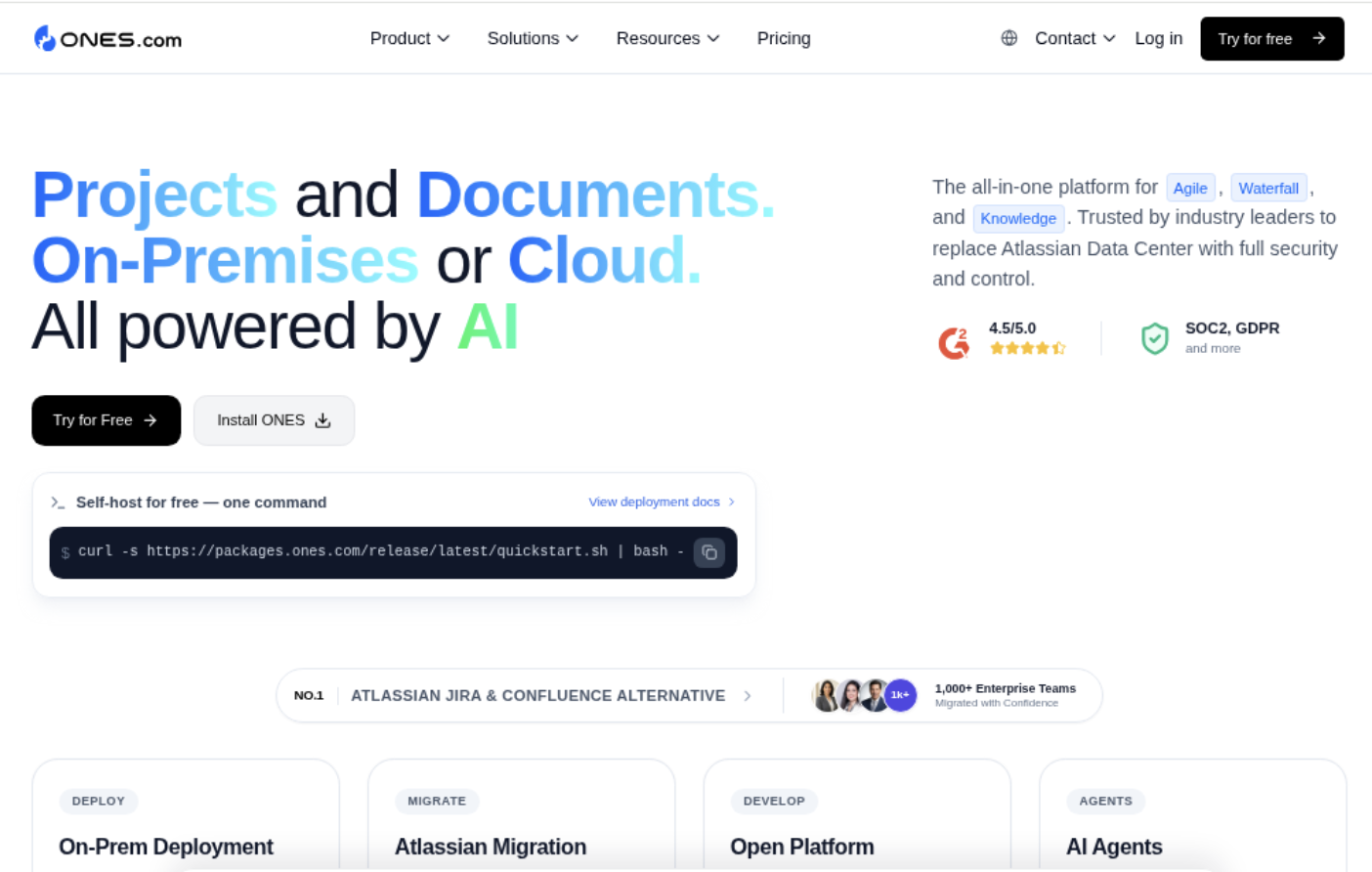
Value Proposition
ONES.com combines project management and knowledge management in one platform, with AI support through ONES Assistant. ONES Project is a Jira alternative for teams that want coordinated planning, reporting, and delivery workflows with fewer separate plugins.
Teams can purchase ONES Project and ONES Wiki separately. The platform supports Cloud, On-Premise, Private Cloud, and Air-gapped deployments, with full feature parity between cloud and self-hosted versions.
Core Capabilities
Disconnected project views
Pain: Program managers may need to combine progress from several team areas manually.
ONES capability: ONES Project provides shared planning views, project structures, and built-in reporting.
Result: You can review program progress through a consistent planning experience.
Complex Jira migrations
Pain: Teams may hesitate to change platforms when their delivery habits depend on Jira-compatible workflows.
ONES capability: ONES Project supports Jira-compatible workflows, custom fields, sprint management, and automation.
Result: Teams can preserve familiar delivery patterns while evaluating a Jira alternative.
Plugin-heavy reporting
Pain: Adding separate plugins for reporting and coordination can increase administration and maintenance.
ONES capability: Built-in reporting supports common program views without requiring the same level of external customization.
Result: Program reviews can rely on more consistent reporting practices.
Inconsistent workflows
Pain: Different project teams may use different statuses, fields, and approval paths.
ONES capability: Custom workflows and fields allow teams to model program-specific governance.
Result: You can standardize important controls while allowing appropriate team-level flexibility.
Restricted-network requirements
Pain: Some organizations cannot place planning work in a public cloud environment.
ONES capability: ONES.com supports On-Premise, Private Cloud, and Air-gapped deployment options.
Result: Teams can evaluate a deployment model that fits their security and network requirements.
Separate knowledge and delivery spaces
Pain: Program decisions may become difficult to find when planning work and team knowledge sit in separate systems.
ONES capability: ONES Wiki provides knowledge management capabilities alongside ONES Project.
Result: Teams can connect delivery planning with decisions, guidance, and working practices.
Limited automation
Pain: Manual transitions and reminders can delay dependency handling and review preparation.
ONES capability: Automation can support recurring workflow actions, notifications, and process rules.
Result: Teams spend less time on repetitive coordination tasks.
Small-team budget concerns
Pain: Smaller teams may need a practical way to test a platform before broader adoption.
ONES capability: ONES.com offers a free plan for up to 30 seats.
Result: A team can evaluate core planning workflows with a smaller initial commitment.
Application Scenarios
Multi-team product launch: A product organization can use ONES Project to coordinate engineering, design, quality, and operations around shared milestones. Custom fields can capture launch readiness, ownership, and risk.
Restricted-network delivery: A regulated organization can assess an Air-gapped or On-Premise deployment while maintaining project planning capabilities aligned with its network requirements.
Project and knowledge coordination: A program office can use ONES Project for execution and ONES Wiki for governance guidance, decisions, and reusable delivery practices. The products are sold separately, so teams can select the combination they need.
Common Challenges in Program Planning
Challenge: Every project uses a different structure
Solution: Define shared naming, statuses, milestone types, and ownership fields. Let teams retain local practices where those differences do not affect program reporting.
Challenge: Dependencies appear too late
Solution: Ask each team to identify external dependencies during planning and review them weekly. Give every high-impact dependency an owner and target resolution date.
Challenge: Dashboards show activity without outcomes
Solution: Pair delivery measures with outcome measures. For a billing program, track completed work alongside payment success rate, customer complaints, or rollout coverage.
Challenge: Status meetings become long reporting sessions
Solution: Use Jira views before the meeting and reserve meeting time for exceptions, trade-offs, and decisions. Ask owners to explain changes rather than repeat unchanged updates.
Challenge: Scope keeps expanding
Solution: Create a visible change process. Record the requested change, expected benefit, delivery effect, decision owner, and impact on the target date.
FAQs
Can Jira manage several projects as one program?
Yes. You can coordinate several Jira projects through shared issue structures, links, dashboards, plans, milestones, and reporting views. The exact setup depends on your Jira edition and configuration. Start by defining the program outcome, then connect each project to the initiatives and milestones that support it.
What is the difference between a Jira project and a program?
A Jira project usually organizes work for a team, product area, or delivery objective. A program coordinates multiple related projects that contribute to a broader outcome. For example, a mobile redesign, API upgrade, and support enablement effort may be separate projects within one customer experience program.
How should I track dependencies in Jira?
Use issue links, dependency fields, labels, or a dedicated dependency view. Each important dependency should include the affected teams, owner, expected resolution date, current status, and delivery impact. Review these relationships regularly because a dependency can change from a manageable risk into a blocker.
Which Jira reports are useful for program planning?
Useful reports include milestone progress, blocked work, unresolved dependencies, scope changes, risk status, and delivery trends. Choose reports that support decisions. A chart that looks impressive but never changes a priority or escalation adds little value to the program.
Should every team use the same Jira workflow?
Teams do not always need identical workflows. However, shared program reporting becomes easier when important statuses and fields have consistent meanings. You might standardize statuses such as planned, in progress, blocked, ready for review, and complete while allowing teams to add steps for their own delivery needs.
Conclusion
Effective Jira program planning starts with a clear outcome, a practical hierarchy, shared milestones, visible dependencies, and a review rhythm focused on decisions. You do not need to represent every detail at the program level.
Instead, connect the information that helps teams coordinate. Show what matters across projects, assign ownership, define escalation rules, and update the plan when decisions change.
But here's the truth: scattered project activity can create the appearance of progress while important risks remain hidden. A structured program view brings those risks forward early enough to respond.
Whether you continue with Jira or evaluate a Jira alternative such as ONES Project, the principle stays the same: link daily work to shared outcomes, and make coordination visible before delays become expensive.