Jira Project Management: A Step-by-Step Guide for Teams
Struggling with messy sprints and shifting deadlines? Learn jira project management step by step to build clearer workflows—read now.
Jira project management can feel overwhelming when your team has too many issues, unclear priorities, and deadlines that keep moving. A poorly configured project quickly becomes a maze of tickets, status updates, and forgotten handoffs. Even a simple sprint can lose momentum when nobody knows what should happen next.
But here's the truth: Jira becomes much easier when you treat it as a workflow system rather than a collection of tasks. You need clear project goals, practical issue types, useful statuses, and a review rhythm your team can maintain. This guide walks you through the process step by step, with examples for software teams, marketing groups, and cross-functional projects.
How to Set Up Jira Project Management Step by Step
Jira project management is the practice of planning, organizing, tracking, and improving project work through Jira issues, workflows, boards, reports, and team routines.
You can use Jira for agile software development, service delivery, product launches, marketing campaigns, and operational work. The setup differs by team, yet the foundation stays consistent: define the work, assign responsibility, show progress, and review results.
Step 1: Define the Project Outcome
Start with the result you want to achieve. A project outcome should describe a meaningful change, such as launching a payment feature or reducing customer response time.
A vague goal like “improve the mobile app” creates scattered work. A clearer goal might be “release passwordless login for all active customers by September 30.”
Write down three practical details before creating many issues:
- The business or customer problem you want to solve
- The measurable result that indicates success
- The target date and major constraints
Here's why: a clear outcome helps you decide whether a task belongs in the project. If an issue does not support the outcome, you can defer it or manage it elsewhere.
Step 2: Choose the Right Jira Project Type
Jira generally gives you different project approaches for teams with different levels of process maturity. A team-managed project offers more local control, while a company-managed project supports broader governance and shared configuration.
Choose a team-managed approach when a small group needs to move quickly and can maintain its own workflow. Choose a company-managed approach when several teams need consistent issue types, permissions, fields, or reporting.
For example, a five-person design team may need a simple board with To do, In progress, Review, and Done. A product organization with several squads may need common workflows and shared reporting standards.
Step 3: Build a Work Breakdown Structure
Break the outcome into manageable layers. In Jira, a common structure includes:
- Epic: a large body of related work
- Story: a user-centered capability or requirement
- Task: a specific piece of work
- Bug: a defect that needs investigation or correction
- Sub-task: a smaller action within a larger issue
Suppose your epic is “Improve checkout reliability.” Stories might include payment retry handling, clearer error messages, and transaction monitoring. Tasks can then cover technical design, testing, and release preparation.
Keep the hierarchy useful. If every minor action becomes a separate epic, reporting becomes confusing. If an entire product launch sits in one issue, ownership and progress become difficult to see.
Step 4: Create Clear Issues
Each issue should explain what needs attention, why it matters, and how someone can recognize completion. A useful issue includes a concise title, context, acceptance criteria, an owner, and relevant links.
Compare these two titles:
- “Login work”
- “Add email-based password reset for verified customers”
The second title gives the team a clearer starting point. Add acceptance criteria such as:
- A verified customer receives a reset message within two minutes.
- The reset link expires after 30 minutes.
- An invalid or expired link shows a clear recovery message.
You might be wondering: how much detail is enough? Add enough context for the assignee to act without scheduling a separate clarification meeting. Keep long discussions in comments and summarize the decision in the issue.
Step 5: Design a Workflow That Matches Reality
A workflow represents how work moves from request to completion. Start with the fewest statuses your team genuinely needs.
A practical software workflow could be:
- Backlog
- Selected for development
- In progress
- Code review
- Testing
- Ready for release
- Done
A marketing workflow might use Brief, Drafting, Review, Approved, Scheduled, and Published. The labels change because the work changes.
But here's the truth: extra statuses rarely create extra control. They often create confusion. If team members cannot explain the difference between “Ready for QA” and “QA queued,” combine them or define the distinction clearly.
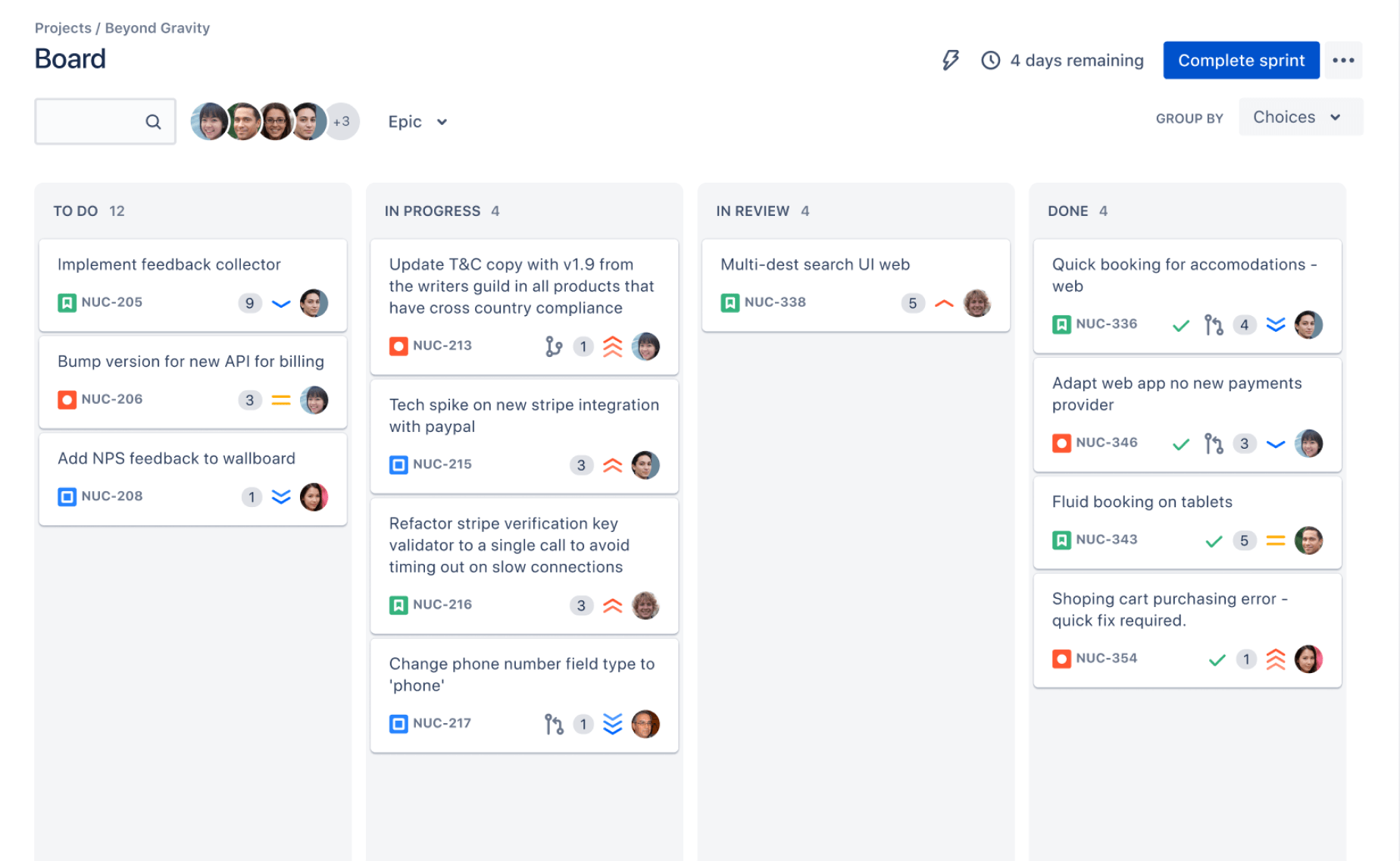
Step 6: Set Up the Board
Configure the board so it reflects the workflow and highlights blocked work. Columns should make progress visible at a glance.
Use swimlanes when your team needs to separate work by epic, priority, assignee, or service class. Use quick filters for urgent issues, bugs, unassigned work, or a specific product area.
Set a work-in-progress limit for important stages. For example, a review column with a limit of three issues encourages the team to finish existing reviews before starting more work.
The best part? A board becomes useful when it supports a conversation. During a daily review, ask why an issue has stayed in one column for several days and what will move it forward.
Step 7: Plan Sprints or Use a Continuous Flow
Use sprints when your team works toward short, time-boxed goals. A sprint may last one or two weeks and should have a clear objective.
Use a continuous-flow board when priorities arrive throughout the week, such as support engineering, content operations, or infrastructure maintenance.
For sprint planning, select work according to capacity rather than optimism. If six people each have five productive hours per day for a five-day sprint, the theoretical capacity is 150 hours. Meetings, support requests, and interruptions reduce that amount.
Leave room for uncertainty. A team that plans every available hour may appear efficient during planning and overloaded by the middle of the sprint.
Step 8: Assign Ownership and Dependencies
Every active issue should have a clear owner. Ownership means someone is responsible for moving the issue forward, even when several people contribute.
Use links to show relationships such as blocks, is blocked by, relates to, or duplicates. For example, a mobile release may be blocked by an authentication service upgrade.
Dependencies should appear before they become emergencies. During planning, review the highest-risk links and confirm who owns the prerequisite work.
Step 9: Track Progress with Reports
Jira reports help you inspect progress, workload, delivery patterns, and bottlenecks. Useful reports include:
- Burndown charts for sprint progress
- Velocity reports for completed sprint work
- Cumulative flow diagrams for workflow congestion
- Control charts for cycle time
- Created-versus-resolved charts for issue trends
- Workload views for capacity conversations
Use reports to ask better questions rather than judge individuals. If cycle time rises, investigate queue size, review delays, unclear requirements, or frequent priority changes.
Step 10: Review and Improve the System
End each sprint or delivery cycle with a short review. Check which work was completed, what carried over, where work waited, and whether the workflow still matches team behavior.
Choose one improvement at a time. For example, your next experiment might be reducing the review queue from eight issues to four or adding acceptance criteria before development begins.
A project system improves through small adjustments. Avoid redesigning every field and status after one difficult sprint.
How Jira Organizes Project Work
Jira connects several layers of project management. The project provides the overall workspace, issues represent individual work items, boards show movement, and reports help you inspect performance.
Think of it like a city map. The project is the city, epics are districts, individual issues are destinations, and the board shows the routes between them. Without labels and routes, the map contains information but offers little guidance.
Issues Turn Goals into Action
Issues give work a visible owner, status, priority, and history. A product manager can create a story, an engineer can update implementation progress, and a tester can record verification results in the same place.
Good issue hygiene matters. Close duplicates, update stale statuses, and move abandoned requests to an appropriate state. A board loses credibility when half its issues no longer represent active work.
Epics Connect Daily Work to Larger Outcomes
Epics help you see whether individual tasks contribute to a broader initiative. A dashboard might show that an epic has 20 issues, with 12 complete, five in progress, and three blocked.
That view is more useful than counting tickets alone. A team can close many small issues while making little progress on the core outcome.
Workflows Make Handoffs Visible
Every handoff creates a possible delay. A developer may finish an issue, yet testing does not begin for two days. A workflow makes that waiting period visible.
Use transition rules carefully. Requiring a resolution reason when closing a bug can improve reporting. Requiring six fields before moving a simple task forward may slow the team without adding useful control.
Planning a Jira Project for Agile Teams
Agile planning in Jira works best when the team plans at several levels. Start with the product direction, move into a release or milestone view, then prepare a sprint or flow queue.
Roadmap Planning
A roadmap should show major outcomes, dependencies, and expected timing. It does not need to predict every task months in advance.
For example, a quarterly roadmap might include improving search, launching a mobile payment method, and reducing onboarding time. Each outcome can connect to an epic with measurable completion criteria.
Backlog Refinement
Backlog refinement prepares upcoming work so planning does not become a guessing exercise. Review unclear issues, split oversized stories, confirm priority, and identify dependencies.
A story such as “improve notifications” is too broad for most teams. Split it into notification preferences, email delivery monitoring, and in-product alerts. Each part can then receive separate acceptance criteria.
Sprint Planning
A sprint should answer two questions: what will the team complete, and why does that work matter now?
Start with the sprint goal, then select issues that support it. Check team capacity, unresolved dependencies, and work already in progress. If the goal cannot be stated in one or two sentences, the sprint may contain unrelated commitments.
Daily Coordination
A daily check should focus on movement and risk. Instead of asking every person for a long status report, review issues that are blocked, aging, or close to a deadline.
For example, a team might discover that three tasks are waiting for the same design decision. One short conversation can remove a bottleneck affecting the entire sprint.
Sprint Review and Retrospective
Use the sprint review to discuss completed outcomes with stakeholders. Use the retrospective to improve the team’s working method.
A review might reveal that customers value faster search results more than a planned visual change. A retrospective might reveal that testing starts too late. Both findings can influence the next planning cycle.
Jira Project Management for Different Teams
Jira can support different types of work, but each team should configure it around its actual delivery path. Copying a software workflow into marketing or operations often creates unnecessary friction.
Software Development
Software teams commonly track stories, bugs, technical tasks, code review, testing, and release readiness. Useful fields may include component, environment, severity, fix version, and acceptance criteria.
Example: a bug affecting checkout may receive a high priority, a payment component label, a reproduction path, and a link to the release milestone. That context helps engineering and quality teams act faster.
Product Management
Product teams can use epics for opportunities or product initiatives, then connect research, requirements, experiments, and delivery work. A separate prioritization view can help compare customer impact, effort, risk, and strategic fit.
Keep discovery work visible without mixing it blindly with committed delivery. A research task and a production bug may both be important, yet they require different expectations.
Marketing Teams
Marketing teams can track campaigns, creative requests, landing pages, approvals, and publishing activities. A workflow might move from Brief to Draft, Internal Review, Legal Review, Approved, and Live.
Use due dates and dependencies for launch coordination. A campaign issue may depend on creative approval, tracking setup, and a completed landing page.
Operations and Service Teams
Operations teams often handle a continuous stream of requests. A Kanban-style board can show intake, triage, active work, waiting, and completed requests.
Prioritize urgent work without allowing every request to become urgent. Service classes, response targets, and clear escalation rules can help the team protect planned work.
How to Keep Jira Projects Clean and Reliable
Jira quality depends on daily habits. The most advanced configuration cannot compensate for stale statuses, unclear ownership, or excessive customization.
Use Consistent Naming
Choose naming conventions for epics, components, labels, and versions. For example, use “Mobile Checkout” consistently instead of switching between “mobile-buy,” “checkout-app,” and “phone payment.”
Consistent names improve search, filters, reporting, and handoffs. Share the convention in the team’s working guidance and revisit it when the project changes.
Limit Custom Fields
Every field creates a maintenance cost. Add a field when it supports a real decision, report, rule, or handoff.
If nobody uses a field after several weeks, remove it or make it optional. A crowded issue screen slows creation and encourages incomplete entries.
Define “Done”
A shared definition of done prevents premature closure. It might require completed implementation, peer review, testing, updated release notes, and stakeholder approval.
The definition should match the team’s risk level. A minor internal change may need fewer checks than a payment or security change.
Review Aging Work
Aging work often signals hidden problems. An issue that stays in progress for ten days may need clarification, a smaller scope, additional help, or a decision.
Set a weekly aging-work review. Look at the oldest active issues and decide whether to finish, split, pause, reassign, or close them.
Protect Reporting Quality
Reports become misleading when teams close issues in batches, change priorities without recording the reason, or leave work in the wrong status.
Use a lightweight reporting routine. Review completion trends, cycle time, blocked work, and carryover. Focus on patterns over several cycles rather than reacting to one unusual week.

Value Proposition
ONES.com combines project management and knowledge management in one platform, with ONES Project providing project and workflow capabilities. It can suit teams that want Jira-compatible workflows, native reporting, and flexible deployment without relying heavily on plugins.
ONES Project is sold separately from ONES Wiki, and both sit within the broader ONES.com product family. Teams can choose cloud, on-premise, private cloud, or air-gapped deployment options.
Core Capabilities
Scattered project tracking → Jira-compatible workflows
When work is spread across disconnected systems, handoffs become harder to follow. ONES Project supports Jira-compatible workflows that help teams organize issues, statuses, transitions, and ownership in a familiar model. The result is a more consistent path from planning to completion.
Limited visibility → Built-in reporting
When managers rely on manual status collection, project risks can remain hidden. Built-in reporting helps teams inspect progress, workload, cycle time, and delivery trends. The result is faster discussion around bottlenecks and priorities.
Rigid project structure → Custom workflows and fields
Different teams need different delivery paths. ONES Project supports custom workflows and fields so software, product, marketing, and operations teams can reflect their actual processes. The result is more relevant tracking without forcing every group into one template.
Unclear iteration planning → Sprint management
Teams using short delivery cycles need a practical way to plan, run, and review sprints. Sprint management features help organize goals, selected work, capacity conversations, and completed issues. The result is a clearer connection between daily work and iteration outcomes.
Repeated manual actions → Automation
Routine transitions, notifications, and assignments can consume attention. Automation can handle suitable repeatable actions while keeping human review for decisions that require judgment. The result is less administrative work and more consistent movement through the workflow.
Plugin-heavy environments → Native feature parity
When essential capabilities depend on many extensions, maintenance and compatibility become concerns. ONES.com emphasizes native parity between its cloud and self-hosted versions, covering core project functionality without requiring the same plugin mix. The result is a more predictable operating environment.
Restricted deployment requirements → On-premise and air-gapped options
Some organizations cannot place project work in a public cloud. ONES.com supports on-premise, private cloud, and air-gapped deployments, alongside its cloud option. The result is greater flexibility for teams with security, compliance, or network restrictions.
Separate project and knowledge work → ONES Project and ONES Wiki
Project decisions often need a connected knowledge space. ONES Project handles project management, while ONES Wiki provides knowledge management and serves as a Confluence alternative. The result is a clearer relationship between delivery work and reusable team knowledge.
Application Scenarios
Software product team: A product group can plan epics, manage sprints, automate routine transitions, and use reporting to identify testing bottlenecks. An on-premise deployment may fit an organization with strict infrastructure requirements.
Cross-functional launch team: Product, design, marketing, and operations can use custom workflows for their different handoffs while tracking one shared launch outcome. Connected knowledge pages can preserve decisions, launch guidance, and lessons learned.
Restricted-network engineering group: An engineering team working in an air-gapped environment can maintain project tracking within its permitted network model. This supports controlled access while preserving familiar planning and reporting practices.
Common Challenges in Jira Project Management
Challenge: The Backlog Becomes a Storage Area
Problem: Old requests, duplicates, and vague ideas accumulate until the backlog stops helping with prioritization.
Solution: Schedule regular refinement. Close duplicates, archive irrelevant requests, add missing context, and separate potential ideas from near-term candidates.
Challenge: Too Many Issues Stay In Progress
Problem: Team members start new work before finishing existing work, creating long queues and slow delivery.
Solution: Add practical work-in-progress limits. When a column reaches its limit, ask the team to finish or unblock existing work before pulling another issue.
Challenge: Statuses Do Not Match Team Behavior
Problem: People leave issues in “In progress” because the available statuses do not reflect real handoffs.
Solution: Observe the workflow for one or two cycles. Add a meaningful status only when it represents a real ownership change, approval point, or waiting condition.
Challenge: Stakeholders Want Constant Priority Changes
Problem: Frequent interruptions make sprint goals unstable and reduce trust in delivery forecasts.
Solution: Define an escalation path for urgent work. If a new issue enters a sprint, remove or defer another issue unless the team agrees to increase the commitment.
Challenge: Reports Trigger Blame
Problem: Teams may treat velocity, cycle time, or ticket counts as individual performance scores.
Solution: Use metrics to inspect the system. Discuss queue size, dependency delays, scope changes, and quality trends before drawing conclusions about individual performance.
FAQs
Is Jira suitable for project management outside software development?
Yes. Jira can support marketing campaigns, product discovery, operations, design requests, and service work. The key is configuring issue types, statuses, fields, and reports around the team’s real delivery process. A marketing team may need approval and publishing stages, while an engineering team may need code review and testing stages.
What should a Jira project include at minimum?
Start with a clear goal, a small set of issue types, a practical workflow, an owner for active work, a board, and a review routine. Add reports and automation after the basic process works. A simple project with accurate statuses usually creates more value than a complex project nobody maintains.
Should every team use sprints?
No. Sprints work well when a team plans around short delivery goals and can protect a time-boxed commitment. Continuous flow may fit teams handling unpredictable requests, support work, or operational tasks. Choose the approach that matches how priorities actually arrive and how the team delivers.
How many statuses should a Jira workflow have?
Use enough statuses to show meaningful handoffs and waiting points. Many teams can begin with four to seven statuses, then adjust after observing real behavior. If team members cannot explain why two statuses differ, combine them or clarify the transition rules.
How can a team improve Jira reporting?
Keep issue statuses accurate, use consistent naming, define completion clearly, and review reports regularly. Focus on trends such as cycle time, blocked work, carryover, and aging issues. Reports become useful when they support decisions about capacity, scope, workflow, and risk.
Conclusion
Effective Jira project management starts with a clear outcome and a workflow your team can follow without constant explanation. Break large goals into useful issues, connect them to epics, assign ownership, make dependencies visible, and choose sprints or continuous flow according to the work.
But here's the truth: Jira cannot rescue a process that lacks priorities or ownership. Keep the configuration focused, review aging work, and improve one bottleneck at a time. With those habits in place, your board becomes a practical operating view instead of a crowded list of tickets.
If your team needs familiar Jira-compatible workflows alongside native reporting, flexible customization, and deployment choices, ONES.com is another platform worth evaluating. The right system should make progress easier to understand and action easier to take.