Jira Scrum Poker: 5 Steps to Improve Your Sprint Estimates
Are sprint estimates throwing your team off track? Learn 5 steps to use jira scrum poker for clearer estimates and more reliable sprints. Read now.
Estimates can derail a sprint before the work even begins. One person says two days, another says two weeks, and the loudest opinion can quietly set the team’s commitment.
That uncertainty gets expensive when stories are underspecified or estimates reflect individual confidence instead of shared understanding. Jira Scrum Poker gives your team a structured way to discuss work, compare estimates, and expose assumptions before sprint planning.
Here’s how to run a focused five-step session, avoid common estimation traps, and turn the discussion into more reliable sprint plans. You don’t need perfect predictions; you need a repeatable process that helps your team make informed decisions together.
How to run Jira Scrum Poker in five steps
Jira Scrum Poker is a collaborative estimation approach that lets team members privately choose effort values, reveal them together, and discuss differences before agreeing on an estimate.
The exact controls depend on the Jira app or integration your team uses. The workflow below works as a practical guide whether your team estimates inside Jira or uses a separate voting room alongside Jira issues.
- Prepare the work. Select a small group of upcoming stories and check that each has a clear goal and acceptance criteria. Share relevant context before the meeting so the team can focus on estimation.
- Choose an estimation scale. Agree on a scale, such as Fibonacci values of 1, 2, 3, 5, 8, and 13. Define what a small or large estimate means for your team.
- Explain one story and invite questions. The product owner or story owner describes the expected outcome. Team members ask about dependencies, edge cases, and unknowns before voting.
- Vote privately, then reveal together. Each person selects an estimate without seeing everyone else’s choice. Reveal the votes at the same time to reduce anchoring on the first number mentioned.
- Discuss differences and record the result. Ask people with the highest and lowest estimates to explain their reasoning. Clarify the story, vote again if needed, and save the agreed estimate on the Jira issue.
For example, a story might receive votes of 3, 5, 5, and 13. The spread signals that the team sees the work differently. A short discussion may uncover an unplanned integration, a missing acceptance criterion, or a simpler implementation path.
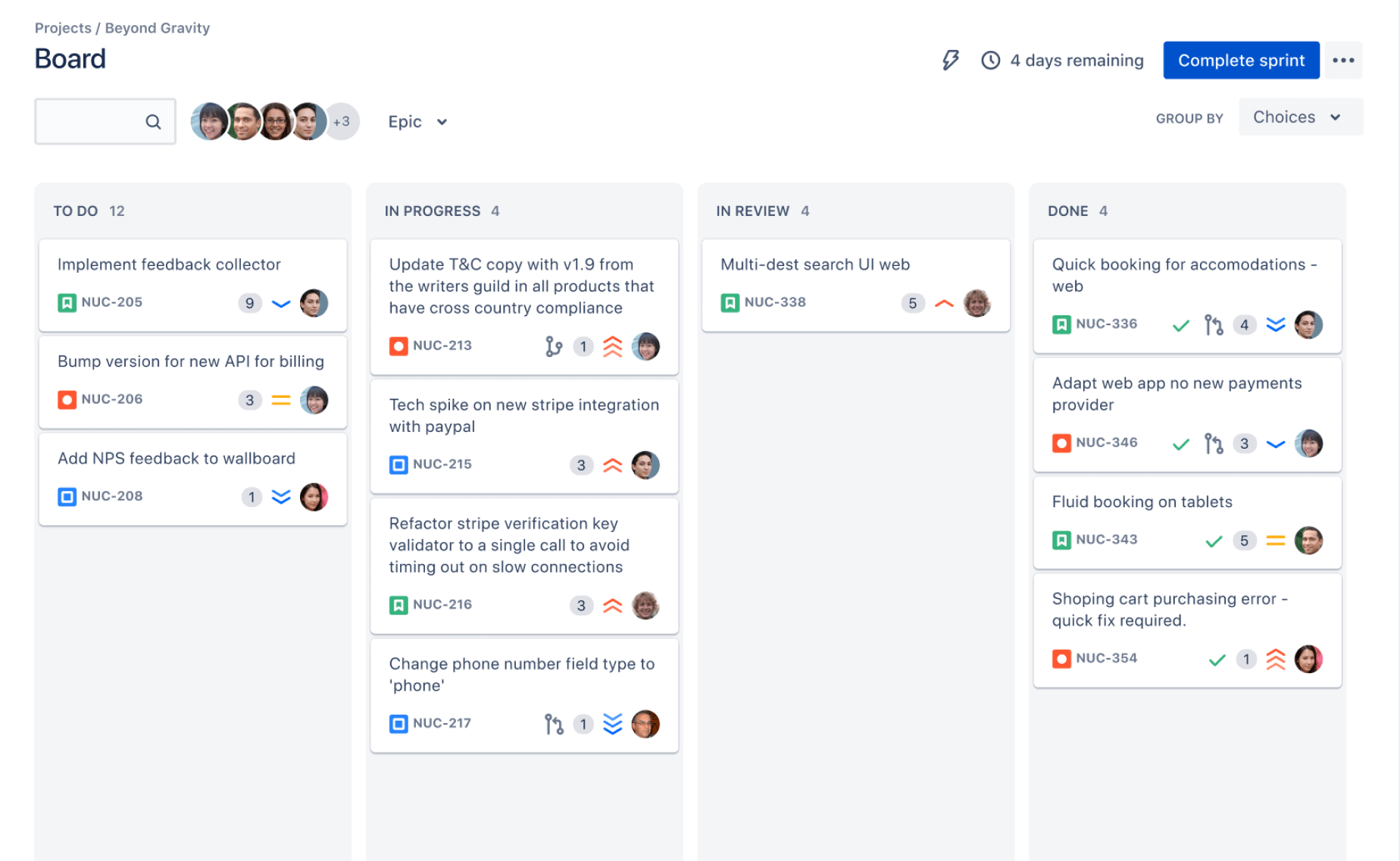
Why teams use poker-style estimation
Private voting gives each person a chance to form an independent view before hearing the group’s opinions. That can help prevent a confident early estimate from anchoring the rest of the team.
Here’s why: the value is often in the conversation around the numbers. If a developer estimates 3 while a tester estimates 8, they may be accounting for different work or risks.
For instance, the developer may be thinking only about the code change, while the tester is considering test data, regression checks, and an external service dependency. The discussion brings those assumptions into the open.
Planning poker does not make estimates certain. It helps a team share its reasoning, identify uncertainty, and decide whether a story is clear enough to plan.
Prepare Jira issues before the session
Start with a manageable set of candidate stories rather than estimating the entire backlog. A focused session gives the team time to understand each item instead of rushing through a long queue.
Check that every selected issue explains the intended outcome, relevant constraints, and acceptance criteria. If a story says only “improve checkout,” ask what improvement the team expects and how it will know the change is complete.
Agree on the estimation scale before voting begins. A Fibonacci scale can help express growing uncertainty: the gap between 8 and 13 is intentionally larger than the gap between 2 and 3.
You might be wondering: should the team estimate hours or story points? Pick the measure your team uses consistently, then keep it separate from individual time commitments. Story points are a relative planning aid, not a promise that a story will take a fixed number of hours.
Facilitate a discussion that stays useful
Give each story a brief explanation, then let the team ask clarifying questions. Keep the conversation centered on scope and uncertainty; detailed solution design can happen later when it is needed.
Reveal votes simultaneously when your voting tool supports it. If the team uses physical cards or a simple verbal round, ask everyone to choose before anyone shares a number.
When votes differ, invite the people with the lowest and highest estimates to explain what they considered. For a story estimated at 2 and 8, one person may have assumed an existing service handles validation, while another expects the team to build it.
Let me explain: the goal is to understand the gap, not to pressure everyone into one person’s estimate. After the team clarifies assumptions, vote again or split the story if the scope remains too broad.
Use estimates carefully in sprint planning
Once the team agrees on an estimate, record it on the relevant Jira issue using the field or workflow your team has chosen. Keep the reasoning visible in the issue discussion when it will help with later planning.
Compare completed work with estimates over several sprints. If stories estimated at 5 routinely vary in size, review whether the team’s examples, refinement practices, or definitions of scope are consistent.
A useful estimate helps the team discuss capacity alongside availability, dependencies, and unfinished work. It should not become a target for measuring individual performance or a guarantee of delivery.
The best part? A steady estimation process can show where planning assumptions need attention. If stories repeatedly grow after work starts, the likely improvement may be clearer acceptance criteria or earlier dependency checks.
Jira Scrum Poker solution: ONES.com
ONES.com brings project management and knowledge management together in an AI-powered platform, with ONES Project for project management and ONES Wiki for knowledge management. They are sold separately. ONES Project is a Jira alternative for teams looking to manage issues, sprints, workflows, and reporting with less reliance on plugins.
For estimation work, the important question is how your team will capture decisions and connect them to sprint planning. ONES Project supports custom workflows and fields, sprint management, automation, and built-in reporting. Those capabilities can help teams organize estimation practices around their existing planning process.
Core capabilities for planning and estimation
- Scattered work details: ONES Project organizes project issues in a shared work environment, helping the team find relevant context while preparing estimates.
- Inconsistent issue handling: Custom workflows let teams shape how work moves through refinement, estimation, and delivery, making the process easier to follow.
- Missing estimation fields: Custom fields can capture the estimate or planning details your team needs, keeping key information attached to the issue.
- Sprint planning friction: Sprint management helps teams organize work into iterations and review the planned scope alongside active work.
- Repeated manual actions: Automation can handle selected routine workflow tasks, reducing administrative steps around project work.
- Limited progress visibility: Built-in reporting gives teams a way to review project status and sprint progress without depending on a separate reporting add-on.
- Jira migration concerns: Jira-compatible workflows can make it easier to adapt familiar project processes while evaluating a Jira alternative.
- Plugin-heavy setups: Native feature parity between cloud and self-hosted versions can reduce plugin dependence for teams that need core project capabilities in different deployment environments.
Where teams might apply it
A software team could use ONES Project to manage sprint issues, record estimates in custom fields, and review iteration progress through built-in reporting. Its workflow can reflect the team’s refinement and delivery steps.
A team with restricted hosting requirements could evaluate the available deployment choices: Cloud, On-Premise, Private Cloud, or Air-gapped. ONES.com offers a free plan for up to 30 seats, with full feature parity between cloud and self-hosted versions.
ONES Project should not be assumed to provide a particular interactive poker-voting room. If live card voting is essential, confirm that the required estimation experience is available before changing platforms. The platform’s relevant strengths are project workflows, sprint management, configurable fields, automation, and reporting.
Common challenges and practical fixes
- One person anchors the vote: Early estimates can sway the group. Ask everyone to vote privately and reveal choices together when the team’s tool supports it.
- The team debates implementation details: Long design discussions can consume the session. Capture open technical questions and return to them separately, unless they change the estimate materially.
- Estimates vary widely: A wide spread often points to different assumptions or unclear scope. Compare the reasons behind the high and low votes, then clarify or split the story.
- Large stories keep receiving the biggest value: Repeated high estimates may signal work that is too broad to discuss as one item. Break it into smaller outcomes that can be understood and planned.
- Estimates become delivery promises: Treating points as fixed time commitments can distort planning. Use estimates alongside capacity, availability, and team experience rather than as guarantees.
FAQs about Jira Scrum Poker
Is Jira Scrum Poker a built-in Jira feature?
Jira Scrum Poker usually refers to a planning poker workflow used with Jira issues. The specific voting experience may come from an app, integration, or a separate tool, so available controls depend on your team’s setup. Check how your chosen option handles issue linking, voting, and saving the agreed estimate before adopting it.
Which estimation scale should our team use?
Choose a scale your team can explain and apply consistently. Fibonacci values such as 1, 2, 3, 5, 8, and 13 are common because they reflect increasing uncertainty between larger estimates. A simpler scale can also work. Agree on the meaning of the values and use the same approach across comparable work.
What should we do when votes are far apart?
Ask the people with the highest and lowest estimates to explain their assumptions. Differences may reveal hidden work, a dependency, unclear acceptance criteria, or different interpretations of the story. Clarify the issue and vote again if that helps. If the scope still feels too broad, split the work into smaller stories.
Should story points represent hours?
Story points are usually a relative measure of effort, complexity, and uncertainty rather than a direct conversion to hours. A team can use estimates to support sprint planning, but individual tasks and availability still affect delivery time. Keep points consistent within your team, and avoid using them as individual performance targets.
Conclusion
Jira Scrum Poker works best when the team prepares clear stories, votes independently, and uses differences to uncover assumptions. Record agreed estimates on Jira issues, then use them as one planning signal alongside sprint capacity and dependencies.
When estimation feels inconsistent, the fix may be better refinement or clearer scope rather than more voting rounds. A repeatable process gives your team a practical way to discuss uncertainty and make sprint plans with greater confidence.