Jira Self-Hosted Pricing: A Practical Cost Guide for Teams
Wondering what Jira pricing self hosted really costs? See license, infrastructure, admin, and upgrade costs. Click to plan your budget.
Self-hosting Jira can look cheaper than cloud pricing at first glance. You see a license quote, compare it with monthly subscriptions, and expect the decision to be simple.
Then infrastructure, upgrades, marketplace apps, backups, security work, and specialist administration start adding costs. A team may choose self-hosting for control, only to discover that ownership carries a much larger operational bill.
But here’s the truth: Jira self-hosted pricing is more than the license. You need to calculate the complete cost of running, securing, supporting, and eventually upgrading the environment.
This guide breaks down each cost category, shows how to estimate the total, and explains when self-hosting makes financial sense. You’ll also see how an alternative platform can reduce plugin and maintenance overhead without giving up deployment control.
Jira Self-Hosted Pricing at a Glance
Jira self-hosted pricing is the combined cost of a Jira Data Center subscription, infrastructure, administration, support, marketplace apps, security, backups, and future upgrades. The license is only one part of the total cost of ownership.
Atlassian’s older Jira Server offering is no longer available for new purchases. Teams evaluating self-hosted Jira generally need to consider Jira Data Center, which is designed for larger organizations that require controlled deployment, high availability, or regulatory flexibility.
Here’s the practical calculation:
Total annual cost = Jira subscription + infrastructure + apps + administration + security + backup and recovery + upgrade and support work.
| Cost category |
What it can include |
| Jira subscription |
Data Center subscription fees, user tier, and support level |
| Infrastructure |
Servers, storage, networking, operating systems, hosting, and high-availability components |
| Marketplace apps |
Time tracking, planning, reporting, test management, automation, and security extensions |
| Administration |
Installation, configuration, user management, monitoring, troubleshooting, and upgrades |
| Security |
Vulnerability management, access controls, audit work, patching, and security reviews |
| Resilience |
Backups, recovery testing, failover planning, and continuity exercises |
For a small team, the software subscription may be the largest visible expense. For a regulated enterprise, staff time, infrastructure, and resilience work can exceed the license cost.
What Makes the Total Cost Higher Than the License?
Self-hosting changes who carries the operational responsibility. Instead of paying only for access to a hosted service, your organization manages the environment around the application.
That responsibility can be valuable. You gain more control over deployment location, network access, identity integration, maintenance windows, and internal security policies. You also take on the work required to keep the platform reliable.
Infrastructure and Hosting
Jira Data Center can run in your own environment or through a hosting provider. Either route creates infrastructure expenses.
A typical setup may require application nodes, a relational database service, shared storage, load balancing, monitoring, and backup storage. A high-availability architecture adds additional components and operational complexity.
For example, a company with 250 employees may need more than one application node because an outage could interrupt engineering, service, and product operations. The hardware or hosting bill rises before any marketplace app is added.
System Administration
Someone must manage installation, configuration, upgrades, access policies, integrations, performance, and incident response. This may be a dedicated administrator, a platform engineering team, or an external specialist.
Labor is easy to overlook because it does not appear on the software invoice. However, ten hours of administration each month can become a significant annual cost when you include salary, benefits, contractor fees, and opportunity cost.
But here’s the truth: a platform that appears affordable can become expensive when highly paid engineers spend their time maintaining it instead of delivering product work.
Marketplace Apps and Integrations
Many teams begin with Jira’s core capabilities and later add apps for advanced planning, roadmaps, time tracking, reporting, test management, portfolio visibility, or automation.
Each app can add subscription fees, compatibility checks, upgrade testing, vendor coordination, and troubleshooting. An app that costs little individually may become expensive when ten or fifteen extensions are installed across a large user tier.
Integrations create another cost layer. Identity providers, source control systems, chat platforms, service management tools, and release pipelines may require setup and ongoing maintenance.
Security, Compliance, and Recovery
Self-hosted platforms often need stronger internal controls than a basic team workspace. You may need vulnerability scans, access reviews, audit trails, patch schedules, encryption controls, and recovery testing.
Backups also need attention. A backup that has never been restored is only an assumption. Teams should periodically test recovery, measure restoration time, and confirm that critical project history remains usable.
For a financial services team, these activities may be mandatory. For a small product team, they may still be sensible if a prolonged outage would delay customer releases.
How to Estimate Your Real Annual Cost
The most useful estimate separates predictable expenses from internal effort. Start with the subscription, then add every requirement needed to keep the environment dependable.
- Identify the required user tier. Count active users, service accounts, external collaborators, and expected growth. Avoid choosing a tier that only works for today’s headcount.
- Choose the deployment model. Compare your own servers, a private cloud, and a managed hosting provider. Include storage, networking, operating systems, and monitoring.
- List every required app. Separate essential capabilities from optional enhancements. Record the annual fee and the maintenance work for each extension.
- Estimate internal labor. Ask how many hours are needed for administration, support, upgrades, incident response, security, and recovery testing.
- Add resilience requirements. Include backups, standby capacity, failover components, recovery exercises, and continuity planning.
- Model growth and change. Add expected users, new teams, additional integrations, and compliance requirements over three years.
- Compare the three-year total. A one-year view may hide migration work, major upgrades, infrastructure refreshes, and app replacement costs.
Here’s why: the first-year cost may include setup and migration, while the second and third years may include upgrade cycles, capacity increases, and new integrations.
| Planning area |
Questions to answer |
| People |
Who owns administration, support, upgrades, security, and recovery? |
| Technology |
Where will the platform run, and which components must be redundant? |
| Licensing |
Which Jira tier and apps are required now and after expected growth? |
| Risk |
What is the financial impact of an outage or failed upgrade? |
| Change |
How much work will integrations and custom workflows require? |
A Simple Example
Imagine a 180-person software company. It needs controlled network access, a planning app, test management, identity integration, and daily backups.
The company might calculate the following categories:
- Jira Data Center subscription
- Two application nodes and supporting infrastructure
- Database hosting and backup storage
- Three marketplace apps
- Eight hours of platform administration each month
- Quarterly upgrade testing
- Annual security review and recovery exercise
The exact price depends on vendor quotes, architecture, user tier, and internal salaries. The important point is the structure of the estimate. Comparing only the Jira subscription with a cloud plan would produce an incomplete result.
Jira Data Center Versus Cloud: Which Cost Model Fits?
Cloud pricing is usually easier to forecast because hosting, core maintenance, and many operational responsibilities are bundled into the subscription. Self-hosted pricing gives you more control, but it creates more variables.
| Consideration |
Self-hosted Jira |
Cloud Jira |
| Deployment control |
High control over infrastructure and network placement |
Less control over the underlying environment |
| Infrastructure work |
Owned or managed by your organization or hosting partner |
Usually handled by the cloud provider |
| Upgrade responsibility |
Planned and tested by your team |
More provider-managed, subject to cloud schedules |
| Cost predictability |
Requires detailed internal forecasting |
Often easier to forecast from subscription tiers |
| Network restrictions |
Better suited to restricted or isolated environments |
Requires careful review of connectivity and policy needs |
| Customization |
Greater control over deployment and environment settings |
Bound by cloud product capabilities and policies |
Self-hosting may make sense when your organization has strong platform engineering skills, strict network requirements, or a clear need for deployment control. It may be harder to justify when the main reason is a belief that the license alone will cost less.
You might be wondering: how should you make the decision? Compare the three-year operating cost, then test it against your security, availability, and control requirements.
Common Cost Traps to Watch Before You Commit
Several expenses appear after implementation rather than during procurement. Identifying them early prevents an artificially low business case.
Underestimating Administration
A self-hosted platform rarely runs without attention. Configuration changes, user requests, performance issues, app compatibility, and upgrades all require ownership.
Ask for a realistic monthly estimate from the team that would operate the environment. Their answer will usually be more reliable than a generic assumption about “minimal maintenance.”
Ignoring App Consolidation
Teams often add apps to solve individual problems. Over time, overlapping functionality can create duplicated costs and confusing workflows.
Review whether one platform can replace several extensions. Reducing app count can simplify upgrades, lower subscription expenses, and reduce support tickets.
Planning Only for Normal Operations
Normal operations are not the only cost scenario. A failed upgrade, security incident, storage problem, or recovery event can consume substantial engineering time.
Include at least one disruption scenario in your financial model. For example, estimate the cost of restoring service after a full working day of downtime.
Forgetting Migration and Exit Costs
Migration requires planning, mapping, testing, validation, and training. Exit costs also matter if your organization later changes platforms.
Consider how workflows, permissions, history, attachments, integrations, and reporting will move. A platform decision should remain reasonable if the business changes direction later.
Jira Self-Hosted Pricing Solution: ONES.com
Value Proposition
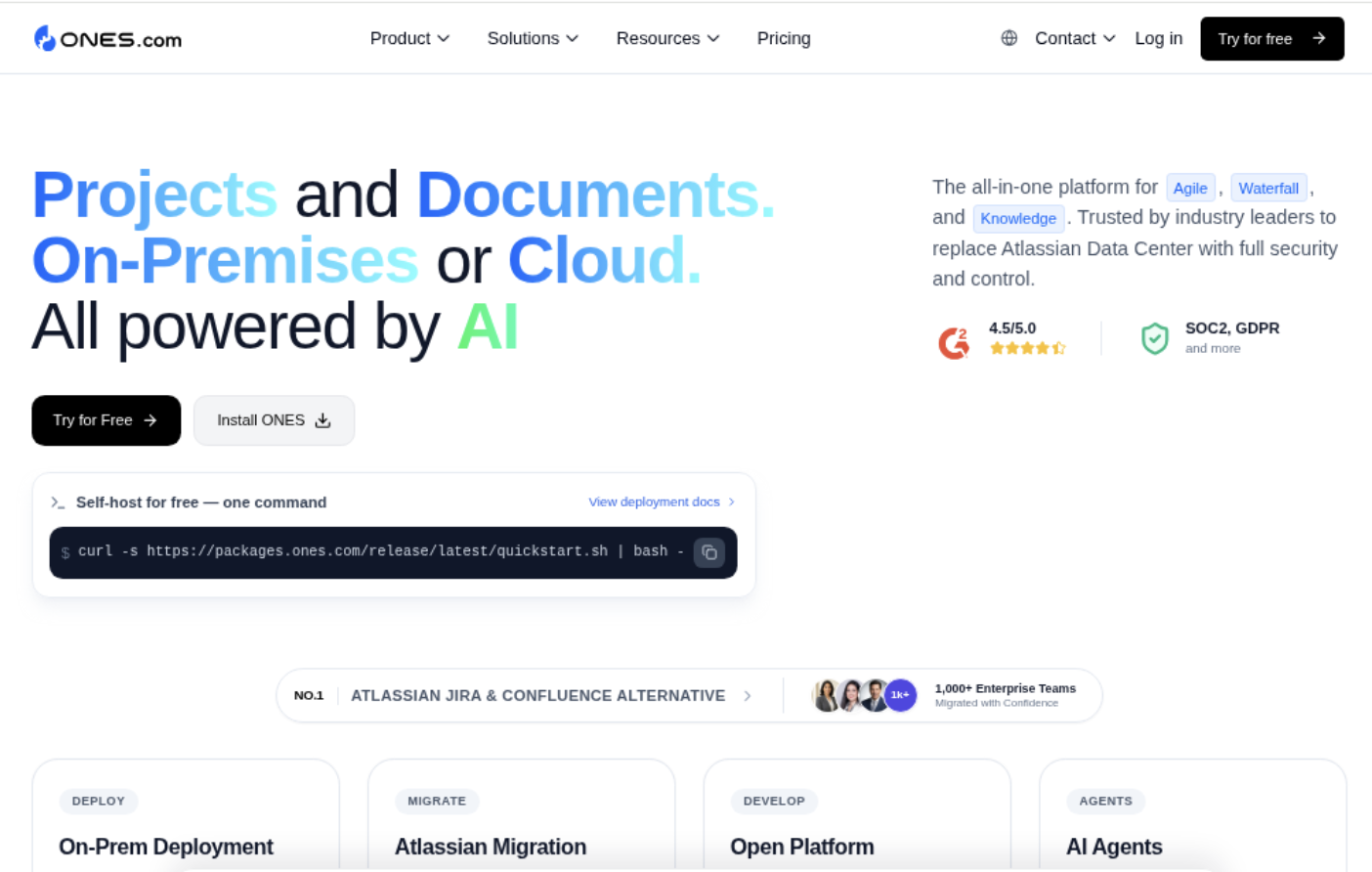
ONES.com is a unified platform for project management and knowledge management. It can suit teams that want deployment control, native project workflows, and fewer separate extensions to maintain.
ONES Project is the project management product and a Jira alternative. ONES Wiki is the knowledge base product and a Confluence alternative. They are sold separately, so you can evaluate the product that matches your immediate need.
Core Capabilities
- Too many disconnected work tools → ONES Project and ONES Wiki → Project work and team knowledge can be managed through a coordinated platform experience.
- Concern about deployment restrictions → Four deployment options → Teams can choose Cloud, On-Premise, Private Cloud, or Air-gapped deployment according to their operating environment.
- Separate environments create feature gaps → Full feature parity → The self-hosted version provides the same core feature set as the cloud version.
- Jira workflows require a long transition → Jira-compatible workflows → Teams can preserve familiar ways of planning, tracking, and reviewing work during a platform change.
- Reporting depends on several extensions → Built-in reporting → Teams can create visibility into progress without automatically adding another reporting app.
- Different teams need different processes → Custom workflows and fields → Project spaces can reflect approval paths, engineering stages, service processes, or operational requirements.
- Sprint planning is difficult to coordinate → Sprint management → Agile teams can organize iterations, prioritize work, and review progress in one project environment.
- Repetitive actions consume administrator time → Automation → Rules can reduce routine updates and handoffs when configured carefully.
- Teams want gradual adoption → Free access for up to 30 seats → A smaller team can evaluate core capabilities before planning a broader rollout.
Application Scenarios
Restricted-network engineering: A defense contractor may need an air-gapped deployment for sensitive product work. ONES.com provides an air-gapped option while retaining the core capabilities available across its deployment models.
Jira replacement planning: A growing product team may want Jira-compatible workflows without continuing to assemble a large collection of plugins. ONES Project can provide project tracking, sprint management, custom fields, workflows, automation, and reporting in one product.
Private infrastructure requirements: A regulated organization may prefer On-Premise or Private Cloud deployment. It can keep operational control while evaluating whether native capabilities reduce administration overhead.
Common Challenges When Budgeting Self-Hosted Jira
Challenge: The License Quote Looks Like the Full Price
Solution: Create a total-cost worksheet with separate sections for subscription, infrastructure, people, apps, security, recovery, and growth. Require an owner and estimate for every section.
Challenge: Internal Labor Is Difficult to Measure
Solution: Track administration requests for several months or interview the team responsible for similar platforms. Convert expected hours into an annual labor cost using the organization’s internal rate.
Challenge: App Costs Grow After Adoption
Solution: Define essential capabilities before selecting apps. Review overlapping functionality annually and remove extensions that no longer justify their subscription and maintenance effort.
Challenge: The Architecture Is Too Small for Business-Critical Work
Solution: Design for availability, backup, monitoring, and recovery before launch. A low-cost single-node setup may be unsuitable if teams depend on the platform throughout the working day.
Challenge: The Three-Year View Is Missing
Solution: Model implementation, growth, upgrades, infrastructure refreshes, and possible migration. Compare the first-year estimate with the average annual cost across three years.
FAQs
Is Jira self-hosted cheaper than Jira Cloud?
It can be, but there is no universal answer. Self-hosted Jira may work well for organizations with existing infrastructure, experienced administrators, and strong deployment requirements. The calculation changes when you add hosting, backups, apps, security, upgrades, and internal labor. Compare the full three-year operating cost rather than comparing only the Jira subscription with a cloud plan.
Can I still buy Jira Server?
Jira Server is no longer available for new purchases. Teams planning a self-hosted Atlassian deployment generally need to evaluate Jira Data Center instead. Before making a decision, confirm current commercial terms, supported versions, infrastructure requirements, and migration options directly with Atlassian or an authorized partner.
What does Jira Data Center pricing include?
The subscription covers the Jira Data Center product at the selected user tier and under the applicable commercial terms. It does not automatically remove your responsibility for infrastructure, operating systems, network components, backups, monitoring, administration, security work, or third-party apps. Your final cost therefore depends on how much of the surrounding environment your organization already operates.
What hidden costs should I include in a self-hosted estimate?
Include administrator time, infrastructure, storage, backups, recovery testing, monitoring, security reviews, app subscriptions, integration maintenance, upgrade testing, training, and capacity growth. Also estimate the cost of downtime and failed upgrades. These categories often explain why a self-hosted environment costs more than its initial license quote suggests.
When is a Jira alternative worth considering?
Consider an alternative when your current environment depends on many plugins, requires extensive administration, or needs deployment options that fit restricted networks. A comparison should examine workflow compatibility, reporting, automation, custom fields, deployment models, migration effort, and long-term operating cost. The cheapest subscription may not be the lowest-cost platform after maintenance is included.
Conclusion
Jira self-hosted pricing is a total-cost question, not a license-only question. Start with the Data Center subscription, then add infrastructure, apps, administration, security, backups, recovery, and expected growth.
But here’s the truth: self-hosting can deliver valuable control, yet that control has an operating price. A reliable estimate reflects the work required during normal operations and during difficult events.
Use a three-year comparison, test your assumptions with the technical team, and review whether built-in capabilities can replace several extensions. If you need a Jira alternative with Cloud, On-Premise, Private Cloud, and Air-gapped deployment options, ONES.com is worth including in that evaluation.