Jira Server License Pricing: A 2026 Cost Planning Guide
Confused by jira server license pricing in 2026? Learn legacy costs, renewal limits, migration expenses, and replacement options. Read now to plan ahead.
Planning around Jira Server license pricing in 2026 can feel confusing. The product is no longer available for new purchases, yet many teams still operate legacy installations, renew support, or prepare for migration. That creates difficult questions: What did the old license cost? Can you still renew it? What replaces the original annual maintenance bill? The longer you wait, the more likely hidden costs will appear through infrastructure, security, migration work, and new subscriptions. But here’s the truth: there is no new Jira Server purchase price for 2026. The practical task is comparing remaining support obligations with Jira Cloud, Data Center, or another self-hosted platform. This guide gives you a clear planning framework, realistic cost categories, and a replacement option to evaluate.
Jira Server License Pricing in 2026: The Short Answer
Jira Server license pricing refers to the historical cost of Atlassian’s self-managed Jira Server licenses and their associated maintenance. In 2026, Jira Server is retired, so organizations cannot buy a new Server license through Atlassian.
Atlassian ended new Server sales in 2021 and ended official Server support on February 15, 2024. Therefore, a 2026 budget should treat Jira Server as a legacy environment rather than an active purchasing option.
Here’s why: the original Server model used a perpetual license with optional annual maintenance. Your current cost may still include support renewal, hosting, backups, administration, security work, plugins, and migration preparation.
- New Server licenses: no longer available through Atlassian.
- Existing Server licenses: may continue operating under legacy rights, depending on your agreement.
- Official Server support: ended in February 2024.
- Common 2026 alternatives: Jira Cloud, Jira Data Center, or another self-hosted project management platform.
- Main planning risk: comparing only license fees while ignoring infrastructure and operational work.
The best part? You can still create a useful 2026 estimate by separating historical license ownership from future operating costs.
How the Old Jira Server Cost Model Worked
Jira Server pricing had two main components: a one-time perpetual license and annual maintenance. The perpetual license allowed continued use of a specific major version, while maintenance generally provided updates and support during the paid period.
For example, a 100-user team might have paid a one-time license fee, then renewed maintenance each year. The renewal was usually lower than the initial purchase, but the team still carried hosting, administration, storage, backup, and marketplace app costs.
| Cost component |
What it covered |
2026 planning question |
| Perpetual license |
Right to run the purchased Server edition |
Do you already own a valid license? |
| Annual maintenance |
Support and eligible product updates during the term |
Is renewal still available under your agreement? |
| Infrastructure |
Servers, storage, networking, and operating systems |
What does the environment cost to keep available? |
| Marketplace apps |
Additional functions such as testing, reporting, or asset management |
Which apps still work, and which need replacement? |
| Administration |
Upgrades, monitoring, backups, permissions, and troubleshooting |
How many staff hours does the system require? |
| Migration |
Assessment, cleanup, testing, training, and cutover |
What one-time work is required before a transition? |
Let me explain: a low historical license price does not automatically mean a low current cost. A self-managed environment can require more operational attention than a subscription platform.
Perpetual licensing versus subscription pricing
A perpetual license is paid once, while a subscription is paid monthly or annually. The comparison looks simple, but the ownership model changes your responsibilities.
With a perpetual Server license, you generally manage the application environment yourself. With Cloud, the vendor manages much of the hosting layer. With Data Center, you still manage significant infrastructure, availability, and administration.
Consider a 75-person team. Its old Server maintenance bill may appear modest beside a new subscription. However, adding two administrators, cloud infrastructure, backup services, and security reviews can reverse the comparison.
Why historical price lists can mislead you
Older pricing pages may show license tiers that no longer represent a purchasable product. They can also exclude apps, taxes, partner services, infrastructure, and internal labor.
Use old numbers only to understand what your organization originally bought. Do not treat them as a 2026 quote. Your current decision requires a total-cost view across licensing, operations, risk, and migration.
What Changed After Server End of Support?
Atlassian’s Server retirement changed the question from “How much does renewal cost?” to “What operating model should replace this environment?” That shift affects finance, IT, security, procurement, and project teams.
End of support does not necessarily mean your installation stops working on a specific day. It means official maintenance and security coverage are no longer available in the normal Server model. That distinction matters when you assess operational risk.
Security and compliance exposure
An unsupported application may continue running, but newly discovered vulnerabilities can create urgent remediation work. Your security team may also require compensating controls, network isolation, or a transition deadline.
For example, a regulated company might keep a legacy instance temporarily isolated while migrating active projects. That can reduce exposure, but it also adds access controls, monitoring, and approval steps.
Marketplace app dependency
Many Jira Server installations rely on apps for test management, time tracking, reporting, automation, or asset workflows. App retirement can become a larger problem than the core platform itself.
Create an application inventory before choosing a replacement. Record each app’s purpose, active users, critical workflows, replacement options, and historical information that must remain accessible.
Internal expertise and hiring pressure
Server administration skills may become harder to maintain when fewer teams run the retired product. A key administrator leaving can expose undocumented workflows and fragile integrations.
That risk is measurable. Estimate the hours spent on upgrades, incident response, access requests, performance checks, and backup testing during a typical quarter.
How to Build a 2026 Cost Plan
A dependable estimate starts with the current environment, then adds future options. Follow these steps to avoid comparing one narrow price against another complete budget.
- Confirm your license position. Identify whether you own a perpetual Server license, an active maintenance agreement, or only an operational installation.
- Count actual users. Separate licensed users, occasional viewers, external collaborators, service accounts, and inactive accounts.
- List every paid extension. Include marketplace apps, integrations, reporting tools, test management, automation, and authentication services.
- Calculate operating work. Estimate administrator time for maintenance, backups, monitoring, upgrades, security reviews, and incident handling.
- Estimate infrastructure. Include compute, storage, networking, disaster recovery, backup retention, monitoring, and secondary environments.
- Model migration work. Add discovery, workflow cleanup, testing, data transfer, permissions review, training, and post-launch support.
- Compare replacement models. Evaluate Cloud, Data Center, and self-hosted alternatives using the same user count and capabilities.
- Add contingency. Reserve funds for custom integrations, unexpected cleanup, app replacement, and temporary dual operation.
- Choose a decision date. A defined deadline prevents a legacy environment from becoming a permanent exception.
You might be wondering: should you include sunk license costs? Usually, no. Include them for historical reporting, but focus your decision on future cash costs, staff effort, risk, and business continuity.
A simple total-cost formula
Use this planning formula:
Annual operating cost = platform fees + app fees + infrastructure + administration + security controls + support + migration allocation.
For a legacy environment, platform fees may be small while administration and risk controls are large. For a cloud subscription, platform fees may rise while infrastructure and routine maintenance decline.
Build three scenarios
Create at least three scenarios: keep temporarily, migrate to a vendor-hosted service, and move to a self-hosted replacement. Each scenario should use the same planning horizon, such as three years.
A three-year view helps reveal transition costs. A solution that looks expensive in year one may become more predictable after migration, while a legacy environment may accumulate rising support and risk costs.
Jira Cloud, Data Center, and Self-Hosted Alternatives
There is no single replacement path for every team. The right choice depends on security requirements, administrative capacity, workflow complexity, user location, and tolerance for infrastructure work.
| Option |
Good fit for |
Cost pattern |
Planning concern |
| Jira Cloud |
Teams that prefer vendor-managed hosting |
Recurring subscription, plus apps and services |
Migration, customization limits, and subscription growth |
| Jira Data Center |
Large organizations needing self-managed deployment |
Annual subscription with infrastructure costs |
Capacity, availability, administration, and support requirements |
| Self-hosted alternative |
Teams requiring deployment control or restricted networks |
License or subscription plus infrastructure and administration |
Feature fit, migration effort, integrations, and vendor maturity |
Here’s why comparisons often fail: teams compare the old Server renewal to only the new platform fee. A fair comparison includes user access, workflow coverage, integrations, administration, security, and transition work.
When Cloud is attractive
Cloud can reduce routine infrastructure duties and simplify access for distributed teams. It may suit organizations with standard workflows and limited requirements for network isolation.
However, recurring fees can grow as the team expands. Review identity management, retention, integration limits, automation usage, and app subscriptions before approving a move.
When Data Center makes sense
Data Center may suit organizations that need more control over deployment, availability, or network architecture. It is still a substantial operating environment rather than a simple continuation of Server.
Budget for infrastructure capacity, administrative expertise, upgrade planning, disaster recovery, and annual subscription commitments. The model can work well when self-management is a firm requirement.
When a self-hosted alternative deserves attention
A self-hosted alternative can be useful when your team needs on-premise deployment, an air-gapped environment, or more control over workflows and integrations.
Evaluate it through a pilot. Test permissions, project templates, sprint planning, reporting, automation, integrations, import quality, and administrator experience before making a broad commitment.
Common Cost Traps in Legacy Jira Planning
Most budget surprises do not come from the headline license figure. They appear in surrounding work that was previously treated as routine or invisible.
Ignoring administrator time
A team may report a small annual software bill while several employees spend hours every week maintaining the environment. Assign an internal hourly rate to those activities and include the result.
Keeping inactive accounts
Old accounts can affect subscription tiers, access reviews, permissions, and migration scope. Remove inactive access where appropriate and separate occasional viewers from regular contributors.
Recreating every historical workflow
Migration is an opportunity to retire unused statuses, custom fields, notifications, and automations. Rebuilding everything can increase cost without preserving business value.
Forgetting temporary dual operation
Many teams run the old and new environments together during testing and rollout. Budget for overlapping subscriptions, administration, training, and support rather than assuming an instant cutover.
Underestimating integration work
Single sign-on, source control, chat alerts, reporting, service management, and custom scripts may need new connections. Test the highest-value integrations early.
ONES.com is a unified platform for project management and knowledge management, powered by AI through ONES Assistant. ONES Project is its project management product and can serve as a Jira alternative, while ONES Wiki is its knowledge base product and can serve as a Confluence alternative. They are sold separately.
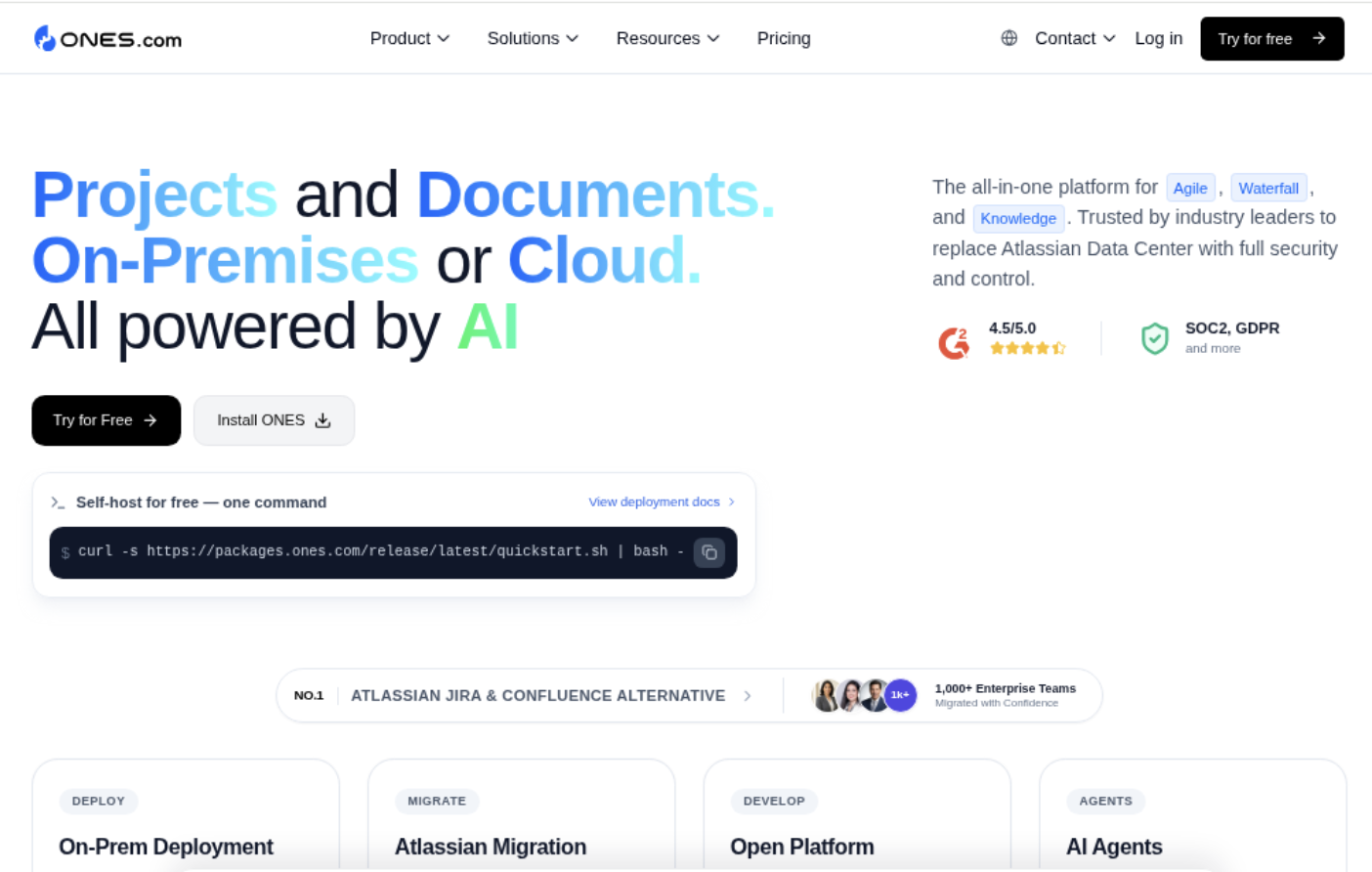
For teams planning beyond retired Server licensing, ONES.com is worth evaluating when deployment control, workflow continuity, and reduced plugin dependence matter. It supports Cloud, On-Premise, Private Cloud, and Air-gapped deployments, with feature parity between cloud and self-hosted versions.
Core Capabilities
Jira-like workflows
Pain: A migration can disrupt statuses, approvals, assignments, and issue movement.
ONES capability: ONES Project supports Jira-compatible workflows and configurable process design.
Result: Your team can map familiar delivery processes while refining unnecessary steps during migration.
Custom fields and workflows
Pain: Generic templates may force teams to abandon important project attributes.
ONES capability: You can configure custom workflows and custom fields for different project types.
Result: Engineering, product, operations, and compliance teams can retain distinct processes without multiplying separate systems.
Sprint management
Pain: Agile teams need reliable planning, execution, and review cycles after moving platforms.
ONES capability: ONES Project includes sprint management for iterative delivery.
Result: Teams can plan work, monitor progress, and maintain familiar sprint routines during platform change.
Built-in reporting
Pain: Replacing a reporting app can add cost and create inconsistent metrics.
ONES capability: Built-in reporting supports common project visibility needs without requiring as many separate plugins.
Result: Administrators can reduce extension dependency and give stakeholders a more consistent view of progress.
Automation
Pain: Manual transitions, notifications, and repetitive assignments consume administrator and team time.
ONES capability: Automation helps handle repeatable project actions.
Result: A migration plan can preserve practical workflow rules instead of recreating every action manually.
Deployment choice
Pain: Some organizations cannot place project systems entirely in a public cloud.
ONES capability: ONES.com supports Cloud, On-Premise, Private Cloud, and Air-gapped deployments.
Result: Security and infrastructure teams can select a deployment model that matches network and compliance constraints.
Self-hosted feature parity
Pain: Self-hosted products sometimes provide fewer capabilities than their cloud editions.
ONES capability: ONES.com states that its cloud and self-hosted versions have full feature parity.
Result: You can evaluate deployment location without assuming that self-hosting requires major feature concessions.
Separate knowledge management
Pain: Project tracking and team knowledge often become scattered across unrelated tools.
ONES capability: ONES Wiki provides a knowledge base option, while ONES Project handles project management.
Result: You can choose the products separately and connect project delivery with team knowledge where appropriate.
Application Scenarios
Scenario one: a regulated engineering team. The team needs an air-gapped deployment, sprint planning, custom approval stages, and internal reporting. It can pilot ONES Project in an air-gapped environment while testing permissions and workflow mapping.
Scenario two: a mid-sized product organization. The organization wants to reduce marketplace app dependence and move away from unsupported Server operations. It can inventory current workflows, rebuild only active processes, and evaluate built-in reporting and automation.
Scenario three: a distributed delivery group. The group needs project management plus a separate knowledge base. It can assess ONES Project and ONES Wiki independently, then decide whether both products fit its collaboration model.
Common Challenges and Practical Solutions
Challenge: no current Server quote
Solution: Stop treating Server as a normal purchase option. Record the historical license position, then compare future operating models using a three-year total-cost estimate.
Challenge: unclear user counts
Solution: Review active access, project participation, external collaboration, and service accounts. Remove inactive access before modeling subscription tiers.
Challenge: too many custom workflows
Solution: Classify each workflow as essential, useful, or obsolete. Rebuild essential processes first and retire steps that no longer support a current business outcome.
Challenge: migration disruption
Solution: Use a pilot project, test permissions and integrations, train representative teams, and schedule a controlled cutover with rollback planning.
Challenge: security approval delays
Solution: Involve security and infrastructure teams early. Confirm deployment options, identity controls, encryption expectations, backup design, network access, and audit requirements before selecting a platform.
FAQs
Can I buy a new Jira Server license in 2026?
No. Atlassian ended new Server sales in 2021, and Jira Server support ended on February 15, 2024. An organization may still operate an existing installation under its historical rights, depending on its agreement. However, a 2026 budget should not assume that a new Server purchase or normal support renewal is available. Compare migration and replacement options instead.
Does an existing perpetual license mean Jira Server is free to operate?
No. A perpetual license may reduce or remove a new software purchase, but operating costs remain. You may still pay for infrastructure, backups, monitoring, administration, security controls, marketplace apps, and support services. Unsupported software can also create risk-related costs. Calculate the full annual operating burden before deciding that retaining the environment is cheaper.
What should I include in a 2026 Jira cost estimate?
Include platform fees, user tiers, extensions, infrastructure, administrator time, security work, backup and recovery, integrations, training, migration, and temporary overlap between systems. Use the same user count and feature requirements for every option. A three-year estimate is usually more useful than a single annual figure because migration and transition expenses often occur early.
Should I choose Jira Cloud or Data Center after Server?
Cloud may fit teams that want vendor-managed hosting and simpler infrastructure operations. Data Center may fit organizations that need self-managed deployment and greater control over their environment. Neither choice is automatically cheaper. Compare security requirements, infrastructure capacity, administration, integrations, availability expectations, user growth, and subscription costs before selecting a path.
Can ONES.com replace Jira Server?
ONES Project can be evaluated as a Jira alternative for project management workflows, including custom workflows, custom fields, sprint management, automation, and reporting. ONES.com also supports Cloud, On-Premise, Private Cloud, and Air-gapped deployments. Run a pilot using representative projects, permissions, integrations, reports, and migration requirements before making a final decision.
How can I reduce migration costs?
Start by removing inactive accounts, unused apps, obsolete workflows, duplicate fields, and outdated automations. Choose a representative pilot rather than migrating every project immediately. Test high-value integrations early and define what historical activity must remain accessible. Clear scope prevents your team from spending time recreating processes that nobody uses.
Conclusion
Jira Server license pricing is no longer a normal 2026 buying question because new Server sales have ended and official support is over. The useful question is how much it costs to keep a legacy environment running compared with moving to Cloud, Data Center, or a self-hosted alternative.
Start with your license position, user count, apps, infrastructure, administration, security exposure, and migration scope. Then compare three-year scenarios rather than headline license fees.
But here’s the truth: delaying a decision does not eliminate cost. It usually shifts spending into administration, risk controls, emergency migration work, or duplicated systems. A focused inventory and a controlled pilot can turn an uncertain legacy expense into a clear 2026 transition plan.