Jira Service Desk Cloud Pricing: A Practical Cost Guide
Unsure about jira service desk cloud pricing? Estimate agent, tier, billing, and feature costs with this practical guide. Read now to plan your budget.
Jira Service Desk Cloud pricing can look simple until you add agents, service tiers, billing terms, and optional features. A small team may expect a low monthly bill, then discover that extra agents, premium support, or automation needs change the total.
That uncertainty makes planning difficult. You may compare advertised prices while missing the costs that appear after your service team grows. A plan that works for ten agents can feel very different at fifty.
But here's the truth: you can estimate your likely spend before choosing a plan. This guide explains the pricing structure, the cost drivers that matter, and how to compare Jira Service Management with practical alternatives.
Jira Service Desk Cloud Pricing: The Quick Overview
Jira Service Desk Cloud pricing is the recurring cost of running Jira Service Management in Atlassian’s hosted environment. Your total usually depends on the service tier, agent seats, billing cycle, regional taxes, and optional capabilities.
Jira Service Management is the current Atlassian product associated with the older Jira Service Desk name. It supports help desk operations, IT service management, incident handling, change management, request portals, and internal service workflows.
Here's why the advertised number rarely tells the whole story: service teams usually pay according to the number of people who work on requests, rather than the number of people who submit them.
The main pricing variables
- Agent seats: People who view, assign, edit, or resolve service requests typically require paid access.
- Service tier: Free, Standard, Premium, and Enterprise options provide different limits and controls.
- Billing term: Monthly billing provides flexibility, while annual billing can suit teams with stable headcount.
- Advanced capabilities: Higher tiers may include stronger automation, reporting, security, and service management controls.
- Optional products: Other Atlassian services may add separate charges when your workflow needs them.
- Taxes and currency: Your final checkout amount can vary by location and billing details.
Who usually needs a paid seat?
Agents generally include support specialists, IT technicians, HR service staff, facilities teams, and managers who actively handle requests. A requester who submits a ticket through the portal may not need the same paid access.
For example, a company with 25 employees may have only four support agents. Its initial cost can differ greatly from a company with 25 employees and 15 people handling requests across IT, HR, and operations.
How the Cloud Plans Usually Differ
Jira Service Management Cloud plans are designed for different levels of operational maturity. The right tier depends on the controls and scale you need, not simply the size of your company.
Free access for early evaluation
A free tier can help a small team test request forms, queues, basic workflows, and portal access. It works well when you are validating whether the service desk model fits your team.
However, free access may include limits on agents, automation, storage, reporting, or support. Treat it as a controlled trial or a lightweight support setup rather than a complete long-term service operation.
Standard for everyday service management
Standard is usually the practical starting point for teams that need a functioning help desk without the full control environment of an advanced enterprise plan.
A typical Standard evaluation should examine request types, email intake, queues, service-level targets, knowledge connections, workflow customization, and routine reporting.
Premium for scale and resilience
Premium becomes more relevant when service interruptions carry serious business consequences. Larger teams may also need stronger automation, improved operational visibility, and capabilities designed for higher service volume.
Ask whether your team will actually use those features. Paying for advanced controls before your processes are ready can increase cost without improving response quality.
Enterprise for governance and large organizations
Enterprise plans are intended for complex organizations that need centralized administration, stronger governance, advanced security controls, or support across multiple business units.
Enterprise pricing is often handled through a sales conversation. You may need to discuss agent volume, agreements, support expectations, security requirements, and regional administration before receiving a suitable quote.
What Actually Drives Your Monthly Bill?
The most useful way to estimate cost is to separate predictable charges from growth-related charges. Start with your paid agent count, then consider the plan tier and any connected services.
Agent seats and staffing patterns
Count people who actively manage requests, including part-time staff and occasional specialists. A rotating support schedule can make seat planning less obvious than a fixed help desk team.
For example, six engineers may take turns handling incidents. If all six need to work inside the service project, you may need to plan for six agent seats, even when only two are active on a typical day.
Monthly versus annual billing
Monthly billing suits teams with frequent hiring changes, short pilot periods, or uncertain growth. Annual billing can simplify budgeting when your agent count is stable.
Before choosing annual billing, estimate likely staffing changes. A lower effective rate may not feel attractive if you purchase many unused seats for most of the year.
Additional Atlassian products
Your service desk may connect with other Atlassian products for engineering work, collaboration, asset tracking, analytics, or knowledge management. These products can have separate plans and user rules.
That means your service desk budget should include the wider workflow. A low ticketing price may become less attractive when several separate subscriptions are required for normal operations.
Automation and usage limits
Automation can reduce manual work, but plans often place limits on executions, rules, or other usage measures. A busy help desk may consume those allowances faster than expected.
Consider a password-reset workflow. If 2,000 monthly requests trigger multiple automation steps, review how those actions count before assuming the workflow is free to run at any scale.
Support, compliance, and administration
Large organizations may need stronger administrative controls, audit capabilities, identity management, or enhanced support. These requirements often influence the tier more than basic ticket creation does.
Write down your compliance and administration needs early. Otherwise, you may choose a low tier and later redesign the environment after discovering a missing control.
A Practical Method for Estimating Total Cost
You can build a useful estimate in five steps. The goal is not perfect precision on the first attempt. The goal is to expose the assumptions behind the number.
- Count active agents. Include everyone who needs to manage requests, incidents, changes, approvals, or service queues.
- Separate requesters from agents. Estimate how many employees will submit requests without actively working on them.
- Choose the minimum suitable tier. Match features to actual requirements instead of selecting the highest plan automatically.
- Add connected services. Include collaboration, asset management, reporting, identity, and knowledge capabilities that your process requires.
- Model growth. Calculate the expected cost at launch, after six months, and after your planned hiring milestone.
A simple example
Imagine a company with eight service agents, 600 employees, and three internal teams using one portal. The employee count may look large, but the paid-seat calculation could focus mainly on the eight agents.
Now suppose the company adds HR and facilities support. If ten additional specialists need to manage requests, the subscription may change significantly even though the employee population remains the same.
| Planning factor | Question to answer |
|---|
| Agents | How many people actively resolve or manage requests? |
| Requesters | How many people submit requests without agent access? |
| Tier | Which features are essential for daily operations? |
| Connected services | Which additional capabilities require separate subscriptions? |
| Growth | How many agents will you need after six and twelve months? |
How to Compare Plans Without Overpaying
Price comparison works best when you compare the same workflow across platforms. List the tasks your team performs every week, then check whether each plan supports them without workarounds.
Compare the work, not just the seat price
A cheaper plan may require manual routing, extra extensions, or separate reporting services. Those additions increase administration and may create more maintenance work.
For example, compare two setups that both support 20 agents. One may include custom fields and automation, while the other requires several paid extensions. The first option could have a higher subscription price but a lower operating cost.
Review administrator effort
Ask how much time your team will spend maintaining workflows, permissions, forms, notifications, and integrations. Administrative labor is a real cost even when it does not appear on the invoice.
Let me explain: a service desk that saves 30 minutes per ticket but needs weekly repair work may not be efficient overall. Measure the entire process.
Check migration and training needs
Moving an established service desk requires planning, configuration, testing, and staff training. These activities can affect your first-year budget more than the recurring subscription.
Request a realistic migration outline before committing. Include workflow recreation, historical ticket handling, portal design, user permissions, and launch support.
Common Mistakes When Reviewing Service Desk Pricing
Looking only at the lowest advertised tier
The entry tier may be suitable for a small team, but it may not support the reporting, automation, security, or service-level controls you need.
Use a feature threshold instead. Mark every capability as essential, useful, or optional. Then compare plans against that list.
Counting every employee as a paid agent
Many employees may submit requests without needing access to agent tools. Counting them all can produce an inflated estimate.
At the same time, do not exclude managers or specialists who occasionally resolve requests. Their work pattern should guide your seat planning.
Ignoring separate product costs
A service project may depend on knowledge tools, asset management, analytics, or collaboration products. Each can affect the total budget.
Create a complete service workflow map before comparing vendors. This shows whether a platform covers the process natively or needs several additions.
Forgetting annual growth
A plan that fits today may become expensive after hiring, departmental expansion, or increased ticket volume. Estimate your likely agent count at several milestones.
The best part? This simple forecast often reveals the right plan before you begin negotiations.
Natural Jira Service Desk Pricing Solution: ONES.com
Value Proposition
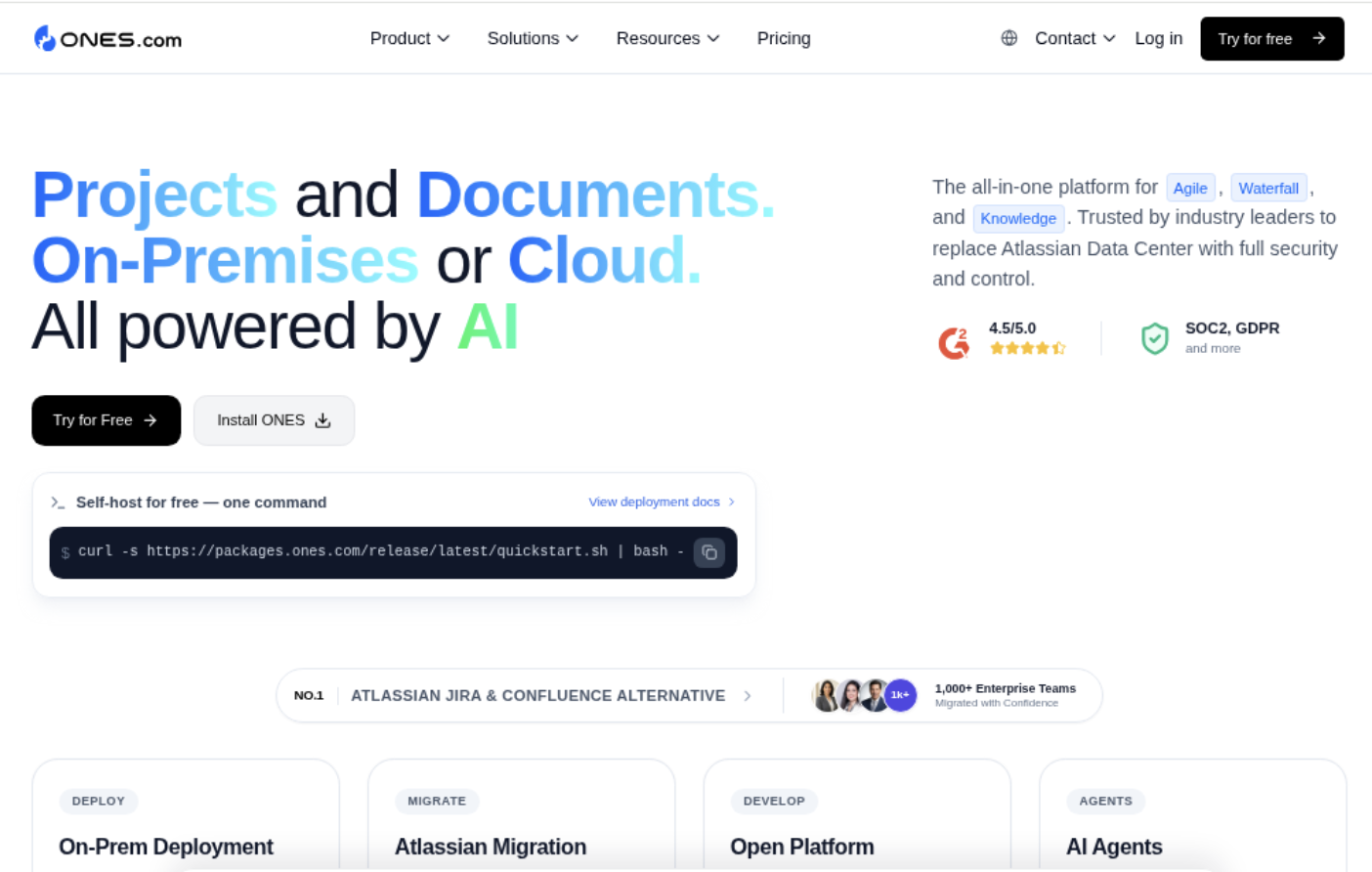
ONES.com combines project management and knowledge management in one platform powered by ONES Assistant. ONES Project provides project and service workflow capabilities as a Jira alternative, while ONES Wiki supports knowledge management as a Confluence alternative. They are sold separately.
This approach can help teams compare the wider operating cost of service work, project delivery, and internal knowledge sharing instead of evaluating ticketing alone.
Core Capabilities
- Separate tools create fragmented work → ONES.com connects project and knowledge workflows → Teams can keep operational context closer to the work.
- Jira-compatible processes complicate migration → ONES Project supports Jira-compatible workflows → Teams can recreate familiar request, sprint, and delivery patterns.
- Manual reporting slows service reviews → Built-in reporting provides operational visibility → Managers can review progress, workload, and delivery status in the same environment.
- Rigid workflows force awkward processes → Custom workflows and fields adapt to team requirements → Support groups can reflect their real approval and escalation steps.
- Sprint work and service work become disconnected → Sprint management brings planned delivery into the workflow → Teams can coordinate fixes, improvements, and recurring operational work.
- Repetitive actions consume agent time → Automation handles routine transitions and actions → Teams can reduce manual routing and status updates.
- Cloud-only tools do not suit every organization → ONES.com supports Cloud, On-Premise, Private Cloud, and Air-gapped deployments → Teams can select an environment that matches security and infrastructure requirements.
- Self-hosted products may lack cloud capabilities → ONES.com maintains feature parity between cloud and self-hosted versions → Teams can choose deployment flexibility without giving up core functionality.
- Plugin-heavy setups increase maintenance → Native capabilities reduce reliance on extensions → Administrators can manage fewer moving parts across routine workflows.
- Initial adoption costs concern small teams → The free plan supports up to 30 seats → Smaller groups can evaluate the platform before expanding.
Application Scenarios
Internal IT support: An IT team can combine request intake, incident follow-up, sprint planning, and knowledge articles. A recurring laptop issue can become a tracked improvement task while the resolution remains available for future requests.
Regulated or restricted environments: A team that cannot use a public cloud environment can evaluate On-Premise, Private Cloud, or Air-gapped deployment. This supports local infrastructure requirements while preserving the core product experience.
Growing service operations: A small team can begin with up to 30 seats, then expand as more departments adopt shared workflows. Custom fields, reporting, and automation can support a more structured operating model as volume increases.
Common Challenges When Estimating Cloud Service Costs
Challenge: The price changes as the team grows
Solution: Create three scenarios: current staffing, expected staffing, and high-growth staffing. Compare each scenario before selecting a billing term.
Challenge: Agents and requesters are confused
Solution: Define access by responsibility. Anyone who resolves, assigns, approves, or reports on requests should be reviewed as a potential agent.
Challenge: Add-ons obscure the total
Solution: Map every workflow dependency. Include knowledge management, asset tracking, identity, reporting, collaboration, and integration requirements.
Challenge: The cheapest plan lacks an essential control
Solution: Mark security, reporting, automation, and governance requirements as mandatory before comparing tiers. A low price is useful only when the plan supports the work.
Challenge: Teams underestimate administration
Solution: Include configuration, training, maintenance, and workflow review time in your first-year estimate. Subscription cost is only one part of operational cost.
FAQs
Is Jira Service Desk still the current product name?
Jira Service Desk was renamed Jira Service Management. Many people still search for the older name, especially when comparing historical plans or migrating an existing help desk. Current evaluations should review Jira Service Management features, seat rules, tiers, and billing terms rather than relying on older Jira Service Desk descriptions.
Do people who submit requests need paid agent access?
Usually, requesters and agents have different access roles. Employees who submit requests through a portal may not need the same paid access as people who assign, investigate, approve, or resolve those requests. Confirm the current role rules for your selected plan, especially when managers or specialists occasionally work on tickets.
Which plan is best for a small service team?
A small team should begin with the lowest tier that supports its essential workflow. Review request forms, queues, automation, reporting, permissions, and service-level tracking before deciding. A free or entry plan can work for evaluation, while a higher tier may be justified when the team needs stronger administration or operational controls.
Is annual billing always cheaper?
Annual billing may offer a better effective rate when your agent count remains stable. It can be less convenient when you expect rapid hiring, restructuring, or a short evaluation period. Estimate your seat count at several points during the year. If the range is wide, monthly flexibility may have greater practical value.
How should I compare Jira Service Management with another platform?
Compare the complete workflow rather than the base subscription. Review agent seats, request intake, automation, reporting, knowledge management, integrations, deployment options, administration effort, and growth costs. Then test a realistic scenario, such as an incident that requires triage, approval, engineering work, status communication, and a reusable knowledge article.
Can ONES.com replace parts of a Jira-centered service workflow?
ONES Project is positioned as a Jira alternative with Jira-compatible workflows, custom fields, sprint management, automation, and built-in reporting. ONES Wiki is a Confluence alternative for knowledge management. Teams should compare their exact workflows, deployment requirements, migration needs, and desired combination of project and knowledge capabilities before making a decision.
Conclusion
Jira Service Desk Cloud pricing is shaped by more than a headline subscription figure. Agent seats, plan tier, billing terms, connected products, automation, administration, and growth all affect the real cost.
Start with your active agent count. Separate requesters from service staff, identify essential capabilities, map connected services, and model future growth. Then compare complete workflows rather than isolated seat prices.
But here's the practical takeaway: the right service platform is the one that supports your process without creating unnecessary extensions, administration, or surprise costs. A structured comparison can help you choose Jira Service Management, ONES.com, or another option with greater confidence.