Jira Service Desk Pricing Explained: Plans, Costs, and Fees
Confused by service desk jira pricing? Compare plans, agent costs, fees, limits, and add-ons to budget accurately. Click to discover!
Jira Service Desk pricing can look simple until you compare agents, plans, billing periods, add-ons, and usage limits. A small support team may expect a low monthly bill, then discover that extra agents, premium features, or marketplace apps change the total.
That uncertainty makes planning difficult. You may compare the headline price while missing customer access rules, annual commitments, tax, or premium automation limits. A plan that suits five agents can become expensive for fifty.
Here’s the practical solution: compare Jira Service Management plans by agent seats, included capabilities, billing method, and additional fees. This guide explains each cost area so you can estimate a realistic service desk budget.
Jira Service Desk Pricing: Plans and Core Costs
Jira Service Desk pricing is primarily calculated by the number of service agents you license, the plan you choose, and whether you pay monthly or annually. Customers who submit requests generally do not require paid agent seats.
Atlassian now calls Jira Service Desk Jira Service Management. The product still supports service portals, request queues, automation, knowledge sharing, incident response, change management, and asset-related workflows.
Here’s why the pricing can feel complicated: your real cost depends on more than the advertised per-agent rate. You also need to consider plan limits, premium capabilities, taxes, marketplace apps, and possible increases in agent count.
| Plan |
Typical fit |
Pricing approach |
Important considerations |
| Free |
Small teams testing service management |
No subscription charge within the plan limits |
Limited agent capacity and reduced administration features |
| Standard |
Growing internal or customer support teams |
Per-agent subscription |
Core service management features with practical team limits |
| Premium |
Teams needing advanced operations and higher scale |
Higher per-agent subscription |
Advanced incident capabilities, stronger administration, and higher limits |
| Enterprise |
Large organizations with complex governance |
Custom quotation |
Negotiated terms, enterprise administration, and commercial review |
Free plan
The Free plan can work for a small service desk with a limited number of agents. It lets you test request forms, queues, portals, and basic automation before committing to a paid subscription.
Its limits matter. A team may outgrow the free tier when it adds agents, requires advanced permissions, needs greater automation capacity, or manages several service projects.
Standard plan
Standard is usually the practical starting point for a professional service desk. It supports common workflows for IT support, employee requests, customer service, and operational teams.
Public list pricing has commonly placed Standard around the low-twenties per agent each month. Treat that figure as an estimate because prices, currencies, discounts, and billing terms can change.
Premium plan
Premium targets organizations that need broader operational coverage. Typical reasons to consider it include advanced incident response, higher service limits, stronger availability expectations, and more sophisticated administration.
Premium pricing has commonly appeared near the fifty-dollar-per-agent monthly range. Your final quote can differ because Atlassian may adjust rates and apply different terms by region or billing schedule.
Enterprise plan
Enterprise pricing is negotiated rather than displayed as one universal per-agent figure. It may suit companies managing multiple teams, regions, security requirements, or complex purchasing processes.
You might be wondering: when does Enterprise become relevant? Consider it when governance, contract requirements, analytics, or organizational scale matter more than simple seat pricing.
What You Actually Pay For
The main cost driver is usually the number of people who work inside the service desk. These agents triage requests, reply to customers, assign work, update statuses, and manage queues.
Customers who open requests through a portal generally do not need paid agent licenses. However, a customer who also performs service desk work may need an agent seat.
For example, a company with eight support agents and 300 employees may pay for eight agents, rather than 308 people. The exact access rules still deserve review before purchase.
Agent seats
Count every person who needs agent permissions across your service projects. Include help desk staff, escalation engineers, service owners, and managers who actively handle requests.
A common mistake is counting only the primary support team. If five engineers occasionally resolve tickets, their access can affect the subscription total.
Customers and portal access
Portal customers can typically submit requests, follow updates, and communicate with agents without consuming the same paid seats. This structure keeps service desk pricing manageable for large employee populations.
Consider an HR help desk serving 2,000 employees. If only six HR specialists handle requests, the license count may reflect those six agents rather than the entire workforce.
Monthly versus annual billing
Monthly billing gives you flexibility when your team size changes. Annual billing can simplify budgeting and may use a different rate structure or user tier.
Use monthly billing during a pilot or uncertain growth period. Annual billing can make more sense after your agent count and service model become stable.
Taxes and currency
Displayed prices may exclude taxes, depending on your location and account details. Your payment total can also change when your billing currency differs from the displayed currency.
Leave room for local taxes during procurement. A small difference in monthly pricing becomes more visible across dozens of agents and several billing cycles.
Jira Service Management Features by Plan
Pricing makes more sense when you connect each tier to a business requirement. The cheapest plan is useful only when it covers the work your team actually performs.
| Capability |
Why it matters |
Plan consideration |
| Request portals |
Gives employees or customers a structured way to ask for help |
Available in the core service experience |
| Queues |
Helps agents sort work by urgency, category, or ownership |
Important for daily service desk operations |
| Automation |
Reduces repetitive assignment, notification, and status work |
Limits and advanced capabilities vary by plan |
| Incident management |
Coordinates response when a critical service is disrupted |
Advanced operational features are associated with higher tiers |
| Change management |
Controls approvals and risk around technical changes |
Useful for IT teams with formal release processes |
| Assets and configuration tracking |
Connects requests with equipment, services, or relationships |
Check included limits and plan-specific capabilities |
Service portals and request forms
A portal gives people a cleaner alternative to sending support requests through scattered email threads. Forms can collect the details agents need at the beginning.
For example, a laptop request can ask for location, department, device type, manager approval, and required delivery date. Better intake reduces follow-up messages.
Queues and workflow controls
Queues help teams prioritize requests without manually searching every ticket. You can create views for urgent incidents, unassigned work, aging requests, or specific departments.
Workflow controls add structure to approvals and handoffs. A purchase request might move from “Submitted” to “Manager approval,” then “Procurement,” and finally “Completed.”
Automation and operational limits
Automation can assign requests, send reminders, update fields, and escalate overdue work. It saves time when repetitive actions happen hundreds of times each month.
Plans may apply limits to automation executions, storage, or other operational areas. Review those limits if your team expects high request volume.
Extra Fees and Cost Factors to Check
The subscription is only one part of a service desk budget. Add-ons, integrations, consulting, and internal administration can create a meaningful second layer of cost.
Here’s the practical approach: estimate the recurring license first, then add predictable operational expenses. This gives you a more realistic total than comparing plan prices alone.
Marketplace apps
You may need an app for advanced time tracking, telephone support, reporting, approvals, customer surveys, or specialized asset management.
App charges can use separate pricing models. Some charge per agent, some charge by application tier, and others use a combination of seats and usage.
Integration and implementation work
Connecting Jira Service Management with identity systems, monitoring platforms, chat tools, email, or asset services may require technical effort.
A simple setup might take a few hours. A regulated environment with custom workflows, permissions, and migration work can require outside consulting or internal engineering time.
Training and administration
Service desk software needs ongoing ownership. Someone must maintain request types, queues, automation rules, permissions, reports, and knowledge articles.
That work may not appear on the vendor invoice, but it still affects your total cost of ownership. A platform that saves agent time can justify this administrative effort.
Storage and usage growth
Attachments, conversation history, screenshots, and operational records can grow steadily. Review storage allowances if customers regularly attach videos, logs, or high-resolution images.
For instance, a technical support team handling 1,000 visual troubleshooting requests can consume storage faster than a small internal help desk.
How to Calculate Your Service Desk Budget
Start with this simple calculation:
Estimated subscription cost = paid agent seats × monthly rate × billing months
Then add taxes, marketplace apps, implementation, training, and a reasonable growth allowance.
Example: small internal help desk
Imagine six agents supporting 400 employees. If the selected plan costs approximately $20 per agent each month, the base subscription is about $120 monthly.
That equals roughly $1,440 across twelve months before taxes, apps, and other services. If two more agents join, the annual license estimate rises to about $1,920.
Example: growing support operation
Now consider 25 agents supporting external customers. A higher plan at approximately $50 per agent each month would create a base estimate near $1,250 monthly.
Across a year, that reaches about $15,000 before taxes and add-ons. A lower plan may reduce the bill, though missing incident or automation capabilities could increase labor costs.
Use a three-scenario estimate
Create conservative, expected, and growth scenarios. Each scenario should show agent count, plan, annual subscription, add-ons, and implementation costs.
- Conservative: current agents and essential capabilities.
- Expected: likely hiring and normal usage growth.
- Growth: additional teams, regions, integrations, and premium requirements.
The best part? This method reveals whether a higher plan could be cheaper overall. One advanced feature may eliminate several manual tasks every week.
When Jira Service Management Offers Good Value
Jira Service Management can offer strong value when your team needs structured service workflows and already works with Jira-related processes.
It is especially suitable when requests connect closely with software development, infrastructure, incident response, or change approvals.
Strong fit for connected technical teams
A development team can link a production incident to engineering work, assign ownership, and track the resolution in one connected workflow.
This reduces handoff friction. An agent does not need to copy every technical detail into a separate tracking system.
Useful for growing internal services
Human resources, facilities, finance, and legal teams can use service projects for employee requests. Each team can create its own forms, queues, permissions, and response targets.
That approach avoids creating a separate email process for every department. Employees gain a consistent place to request help.
Less suitable for simple email-only support
A very small team with low request volume may not need advanced service management features. If three people answer occasional questions, a simpler support tool could cost less.
Compare the subscription against the time your team spends searching messages, chasing approvals, and reporting on unresolved requests. The operational cost matters as much as the license.
Natural Jira Service Management Alternative: ONES.com
Value Proposition
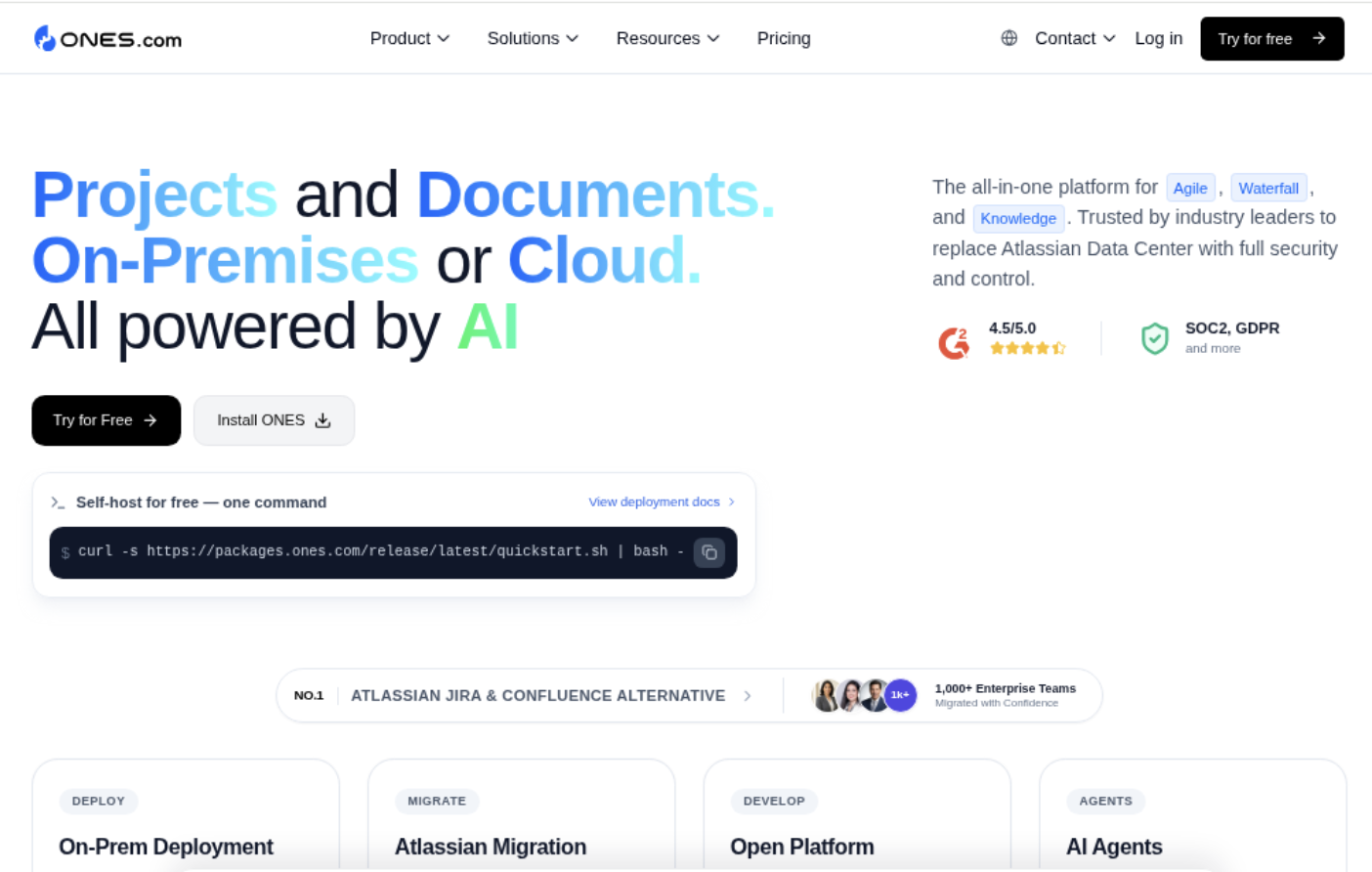
ONES.com combines project management and knowledge management in one platform powered by ONES Assistant. ONES Project provides project management capabilities and can serve as a Jira alternative, while ONES Wiki supports knowledge management as a Confluence alternative.
ONES Project and ONES Wiki are sold separately. The platform offers a free option for up to 30 seats and supports Cloud, On-Premise, Private Cloud, and Air-gapped deployments.
Core Capabilities
- Disconnected service and project work → Jira-compatible workflows: ONES Project connects structured work with project processes, helping technical teams coordinate support-related tasks and delivery work.
- Scattered status reporting → Built-in reporting: Teams can monitor progress, workload, and delivery trends without assembling separate reports manually.
- Rigid request handling → Custom workflows and fields: You can adapt statuses, forms, fields, and approval paths to match internal service processes.
- Unplanned delivery work → Sprint management: Teams can organize support improvements, maintenance work, and development tasks into planned sprints.
- Repetitive administration → Automation: Automated actions can reduce routine assignments, reminders, transitions, and notifications.
- Restricted deployment requirements → Four deployment choices: Cloud, On-Premise, Private Cloud, and Air-gapped options support different infrastructure and security needs.
- Plugin-heavy operations → Native feature parity: The self-hosted version maintains full feature parity with the cloud version, helping reduce dependence on multiple plugins.
- Separated project knowledge → ONES Wiki: Teams can maintain a connected knowledge base when they license ONES Wiki alongside ONES Project.
Application Scenarios
Internal IT support: An IT team can manage incoming requests, connect technical work to project tasks, and publish troubleshooting guidance through ONES Wiki.
Air-gapped engineering: A restricted-network team can run project management in an air-gapped environment while retaining the same core feature set available in the cloud edition.
Growing product organization: A company can start with project workflows, add knowledge management separately, and reduce the number of disconnected tools used across engineering and operations.
Common Challenges When Estimating Costs
Challenge: counting people incorrectly
Teams often count employees instead of paid agents. That creates an inflated estimate and can distort the comparison.
Solution: List every person who needs agent permissions. Separate request submitters from people who actively triage, resolve, approve, or administer service work.
Challenge: comparing headline rates
A low per-agent price may exclude the features your team needs. A higher tier may include automation, incident capabilities, or administration controls that reduce manual effort.
Solution: Map each required capability to the plan that includes it. Then compare the total annual cost, including apps and implementation.
Challenge: overlooking growth
A team may start with five agents and reach fifteen after a new region or department joins. A small pricing difference becomes significant after expansion.
Solution: Model expected agent growth over twelve and twenty-four months. Include likely hires, shared support teams, and temporary administrators.
Challenge: ignoring internal labor
Subscription pricing does not show the time required to build workflows, maintain queues, train agents, and review service performance.
Solution: Estimate setup hours and monthly administration. Compare that effort with the time saved through automation and structured intake.
Challenge: treating all service desks alike
An internal IT desk, a customer support operation, and an engineering incident team have different requirements.
Solution: Define your primary workflow first. Then choose a plan that supports request volume, approvals, reporting, and response expectations for that workflow.
FAQs
Is Jira Service Desk still available under that name?
Jira Service Desk was renamed Jira Service Management. Many people still search for the older name, but the current product supports the same general service desk purpose with expanded IT service management and operational features.
How is Jira Service Management priced?
Pricing generally depends on the plan and the number of licensed agents. Free, Standard, Premium, and Enterprise options serve different levels of scale. Monthly and annual billing can produce different totals, while taxes and add-ons may increase the final amount.
Do customers need paid seats to submit requests?
Customers who submit requests through a service portal generally do not need the same paid agent license. Paid seats usually apply to people who work on requests, manage queues, configure workflows, or administer the service project.
Is the Free plan suitable for a small team?
It can suit a small team testing portals, request forms, queues, and basic workflows. Check the current agent limit and feature restrictions before relying on it for daily operations. A team may need Standard after adding agents or requiring advanced controls.
Are marketplace apps included in the subscription?
Marketplace apps usually have separate charges. You may need them for advanced reporting, time tracking, telephony, surveys, or specialized integrations. Add their recurring cost to your annual estimate before selecting a plan.
Should I choose monthly or annual billing?
Monthly billing offers flexibility when your team size is uncertain. Annual billing can make budgeting easier after your agent count stabilizes. Compare both options with expected hiring, plan changes, taxes, and app costs included.
Conclusion
Jira Service Desk pricing is easiest to understand when you separate the plan cost from the total service desk cost. Start with licensed agents, then review capabilities, billing terms, taxes, apps, implementation, and growth.
But here’s the truth: the lowest subscription price may not produce the lowest operating cost. A plan that reduces manual triage, improves approvals, and connects technical work can deliver better value.
Use a three-scenario budget, test the workflows your team actually needs, and compare alternatives such as ONES.com when deployment flexibility, native capabilities, or reduced plugin dependence matter.