Jira Service Management Pricing: A 2026 Cost Guide for Teams
Wondering what jira service management pricing will cost your team in 2026? Compare plans, agents, billing, and features—read now to plan your budget.
Jira Service Management pricing can look simple until you add agents, service projects, premium features, and billing terms. A small team may fit comfortably into the free plan, while a growing support operation can face a much larger monthly bill.
That uncertainty creates expensive planning mistakes. You might compare only the advertised agent price, then discover that annual billing, user growth, asset management, virtual support, or higher-tier features change the total.
Here’s the practical way to plan: start with your agent count, compare the available tiers, separate included features from add-ons, and calculate the cost for your actual support workflow. This guide walks you through each step.
Jira Service Management Pricing at a Glance
Jira Service Management pricing is primarily determined by your plan tier, the number of agents, billing frequency, and optional capabilities. Customers who submit requests generally do not require paid agent licenses.
For planning purposes, Jira Service Management commonly offers four tiers:
- Free: A no-cost option for small teams with limited agent capacity and core service management functions.
- Standard: A paid tier for growing support, IT, HR, facilities, and internal service teams.
- Premium: A higher tier with advanced scale, automation, service management, and operational capabilities.
- Enterprise: A custom-priced tier for larger organizations with complex governance and deployment requirements.
Public list prices can change during 2026. Treat the figures below as planning guidance, then confirm the final amount in Atlassian’s pricing calculator before purchasing.
| Plan |
Best fit |
Typical pricing approach |
Main consideration |
| Free |
Small teams testing service management |
$0, with limits |
Check agent limits and feature restrictions |
| Standard |
Growing service desks and internal teams |
Per-agent subscription |
Usually the starting point for serious production use |
| Premium |
Teams needing greater scale and advanced capabilities |
Higher per-agent subscription |
Compare advanced features with your actual workload |
| Enterprise |
Large organizations with complex requirements |
Custom quote |
Evaluate governance, support, and commercial terms |
Here’s why: the number of customers and the number of agents affect your bill differently. A customer may submit a ticket without needing a paid seat, while an agent who triages, edits, assigns, or resolves requests generally requires a license.
How to Calculate Your Expected Cost
The fastest way to estimate your bill is to calculate paid agents first, then add the plan premium and optional services.
- Count agents. Include every person who needs to work on requests, even if they handle tickets only occasionally.
- Separate customers from agents. Employees submitting HR or IT requests may not need agent access.
- Choose a plan tier. Match your requirements to Free, Standard, Premium, or Enterprise.
- Compare monthly and annual billing. Annual commitments may offer different commercial terms than month-to-month billing.
- List optional capabilities. Review virtual support, asset management, premium automation, integrations, and other paid services.
- Model growth. Calculate the cost at your current size and at the headcount you expect in 6 and 12 months.
A simple planning formula looks like this:
Estimated subscription cost = paid agent count × effective agent rate + optional services + applicable taxes
For example, imagine a service team with 12 agents. If the effective Standard rate were $20 per agent each month, the base estimate would be $240 per month before taxes and extras.
That example is only a planning illustration. Your actual rate may vary by billing term, region, user count, promotions, or revised commercial terms.
The best part? You can avoid most surprises by calculating three scenarios instead of one: current staffing, expected growth, and peak staffing.
What Each Plan Usually Includes
Free plan
The Free plan is useful when you are testing a service desk or supporting a very small group. It lets you validate request forms, queues, basic workflows, and customer access without an immediate subscription commitment.
Its limits matter. Agent capacity, automation, reporting, storage, permissions, and support options may be restricted. A team with four or more active agents may outgrow it quickly.
Use this tier for a pilot, a small internal help desk, or a simple request portal. Do not choose it solely because the starting price is zero.
Standard plan
Standard is often the practical starting point for production teams. It typically supports core service desk workflows, request portals, queues, service-level agreements, reporting, automation, and integrations.
Consider it when IT, HR, facilities, or legal teams need a shared request process. For example, an HR team could route onboarding requests while IT handles access and equipment tasks through separate service projects.
The key cost question is agent count. A customer who submits a request generally does not create the same licensing expense as a person who manages that request.
Premium plan
Premium is designed for teams that need more scale, advanced operational capabilities, or stronger continuity features. It may suit organizations with multiple service desks, large request volumes, or demanding uptime expectations.
Premium only makes financial sense when its additional capabilities solve a measurable problem. If your team uses one queue, a small automation set, and basic reporting, Standard may be enough.
Compare the annual price difference with your workload. A higher tier can be worthwhile when it reduces manual triage, shortens resolution time, or supports business-critical operations.
Enterprise plan
Enterprise pricing is usually negotiated rather than displayed as one universal rate. The commercial discussion may consider organization size, security requirements, support expectations, governance, and deployment needs.
Ask for a clear breakdown of included capabilities, service commitments, user assumptions, renewal terms, and any implementation services. A custom quote should still be converted into a per-agent and annual equivalent for comparison.
What Changes the Total Bill?
The advertised rate is only one part of your total cost. Agent roles, billing terms, optional services, and growth can change the final number.
Agent licensing
Count people who actively work on requests, including service desk analysts, approvers, team leads, and occasional administrators. A person who only views a request may have different access requirements.
For example, 20 IT agents and 2 HR agents may require 22 paid users, even when the organization has thousands of employees submitting requests.
Billing frequency
Monthly billing offers flexibility when your team changes often. Annual billing may provide different rates or commercial advantages, but it requires a longer commitment.
Compare the total 12-month amount rather than the headline monthly figure. Also check how new agents are charged when people join during the term.
Optional capabilities
Advanced virtual support, asset and configuration management, premium automation, analytics, integrations, and external services can increase your total spend.
Make a separate list of required and optional capabilities. If your team needs only request intake and approvals, paying for advanced operational functions may not create enough value.
Marketplace apps
Many teams extend Jira Service Management with third-party apps. Those subscriptions can add meaningful cost, especially when each app uses its own user-count rules.
Review every app before approval. A low-cost service desk can become expensive after adding separate tools for forms, reporting, time tracking, approvals, and knowledge management.
Implementation and administration
Subscription cost does not capture setup effort. Someone must design request types, permissions, queues, automation, service levels, and reporting.
A small internal team may handle setup alone. A larger organization may need consulting, migration assistance, training, or ongoing administration.
Monthly Versus Annual Commitments
Monthly billing is usually easier to manage when your agent count is uncertain. It gives you room to test adoption before committing to a larger term.
Annual billing can be more predictable for established teams. It may also offer a lower effective rate, depending on the current commercial terms and contract size.
Let me explain: flexibility has a value. If you expect to reduce a service team from 30 agents to 15, an annual commitment may create unused capacity.
On the other hand, a stable team with 50 agents may benefit from predictable annual budgeting. Compare these scenarios:
| Situation |
Potentially better fit |
Reason |
| Pilot with uncertain adoption |
Monthly |
Limits long-term commitment |
| Stable team with planned growth |
Annual |
Improves budget predictability |
| Seasonal support workforce |
Monthly or negotiated terms |
Matches staffing changes more closely |
| Large enterprise rollout |
Custom agreement |
Allows commercial and governance discussions |
You might be wondering: should you choose annual billing just to obtain a lower rate? Compare the discount with the cost of unused seats and the effort required to change plans.
How to Choose the Right Tier
Start with capability requirements rather than plan labels. Write down the workflows your team must run during the next year.
- How many people will actively resolve requests?
- Do you need separate service projects for IT, HR, facilities, or legal?
- Will customers submit requests through a portal, email, chat, or an integration?
- Do you need service-level agreements and escalation rules?
- Will automation handle routing, approvals, notifications, or recurring tasks?
- Do you require asset relationships or configuration visibility?
- Are advanced reporting and operational continuity important?
- Will your team install marketplace apps?
Choose Free when a small team can work within the limits. Choose Standard when you need a reliable production service desk with core workflows.
Choose Premium when advanced scale or operational features justify the difference. Discuss Enterprise when governance, support, security, or organization-wide deployment needs exceed standard plans.
A useful comparison is cost per resolved request. If Standard costs more but removes hundreds of manual steps each month, the higher subscription may produce a better operational result.
Jira Service Management Solution: ONES.com
ONES.com is a unified platform for project management and knowledge management, with ONES Project serving as a Jira alternative and ONES Wiki serving as a Confluence alternative. The products are sold separately.
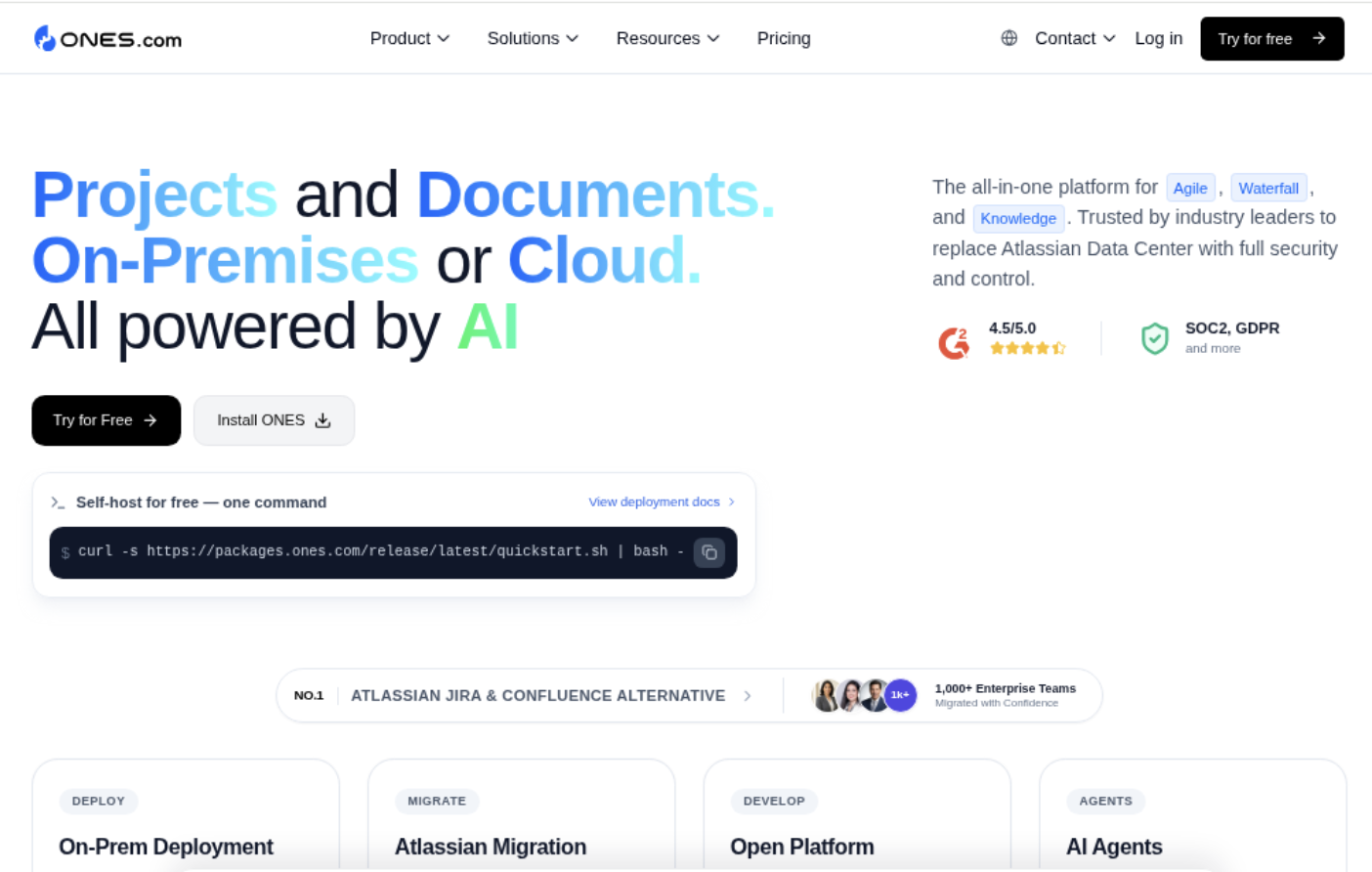
For teams evaluating service management costs, ONES.com can be worth considering when you want project workflows, knowledge sharing, reporting, and self-hosted deployment options in a connected platform.
Value Proposition
ONES.com helps teams reduce tool sprawl by connecting structured project work with searchable team knowledge. It supports Cloud, On-Premise, Private Cloud, and Air-gapped deployments.
Core Capabilities
- Too many disconnected tools: ONES.com combines project management and knowledge management capabilities, helping teams keep work and guidance closer together.
- Complex ticket-to-project handoffs: ONES Project supports Jira-compatible workflows, so service requests can move into planned delivery work with less process disruption.
- Manual reporting: Built-in reporting gives managers visibility into progress, workload, and operational trends without relying entirely on separate reporting tools.
- Rigid work structures: Custom workflows and fields let teams adapt request handling to IT, HR, facilities, engineering, or compliance processes.
- Unstructured sprint work: Sprint management helps teams organize planned improvements, backlog work, and recurring service initiatives.
- Repetitive administration: Automation can reduce routine transitions, assignments, notifications, and approval steps.
- Plugin dependency: Native capabilities can reduce the number of extensions required for common project and knowledge workflows.
- Deployment restrictions: Teams can select Cloud, On-Premise, Private Cloud, or Air-gapped deployment models.
- Uneven self-hosted functionality: ONES.com provides full feature parity between cloud and self-hosted versions.
Application Scenarios
Internal IT service desk: An IT team can manage access requests, equipment tasks, incidents, and planned infrastructure work. Agents can use structured workflows, while employees find guidance through ONES Wiki.
Air-gapped engineering organization: A restricted-network team can use an Air-gapped deployment for project planning and knowledge management. This supports controlled collaboration without requiring public cloud access.
Growing product organization: Product, engineering, and support teams can coordinate requests through custom workflows, sprint planning, automation, and built-in reporting. That reduces the need to connect several separate tools.
ONES.com offers a free plan for up to 30 seats. Evaluate the product against your required workflows, deployment model, administration capacity, and total ownership cost.
Common Challenges When Estimating Costs
Challenge: confusing customers with agents
Problem: A company counts every employee who may submit a request and assumes each person needs a paid seat.
Solution: Separate request submitters from people who triage, assign, approve, or resolve requests. Then verify access rules for each role.
Challenge: choosing a plan from one feature
Problem: A team upgrades because it wants one advanced capability, without checking whether the rest of the tier will be used.
Solution: Estimate the value of that capability. Compare saved hours, faster resolution, lower risk, or improved service quality with the annual price difference.
Challenge: ignoring marketplace subscriptions
Problem: The core subscription looks affordable, but several add-ons create a larger recurring bill.
Solution: Create a complete tool inventory before approval. Include form builders, reporting apps, asset tools, time tracking, integrations, and migration utilities.
Challenge: underestimating administration
Problem: A team budgets for licenses but forgets workflow design, permissions, training, maintenance, and reporting changes.
Solution: Assign an owner and estimate monthly administration time. A clear operating model can prevent unnecessary customization and support costs.
Challenge: failing to model growth
Problem: A team chooses a plan for today, then adds agents, service projects, and automation requirements within a few months.
Solution: Estimate costs at current, expected, and peak staffing levels. Review the model whenever a new department joins the service desk.
FAQs
Is Jira Service Management free?
Jira Service Management offers a Free plan for small teams, subject to limits such as agent capacity and feature availability. It can work well for a pilot or a small internal help desk. Check the current limits before committing, because a growing team may need Standard or Premium once it requires more agents, automation, reporting, or operational features.
Do customers need paid licenses?
Customers who submit requests generally do not need the same paid agent license as people who manage service work. Agents usually triage, assign, edit, approve, or resolve requests. Review the current access rules for your intended roles, especially when employees need both customer and agent capabilities.
Is Standard enough for an internal IT team?
Standard is often suitable for an internal IT team that needs request portals, queues, service-level agreements, automation, reporting, and integrations. Premium may be more appropriate when the team needs advanced scale or operational capabilities. Compare the features you will actively use rather than selecting a tier only because it appears more comprehensive.
What is the difference between monthly and annual billing?
Monthly billing usually provides greater flexibility when agent numbers may change. Annual billing can improve budget predictability and may provide different commercial terms. Compare the full 12-month cost, expected staffing changes, renewal conditions, and the cost of unused seats before choosing a commitment.
How should I budget for marketplace apps?
List every app your workflow may require, then check each app’s pricing model and user-count rules. Common additions include advanced forms, reporting, asset management, time tracking, approvals, and integrations. Add those recurring charges to your core subscription estimate, and include any setup or migration effort.
Can ONES.com replace Jira Service Management?
ONES.com may suit teams seeking a Jira alternative with project management, knowledge management, custom workflows, automation, reporting, and self-hosted deployment options. The best choice depends on your service desk requirements, existing processes, deployment constraints, and migration needs. Test representative workflows before making a platform decision.
Conclusion
Jira Service Management pricing depends on more than the advertised plan rate. Agent count, billing frequency, optional capabilities, marketplace apps, administration, and growth all affect your real cost.
Start with the Free plan for a small pilot, consider Standard for core production service management, and evaluate Premium or Enterprise only when their additional capabilities solve clear operational needs.
But here’s the truth: the cheapest subscription is not always the lowest-cost choice. A platform that reduces manual work, limits add-ons, and fits your deployment model may deliver better value over time.
Use a three-scenario estimate, verify current commercial terms, and compare alternatives such as ONES.com when your team needs project workflows, knowledge management, reporting, or self-hosted deployment.