Jira Service Management Pricing: A Clear 2026 Breakdown
Confused by jira service manager pricing? Get a clear 2026 breakdown of plans, agent costs, and hidden fees. Click to plan smarter now!
Jira Service Management pricing can feel confusing because your bill depends on agent seats, plan level, billing term, and optional products. A small support team may fit comfortably within the lower tiers, while a growing IT department can see costs rise quickly as more agents need access.
The difficult part is planning beyond the advertised per-agent rate. You also need to consider customer access, premium features, extra Atlassian products, annual commitments, taxes, and marketplace apps. A plan that looks affordable at five agents may become expensive at fifty.
But here's the truth: you can estimate your likely cost with a simple seat-based model. This guide explains the available plans, common 2026 planning figures, hidden cost drivers, and practical alternatives for teams comparing service management platforms.
Jira Service Management Pricing at a Glance
Jira Service Management pricing is primarily calculated by the number of agents who work on requests, incidents, changes, and other service tickets. Customers who submit requests through the help center generally do not require paid agent seats.
For planning purposes, Jira Service Management commonly follows four tiers: Free, Standard, Premium, and Enterprise. The exact amount shown at checkout can vary by billing term, region, currency, taxes, and Atlassian’s current pricing rules.
| Plan |
Typical fit |
Common planning position |
Main consideration |
| Free |
Small teams testing service management |
Up to 3 agents at no subscription charge |
Limited scale and administration features |
| Standard |
Small and mid-sized service desks |
Often shown near USD 20 per agent per month |
Strong core service management features |
| Premium |
Teams needing advanced scale and operations |
Often shown near USD 51.42 per agent per month |
Higher cost for advanced capabilities |
| Enterprise |
Large organizations with complex governance |
Custom quote |
Contract terms and organization-wide requirements |
These figures are useful for an initial estimate rather than a guaranteed invoice. Check the live Atlassian pricing page before committing to a budget.
Here's why: per-agent pricing becomes significant when every service desk specialist, administrator, and resolver needs a paid seat. A 10-agent Standard team at approximately USD 20 per agent monthly would start near USD 200 per month before taxes and additions.
What Counts as an Agent?
An agent is someone who works inside the service project. They may assign requests, communicate with customers, change ticket status, approve work, create queues, or manage service workflows.
A customer usually submits a request through the portal, email, or another connected channel. That person does not typically need an agent license merely to ask for help or view their own requests.
Consider a 40-person company with three IT specialists and one human resources specialist handling employee requests. The business may need four agent seats, even though all 40 employees can submit requests.
Monthly and Annual Billing
Monthly billing gives you flexibility when your team size changes. Annual billing can simplify budgeting and may offer different commercial terms, depending on the plan and current Atlassian policies.
Before choosing annual billing, estimate hiring plans, seasonal support needs, and planned reorganizations. Paying for unused seats over a long commitment can reduce the value of a lower per-seat rate.
How to Calculate Your Expected Cost
You can estimate your service desk budget with four inputs: paid agents, plan rate, billing period, and additional services. Start with the simplest formula:
Estimated subscription cost = agent seats × monthly price per agent × number of months.
- Count active agents. Include everyone who regularly handles requests or needs service project permissions.
- Choose the required plan. Base the choice on features, scale, governance, and operational requirements.
- Multiply by the billing period. Use 12 months for an annual estimate or one month for a monthly cash-flow estimate.
- Add related costs. Include apps, automation consumption, extra Atlassian products, implementation, training, and taxes.
- Model growth. Run the calculation for your current team and your expected team size six or twelve months later.
Example: A Five-Agent Service Desk
Imagine a company with five IT agents choosing a Standard plan at an estimated USD 20 per agent each month.
The subscription estimate would be:
- 5 agents × USD 20 = approximately USD 100 per month
- USD 100 × 12 months = approximately USD 1,200 per year
This estimate excludes taxes, optional apps, implementation services, and any separate Atlassian subscriptions.
Example: A Twenty-Agent IT Department
Now consider 20 agents on a Premium plan at an estimated USD 51.42 per agent monthly.
- 20 agents × USD 51.42 = approximately USD 1,028.40 per month
- USD 1,028.40 × 12 months = approximately USD 12,340.80 per year
The difference between the plans becomes substantial as the seat count increases. That is why feature requirements deserve as much attention as the headline price.
Use a Scenario Range
A single estimate can create false confidence. Prepare three scenarios instead:
| Scenario |
Agent count |
Purpose |
| Current |
Today’s active agents |
Shows the immediate subscription requirement |
| Growth |
Expected team size within 12 months |
Reveals likely expansion costs |
| Peak |
Maximum planned support capacity |
Tests long-term affordability |
What Each Jira Service Management Plan Includes
The right tier depends on how your team operates. A small internal help desk may need request forms, queues, email intake, and a knowledge center. A global operations team may require stronger controls, advanced incident management, and broader administration.
Free Plan
The Free plan is designed for very small teams. It can help you test portal-based support, basic request handling, and fundamental service workflows.
Its main limitation is scale. With a maximum of three agents, it suits a founder-led support function, a tiny internal IT group, or an early evaluation.
You may outgrow it when several departments need their own agents or when your team requires more administrative control.
Standard Plan
Standard is commonly the practical starting point for a growing service desk. It supports core request management, queues, forms, service portals, automation, and reporting features.
For example, an IT team can create separate request types for laptop access, password help, software installation, and employee onboarding.
Standard often provides a balance between capability and cost. Still, review storage, automation, integration, and administration limits before selecting it for a large operation.
Premium Plan
Premium is intended for teams with more demanding service operations. It can support advanced incident response, larger-scale administration, stronger operational continuity, and broader service management requirements.
A distributed company may consider Premium when downtime, cross-team coordination, or high request volume creates a need for more advanced operational features.
Premium costs considerably more per agent, so you should connect each upgraded feature to a measurable business need.
Enterprise Plan
Enterprise pricing is usually negotiated rather than displayed as one universal public rate. It is aimed at organizations requiring complex governance, centralized administration, large-scale deployment, or commercial terms tailored to their structure.
Enterprise evaluation should include procurement requirements, security reviews, support expectations, regional operations, and the number of service projects involved.
Costs That Can Change Your Final Bill
The subscription rate is only one part of the total cost. Your actual budget can change because of seat growth, connected products, marketplace apps, implementation work, and internal administration.
Agent Growth
Seat growth is often the largest recurring cost driver. A service desk may start with five agents, then add specialists from security, facilities, human resources, and finance.
Review access every quarter. Remove inactive seats where appropriate, and distinguish occasional collaborators from people who work in the queue every day.
Additional Atlassian Products
Jira Service Management may connect with Jira, Confluence, Assets, Statuspage, and other Atlassian products. Each product can have its own pricing model and seat rules.
For example, a team may need a knowledge space for support articles or a status communication service for customer-facing incidents. Those additions can affect the total budget.
Marketplace Apps
Apps can extend reporting, time tracking, approval handling, customer surveys, asset management, or advanced automation. They can also create separate recurring charges.
Before installing an app, calculate its annual cost at your highest expected user count. A low monthly fee can become material across several teams.
Implementation and Administration
Configuration requires time. Someone must design request types, create workflows, build forms, write automation rules, organize permissions, and train agents.
You may handle this internally or hire a consultant. Either approach belongs in your total cost estimate because setup quality affects adoption and support efficiency.
Automation and Integration Requirements
Integrations with identity management, email, monitoring, chat, asset systems, and software delivery tools can improve response times. They can also require engineering effort and ongoing maintenance.
A useful comparison is simple: a native integration may reduce maintenance, while a custom connection may offer flexibility with a higher ownership burden.
Which Plan Should You Choose?
Choose the lowest tier that supports your required workflows today and your realistic growth during the next planning period.
| Your situation |
Likely starting point |
What to verify |
| Up to three agents testing a basic help desk |
Free |
Agent limits and missing administrative features |
| Small or mid-sized IT support team |
Standard |
Automation, reporting, integrations, and service project limits |
| High-volume or operationally complex service desk |
Premium |
Incident response, scale, continuity, and governance needs |
| Large organization with centralized procurement |
Enterprise |
Contract scope, security, support, and commercial terms |
You might be wondering: should you upgrade for features you may need later? Usually, model the cost of each option and identify the trigger that would justify moving upward.
For instance, you might begin with Standard and define an upgrade condition such as 24-hour operations, a higher incident volume, or a requirement for advanced continuity controls.
How to Reduce Service Management Costs
Cost control starts with service design. A cluttered portal generates repeated questions, unnecessary escalations, and manual work that makes every paid seat less productive.
Improve the Request Catalog
Group common requests into clear categories. “New laptop,” “VPN access,” and “software installation” are easier to route than a single form called “General IT Help.”
Clear forms reduce clarification messages and help automation assign work to the right queue.
Build a Useful Knowledge Center
Write short, task-focused help articles for recurring issues. Include the symptoms, the safe steps to try, and the point where someone should contact support.
If a password reset question appears 100 times monthly, a clear self-service article can reduce agent workload significantly.
Review Automation Rules
Automate routine routing, notifications, approvals, and status changes. Then review rules regularly so outdated conditions do not create duplicate alerts or incorrect assignments.
Automation is valuable when it removes repetitive work. It becomes costly when nobody owns its maintenance.
Separate Customers From Agents
Give portal access broadly where appropriate, while reserving agent seats for people who actively handle requests. This distinction keeps the licensing model aligned with actual responsibilities.
Review permissions whenever someone changes roles. A former agent may still retain access after moving to another department.
Jira Service Management Alternative: ONES.com
Value Proposition
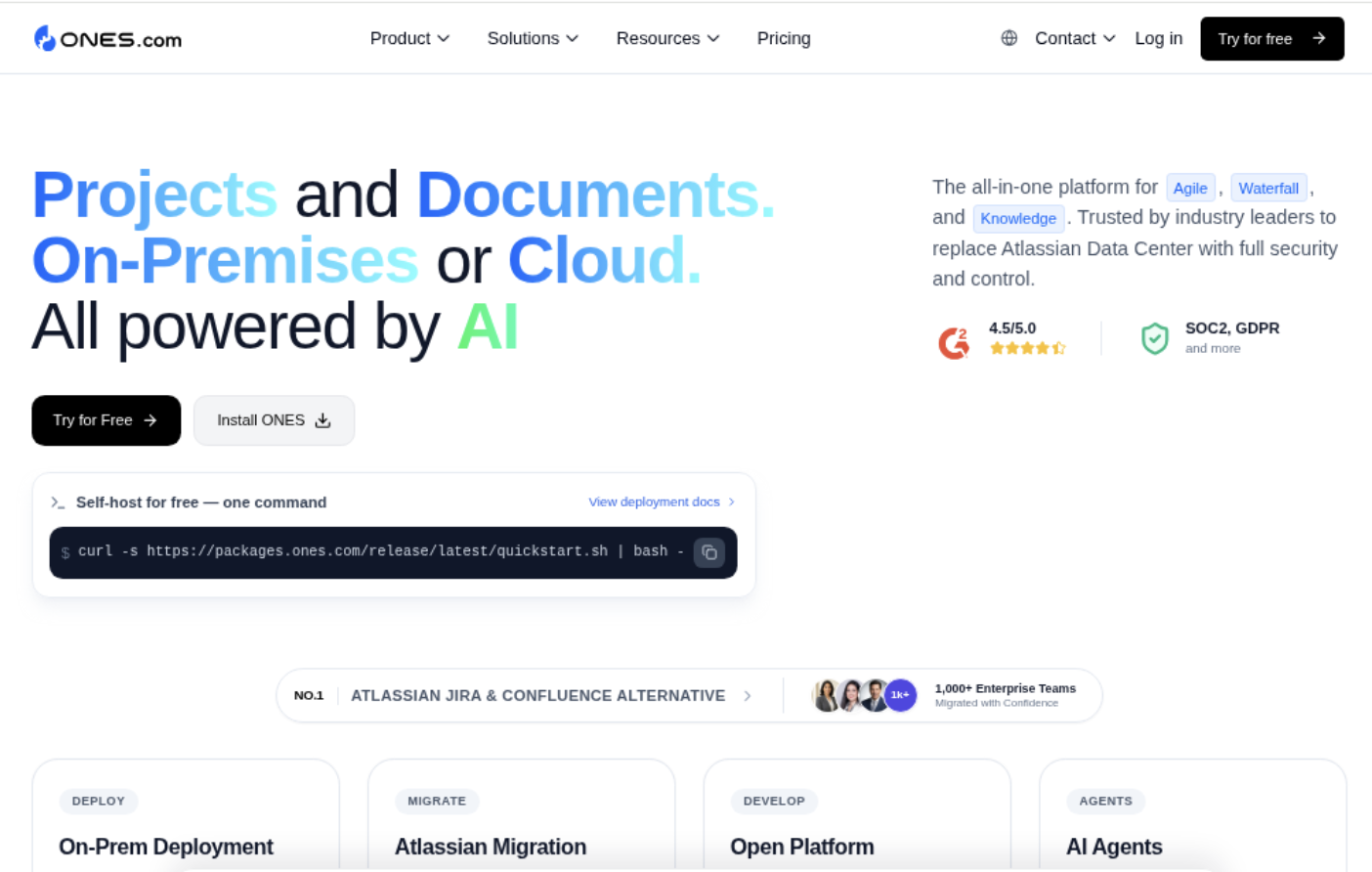
ONES.com combines project management and knowledge management in one platform. It can suit teams comparing Jira alternatives that want service workflows, delivery planning, and internal knowledge connected in a unified environment.
ONES Project is the project management product, while ONES Wiki provides knowledge management capabilities. They are sold separately, so confirm the products required for your service operation.
Core Capabilities
- Disconnected work across service and delivery teams: ONES Project connects Jira-compatible workflows with project planning, helping teams carry operational requests into delivery work. The result is less manual handoff between support and engineering.
- Limited visibility into work status: Built-in reporting gives managers a clearer view of request progress, workload, and delivery activity. Teams can use that visibility during service reviews.
- Rigid workflow requirements: Custom workflows and fields allow teams to reflect approval paths, escalation rules, and department-specific information. This can reduce workarounds around standard ticket stages.
- Manual sprint coordination: Sprint management helps delivery teams plan, prioritize, and review work connected to operational demands. Support-driven engineering work can receive a clearer place in the backlog.
- Repetitive administrative actions: Automation can handle routine transitions, assignments, and notifications. Agents and project contributors spend less time repeating simple updates.
- Scattered support knowledge: ONES Wiki provides a knowledge base for procedures, troubleshooting guidance, and internal policies. Teams can place reusable guidance near related work.
- Concerns about deployment restrictions: ONES.com supports Cloud, On-Premise, Private Cloud, and Air-gapped deployments. Organizations with restricted network requirements have more deployment choices.
- Different behavior between hosted and self-managed environments: ONES.com maintains full feature parity between its cloud and self-hosted versions. Teams can select a deployment model without giving up core platform capabilities.
- Too many extensions: Native project, workflow, reporting, sprint, and automation capabilities can reduce dependence on separate plugins. That may simplify administration and integration planning.
- Small teams needing a low-risk evaluation: The free plan supports up to 30 seats. This gives smaller groups room to test the platform before making a larger commitment.
Application Scenarios
Internal IT and engineering: An employee submits an access request through the service process. IT handles the request, while engineering receives related implementation work through a Jira-compatible workflow in ONES Project.
Restricted-network operations: A regulated organization deploys the platform in an air-gapped environment. Its teams retain project planning, reporting, and knowledge capabilities without relying on a public cloud connection.
Growing product company: Support, product, and engineering teams use shared workflows and reporting. ONES Wiki stores troubleshooting guidance, while ONES Project tracks improvements that originate in recurring service issues.
Common Challenges and Practical Solutions
Challenge: The Team Underestimates Agent Seats
Solution: List every role that triages, assigns, approves, or resolves requests. Review the list separately from the people who only submit requests through the portal.
Challenge: The Lowest Plan Lacks a Needed Feature
Solution: Create a feature checklist before comparing prices. Mark each capability as essential, useful, or optional, then price the lowest plan covering every essential requirement.
Challenge: Optional Apps Expand the Budget
Solution: Calculate each app’s annual cost at your expected maximum seat count. Test whether native automation or reporting can handle the requirement first.
Challenge: Service Requests Become Difficult to Route
Solution: Simplify request categories and add clear forms. Start with the five most common request types, then expand when real demand justifies it.
Challenge: The Portal Exists, Yet People Still Use Email
Solution: Make the portal faster than email for common needs. Add concise forms, automatic confirmations, visible request status, and helpful articles for frequent questions.
FAQs
Is Jira Service Management free?
Yes, Jira Service Management offers a Free tier for small teams, commonly limited to three agents. Customers can generally submit requests without paid agent seats. The Free plan may lack the scale, administration, and advanced operational controls required by larger service desks.
How much does Jira Service Management cost per agent?
Standard pricing is commonly displayed near USD 20 per agent per month, while Premium is often shown near USD 51.42 per agent per month. These are planning figures, not guaranteed quotes. Your final amount may vary with billing terms, currency, taxes, and current Atlassian pricing.
Do customers need paid licenses?
Customers who submit requests through the portal, email, or other supported channels generally do not need paid agent licenses. Paid seats usually apply to people who work inside the service project. Confirm the current access rules when designing external customer support.
What is the difference between Standard and Premium?
Standard typically covers core service desk operations, including request handling, portals, queues, automation, and reporting. Premium is designed for teams with more demanding scale, incident operations, continuity, and administrative needs. Compare the feature requirements against the cost of every agent seat before upgrading.
Does Jira Service Management pricing include Jira and Confluence?
Jira Service Management pricing does not automatically mean every Atlassian product is included under one subscription. Jira, Confluence, Statuspage, Assets-related capabilities, and marketplace apps may have separate commercial terms. List every connected product before calculating your complete service management budget.
An alternative may be worth evaluating when you need different deployment options, fewer extensions, a combined project and knowledge environment, or a pricing model that fits your team structure better. Compare workflows, reporting, permissions, migration effort, integrations, and long-term administration rather than comparing only the monthly seat rate.
Conclusion
Jira Service Management pricing usually comes down to agent seats, plan level, billing term, and related products. Free can support a very small team, Standard often fits everyday service desks, Premium serves more complex operations, and Enterprise requires a tailored commercial discussion.
But here's the truth: the advertised rate is only the beginning. Count agents carefully, model current and future staffing, include apps and connected products, and tie every upgrade to a specific operational need.
If your current platform creates licensing pressure or separates service work from project and knowledge management, compare alternatives such as ONES.com. A clear feature checklist and three-scenario budget will help you choose with greater confidence.