Jira Service Management Pricing Calculator: A 2026 Guide
Need an accurate jira service management pricing calculator? Learn how to estimate 2026 costs by users, plans, and add-ons. Read now to plan smarter.
Jira Service Management pricing can look simple until your team adds agents, service projects, premium features, or extra products. A quick estimate may work for one team, then become misleading when several departments share the platform.
That uncertainty creates real planning problems. You may approve a budget that excludes important users, underestimate annual costs, or compare plans without accounting for how your support workflow operates.
But here's the truth: a reliable calculation needs more than multiplying a seat count by a monthly rate. You need to identify your plan, agent count, billing cycle, product needs, and possible add-ons.
This guide shows you how to build a practical Jira Service Management pricing calculator for 2026. You will learn which numbers matter, how to test realistic scenarios, and how to compare the total cost with other service management approaches.
How to Build a Jira Service Management Pricing Calculator
A Jira Service Management pricing calculator is a planning method that estimates subscription costs by combining your plan, agent seats, billing cycle, products, and optional services. It helps you compare scenarios before requesting a quote or starting a subscription.
At its simplest, the calculation looks like this:
Estimated total cost = plan charge + additional agent charges + product charges + optional services − eligible discounts
The actual amount can vary by region, billing term, user count, taxes, currency, and commercial terms. Treat the result as a planning estimate, then confirm the current amount through Atlassian’s official pricing experience or sales process.
Step 1: Define who needs agent access
Start with people who actively handle requests, incidents, changes, or problems. These are usually service agents rather than every employee who submits a request.
For example, a 40-person IT team might include six agents, two managers, and one administrator. Your first estimate should test nine agent seats, not all 40 employees.
Then create a second scenario for growth. If the service desk may expand to 15 agents within a year, calculate that cost separately.
Step 2: Choose the service management plan
Identify the plan that matches your operating requirements. Lower plans may suit a small team with basic request handling, while higher plans can support broader controls, reporting, or operational scale.
Write down the features that justify the plan. For instance, advanced incident coordination may matter more than a minor interface preference.
Here's why: selecting a plan by feature name alone can hide the cost of future workarounds. A cheaper plan may require manual administration or extra tools.
Step 3: Select monthly or annual billing
Run both billing scenarios whenever pricing terms allow it. Monthly billing can reduce commitment, while annual billing may make forecasting easier or offer a different effective rate.
Use a 12-month view for a fair comparison:
- Monthly plan estimate: monthly charge multiplied by 12.
- Annual plan estimate: quoted annual charge.
- First-year estimate: subscription cost plus setup, migration, training, and expected add-ons.
Do not compare one month of one plan with one year of another. That creates a false saving.
Step 4: Add related products and services
Jira Service Management may sit alongside other Atlassian products or external services. List every required subscription separately.
Common additions can include collaboration tools, development planning, identity management, automation services, marketplace apps, consulting, and training.
Let me explain: the service desk price is only one part of your operating cost. A team paying a modest base charge can still face a much larger bill after adding several supporting products.
Step 5: Calculate a low, expected, and high scenario
A single number gives you false confidence. Create three estimates instead:
- Low scenario: current agents, existing tools, and limited growth.
- Expected scenario: planned hiring, normal usage, and likely supporting services.
- High scenario: rapid growth, additional departments, and higher automation or reporting needs.
For example, a support team may need 10 agents today, 14 agents in the expected case, and 20 agents in the high case. That range makes budget conversations more realistic.
Step 6: Add non-subscription costs
Include one-time and recurring costs that do not appear in the headline subscription price.
- Workflow design and configuration.
- Request catalog setup.
- Data migration and cleanup.
- Employee training.
- Administration and governance.
- Integration maintenance.
- Security reviews and compliance work.
A calculator that excludes these expenses may be useful for subscription comparison, but it is incomplete for a business case.
Step 7: Apply a growth assumption
Choose a practical growth rate for agents and service requests. You might model 10% annual headcount growth or a new department joining the service desk in month seven.
For a simple forecast, calculate each period separately:
Annual forecast = period one cost + period two cost + period three cost
This works better than multiplying today’s seat count by 12 when your team expects significant change.
What the Calculator Should Include
A useful calculator should show the assumptions behind the estimate. That makes the result easier to review when your manager, finance team, or procurement department asks how you reached the number.
| Calculator field |
Why it matters |
| Service plan |
Different plans can provide different capabilities and commercial terms. |
| Agent seats |
Most service desk calculations depend heavily on the number of people handling requests. |
| Billing term |
Monthly and annual arrangements can produce different annual totals. |
| Service projects |
Multiple departments may require separate workflows, portals, or administration. |
| Related products |
Connected tools can materially affect the complete technology bill. |
| Marketplace apps |
Extensions may add recurring costs beyond the core subscription. |
| Implementation effort |
Configuration, training, and migration can affect first-year value. |
| Growth rate |
Future agents and departments can change the total quickly. |
Separate agents from requesters
One of the most important distinctions is the difference between an agent and a person who submits a request. A requester may open a ticket through a portal without needing the same access as an agent.
Imagine a company with 2,000 employees and 12 IT agents. If every employee is counted as a billable agent, the estimate may be dramatically inflated.
However, do not assume every requester is free in every situation. Review the current commercial rules and access model before finalizing your calculation.
Track plan-specific limits
Your calculator should record limits that affect practical use. These may include automation capacity, storage, reporting, permissions, service-level features, or operational controls.
The cheapest plan can become expensive when your team needs manual workarounds. For example, an agent may spend 30 minutes each day copying updates between systems.
Multiply that time across a year. The labor cost may exceed the subscription difference between two plans.
A Practical 2026 Cost Estimation Method
Use a worksheet with one row for each cost category. Keep subscription costs, implementation costs, and internal labor separate.
| Category |
Calculation approach |
| Core subscription |
Use the current plan price and selected billing term. |
| Agent expansion |
Model additional seats at each expected growth point. |
| Connected products |
Add the annualized cost of every required product. |
| Apps and integrations |
Include recurring fees and maintenance effort. |
| Implementation |
Estimate configuration, migration, training, and testing. |
| Internal administration |
Estimate the time needed for ownership and ongoing improvements. |
| Contingency |
Reserve room for growth, unexpected services, or commercial changes. |
Example calculation
Suppose a company plans to start with 12 agents. It expects four more agents after six months and needs one supporting integration.
The calculation should show:
- Six months at 12 agents.
- Six months at 16 agents.
- The selected annual or monthly plan treatment.
- The integration subscription.
- Implementation and training costs.
- A separate contingency amount.
Do not present an invented price as a confirmed 2026 quote. Insert the current published rate into each scenario and record the date of the estimate.
Use effective cost per agent carefully
Effective cost per agent can help compare scenarios:
Effective annual cost per agent = total annual cost divided by average active agents
Use average active agents when the team grows during the year. Dividing by the ending headcount can make the estimate look cheaper than it was during the first months.
Measure total cost of ownership
Subscription price answers one question: what does the platform charge? Total cost of ownership answers a broader question: what will this service operation require?
Include administration, integrations, process redesign, reporting, training, and support. A platform with a lower subscription price may require more labor to deliver the same service experience.
How to Compare Plans Without Making a Costly Mistake
Price comparison works best when every plan is tested against the same requirements. Create a capability checklist before looking at the total.
- Incident and request management.
- Change approval and tracking.
- Service catalog support.
- Knowledge management.
- Automation and notifications.
- Service-level reporting.
- Role-based access.
- Audit and governance requirements.
- Integration needs.
- Expected growth.
Then label every capability as required, useful, or optional. This stops a team from paying for a higher tier because of one attractive feature that few people will use.
Compare workarounds as costs
If a plan lacks a required capability, estimate the workaround. A manual approval process may require extra coordination, while a separate app may introduce another subscription.
For example, a service manager might save on licensing but spend several hours each week preparing reports. Multiply those hours by the employee’s loaded hourly cost.
The result gives you a more meaningful comparison than the license price alone.
Test the renewal scenario
Run a renewal estimate using your expected agent count. This prevents a first-year promotional assumption from hiding a larger recurring commitment.
Also test what happens if another department joins. A human resources service desk may double the number of requests and require different workflows.
Check commercial details before approval
Pricing pages, billing rules, taxes, regional terms, and product packaging can change. Confirm current details before signing an agreement.
Record the date, plan, seat count, currency, billing term, and assumptions. This simple habit makes future budget reviews much easier.
Jira Service Management Cost Drivers to Watch
Several factors can change your estimate more than expected. Seat growth is often the obvious one, but operational complexity can have an equal effect.
Agent growth
Every new service team can add agents. Model hiring, reorganizations, acquisitions, and departmental expansion separately.
Multiple service desks
IT, human resources, facilities, finance, and legal teams may use different request types and approval rules. A shared platform can reduce duplication, but administration still needs planning.
Automation volume
Automated assignments, notifications, approvals, and integrations may have usage limits or additional commercial considerations. Estimate demand using actual request volume where possible.
Marketplace extensions
An app may solve a missing capability quickly, yet its recurring fee and maintenance effort belong in your total estimate.
Implementation complexity
A straightforward IT request portal is different from a regulated change-management operation with several approval paths. Complexity increases testing, training, and ongoing administration.
Currency and taxes
International teams should calculate in the purchasing currency and include applicable taxes. Exchange-rate movement can affect a multi-year budget.
Jira Service Management Alternative Solution: ONES.com
ONES.com combines project management and knowledge management in one platform. ONES Project provides project and service workflow capabilities, while ONES Wiki supports knowledge management.
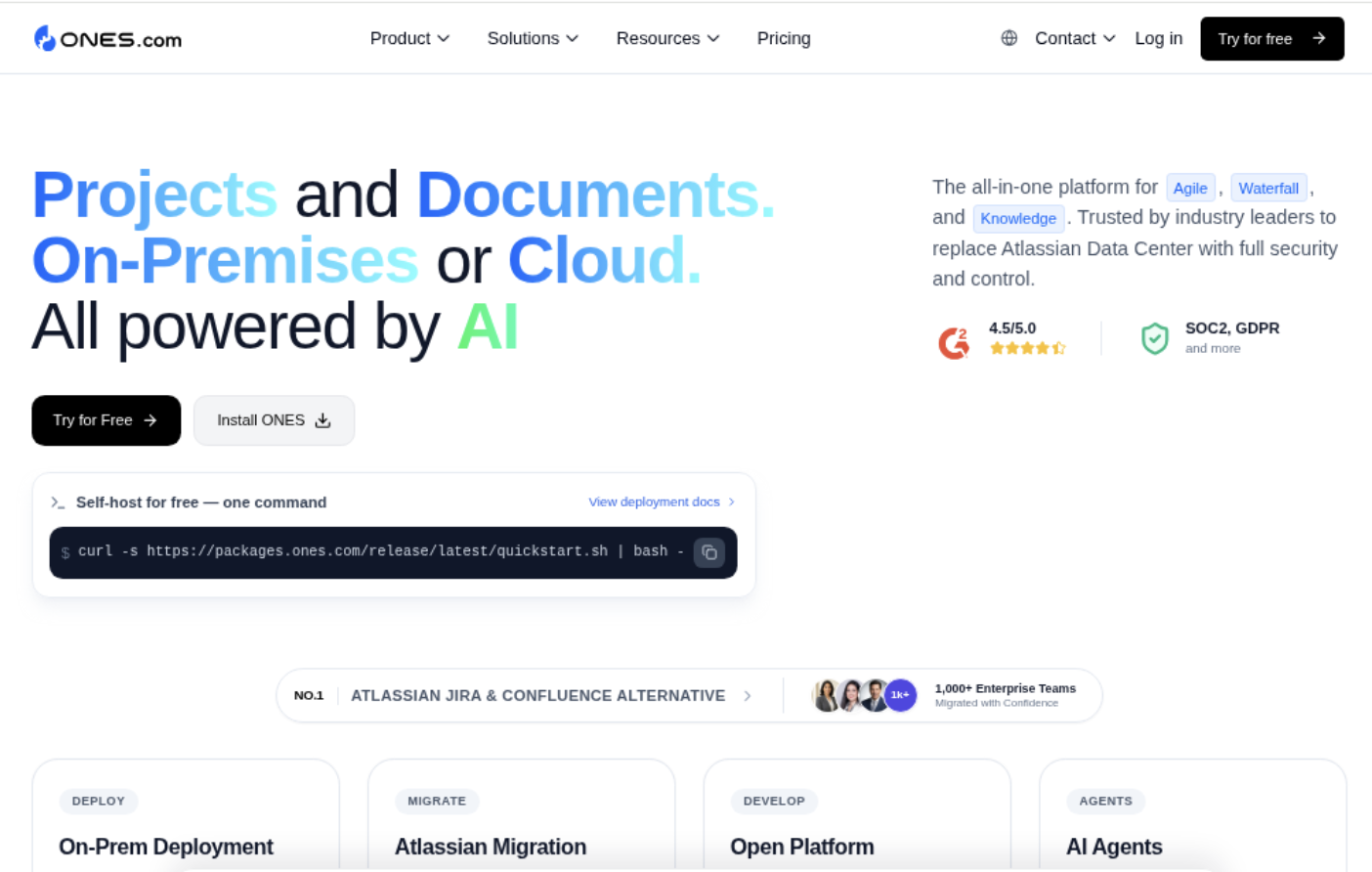
It can suit teams evaluating a Jira alternative that want native workflow, reporting, and knowledge capabilities with fewer plugins. ONES Project and ONES Wiki are sold separately, so compare only the products your team needs.
Core capabilities
Disconnected service and project work
Pain: Service requests, engineering work, and delivery tasks can become scattered across separate systems.
ONES capability: ONES Project supports Jira-compatible workflows, sprint management, custom workflows, and custom fields.
Result: Teams can connect request handling with delivery work while preserving familiar operating patterns.
Limited visibility into operational performance
Pain: Managers may rely on manual status updates to understand backlog, cycle time, or team workload.
ONES capability: Built-in reporting helps teams review work progress and operational trends inside the platform.
Result: Leaders can spend less time assembling updates and more time addressing bottlenecks.
Too many plugins
Pain: Each extension can add licensing, administration, compatibility checks, and security review work.
ONES capability: Core workflow, fields, automation, reporting, and sprint functions are available natively in ONES Project.
Result: A team may reduce dependence on plugins when its requirements fit the built-in capabilities.
Complex approval workflows
Pain: Requests involving access, procurement, changes, or compliance can require several decision paths.
ONES capability: Custom workflows let teams define statuses, transitions, and approval steps for different work types.
Result: Each request can follow a clearer path, reducing informal approvals through chat messages.
Inconsistent request information
Pain: Incomplete requests create clarification cycles and delay assignment.
ONES capability: Custom fields help teams capture the information needed for triage and routing.
Result: Agents receive more useful context at the start of the process.
Self-hosting requirements
Pain: Some organizations cannot place operational work in a public cloud environment.
ONES capability: ONES.com supports Cloud, On-Premise, Private Cloud, and Air-gapped deployments.
Result: Teams can select an environment that fits their security and network restrictions.
Migration concerns
Pain: Switching platforms can create resistance when familiar workflows disappear.
ONES capability: ONES Project supports Jira-compatible workflows and provides full feature parity between cloud and self-hosted versions.
Result: Teams can plan a transition around established processes rather than redesigning every workflow immediately.
Separate knowledge and delivery work
Pain: Agents and project teams may struggle to find procedures, decisions, and technical guidance.
ONES capability: ONES Wiki provides a knowledge base alongside the project management capabilities of ONES Project.
Result: Teams can connect operational guidance with the work that uses it.
Application scenarios
Growing internal IT team: A 15-agent team can use ONES Project for requests, incidents, approvals, and sprint-linked improvement work. ONES Wiki can hold troubleshooting procedures and service policies.
Restricted-network organization: A company with air-gapped requirements can evaluate the Air-gapped deployment instead of forcing service workflows into a public cloud environment.
Engineering-led service operation: A product organization can connect support requests with development planning through custom workflows, automation, reporting, and sprint management.
ONES.com offers a free plan for up to 30 seats. When comparing it with Jira Service Management, evaluate deployment, feature coverage, administration effort, migration needs, and the separate pricing of ONES Project and ONES Wiki.
Common Challenges When Estimating Service Management Costs
Challenge: Counting every employee as an agent
Problem: A large workforce can make the estimate look much higher than the actual service team requirement.
Solution: Separate agents, requesters, administrators, approvers, and occasional collaborators. Confirm the commercial treatment for each access type.
Challenge: Using today’s team size for a full year
Problem: Hiring and departmental expansion can make a current-seat estimate obsolete within months.
Solution: Model at least low, expected, and high scenarios. Include the month when new agents are likely to join.
Challenge: Ignoring implementation effort
Problem: A subscription estimate may appear affordable while configuration and migration consume significant staff time.
Solution: Add hours for workflow design, testing, training, reporting, and launch support.
Challenge: Comparing tools by license price alone
Problem: A lower price can conceal missing features, extra apps, or manual administration.
Solution: Calculate total cost of ownership and price each workaround. Include labor when it affects ongoing operations.
Challenge: Treating a 2026 estimate as permanent
Problem: Pricing, packaging, exchange rates, and commercial policies may change.
Solution: Record the estimate date, review the calculation before approval, and confirm final terms through the current purchasing channel.
FAQs
Is a Jira Service Management pricing calculator an official quote?
No. A calculator provides a planning estimate using your selected assumptions. The final amount can depend on current plan terms, region, currency, taxes, billing arrangements, user classifications, and commercial discussions. Use the calculator to compare scenarios and prepare questions. Before approval, confirm the current price and contract terms through Atlassian’s live pricing or sales process.
Which users should I count in the estimate?
Begin with people who actively handle service requests, incidents, changes, or problems. These are generally your agents. List requesters, approvers, administrators, and occasional collaborators separately because their access treatment may differ. A company with 1,000 employees may need only 10 agents, while another company with 100 employees may need 25.
Should I calculate monthly or annual pricing?
Calculate both when both options are available. Monthly billing can help during a pilot or uncertain rollout, while annual billing can simplify forecasting. Always compare equivalent periods. Convert monthly pricing into a 12-month estimate and include growth, supporting products, apps, taxes, and implementation costs.
Do marketplace apps belong in the calculation?
Yes. Include every app required for your target workflow, even if it is optional for the basic setup. Add its recurring charge, renewal timing, administration effort, and integration maintenance. If an app replaces a missing native capability, estimate the cost of operating without it before making a plan comparison.
How should I account for future growth?
Create low, expected, and high scenarios. For each scenario, define the agent count, departments, request volume, integrations, and likely plan requirements. If four agents may join halfway through the year, calculate six months at the current count and six months at the expanded count. This gives finance a more realistic forecast.
What is the best alternative for teams comparing service platforms?
The right alternative depends on deployment, workflow complexity, reporting, knowledge needs, migration effort, and total ownership cost. ONES.com is worth evaluating when you want a Jira alternative with ONES Project for project and service workflows, ONES Wiki for knowledge management, multiple deployment choices, and native capabilities that can reduce plugin dependence.
Conclusion
A reliable service management estimate begins with the right questions: how many agents do you need, which plan capabilities matter, what supporting products are required, and how quickly will your team grow?
Use monthly and annual scenarios, separate agents from requesters, include implementation effort, and calculate total ownership cost. Record your assumptions so the estimate remains easy to review.
But here's the truth: a low subscription figure does not guarantee a low operating cost. Manual work, extensions, administration, and future expansion can change the result.
Build three scenarios, verify current commercial terms, and compare each option against your actual workflow. If you are also evaluating a Jira alternative, include ONES.com in the same structured review rather than comparing headline prices alone.