Jira Software Cloud Pricing 2024: A Complete Cost Guide
How much will Jira Software Cloud pricing 2024 really cost? Compare plans, user tiers, billing, and hidden expenses in this complete guide. Read now.
Jira Software Cloud pricing in 2024 could look simple at first glance: Free, Standard, Premium, or Enterprise. The difficulty begins when your team grows, billing changes, or you add premium features.
A plan that costs a few dollars per user can become a significant annual commitment for a 50-person team. Storage limits, automation allowances, guest access, and annual billing can also affect your real spend.
But here's the truth: the advertised per-user rate is only the starting point. You need to compare plan features, user tiers, billing terms, and likely growth before choosing.
This guide breaks down Jira Software Cloud pricing in 2024, shows practical cost examples, and explains how to estimate the right plan for your team.
Jira Software Cloud Pricing in 2024: The Quick Overview
Jira Software Cloud pricing in 2024 followed a tiered model with Free, Standard, Premium, and Enterprise plans. Free supported small teams, Standard added core administration and reporting features, Premium added advanced scale and reliability features, and Enterprise used custom pricing.
| Plan |
Typical 2024 list price |
Best suited to |
Main considerations |
| Free |
$0 |
Small teams of up to 10 users |
Limited users, storage, automation, and administration |
| Standard |
About $7.53 per user per month |
Growing teams needing full core project management |
More capacity and controls than Free |
| Premium |
About $13.53 per user per month |
Teams needing advanced planning, scale, and reliability |
Higher cost with additional enterprise-oriented capabilities |
| Enterprise |
Custom quote |
Large organizations managing multiple teams or sites |
Pricing depends on scale, terms, and requirements |
These figures represent common monthly list prices discussed for Jira Software Cloud in 2024. Atlassian pricing could vary by billing frequency, user tier, region, taxes, promotions, and later pricing updates.
Here's why: Jira Cloud generally charges according to the number of users who can access the product, rather than only the people actively creating issues.
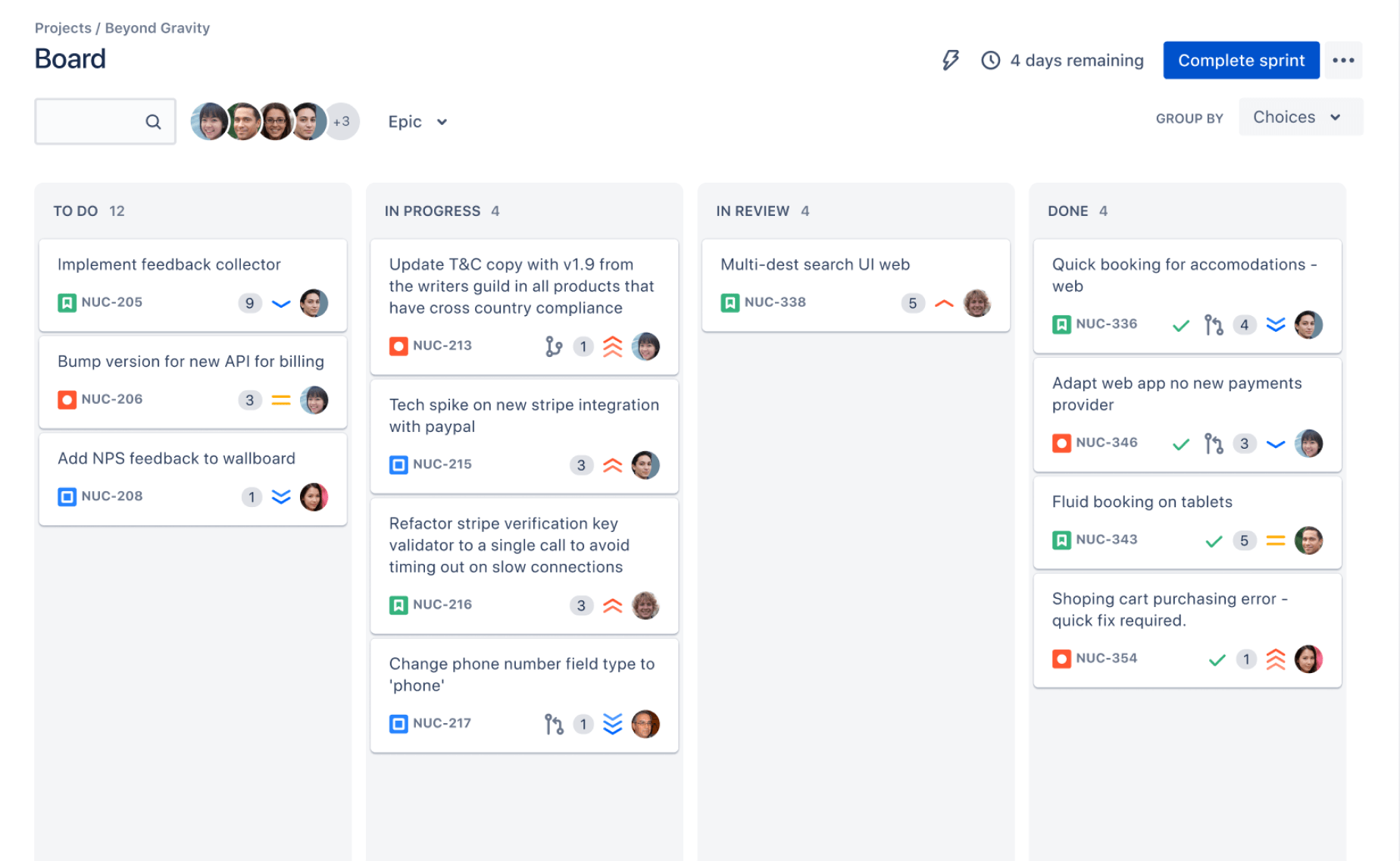
What each plan included
- Free: Basic agile project management for small teams, with restrictions on users, storage, support, automation, and administration.
- Standard: Core Scrum and Kanban workflows, customizable boards, reporting, project permissions, integrations, and higher operating limits.
- Premium: Advanced planning, stronger scaling features, Premium support, and capabilities designed for larger or more complex teams.
- Enterprise: Organization-level administration, advanced governance, and commercial terms negotiated directly with Atlassian.
Remember that Jira Software and Jira Service Management are separate Atlassian products. Adding service management agents or other Atlassian products can change your total technology bill.
How to Calculate Your Actual Jira Cloud Cost
The fastest way to estimate your bill is to multiply the plan’s effective monthly rate by the number of billable users, then add taxes and any related products.
- Count every person who needs access. Include developers, product managers, testers, designers, project leads, and administrators.
- Choose the required plan. Compare the capabilities your team needs, rather than selecting the cheapest tier automatically.
- Apply the billing method. Monthly billing usually offers flexibility, while annual billing may use user tiers and a committed quantity.
- Add connected products. Jira Service Management, Confluence, Guard, Marketplace apps, and other subscriptions may be billed separately.
- Include taxes and currency conversion. Your final checkout amount may differ from the displayed United States list price.
- Test growth scenarios. Calculate the cost at your current size, expected size, and likely maximum size.
Example: a 10-person team
Suppose 10 people need Standard access at approximately $7.53 per user per month. The simple monthly estimate is about $75.30 before taxes or additional products.
At the same approximate rate, the annual estimate is about $903.60. Your actual charge can differ because Atlassian may apply annual user tiers, regional pricing, or updated rates.
Example: a 50-person team
A 50-person team on Standard would produce a simple estimate of approximately $376.50 per month at the same reference rate.
That equals roughly $4,518 per year before taxes and extras. A Premium estimate at $13.53 per user would be approximately $676.50 per month.
Why the simple multiplication can mislead you
Many teams count only active developers. That approach can create access problems when product managers, quality specialists, executives, or contractors need project visibility.
For example, a 30-person engineering group may actually need 42 accounts after adding product, design, testing, and delivery roles. Pricing the team at 30 users would understate the likely bill.
Free, Standard, Premium, or Enterprise?
Choosing a Jira Cloud plan depends on team size, workflow complexity, administrative needs, and tolerance for operational limits.
When Free can work
Free can suit a small startup, student team, or temporary pilot with no more than 10 users. It provides a practical way to test Scrum boards, Kanban workflows, backlog management, and basic issue tracking.
The trade-off appears when you need more automation, storage, permissions, reporting, or administrative control. A team can outgrow Free before it outgrows Jira itself.
When Standard makes sense
Standard is usually the practical middle tier for growing teams. It provides the core Jira experience without the higher Premium commitment.
Consider Standard when you need several projects, custom workflows, project permissions, integrations, reporting, and a larger user population. A 20-person product team often fits this category.
When Premium earns consideration
Premium becomes more relevant when multiple teams share Jira, planning spans several departments, or downtime has a serious operational impact.
For example, a software company with 150 users may value advanced planning and stronger service commitments enough to justify the higher rate.
When Enterprise is appropriate
Enterprise is designed for organizations with complex governance, multiple business units, or broad administrative requirements. It is not simply a larger version of Standard.
Because Enterprise pricing is customized, you need a commercial discussion rather than a public per-user calculation. Ask about minimum commitments, support, security controls, contract length, and expansion terms.
Monthly Versus Annual Billing
Monthly billing gives you flexibility. You can increase or reduce the number of users more frequently, which helps when your team changes often.
Annual billing can provide more predictable budgeting. However, it may require a commitment to a user tier, so you should estimate your likely headcount carefully.
| Billing approach |
Potential advantage |
Potential drawback |
| Monthly |
Flexible changes and lower commitment |
Less predictable annual spend and possible rate changes |
| Annual |
Budget visibility and a defined subscription period |
Possible overpayment if your team shrinks |
Here's a practical example: imagine a company expecting 60 users today and 90 users within six months. Annual billing at 90 users could waste money early, while monthly billing could cost more per month.
Compare the two plans at three headcount levels: current users, expected users, and the minimum team size you can realistically maintain. That comparison reveals whether flexibility or predictability matters more.
Costs Beyond the Jira Subscription
Your Jira bill may not be the full cost of operating Jira Cloud. Related subscriptions, administration, configuration, and implementation can create meaningful expenses.
Marketplace applications
Teams often add apps for time tracking, advanced roadmaps, test management, portfolio reporting, forms, or specialized automation.
An app that costs $2 per user can add $100 per month to a 50-person team. Several small add-ons can eventually cost more than the difference between Standard and Premium.
Other Atlassian products
Many Jira teams also use Confluence for team knowledge, Jira Service Management for support, or Atlassian Guard for identity and security administration.
Evaluate these products together when planning your technology budget. A low Jira rate can become less meaningful when several connected subscriptions are required.
Administration and maintenance
Someone must manage workflows, permissions, custom fields, automation rules, dashboards, and integrations. That work may belong to an internal administrator or an external consultant.
For example, a heavily customized Jira environment can require regular cleanup. Poorly managed workflows may slow reporting and create confusing issue forms.
Migration and implementation
Moving from another project management platform can require workflow mapping, permission design, user training, testing, and historical issue transfer.
Even when the subscription is affordable, a rushed rollout can create hidden costs through rework and low adoption.
How to Control Jira Cloud Spending
You can reduce unnecessary costs without removing the capabilities your team depends on. Start with access, then review configuration and add-ons.
Audit users every quarter
Review accounts at least quarterly. Remove former employees, duplicate accounts, and people who no longer need access.
A 100-user subscription with 12 inactive accounts creates a simple saving opportunity. The exact amount depends on your plan and billing tier.
Separate viewers from contributors
Ask whether every person needs full project access. Some stakeholders may need selected dashboards or updates rather than participation across every project.
Design access around real responsibilities. This prevents temporary collaborators from quietly becoming permanent billable users.
Review every Marketplace app
List each installed app, its owner, its monthly cost, and the problem it solves. Then check whether Jira’s native features now cover that need.
For example, a team may keep a paid reporting app after Jira’s built-in dashboards become sufficient for its current workflow.
Reduce configuration complexity
Custom fields, workflow states, screens, and automation rules can multiply administrative effort. Remove items that no longer support an active process.
A simpler Jira environment is often easier to train, maintain, and report on. It can also reduce the need for specialized add-ons.
Forecast before hiring
Build a cost model for expected headcount rather than reacting after every new hire. Include contractors, interns, acquired teams, and cross-functional partners.
The best part? A basic quarterly review can prevent small pricing leaks from becoming a recurring annual expense.
Jira Cloud Compared With Self-Hosted Alternatives
Jira Cloud removes much of the infrastructure work. Atlassian manages the hosting environment, updates, and platform operations, while your team manages configuration and access.
Self-hosted software gives you more control over deployment location, upgrade timing, and network boundaries. It also makes your organization responsible for infrastructure, backups, monitoring, upgrades, and operational resilience.
| Consideration |
Cloud model |
Self-hosted model |
| Infrastructure |
Managed by the vendor |
Managed by your organization or partner |
| Upgrade control |
More vendor-managed |
More customer-controlled |
| Network requirements |
Internet-accessible service |
Can support restricted internal environments |
| Administration |
Less infrastructure work |
More operational responsibility |
| Budget pattern |
Recurring subscription |
Subscription or license plus operating costs |
This comparison matters for regulated teams, defense contractors, financial institutions, and organizations with strict network policies. The lowest subscription rate may not produce the lowest total ownership cost.
Jira Software Cloud Pricing Alternative: ONES.com
ONES.com combines project management and knowledge management in one platform powered by ONES Assistant. ONES Project is the project management product and a Jira alternative, while ONES Wiki is the knowledge management product and a Confluence alternative. They are sold separately.
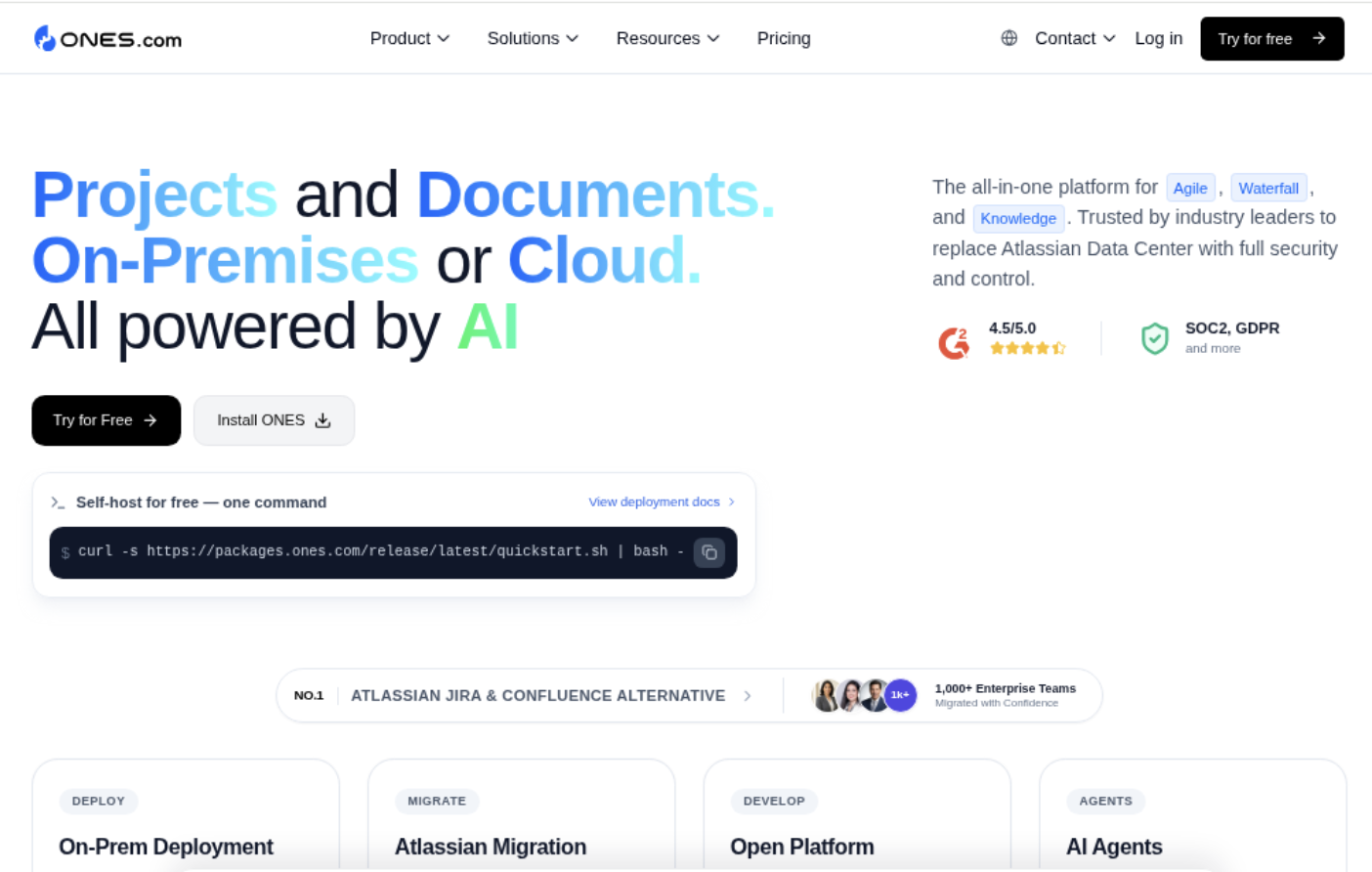
For teams comparing subscription cost with deployment control, ONES.com offers four deployment options: Cloud, On-Premise, Private Cloud, and Air-gapped. The self-hosted versions provide feature parity with the cloud version, which can simplify a restricted-network evaluation.
Value Proposition
ONES.com can suit teams that want Jira-compatible workflows, native reporting, and deployment flexibility without relying on a large collection of plugins.
Core Capabilities
- Plugin sprawl makes administration harder. ONES Project includes core project management capabilities natively, reducing the need to assemble every function through separate add-ons.
- Teams need familiar agile workflows. Jira-compatible workflows support Scrum, Kanban, backlog management, sprint planning, and issue tracking.
- Reports can become fragmented. Built-in reporting helps teams review progress, workload, delivery trends, and project health in one environment.
- Every team has different processes. Custom workflows and custom fields let you represent approval steps, risk reviews, defects, and specialized work.
- Sprint planning can become disconnected from execution. Sprint management connects planned work with active delivery and issue status.
- Repetitive project actions consume time. Automation helps trigger routine updates and workflow actions when defined conditions occur.
- Restricted networks limit cloud choices. On-Premise, Private Cloud, and Air-gapped deployments support organizations with stricter hosting requirements.
- Small teams need a low-risk starting point. The free plan supports up to 30 seats, giving smaller groups room to evaluate the platform.
- Different deployment models can create feature gaps. ONES.com provides feature parity between its cloud and self-hosted versions.
Application Scenarios
A growing software team: A 25-person engineering organization can use sprint management, custom workflows, automation, and reporting without immediately adding multiple plugins.
An air-gapped development environment: A defense supplier can evaluate an air-gapped deployment when internet-connected project management is unsuitable for its network policy.
A distributed product organization: A company can use ONES Project for delivery work and add ONES Wiki separately when its knowledge management needs justify it.
Common Challenges and Practical Solutions
Challenge: The quoted rate does not match the final invoice
Solution: Check billing frequency, user tier, currency, taxes, discounts, and additional Atlassian products before approving the purchase.
Challenge: Your team exceeds the Free plan limit
Solution: Audit access first, then compare the cost of Standard with the operational value of continuing on Jira. Do not remove legitimate contributors simply to preserve a free tier.
Challenge: Add-ons quietly increase the budget
Solution: Assign an owner to every app and review its usage quarterly. Replace overlapping tools when native capabilities meet the requirement.
Challenge: Annual billing locks in an inaccurate estimate
Solution: Forecast headcount for the full subscription period. If hiring plans are uncertain, compare the flexibility of monthly billing before committing.
Challenge: Your workflow becomes difficult to maintain
Solution: Limit custom fields, remove obsolete statuses, and require an owner for every automation rule. Configuration governance protects both productivity and cost control.
FAQs About Jira Cloud Costs in 2024
What was the cheapest Jira Software Cloud plan in 2024?
The Free plan was the cheapest option at $0. It was intended for small teams and included limits on users, storage, automation, administration, and support. Standard was the first paid tier, with a commonly listed rate of about $7.53 per user per month. Your final amount could vary by region, taxes, billing method, and later price changes.
How much did Jira Standard cost for 10 users?
Using the commonly listed 2024 rate of approximately $7.53 per user per month, 10 Standard users would produce an estimated monthly cost of $75.30 before taxes and additional products. An annual estimate would be about $903.60 using simple multiplication. Annual billing tiers, regional pricing, and account-specific terms could change the actual amount.
What was the difference between Jira Standard and Premium?
Standard covered core project management for growing teams. Premium added capabilities for advanced planning, larger-scale coordination, stronger reliability expectations, and more demanding operating environments. Premium was commonly listed at about $13.53 per user per month in 2024. The right choice depended on whether those additional capabilities justified the higher recurring cost.
Did Jira charge for every user?
Jira generally counted users who could access the product, not only people who actively created or edited issues. That means product managers, testers, executives, contractors, and administrators could affect the subscription total. Review account permissions regularly and distinguish genuine project access from accounts that no longer need entry.
Was Jira Cloud cheaper than self-hosted software?
There was no universal answer. Cloud pricing was easier to forecast because it used a recurring subscription and reduced infrastructure responsibilities. Self-hosted software could offer stronger deployment control, but your organization had to account for hosting, upgrades, backups, monitoring, security, and administration. Compare total ownership cost rather than subscription price alone.
Conclusion
Jira Software Cloud pricing in 2024 used a tiered structure: Free for small teams, Standard for core paid usage, Premium for advanced scale, and Enterprise for customized organizational requirements.
Your real cost depended on more than the displayed per-user rate. User count, billing frequency, taxes, Marketplace apps, connected Atlassian products, administration, and growth forecasts all mattered.
But here's the truth: choosing a plan without modeling your next year can leave you paying for unused capacity or struggling with limits.
Start by counting every required user, compare Standard and Premium against actual needs, audit add-ons, and test monthly versus annual billing. If deployment flexibility, native capabilities, or restricted-network operation matter, include platforms such as ONES.com in your evaluation.