Jira Software Cloud Pricing: A Practical Cost Guide for 2026
Unsure what Jira Software Cloud will cost in 2026? Compare tiers, billing, add-ons, and features with this jira software pricing cloud guide. Read now.
Jira Software Cloud pricing can look simple until you compare user tiers, billing terms, add-ons, and premium features. A small team may pay almost nothing, while a growing organization can face a much larger annual commitment.
That uncertainty makes budgeting difficult. You may choose a cheaper plan, then discover that storage, automation, support, or advanced administration limits your workflow. A plan that looks affordable per user can also become expensive after your team expands.
But here's the truth: you can estimate your Jira cloud cost before checkout. Compare plan features, calculate active seats, separate subscription fees from add-ons, and test the effect of monthly versus annual billing. This guide walks you through the calculation with practical examples for 2026.
How Jira Cloud Pricing Works in 2026
Jira Software Cloud uses a tiered subscription model. Your total cost usually depends on the plan, number of seats, billing term, optional products, and any marketplace apps you add.
For planning purposes, Jira Cloud commonly includes these main options:
| Plan |
Best suited to |
Typical considerations |
| Free |
Small teams testing Jira |
Limited users, storage, automation, and support |
| Standard |
Most small and mid-sized teams |
Core project management features with higher limits |
| Premium |
Teams needing scale and advanced administration |
Higher limits, advanced capabilities, and stronger service commitments |
| Enterprise |
Large organizations with complex governance |
Custom commercial terms and organization-wide administration |
Exact rates can change during the year. Atlassian may also use progressive pricing, where the per-user rate changes as your seat count grows. Treat public list prices as planning figures, then confirm the amount shown in your billing screen.
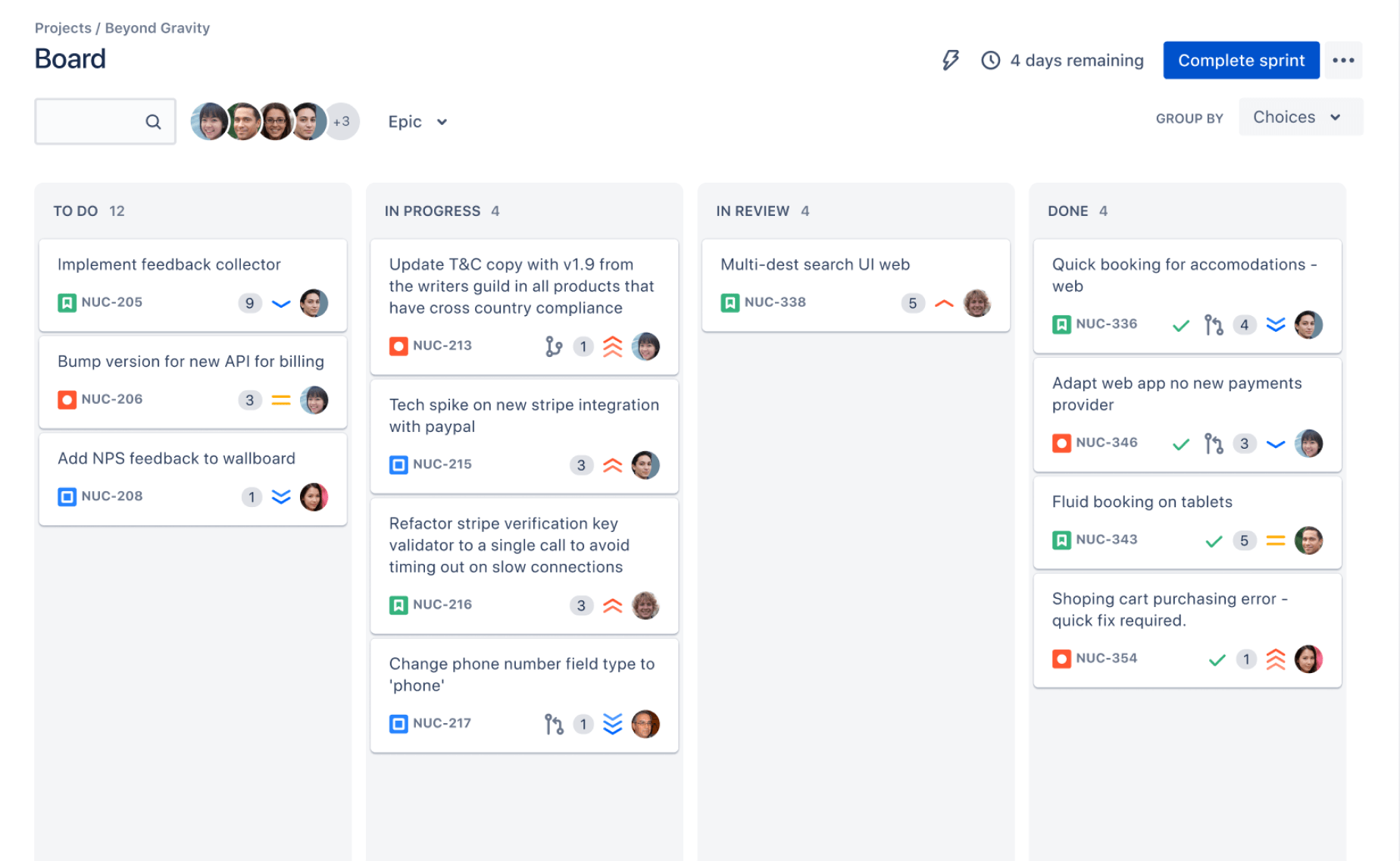
Free plan: useful for a small trial
The Free plan is designed for very small teams. It can work well when you have a few people, basic project tracking needs, and no requirement for advanced administration.
A typical free workspace may support up to 10 users, limited storage, and restricted automation. It is useful for testing issue types, boards, backlogs, and basic reports before committing to a paid plan.
Consider the trade-off carefully. A free workspace may become restrictive when you need more users, greater control, stronger support, or broader automation rules.
Standard plan: the usual starting point
Standard is often the practical choice for growing teams. It provides the core Jira experience without the higher cost of Premium.
Recent public pricing has placed Standard around the low single digits per user each month for smaller teams. A planning figure near $7.50 per user monthly may be useful, but you should verify the current rate before approving a budget.
For example, 25 users at $7.50 per month would produce this simple estimate:
- Monthly subscription: 25 × $7.50 = $187.50
- Estimated annual subscription: $187.50 × 12 = $2,250
- Additional marketplace apps: excluded from this estimate
Your actual amount may differ because of billing rules, promotions, taxes, seat changes, or progressive pricing.
Premium plan: more scale and control
Premium is aimed at organizations with more demanding workflows. It can make sense when you need higher operational limits, advanced administration, or stronger service commitments.
Recent public pricing has placed Premium near the low teens per user monthly for smaller teams. A planning figure near $13.50 per user monthly would produce this estimate for 25 users:
- Monthly subscription: 25 × $13.50 = $337.50
- Estimated annual subscription: $337.50 × 12 = $4,050
- Estimated difference from Standard: $1,800 per year
The extra cost is worthwhile only when your team uses the added capabilities. If your team mainly needs backlogs, boards, sprints, and issue tracking, Standard may provide better value.
Enterprise plan: customized commercial terms
Enterprise pricing is usually negotiated rather than shown as one simple public rate. The final amount can reflect user volume, administrative requirements, support expectations, and contract terms.
Large organizations should assess more than the subscription total. Consider identity management, organization-wide controls, compliance requirements, procurement terms, and the cost of migration.
You might be wondering: when does Enterprise become worthwhile? It usually enters the conversation when multiple teams need centralized governance and a standard contract.
How to Calculate Your Expected Jira Cloud Bill
The fastest approach is to separate your estimate into four layers: core subscription, optional products, marketplace apps, and taxes or commercial adjustments.
- Count active seats. Include employees, contractors, administrators, and occasional contributors who need access.
- Select the plan. Compare the features your team needs instead of choosing only by the lowest monthly rate.
- Apply the billing term. Monthly billing offers flexibility, while annual billing may simplify budgeting or offer different commercial treatment.
- Add related products. Jira Service Management, Confluence, and other Atlassian products may have separate charges.
- Estimate marketplace apps. Add-ons can introduce their own pricing tiers and minimum charges.
- Add taxes and adjustments. Your final invoice can include regional taxes, currency conversion, discounts, or negotiated terms.
Use this formula for a first estimate:
Estimated annual cost = plan subscription + related products + apps + taxes − discounts
Here's why this matters: the headline Jira seat price rarely represents the complete operating cost. A team paying $3,000 annually for Jira may spend another $1,000 on apps and connected services.
Example: a 12-person product team
Imagine a product team with 12 Jira users. The team needs sprint planning, backlog management, dashboards, and basic automation.
At an illustrative Standard rate of $7.50 per user monthly, the core estimate would be:
- 12 users × $7.50 = $90 per month
- $90 × 12 months = $1,080 per year
Now add one testing app at $30 monthly and a reporting app at $40 monthly:
- Core Jira subscription: $1,080 annually
- Apps: $840 annually
- Estimated subtotal: $1,920 annually
This example shows why app dependency deserves attention before you compare plan prices.
Example: a 75-person engineering organization
Suppose 75 people need Jira access, but only 50 actively manage work. The remaining 25 people may need visibility or comment permissions.
Before buying 75 full seats, review how Jira counts users and whether every person needs the same access level. Removing unnecessary accounts may reduce your bill without changing the team’s workflow.
Then compare Standard and Premium using actual needs. If advanced capabilities save several hours of administration each week, Premium may deliver a reasonable return.
Monthly Versus Annual Billing
Monthly billing works well when your team is changing quickly. You can add or remove seats with less long-term commitment, which helps during hiring pauses, reorganizations, or short projects.
Annual billing can make forecasting easier. It may also suit established teams with stable headcount and approved procurement cycles. However, annual commitment can reduce flexibility when your organization changes unexpectedly.
| Billing approach |
Advantages |
Potential drawback |
| Monthly |
Flexible seat changes and lower commitment |
Less predictable annual budgeting |
| Annual |
Simple renewal planning and stable budgeting |
Less flexibility if headcount falls |
The best choice depends on your hiring forecast. A 10-person team expecting rapid growth should model both options before signing an annual contract.
Watch for progressive pricing
Jira pricing may not behave like a simple flat multiplication at larger seat counts. The rate can vary across user bands, so doubling your users does not always double your bill.
For a reliable estimate, enter your expected seat count into the official pricing calculator or checkout screen. Then repeat the exercise at your expected headcount for the next 12 months.
For example, calculate costs at 40, 60, and 80 users. This reveals whether a hiring plan creates a sudden pricing jump.
What Can Increase Your Total Cost?
The subscription is only one part of Jira cloud spend. The following items can change your real budget.
Marketplace apps
Apps can improve roadmaps, time tracking, testing, reporting, capacity planning, and release management. They can also create a second layer of recurring costs.
Before installing an app, ask whether Jira already includes a suitable capability. If you add three apps at $50 monthly, that is $1,800 annually before taxes.
Additional Atlassian products
Teams often combine Jira with Confluence, Jira Service Management, or other Atlassian products. Each product can have separate user counts and pricing rules.
A developer may need Jira access but not a service desk license. Review each product’s user list separately instead of applying one headcount to everything.
Administration and migration
Cloud migration can require planning, testing, workflow redesign, training, and specialist help. These costs may appear outside the subscription invoice.
A practical estimate should include internal hours. For example, 80 hours of administrator time can represent a meaningful expense even when the migration service itself costs nothing.
Unused seats
Inactive accounts quietly increase waste. Former contractors, temporary contributors, and people who changed departments may still occupy paid seats.
Review inactive accounts monthly. A 100-user plan with 15 unused seats may waste hundreds or thousands of dollars each year, depending on the tier.
Choosing the Right Plan for Your Team
Start with workflow requirements, then compare plan limits. Price should confirm the decision rather than make it alone.
| Team situation |
Likely starting point |
Questions to ask |
| Up to 10 people testing Jira |
Free |
Will storage, automation, and support limits become a problem? |
| Growing product or engineering team |
Standard |
Are core planning and reporting features sufficient? |
| Large team with advanced needs |
Premium |
Will higher limits and advanced controls reduce operational risk? |
| Multiple business units |
Enterprise |
Do you need centralized governance and negotiated terms? |
Here's a practical rule: choose the least expensive plan that supports your required workflow without forcing unnecessary manual work.
For instance, Standard may suit a 35-person team with conventional Scrum processes. Premium may suit the same team if it relies heavily on advanced administration, complex scaling, or stronger service commitments.
Jira Cloud Cost-Control Checklist
Use this checklist before purchasing or renewing your subscription:
- Count active users rather than total employees.
- Separate Jira seats from Confluence and service management seats.
- List every marketplace app and its annual cost.
- Review inactive accounts before renewal.
- Model headcount changes for the next 12 months.
- Compare monthly and annual billing.
- Check storage, automation, support, and administration limits.
- Estimate migration, training, and administration time.
- Confirm taxes, currency, discounts, and renewal conditions.
- Recheck pricing immediately before purchase.
The best part? This process usually finds savings without removing a feature your team depends on. Deleting inactive accounts and replacing one unnecessary app can make a larger difference than switching plans.
Jira Cloud Alternative: ONES.com
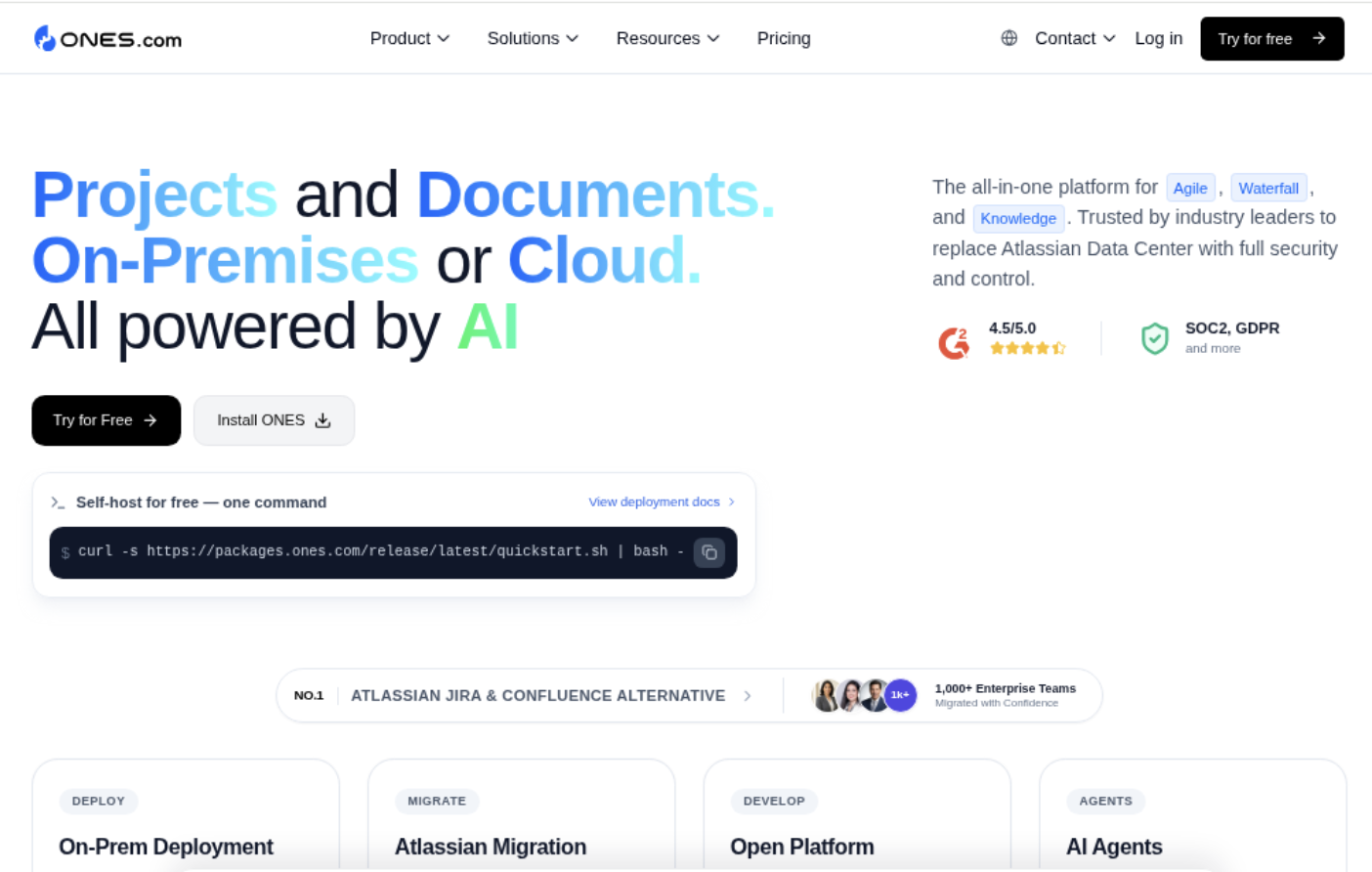
ONES.com combines project management and knowledge management on one platform. ONES Project serves as a Jira alternative, while ONES Wiki provides a knowledge base experience similar to Confluence. They are sold separately, so you can choose the product that matches your needs.
Value Proposition
ONES.com can help teams compare platform costs more broadly by combining core work management capabilities with deployment flexibility. It supports Cloud, On-Premise, Private Cloud, and Air-gapped deployments, with feature parity between cloud and self-hosted versions.
Core Capabilities
- Plugin dependency increases maintenance. ONES Project includes built-in reporting and workflow capabilities, which can reduce the need for extra extensions.
- Teams need familiar delivery methods. Jira-compatible workflows support Scrum, Kanban, backlogs, sprints, and issue-based planning.
- Different teams need different processes. Custom workflows and custom fields let teams reflect approval paths, engineering states, and business rules.
- Manual recurring work slows delivery. Automation helps trigger routine actions and reduce repetitive administration.
- Reporting can become fragmented. Built-in reporting gives teams a central view of progress, workload, and delivery trends.
- Restricted environments limit cloud choices. On-Premise, Private Cloud, and Air-gapped deployment options support controlled network environments.
- Separate work and knowledge systems create friction. ONES Project and ONES Wiki can support connected project and knowledge workflows when both products fit the team.
- Small teams need a low-risk starting point. The free plan supports up to 30 seats, giving teams room to evaluate the platform before expanding.
Application Scenarios
Product development team: A 20-person product group can manage backlogs, sprint planning, custom workflows, and reporting in ONES Project. The team can evaluate whether built-in capabilities reduce app spending.
Restricted engineering environment: A regulated engineering group may need an air-gapped deployment. ONES.com supports this deployment model while retaining the same core feature set as its cloud and self-hosted versions.
Project and knowledge management: A growing organization can use ONES Project for delivery work and ONES Wiki for internal knowledge. Each product is sold separately, allowing a more deliberate purchasing decision.
Common Challenges When Estimating Jira Costs
Challenge: confusing list price with final cost
Solution: Add marketplace apps, related products, taxes, and expected seat changes. Keep a separate monthly and annual estimate.
Challenge: buying too many seats
Solution: Review account activity before renewal. Remove former contractors and people who no longer need access.
Challenge: choosing Premium for features nobody uses
Solution: Map each premium capability to a real workflow. If no team depends on it, compare Standard again.
Challenge: underestimating growth
Solution: Model current seats plus expected hiring. Calculate costs at several headcount levels to identify pricing changes.
Challenge: overlooking migration effort
Solution: Include administrator time, training, workflow testing, and process redesign in the business case.
FAQs
How much does Jira Software Cloud cost per user?
Jira Cloud pricing depends on the plan and number of users. Recent public planning figures place Standard near $7.50 per user monthly and Premium near $13.50 for smaller teams. These figures can change, and larger groups may receive progressive pricing. Confirm the current amount in the Jira billing calculator before purchasing.
Is Jira Cloud free for small teams?
Jira commonly offers a Free plan for very small teams, often up to 10 users. It can support basic issue tracking, boards, and backlog work. Storage, automation, support, and administration limits apply. A free workspace works well for evaluation, but growing teams may need Standard once usage or collaboration requirements increase.
Is annual Jira billing cheaper than monthly billing?
Annual billing may provide different commercial terms and makes budgeting easier, but the answer depends on your seat count and current pricing. Monthly billing provides more flexibility when your team is changing. Compare both options using your expected headcount, then include apps, related products, taxes, and likely seat growth.
Do Jira marketplace apps cost extra?
Yes. Marketplace apps usually have separate pricing, user bands, and renewal terms. Some are charged according to the number of Jira users, even when only a smaller group actively uses the app. Review every app before renewal and check whether Jira’s built-in capabilities can replace an add-on.
Should a small team choose Standard or Premium?
Standard is usually the sensible starting point when a small team needs core planning, issue tracking, boards, and reporting. Premium becomes more attractive when advanced administration, higher operational limits, or stronger service commitments matter. Compare the extra cost with a specific business benefit rather than choosing Premium automatically.
Conclusion
Jira Software Cloud pricing is easiest to understand when you separate plan fees from seats, billing terms, apps, related products, and operational effort.
Start with the Free plan for a small evaluation, consider Standard for core team workflows, and justify Premium with concrete scale or administration needs. Enterprise requires a broader governance and procurement review.
But here's the truth: the cheapest monthly rate does not always create the lowest total cost. Count active seats, test your growth forecast, review add-ons, and check the current checkout price before committing.
If Jira’s combined subscription and app costs no longer fit your workflow, compare alternatives such as ONES.com. The right choice is the platform that supports your required work with predictable costs and manageable administration.