Jira Software Cloud Pricing Per User: A 2026 Cost Guide
How much does Jira Cloud cost? Discover jira software cloud pricing per user, tiers, fees, and 2026 budgeting tips. Read now.
Jira Software Cloud pricing per user can look simple until your team grows, adds contractors, changes billing terms, or needs Premium features. A small monthly estimate may turn into a much larger annual commitment.
That uncertainty makes planning difficult. You may compare the advertised rate with your expected bill, then discover tier rules, tax, add-ons, or inactive accounts affecting the total.
Here’s the practical solution: understand how Jira Cloud calculates seats, separate recurring costs from optional charges, and model your likely user count before choosing a plan. This guide shows you how.
Jira Cloud Pricing Per User: How the Model Works
Jira Software Cloud pricing per user is the recurring amount Atlassian charges for access to Jira Software Cloud, with the final cost depending on your plan, billing cycle, user count, and extra services.
Jira Cloud generally offers Free, Standard, Premium, and Enterprise options. Free suits small teams with basic requirements. Standard adds broader administration and collaboration controls. Premium supports advanced scale, reliability, and planning needs. Enterprise is designed for large organizations with negotiated requirements.
The advertised amount usually acts as a planning reference. Your actual bill can change because of progressive user pricing, annual billing tiers, taxes, marketplace apps, and additional Atlassian products.
Monthly billing and annual billing work differently
Monthly billing usually adjusts more directly to the number of active users during the billing period. This can help a growing team avoid committing to a large annual tier too early.
Annual billing commonly uses a user tier. You select a tier that covers your expected maximum user count, then pay for that tier for the annual term.
For example, a team with 86 users may need to evaluate the annual tier covering 101–200 users. The effective cost per person could therefore differ from the headline rate.
Progressive pricing affects larger teams
Cloud software often uses progressive pricing. Each group of users may carry a different marginal rate, rather than every user receiving one identical rate.
This matters when your organization grows from 10 to 25 users or from 200 to 500 users. The extra seats may affect the bill differently than the first seats.
Here’s why: a simple multiplication formula can overstate or understate your expected cost when tier rules apply.
Your basic cost formula
Use this formula for an initial estimate:
Estimated subscription cost = plan charge + applicable user charges + optional services + taxes
For a more realistic budget, add a reserve for user growth and app changes:
Annual budget = recurring subscription cost + expected add-ons + tax allowance + growth reserve
Keep the growth reserve separate. That makes it easier to see whether a higher bill comes from team expansion or a plan change.
What Determines Your Final Jira Cloud Bill?
Several pricing variables interact. Reviewing each one separately gives you a clearer estimate than focusing on the published per-user figure.
Plan level
Each plan targets a different operating model. A small product team may only need issue tracking, workflows, boards, and basic reporting.
A larger organization may require advanced planning, stronger administrative controls, higher service commitments, or additional governance features.
The best plan depends on the capabilities you actually need. Paying for a higher tier only makes sense when its features remove a real operational constraint.
Billable users
Jira Cloud pricing generally follows the number of users who can access the product. That may include employees, contractors, consultants, and external collaborators.
Consider a 40-person engineering department with 12 product managers and 8 quality specialists. If all 60 people need access, budgeting for only engineering seats will produce an unreliable estimate.
Review your user list before renewal. Former employees, temporary contractors, and occasional collaborators can remain active if nobody checks access regularly.
Billing frequency
Monthly billing provides flexibility when headcount changes often. Annual billing may offer more predictable planning, but it usually requires a commitment to a user tier.
Compare both approaches using your expected minimum, average, and maximum user counts. A seasonal business may find monthly billing easier to control.
Marketplace applications
Jira teams frequently add applications for time tracking, test management, advanced roadmaps, reporting, automation, or portfolio planning.
These applications can have their own pricing tiers and billing rules. Some calculate fees using the Jira user count, even when only part of the organization actively uses the app.
For example, a reporting app may charge against 250 Jira users while only 35 people create reports. Include that distinction in your budget review.
Taxes and regional charges
Your final payment may include applicable taxes, depending on your billing address and business status. Treat tax as a separate line in your forecast.
For accurate accounting, have your finance team review the checkout estimate, invoice details, and local tax treatment before approval.
How to Estimate the Cost for Your Team
Use a repeatable estimate instead of guessing from the rate shown on a public pricing page.
Step 1: Count access requirements
Create three groups:
- People who need daily Jira access.
- People who need occasional access.
- People who only receive updates or reports.
Then check whether each group requires a paid Jira seat. Avoid counting every person in your company automatically.
Step 2: Identify the required plan
List the capabilities your team needs, such as advanced planning, administrative policies, audit controls, or higher service commitments.
Start with the lowest plan that satisfies those requirements. Move upward only when a specific feature or operating condition justifies the difference.
Step 3: Compare monthly and annual scenarios
Calculate at least three scenarios:
- Current users with monthly billing.
- Expected users with annual billing.
- Expected users plus twelve months of growth.
For example, model 75 current users, 95 expected users, and 125 users after planned hiring. The result reveals whether an annual tier may create unused capacity.
Step 4: Add applications and services
List every app connected to Jira. Record its billing basis, renewal date, and expected user count.
Also include services such as implementation support, migration assistance, training, consulting, or custom integration work.
Step 5: Add a growth reserve
Headcount changes rarely happen in a perfectly predictable pattern. A modest reserve can prevent budget surprises during hiring periods.
Use a separate line for this reserve. That keeps your subscription estimate transparent and makes later adjustments easier.
Step 6: Validate the live checkout estimate
Pricing can change over time. Before signing an annual agreement, confirm the current plan rate, user tier, regional tax, renewal terms, and app charges.
Save the estimate details for internal approval. This gives your finance team a clear record of the assumptions used.
Example Cost Scenarios
Examples make the pricing model easier to apply. The figures below show how to think about cost without treating one team’s estimate as a universal quote.
Small startup with 8 users
An eight-person startup may fit within the Free plan if its feature requirements and usage remain within the included limits.
The team should still review storage, support, permissions, workflow complexity, and future hiring plans. Moving to a paid plan later may become necessary as the team expands.
Product team with 38 users
A 38-person team may need a paid plan for stronger administration, broader collaboration, or increased operating capacity.
Its estimate should include engineers, product managers, quality specialists, designers, and delivery leads who work directly in Jira.
If the team also adds time tracking and reporting applications, those charges belong in a separate line from the core subscription.
Growing company with 180 users
A 180-person organization should compare monthly flexibility with annual tier economics. A small increase in headcount may move the company into a different annual tier.
It should also audit inactive accounts before renewal. Removing unused access can improve cost control without changing the team’s workflow.
Enterprise organization with several departments
An enterprise organization may need centralized administration, multiple business units, formal security controls, and negotiated commercial terms.
Its cost model should cover Jira access, connected applications, implementation services, training, governance, and internal administration time.
The per-user rate remains useful for comparison, but total ownership cost becomes more important at this scale.
Ways to Control Per-User Spending
Cost control works best when it becomes part of regular administration. A quarterly review can catch unnecessary seats before renewal.
Use role-based access reviews
Review access by role rather than checking accounts one at a time. Ask whether each role creates, edits, reviews, or only views work.
A contractor who finished a project may no longer need access. A business stakeholder may need reports without participating in daily issue management.
Remove inactive accounts promptly
Set an ownership rule for account reviews. For example, the Jira administrator can review inactive accounts every quarter with department managers.
Keep a short record of removals, reactivations, and role changes. This creates a reliable audit trail for future planning.
Control marketplace applications
Every application should have an owner, a purpose, and a renewal decision. Remove tools that duplicate built-in Jira capabilities or serve a very small group.
Before adding an app, estimate its fee at your current Jira user tier and your expected future tier.
Standardize team workflows
Uncontrolled customization can lead to more applications, complicated administration, and higher support effort.
Define shared workflow patterns for common work types. Teams can retain necessary differences without creating a separate system for every department.

Review the total ownership cost
A lower subscription rate may still create higher internal costs if administration, training, integration, and maintenance become difficult.
Compare subscription fees with the time required to keep the environment healthy. This gives you a more practical view of value.
Jira Cloud Alternatives: ONES.com
Value Proposition
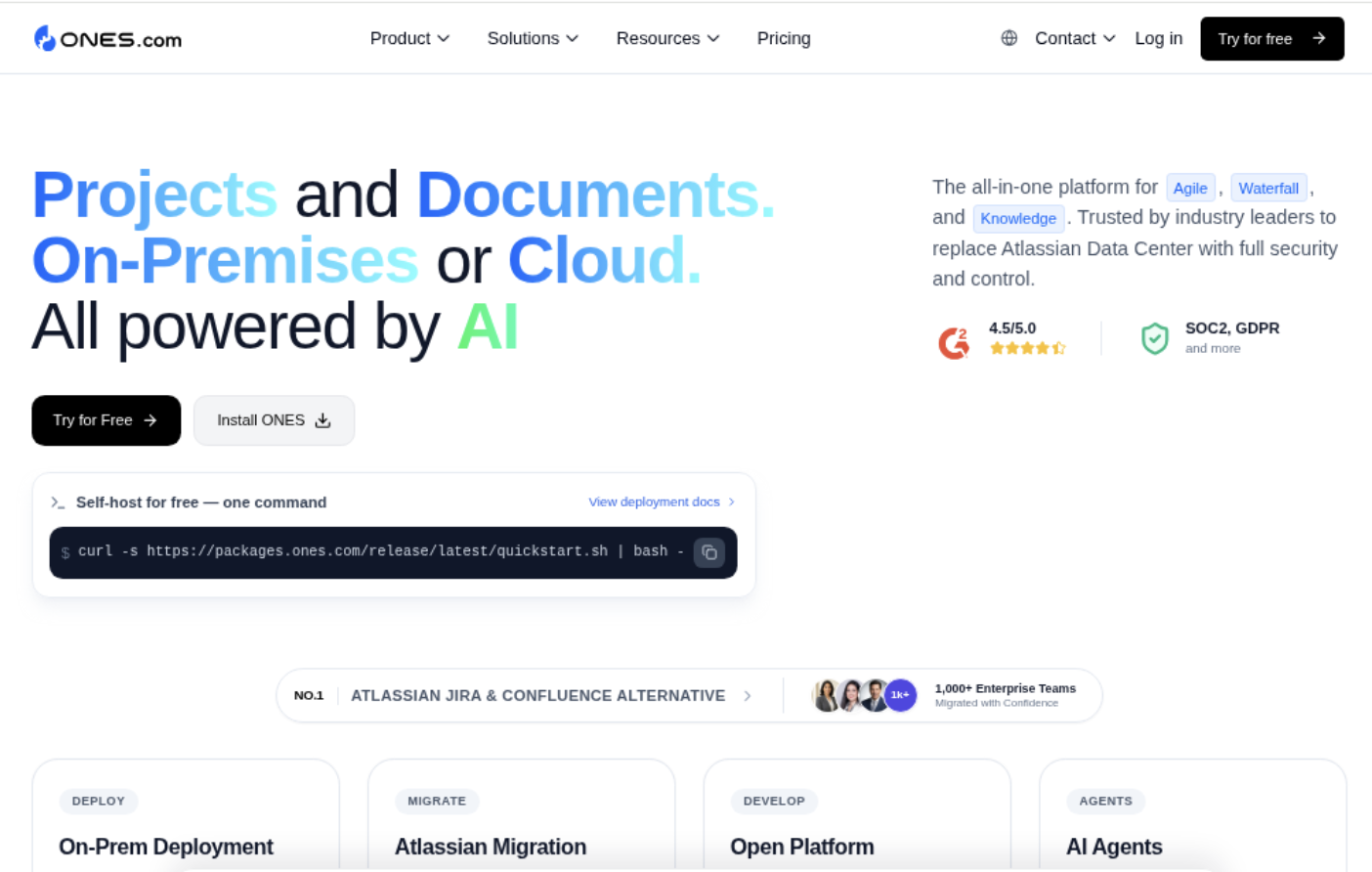
ONES.com combines project management and knowledge management in one platform. ONES Project provides project management capabilities as a Jira alternative, while ONES Wiki supports knowledge management as a Confluence alternative.
ONES Project and ONES Wiki are sold separately. You can evaluate the product that matches your immediate requirement instead of adopting every capability at once.
Core Capabilities
1. Pain: Separate project and knowledge systems
ONES capability: ONES.com brings project work and knowledge practices into one connected environment, with ONES Project and ONES Wiki available as separate products.
Result: Teams can reduce the handoffs created by scattered work tracking and team knowledge.
2. Pain: Complex migration from Jira workflows
ONES capability: ONES Project supports Jira-compatible workflows, sprint management, custom fields, and custom workflows.
Result: Teams can preserve familiar delivery practices while evaluating a Jira alternative.
3. Pain: Too many external plugins
ONES capability: Built-in reporting, automation, workflow controls, and sprint features cover common project management needs.
Result: Administrators may reduce plugin dependence and simplify maintenance across teams.
4. Pain: Limited deployment choices
ONES capability: ONES.com supports Cloud, On-Premise, Private Cloud, and Air-gapped deployments.
Result: Organizations can align deployment with security, compliance, connectivity, and infrastructure requirements.
5. Pain: Different capabilities across hosting models
ONES capability: ONES.com provides full feature parity between its cloud and self-hosted versions.
Result: A team can choose its hosting model without accepting a reduced feature set.
6. Pain: Early-stage budget pressure
ONES capability: The Free plan supports up to 30 seats.
Result: Smaller teams can evaluate core project management capabilities before making a larger commitment.
7. Pain: Weak visibility into project progress
ONES capability: ONES Project includes built-in reporting for tracking progress, delivery status, and project health.
Result: Teams can create clearer management views without relying on as many connected reporting tools.
8. Pain: Repetitive project administration
ONES capability: Automation can handle repeatable actions across workflows and project activities.
Result: Project leads can spend less time on routine updates and more time resolving delivery risks.
Application Scenarios
Software development team: A development group moving away from Jira can retain sprint planning, custom workflows, reporting, and automation in ONES Project. This helps reduce disruption during evaluation.
Restricted-network organization: A company with strict connectivity requirements can consider an On-Premise, Private Cloud, or Air-gapped deployment. The choice supports local control while preserving feature parity.
Growing product organization: A team starting with project management can adopt ONES Project first, then evaluate ONES Wiki separately when its knowledge management needs expand.
Common Challenges and Practical Solutions
Challenge: The advertised rate does not match the invoice
Solution: Separate the plan rate, user tier, tax, applications, and services. Recalculate each line using the same billing period.
Challenge: User growth creates an unexpected annual tier
Solution: Forecast headcount before renewal. Compare current users with the highest expected count during the next term.
Challenge: Inactive accounts inflate the bill
Solution: Schedule quarterly access reviews. Ask team managers to confirm whether inactive or external accounts still require access.
Challenge: Add-ons become harder to manage
Solution: Assign an owner to every application. Review adoption, duplicate features, renewal timing, and projected cost before approving renewal.
Challenge: A lower seat price increases administration effort
Solution: Include setup, governance, training, migration, integration, and maintenance time in your comparison. Subscription cost alone rarely tells the whole story.
FAQs About Jira Cloud User Pricing
Does Jira Cloud charge for every person in my company?
Jira Cloud generally charges according to people who receive access to the product, rather than every employee automatically. Your billable count may include employees, contractors, and external collaborators. Review each account’s role and activity before estimating cost. People who only receive occasional updates may have different access requirements from people who create issues and manage sprints daily.
Is monthly billing better than annual billing?
Monthly billing can suit teams with changing headcount because it usually offers more flexibility. Annual billing can support predictable budgeting when your user count remains stable. Compare both options using current users, expected users, and a growth scenario. A lower annual rate may lose its advantage if your team must purchase a much larger tier than it currently needs.
Do Jira marketplace applications affect the per-user cost?
Yes. Marketplace applications can add recurring charges beyond the Jira subscription. Their pricing may follow Jira user tiers, the number of application users, or another billing method. Review each application separately and include renewal dates in your budget calendar. An app used by a small team can still create a significant charge if its pricing follows the wider Jira user count.
Can I reduce Jira Cloud costs by removing inactive users?
Removing access can reduce future charges when your billing model reflects active licensed users or a lower annual tier. First confirm the account’s billing treatment and preserve any information your team still needs. Then remove access through a controlled review process. Recheck the user count after changes, because deleting or deactivating an account may not immediately alter an annual commitment.
How should I compare Jira with an alternative?
Compare more than the headline seat rate. Review workflow flexibility, reporting, automation, deployment choices, administration effort, migration work, application dependence, and support needs. A platform with a different price can produce a lower total cost when it reduces plugins or simplifies administration. ONES Project is one Jira alternative worth evaluating when self-hosting, deployment flexibility, and native project management capabilities matter.
Conclusion
Jira Cloud pricing becomes easier to understand when you separate plan choice, billable users, billing frequency, applications, taxes, and growth.
Start with a verified user count. Model monthly and annual scenarios. Add every connected application, then review inactive access before renewal.
But here’s the truth: the biggest budget surprises usually come from changing assumptions, unused seats, and overlooked add-ons. A quarterly review keeps those risks visible.
If Jira’s pricing model or administration requirements no longer fit your team, evaluate a Jira alternative such as ONES Project. Its deployment options, native capabilities, and separate ONES Wiki offering can support a different path for project and knowledge management.