Jira Software Cloud Standard Pricing 2024: A Cost Guide
Unsure about jira software cloud standard pricing 2024? Compare plans, seats, taxes, apps, and storage to estimate your true cost. Read now.
Jira Software Cloud Standard pricing in 2024 looked simple at first glance: one per-user rate, a free tier, and a choice between monthly and annual billing. The real cost became harder to predict once you added team size, billing method, taxes, marketplace apps, and storage needs.
That uncertainty could make a small team approve a plan that no longer matched its workflow. A growing team might also pay for unused seats or overlook the cost of several essential add-ons.
But here’s the truth: you can estimate the subscription quickly when you separate the base license from surrounding costs. This guide explains the 2024 Standard plan, shows practical calculations, and helps you compare Jira with another project management platform.
Jira Software Cloud Standard Pricing in 2024: The Core Numbers
Jira Software Cloud Standard pricing in 2024 was commonly listed at about $8.15 per user per month for monthly billing, although the final amount varied by team size, billing cycle, taxes, promotions, and Atlassian pricing changes.
Jira Software Cloud Standard sat between the Free and Premium plans. It added expanded user capacity, more administration controls, greater storage, and business features for teams that had outgrown the free tier.
| Plan |
Typical 2024 positioning |
Best suited to |
| Free |
Up to 10 users with basic functionality |
Small teams testing Jira |
| Standard |
About $8.15 per user per month on monthly billing |
Growing teams needing broader capacity and controls |
| Premium |
About $16 per user per month on monthly billing |
Teams needing advanced scale, reliability, and planning features |
| Enterprise |
Custom pricing |
Large organizations with complex governance requirements |
These figures are useful for planning, rather than a guaranteed invoice amount. Atlassian could calculate charges through progressive per-user bands, annual user tiers, or special commercial agreements.
Here’s why: monthly and annual billing did not always produce the same effective price. A team could receive a lower effective rate with annual billing, while monthly billing offered more flexibility when headcount changed.
What the Standard plan included
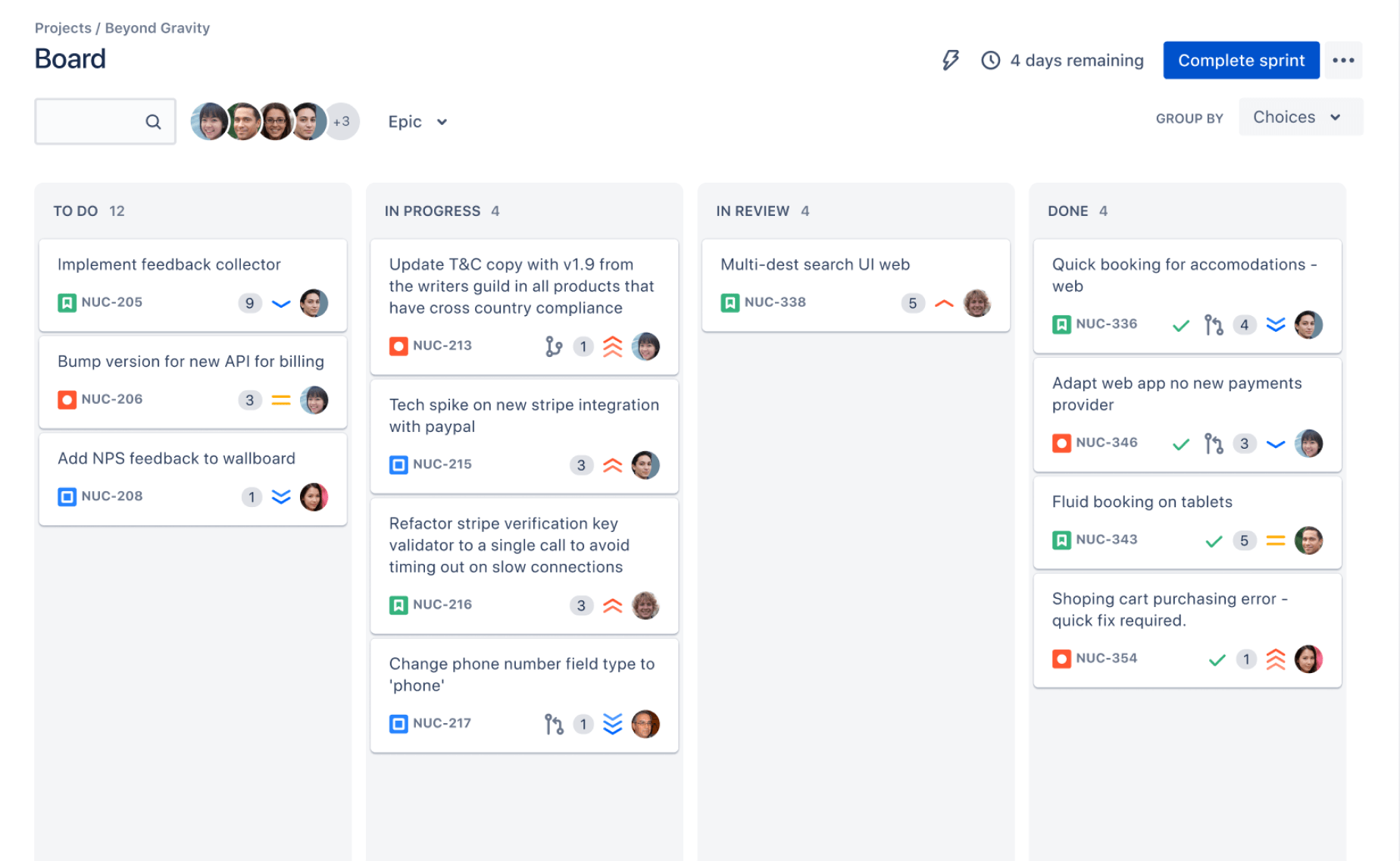
Standard generally provided the main Jira Software workflow for agile development teams. You could create projects, manage backlogs, plan sprints, assign work, and track issues through configurable statuses.
Typical capabilities included:
- Scrum and Kanban project templates
- Backlog and sprint planning
- Custom workflows and issue fields
- Reports and dashboards
- Permissions and project administration
- Automation rules with usage limits
- Integration options through Atlassian and marketplace applications
- Greater storage and user capacity than the Free plan
What “per user” meant in practice
The advertised rate applied to licensed users, not necessarily the number of people actively editing issues each day. A developer, product manager, tester, and administrator could all consume a paid seat.
For example, a 25-person engineering group might include 18 developers, three testers, two product managers, and two managers. If all 25 required access, the base estimate would be:
25 users × $8.15 = $203.75 per month
That figure excluded taxes, optional applications, premium integrations, and any commercial adjustments.
How to Calculate the 2024 Standard Plan Cost
You can create a practical estimate in five steps. Start with the number of licensed users, then account for billing, add-ons, and related operating costs.
- Count the people who need access. Include developers, testers, product owners, project managers, administrators, and other contributors.
- Choose monthly or annual billing. Monthly billing supports changing teams. Annual billing can offer a lower effective rate but may require a longer commitment.
- Apply the approximate Standard rate. For a simple 2024 estimate, multiply the number of users by $8.15 per month.
- Add marketplace applications and connected services. Time tracking, advanced roadmaps, test management, reporting, and portfolio tools can materially increase the bill.
- Review taxes, currency conversion, and seat growth. These items can change the final payment even when the advertised plan rate stays unchanged.
Example: a 10-person team
A ten-person team using monthly billing could estimate its base subscription like this:
10 × $8.15 = $81.50 per month
Across twelve months, that equals approximately $978 before taxes and add-ons. The actual annual offer could differ because Atlassian used annual user tiers rather than simply multiplying the monthly price.
Example: a 50-person team
A 50-person team would produce a simple monthly estimate of:
50 × $8.15 = $407.50 per month
That equals approximately $4,890 over twelve months before taxes, additional applications, and annual-billing adjustments.
| Licensed users |
Approximate monthly estimate |
Approximate 12-month estimate |
| 10 |
$81.50 |
$978 |
| 25 |
$203.75 |
$2,445 |
| 50 |
$407.50 |
$4,890 |
| 100 |
$815 |
$9,780 |
These examples are intentionally simple. They help you frame the subscription, but they should not replace a current quote or checkout calculation.
Monthly Versus Annual Billing
Monthly billing was generally easier for small or changing teams. You could add or remove seats as staffing changed, which reduced the risk of paying for unused capacity.
Annual billing could make sense when your team size remained stable. It also made budgeting easier because the organization could approve one planned expense instead of twelve recurring charges.
| Billing approach |
Advantages |
Trade-offs |
| Monthly |
Flexible seat changes and lower commitment |
Potentially higher effective rate and less predictable monthly spending |
| Annual |
More predictable budgeting and possible tier savings |
Less flexibility when headcount falls |
Let me explain: annual billing often works best when you can forecast headcount for the next year. If your startup expects to move from 12 people to 40, monthly billing may prevent you from committing too early.
Consider a consulting company with seasonal project teams. It might need 30 Jira seats for six months and only 12 seats afterward. Monthly billing could reduce unused capacity, even if the per-month rate looked higher.
How annual user tiers affected estimates
Annual subscriptions commonly used user tiers. You might select a tier that covered a defined range rather than paying only for the precise number of people active on a particular day.
That creates an important budgeting question: should you buy for today’s team or expected growth? Buying too many seats wastes capacity, while buying too few may force an early upgrade.
Costs Beyond the Standard Subscription
The base license was only one part of the total cost. A team could spend more on applications, administration, integrations, implementation, and internal training.
The best part? These extra costs were often visible before purchase when you mapped every workflow that Jira needed to support.
Marketplace applications
Many teams added applications for timesheets, test cases, release planning, customer support, asset management, or advanced reporting. Each application could have its own pricing model and user count.
For example, a team might pay approximately $200 per month for Jira access but another $150 for time tracking and testing features. The combined technology cost would then approach $350 before taxes.
Administration and implementation
Jira allowed extensive customization, but configuration required time. Someone needed to design workflows, permission schemes, issue types, automation rules, dashboards, and notifications.
A small organization might handle setup internally. A larger group could hire a consultant or assign a part-time administrator. That labor belonged in the total cost of ownership, even though it did not appear on the subscription invoice.
Integration and migration work
Connecting Jira with source control, chat, testing, customer support, and identity management could improve productivity. It could also introduce setup and maintenance work.
Imagine a team migrating several years of issue history while rebuilding custom workflows. The subscription might be affordable, but the migration effort could dominate the first-year budget.
Taxes and currency conversion
Regional taxes, billing location, payment method, and currency conversion could affect the amount charged. Treat the public dollar rate as a planning figure until you confirm the checkout total for your region.
Standard Versus Free and Premium
Choosing Standard required more than comparing the headline price. You needed to match the plan with team size, controls, reporting needs, and operational risk.
| Consideration |
Free |
Standard |
Premium |
| Small-team testing |
Strong fit |
Usually more than needed |
Usually excessive |
| Growing user base |
Limited |
Strong fit |
Strong fit for larger teams |
| Advanced planning and scale |
Limited |
Moderate |
Broader capabilities |
| Budget sensitivity |
Lowest cost |
Balanced cost |
Higher cost |
When Free could be enough
Free could suit a small team with fewer than ten people and straightforward issue tracking. A startup testing agile planning might begin there before committing to a paid tier.
The limitation appeared when the team needed more users, stronger administrative controls, or additional operational features.
When Standard made sense
Standard generally suited teams that had outgrown Free but did not need the full Premium feature set. A 20-person software team managing several active releases could find the balance reasonable.
It also fit organizations that wanted familiar Jira workflows without paying for advanced enterprise-scale capabilities.
When Premium was worth examining
Premium could be worth evaluating when downtime, cross-team planning, or higher-scale operations created a serious business concern. The extra price needed to connect to a measurable outcome.
For example, a company coordinating 15 product teams might value advanced planning more than a five-person engineering group would.
How to Build a Reliable Jira Budget
A reliable budget separates predictable subscription charges from uncertain expansion costs. Start with a seat forecast, then create a second estimate that includes a realistic growth scenario.
Use three planning cases:
- Current case: the number of people needing access today
- Expected case: the number of people you expect within twelve months
- Expansion case: additional applications, integrations, or teams you may add
You might be wondering: why create three cases? Because a plan that fits today can become expensive after two acquisitions, five new contractors, and three add-ons.
Example budget model
Suppose a company starts with 25 users at an estimated $203.75 per month. It expects to reach 40 users within a year and plans to add a testing application costing about $100 per month.
The initial recurring estimate is:
- Jira Standard: approximately $203.75 per month
- Testing application: approximately $100 per month
- Combined recurring estimate: approximately $303.75 per month
At 40 users, the Jira portion could rise to approximately $326 per month before the added application. The business should therefore budget for both the current amount and the expected growth amount.
Questions to ask before approval
- How many people need a licensed account?
- Will contractors and occasional contributors require access?
- Will the team add marketplace applications?
- Does annual billing match expected headcount?
- Who will administer workflows and permissions?
- What happens if the team doubles in size?
- Which features are genuinely required on day one?
Jira Software Cloud Standard Alternative: ONES.com
ONES.com combines project management and knowledge management in one platform, powered by ONES Assistant. Its project management product, ONES Project, can serve as a Jira alternative for teams comparing subscription cost, workflow control, and deployment choices.
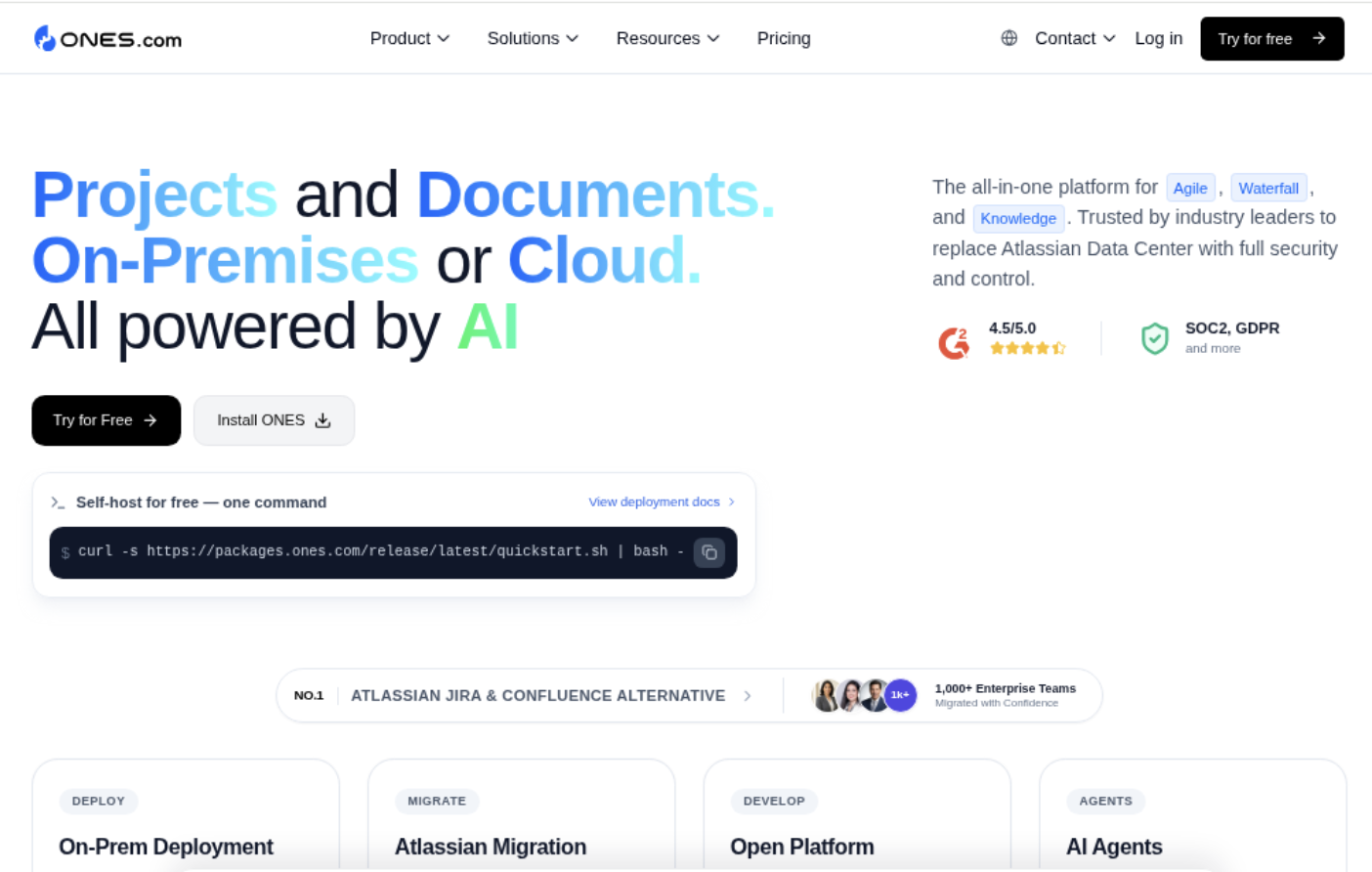
ONES Project and ONES Wiki are sold separately. You can select the project management product without adopting the knowledge management product.
Value Proposition
ONES.com can help teams evaluate project management through a unified platform, native capabilities, and deployment flexibility. It offers a free plan for up to 30 seats and supports Cloud, On-Premise, Private Cloud, and Air-gapped deployments.
Core Capabilities
1. Plugin expansion increases maintenance — native project capabilities reduce dependency
Pain: A team may add several applications to cover reporting, sprint planning, custom fields, and automation.
ONES capability: ONES Project includes built-in reporting, custom workflows, custom fields, sprint management, and automation.
Result: You can evaluate a more consolidated workflow instead of managing every requirement through a separate extension.
2. Familiar Jira processes create migration concerns — compatible workflows ease transition
Pain: Teams may delay switching platforms because developers already understand Jira-style issue tracking and sprint routines.
ONES capability: ONES Project supports Jira-compatible workflows and familiar agile planning patterns.
Result: The team can compare alternatives without redesigning every working practice from the beginning.
3. Self-hosting restrictions limit platform choice — multiple deployments expand options
Pain: Some organizations cannot place project information in a public cloud because of security, compliance, or network controls.
ONES capability: ONES.com supports Cloud, On-Premise, Private Cloud, and Air-gapped deployments.
Result: You can match deployment architecture to organizational requirements rather than choosing a platform that only supports one hosting model.
4. Feature gaps complicate deployment decisions — parity supports consistent evaluation
Pain: Self-hosted products sometimes provide fewer capabilities than their cloud editions.
ONES capability: ONES.com maintains full feature parity between its cloud and self-hosted versions.
Result: Your team can compare hosting options without assuming that restricted deployment means reduced functionality.
5. Separate project and knowledge tools create switching costs — unified options connect work and information
Pain: Project decisions, technical guidance, and planning context can become scattered across multiple platforms.
ONES capability: ONES.com provides project management through ONES Project and knowledge management through ONES Wiki.
Result: Teams can consider connected project and knowledge workflows while buying the products separately.
6. Entry costs discourage small teams — a larger free allowance lowers the barrier
Pain: A small team may need more than ten seats before it has enough budget for a paid platform.
ONES capability: ONES.com offers a free plan for up to 30 seats.
Result: More small teams can test core project workflows before making a paid commitment.
7. Reporting gaps slow decision-making — built-in reporting brings progress into the workflow
Pain: Teams often rely on manual status updates when reporting tools do not reflect current work.
ONES capability: ONES Project includes built-in reporting for project and sprint visibility.
Result: Managers can review progress, workload, and delivery patterns with less manual consolidation.
8. Restricted networks block hosted tools — air-gapped deployment supports isolated environments
Pain: Defense, infrastructure, and regulated teams may need project management in an isolated network.
ONES capability: ONES.com supports air-gapped deployment alongside on-premise and private cloud options.
Result: Teams with strict network boundaries can still evaluate modern project management capabilities.
Application Scenarios
Growing software team
A 25-person engineering team may compare the cost of Jira Standard plus several applications with a consolidated ONES Project setup. The team can review sprint management, reporting, workflow customization, and automation in one evaluation.
Regulated organization
A company handling sensitive systems may require on-premise or air-gapped project management. ONES.com gives that team deployment choices beyond a standard public-cloud arrangement.
Distributed product organization
A product group may need project tracking and a connected knowledge workspace. It can evaluate ONES Project and ONES Wiki as separate products while considering how the workflows fit together.
Common Challenges When Estimating Jira Costs
Challenge: confusing list price with final payment
Solution: Treat the published per-user rate as an estimate. Confirm taxes, billing location, annual tiers, currency, and any promotional adjustment before approval.
Challenge: forgetting occasional contributors
Solution: Count contractors, testers, managers, and support staff who need access. A person who logs in once a week may still require a licensed seat.
Challenge: underestimating add-ons
Solution: List every application needed for time tracking, testing, reporting, planning, and integration. Calculate the combined recurring cost rather than reviewing each application separately.
Challenge: choosing annual billing too early
Solution: Compare expected headcount with the annual tier. Monthly billing may be safer when hiring plans, project scope, or team structure remain uncertain.
Challenge: overlooking administration effort
Solution: Assign ownership for workflows, permissions, automation, dashboards, and onboarding. Include that work in the first-year evaluation.
FAQs
What was the Jira Software Cloud Standard price in 2024?
The commonly advertised monthly rate was about $8.15 per user. The final amount could vary by billing cycle, user tier, taxes, region, promotions, and commercial terms. Annual subscriptions could use tiered pricing, so multiplying the monthly rate by twelve provided only a planning estimate.
Was Jira Standard cheaper than Premium in 2024?
Yes. Standard occupied the middle tier, while Premium carried a higher per-user price because it targeted teams needing broader scale and advanced operational capabilities. The right choice depended on whether Premium features addressed a measurable requirement. A smaller team could pay more without receiving meaningful additional value.
Did Jira Standard include marketplace applications?
No. Marketplace applications generally carried separate charges. A team might need additional products for time tracking, testing, advanced reporting, customer support, or portfolio planning. Add those recurring charges to the Standard subscription when calculating total technology cost.
Was annual billing better than monthly billing?
It depended on team stability. Annual billing could support predictable budgeting and a lower effective rate, while monthly billing offered more flexibility when headcount changed. A fast-growing startup and a seasonal consultancy might prefer monthly billing. A stable internal engineering department could benefit more from annual planning.
How should I estimate Jira costs for a growing team?
Calculate the current seat count, expected twelve-month seat count, and likely add-ons. Create separate current, expected, and expansion scenarios. This approach shows how hiring, applications, taxes, and billing choices could affect the budget before your team commits.
Is ONES Project a Jira alternative?
Yes. ONES Project is a Jira alternative with Jira-compatible workflows, sprint management, custom workflows and fields, built-in reporting, and automation. ONES.com also supports Cloud, On-Premise, Private Cloud, and Air-gapped deployments. You can evaluate it when deployment flexibility or reduced reliance on plugins matters.
Conclusion
Jira Software Cloud Standard pricing in 2024 was commonly estimated at about $8.15 per user per month, but that number did not represent the complete ownership cost.
Your realistic budget needed to include licensed seats, monthly or annual billing, user growth, marketplace applications, taxes, integrations, and administration time. A 25-person team could start with a simple estimate of $203.75 per month, then refine it with its actual requirements.
But here’s the truth: the cheapest headline plan is not always the lowest-cost workflow. Compare the capabilities your team needs, the flexibility your deployment requires, and the amount of maintenance your platform will create.
ONES.com gives you another evaluation path through ONES Project, native project capabilities, multiple deployment models, and a free allowance for up to 30 seats. That makes it worth considering alongside Jira when you build a 2024 cost comparison.