Jira Software License Pricing: A Practical Guide for 2026
Unsure about jira software license pricing? Learn the true costs of plans, users, apps, and support. Click to plan your 2026 budget wisely.
Jira Software can look affordable when you first compare monthly plan prices. Then your team grows, adds products, needs advanced permissions, or chooses a self-managed deployment.
Suddenly, the license is only one part of the bill. Administration, migration, marketplace apps, support, storage, and renewal changes can shift your annual budget considerably.
That uncertainty makes planning difficult. You may approve a plan for 25 people and later discover that 80 occasional contributors need access.
But here's the truth: Jira Software license pricing becomes easier to understand when you separate subscription tiers, user counts, deployment options, and operating costs.
This guide shows you how to estimate the real cost for 2026, compare plans sensibly, and avoid common budgeting mistakes.
Jira Software License Pricing at a Glance
Jira Software license pricing is the cost of giving your team access to Jira Software through a subscription or self-managed license, depending on your deployment choice.
For 2026 planning, calculate your budget across five areas:
- Plan tier and included capabilities
- Number of active seats
- Monthly or annual billing
- Cloud, Data Center, or another deployment model
- Apps, administration, migration, and support
Atlassian can change prices, packaging, and eligibility rules. Check the current Jira pricing page before approving a purchase or renewal.
| Cost area |
What to examine |
| Base subscription |
The recurring charge for the selected Jira plan |
| Seat count |
People who need access, including occasional contributors |
| Billing term |
Monthly flexibility compared with annual commitment |
| Deployment |
Cloud subscription or self-managed infrastructure |
| Extensions |
Marketplace apps, integrations, storage, and automation needs |
| Operations |
Administration, security reviews, training, migration, and support |
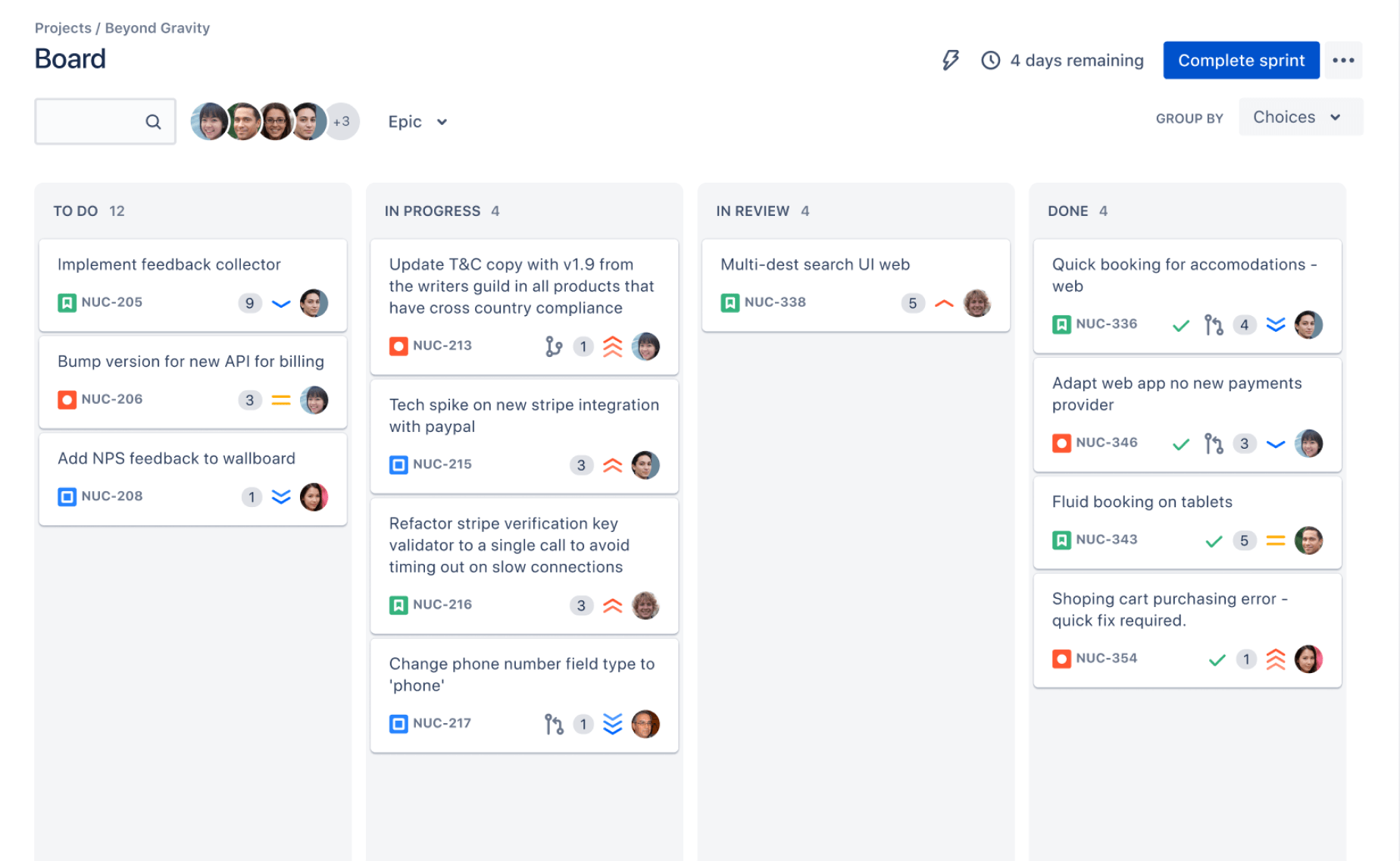
How Jira Pricing Works in Practice
Jira pricing usually follows a tiered model. Your cost depends on the plan, the number of seats, and the deployment method.
Here's why: a small team may fit comfortably within a lower tier, while a larger organization may pay more because of advanced controls and scale.
Cloud subscriptions
Cloud plans charge recurring fees for access to a hosted Jira environment. Atlassian manages the underlying infrastructure, service updates, and much of the operational maintenance.
Cloud billing can suit teams that want fast deployment and predictable administration. You still need to evaluate storage, security requirements, integrations, and third-party apps.
Self-managed deployments
Data Center pricing involves a different planning model. You may need to account for infrastructure, hosting, backups, disaster recovery, monitoring, and specialist administration.
The license can therefore represent only part of the total cost. A lower subscription price may lose its advantage if your organization needs a large operations team.
Free, Standard, Premium, and Enterprise considerations
Jira plans commonly separate capabilities by tier. Exact features and prices can change, so compare the current plan pages before making a decision.
- Free: Useful for very small teams testing core project tracking.
- Standard: Often suitable for everyday issue tracking and collaboration.
- Premium: Designed for organizations needing broader scale, planning, or administrative features.
- Enterprise: Intended for larger organizations with complex governance and support requirements.
The best tier depends on the work you need to manage. A team should not select Premium only because it sounds safer.
How to Estimate Your 2026 Jira Budget
- Count every required seat. Include developers, product managers, testers, service teams, contractors, and occasional approvers.
- Separate active and occasional access. A person who reviews work every week may still require a paid seat.
- List required capabilities. Write down automation, reporting, advanced permissions, planning, audit needs, and security controls.
- Compare billing terms. Annual billing may improve predictability, while monthly billing can help during a pilot or changing headcount.
- Add application costs. Include time tracking, test management, roadmaps, reporting, backup, and integration apps.
- Estimate administration effort. Account for configuration, workflow maintenance, permission reviews, training, and support.
- Model growth. Create scenarios for your current team, expected growth, and a higher-growth case.
- Review the result before renewal. Remove inactive seats and unused apps before committing to another term.
A simple calculation
Use this formula for a practical estimate:
Annual Jira budget = subscription fees + app fees + infrastructure costs + administration + migration or training costs.
For example, imagine a 60-person engineering organization. Forty people work in Jira every day, 10 product specialists review tickets, and 10 contractors contribute during releases.
Counting only the engineering team would underestimate the required access. The safer approach is to model all 60 people, then confirm whether every person needs the same permission level.
What Changes the Total Cost?
The displayed plan price rarely tells the whole story. Several cost drivers can move your annual estimate.
Seat growth
Seat increases can push your team into a higher pricing tier. A five-person increase may have a larger effect near a tier boundary than it has within the middle of a tier.
Track hiring plans, shared service teams, and temporary project contributors before renewal. This gives you time to compare options rather than reacting under deadline pressure.
Marketplace apps
Teams often add apps for test management, capacity planning, time tracking, reporting, approvals, or backup. Each app may use its own pricing structure.
Review app adoption quarterly. If only three people use a paid extension, ask whether a native Jira capability or a simpler process can replace it.
Administration and governance
Jira can require ongoing work as workflows, fields, permissions, notifications, and integrations become more complex.
A practical example is a team with 12 workflows and hundreds of custom fields. Cleaning up that environment may take more effort than maintaining a smaller configuration with clear ownership.
Migration and training
Moving from another project management platform can involve process mapping, permission design, testing, training, and change management.
These activities may be one-time expenses, yet they should appear in the first-year budget. Otherwise, the business case may look stronger than the actual rollout experience.
Monthly Billing or Annual Billing?
Monthly billing offers flexibility. It can work well for a pilot, a temporary team, or an organization with uncertain hiring plans.
Annual billing can make procurement and forecasting easier. It may also require a larger commitment before you have confirmed adoption across every department.
| Billing approach |
Works well when |
Watch for |
| Monthly |
Headcount or project scope may change soon |
Higher flexibility can come with less budget certainty |
| Annual |
Seat demand is stable and procurement favors fixed commitments |
Unused seats can remain part of the commitment |
You might be wondering: which option should you choose? Start with the length of your planning horizon.
If you are running a three-month evaluation, monthly billing reduces commitment risk. If you have a stable 12-month roadmap and predictable staffing, annual planning may be easier.
Common Pricing Mistakes to Avoid
Most budgeting errors come from incomplete planning rather than difficult arithmetic.
Counting only developers
Product managers, quality specialists, designers, support staff, and business approvers may also need access.
Create a role-by-role access list. For example, a release manager who approves work every Friday still needs a reliable way to review and update issues.
Ignoring app dependencies
A team may choose a low Jira tier, then add several paid apps to recover capabilities available in a higher tier.
Compare the combined cost of the base plan and extensions against the next plan level. This comparison can reveal a simpler configuration.
Underestimating self-managed operations
Self-managed Jira may require servers, storage, backup testing, security patches, monitoring, and technical specialists.
Include those expenses in the total cost of ownership. A license comparison without operational effort can produce a misleading result.
Leaving inactive seats untouched
People change teams, leave projects, or stop using Jira. Their access can remain active unless someone reviews it.
Run a quarterly access review. Remove unnecessary accounts and document the approval process for new seats.
Choosing the Right Approach for Your Team
The right choice depends on more than price. You should compare control, administration, security, integrations, reporting, and long-term flexibility.
Cloud may suit you when
- You want a fast rollout.
- Your team prefers vendor-managed infrastructure.
- You have limited internal operations capacity.
- You can meet your security and compliance requirements through a hosted service.
Self-managed deployment may suit you when
- You need deeper infrastructure control.
- Your organization has strict hosting requirements.
- You already operate a capable platform engineering function.
- You can support upgrades, backups, resilience, and security maintenance.
The best part? You can make the decision with a simple scorecard. Give each option a score for cost, security, administration, integration, scalability, and team fit.
Then apply greater weight to the factors that could create serious business risk. For a regulated organization, governance may matter more than a small difference in subscription cost.
Value Proposition
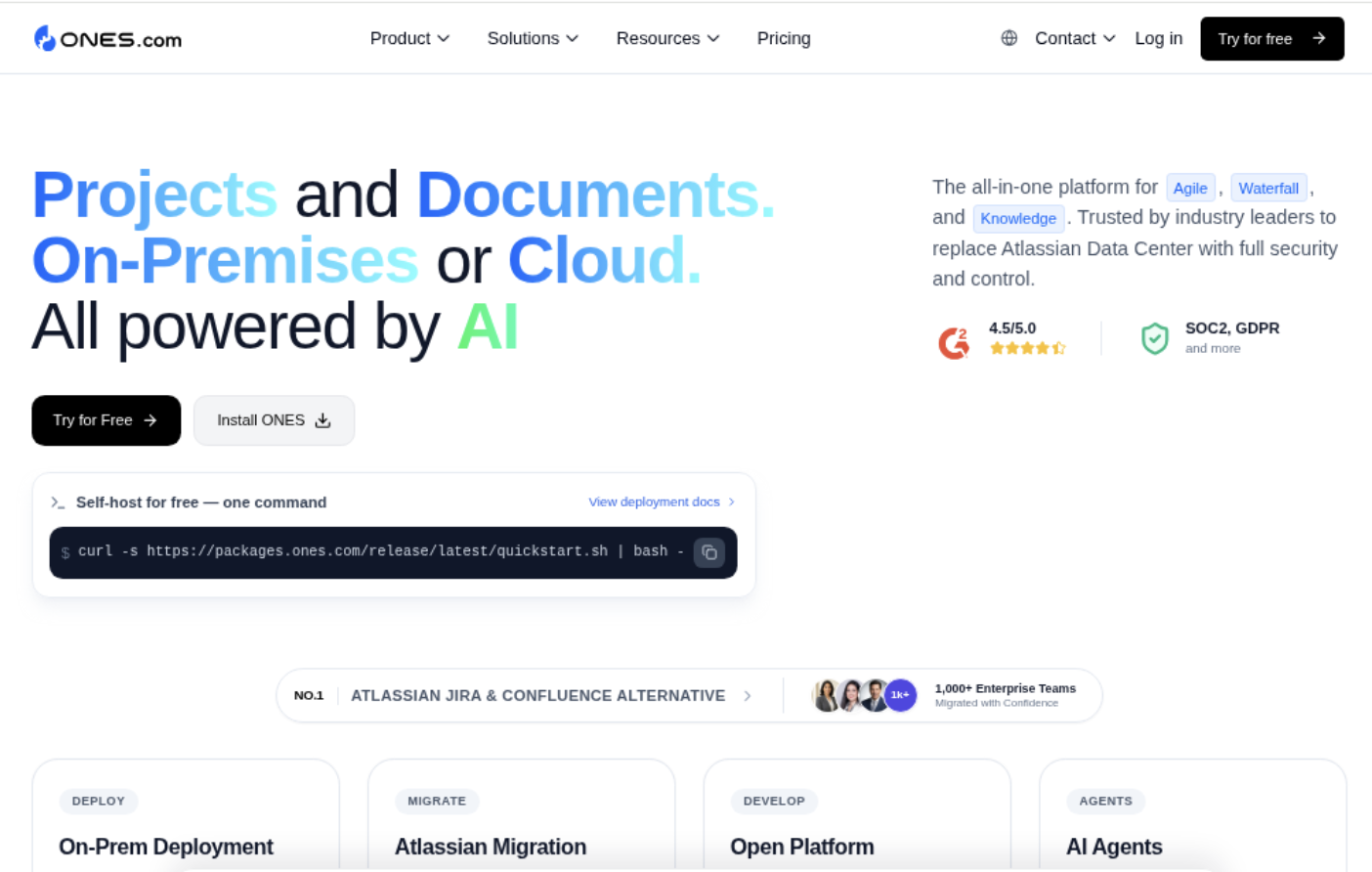
ONES.com combines project management and knowledge management in one platform, powered by ONES Assistant. ONES Project is the project management product and works as a Jira alternative, while ONES Wiki provides knowledge management separately.
You can purchase ONES Project and ONES Wiki separately. The platform offers Cloud, On-Premise, Private Cloud, and Air-gapped deployments, with full feature parity between cloud and self-hosted versions.
Core Capabilities
- Plugin sprawl increases cost: ONES Project includes Jira-compatible workflows and native project controls, which can reduce reliance on extra extensions.
- Workflow changes become difficult to maintain: Custom workflows let you match approval, development, testing, and release processes to your operating model.
- Teams need flexible issue data: Custom fields help you capture risk levels, release targets, ownership, compliance details, and other project information.
- Sprint planning takes too much manual effort: Built-in sprint management helps teams organize backlogs, plan iterations, and review delivery progress.
- Repeated administrative work consumes time: Automation can handle routine transitions, notifications, assignments, and other predictable actions.
- Leadership lacks delivery visibility: Built-in reporting gives teams a way to examine progress, workload, status, and project trends.
- Hosting restrictions limit platform choices: On-Premise, Private Cloud, and Air-gapped deployment options support restricted environments.
- Self-hosted teams fear feature gaps: ONES.com provides full feature parity between cloud and self-hosted versions.
- Knowledge sits apart from project work: ONES Wiki connects knowledge management with the wider ONES.com platform when you need a separate knowledge product.
Application Scenarios
Software development team: A 40-person engineering group can use Jira-compatible workflows, sprint management, custom fields, and reporting without assembling every capability through separate extensions.
Restricted-network organization: A team working in an air-gapped environment can evaluate an Air-gapped deployment while keeping project operations inside its approved network model.
Growing product organization: A company expanding beyond engineering can use ONES Project for delivery work and add ONES Wiki separately for structured knowledge management.
Common Challenges and Practical Solutions
Challenge: Your seat count keeps changing
Solution: Review access every quarter and maintain separate forecasts for permanent staff, contractors, and temporary contributors.
Challenge: The base plan looks affordable, but add-ons raise the bill
Solution: Build a complete capability map before choosing a tier. Compare native features, app costs, administration, and renewal terms together.
Challenge: Cloud and self-managed costs are difficult to compare
Solution: Use a five-year view that includes infrastructure, staff time, upgrades, backups, security work, and disaster recovery.
Challenge: Teams create inconsistent workflows
Solution: Assign an owner for workflow governance. Define when a new workflow is necessary and when an existing process should be reused.
Challenge: Renewal arrives before anyone reviews adoption
Solution: Start your review 90 days before renewal. Check active accounts, app usage, plan requirements, support needs, and expected growth.
FAQs
How should I estimate Jira costs for 2026?
Start with your expected seat count and required plan capabilities. Add marketplace apps, administration, training, migration, infrastructure, and support. Create low, expected, and high-growth scenarios. Since Atlassian can revise prices and plan features, confirm current rates shortly before purchase or renewal.
Is the cheapest Jira plan always the best value?
No. A lower plan may require several paid apps, manual workarounds, or additional administration. Compare the total cost of the capabilities you need. If a higher tier includes features that replace multiple extensions, it may provide better operational value despite the larger subscription charge.
Should I choose monthly or annual billing?
Monthly billing can suit pilots, temporary teams, and uncertain headcount. Annual billing can simplify forecasting when your team size and project demand are stable. Before committing, check whether your expected staffing changes could leave you paying for unused access.
What hidden costs should I include?
Include marketplace apps, migration, training, workflow administration, permission reviews, integrations, reporting maintenance, backup requirements, and infrastructure. Self-managed deployments may also require technical staff for upgrades, monitoring, security, and recovery testing.
How can I reduce unnecessary Jira spending?
Review inactive accounts, remove unused apps, simplify workflows, and confirm that every paid capability supports a real business need. A quarterly access review can prevent gradual seat growth. You can also compare the combined cost of your current plan and extensions with alternative platforms.
Conclusion
Jira Software license pricing is only the starting point for a reliable 2026 budget. Your real cost also includes seats, plan capabilities, apps, administration, infrastructure, training, and growth.
But here's the truth: a careful estimate does not need to be complicated. Count access needs, compare deployment models, map required capabilities, and test several growth scenarios.
That process reduces renewal surprises and helps you choose a platform that matches your team’s work. If Jira’s full cost or operating model no longer fits, evaluate a Jira alternative such as ONES Project alongside the broader ONES.com platform.