Jira Software Pricing 2024: Plans, Costs, and Fees Guide
Comparing jira software pricing 2024? See plans, seat costs, billing terms, and extra fees to estimate your true total. Read now to save.
Jira Software pricing can look simple until you compare plans, seat bands, billing terms, and extra services. A low monthly rate may change when your team grows beyond 10 seats or needs advanced planning.
The confusion gets worse when you add marketplace apps, Atlassian Access, premium support, or self-managed deployment. Two teams with similar project needs can end up paying very different annual totals.
But here's the truth: you can estimate Jira Software costs quickly when you separate the core subscription from optional fees. This guide explains the 2024 plans, indicative prices, billing rules, hidden costs, and practical alternatives.
Jira Software Pricing in 2024 at a Glance
Jira Software pricing in 2024 generally included a Free plan, a Standard plan at about $8.15 per seat per month, a Premium plan at about $16 per seat per month, and an Enterprise plan with custom pricing.
Those figures mainly describe Jira Cloud list pricing. Your final amount could change with seat count, monthly or annual billing, regional taxes, currency conversion, promotions, and optional Atlassian services.
| Plan |
Indicative 2024 price |
Best suited to |
Important limits or considerations |
| Free |
$0 |
Small teams testing Jira |
Up to 10 seats, with reduced administration and support features |
| Standard |
About $8.15 per seat per month |
Growing project teams |
More storage, permissions, and support than Free |
| Premium |
About $16 per seat per month |
Teams needing scale and advanced planning |
Higher service limits and advanced capabilities |
| Enterprise |
Custom quote |
Large organizations |
Usually sold through an annual agreement |
The Free tier could work for a five-person software team. A 25-seat team would usually need Standard or Premium, while a global organization might evaluate Enterprise or Jira Data Center.
Here's why: the per-seat number is only one part of the calculation. You also need to examine billing structure, app subscriptions, administration requirements, and deployment costs.
How the 2024 Jira Plans Worked
Free plan
The Free plan supported small teams with up to 10 seats. It offered core issue tracking, project boards, backlogs, reports, and basic collaboration features.
For example, a startup could use it to manage a mobile app backlog, assign bugs, and track sprint progress without paying a subscription.
The trade-off was limited capacity. Small storage allowances, fewer administrative controls, and reduced support made the plan less suitable for regulated or rapidly expanding teams.
Standard plan
The Standard plan was the usual starting point for paid teams. Its 2024 list price was approximately $8.15 per seat each month on monthly billing.
At that rate, 20 seats would produce a simple monthly estimate of $163 before taxes and additional services. The annual equivalent would be about $1,956 if the monthly rate remained unchanged.
Standard generally added higher limits, stronger permissions, more storage, and better support. It suited software teams that had outgrown the Free tier.
Premium plan
Premium cost approximately $16 per seat per month in 2024. A 20-seat team would therefore estimate $320 per month before taxes and optional services.
Premium was designed for teams needing advanced planning, higher limits, stronger availability commitments, and capabilities for larger-scale delivery.
You might be wondering: is Premium automatically better value? Only if your team will use its additional capabilities. Paying twice the Standard rate makes little sense when your team only needs basic issue tracking.
Enterprise plan
Enterprise pricing was handled through a custom annual agreement. The amount depended on organizational scale, commercial terms, security requirements, and service expectations.
Large companies often evaluate Enterprise alongside centralized administration, multiple teams, governance, analytics, and support needs. A simple per-seat calculation is not enough for this tier.
Jira Data Center
Jira Data Center was the self-managed option for organizations requiring greater control over hosting and deployment. Pricing was generally quoted annually and could involve a minimum seat tier.
Public 2024 estimates often placed the entry level around 500 seats, with annual pricing starting near $44,000. Treat that figure as an indicative planning number rather than a guaranteed quote.
Data Center also introduced infrastructure expenses. You could need hosting, storage, backups, security monitoring, upgrades, and specialist administration.
Monthly Versus Annual Billing
Monthly billing usually gave you more flexibility. You could adjust the subscription as your team changed, though the per-seat rate could be higher.
Annual billing often used user tiers instead of a simple month-to-month count. You might pay for a minimum band even when every seat is not occupied throughout the year.
For example, a 26-seat team could fall into a higher annual tier than a 25-seat team. That jump may affect the annual invoice more than a one-seat increase suggests.
The best part? You can build a reliable estimate by calculating both options before committing:
- Count active seats and expected growth.
- Multiply seats by the published monthly rate.
- Multiply the monthly result by 12.
- Compare that amount with the annual tier quote.
- Add optional services, taxes, and marketplace subscriptions.
Additional Fees That Can Raise the Total
Marketplace apps
Many teams extend Jira with apps for time tracking, test management, portfolio planning, roadmaps, reporting, and automation.
Each app can carry its own subscription. Some are priced by the Jira seat count, while others use separate limits or usage measures.
A team paying $4,000 annually for Jira could spend another $2,000 on essential apps. That changes the real technology budget considerably.
Atlassian Access
Atlassian Access was a separate service for centralized identity and security administration. Features could include single sign-on, user provisioning, directory integration, and organization-wide controls.
Access pricing was typically calculated per managed account. If your company required centralized security, include it in the total rather than treating it as part of the Jira subscription.
Premium support and enterprise services
Large organizations may require stronger support arrangements, onboarding assistance, or commercial service commitments. Those terms can sit outside the normal plan price.
Ask whether the quoted amount includes support, implementation assistance, training, or account management. A lower subscription quote may exclude services your team expects.
Taxes and currency conversion
Published prices commonly exclude local taxes. Your invoice may include VAT, sales tax, or another regional charge.
Currency conversion can also affect the final amount. Keep a small budget buffer when you are planning a multi-year agreement.
A Practical Jira Cost Calculation
Let me explain: a useful estimate separates predictable subscription costs from variable operating costs.
| Cost category |
Example calculation |
Estimated annual amount |
| Standard subscription |
25 seats × $8.15 × 12 months |
$2,445 |
| Marketplace apps |
Two apps at $80 per month |
$960 |
| Identity and security |
Separate service priced by managed account |
Confirm with a quote |
| Taxes |
Applied to eligible charges |
Depends on region |
In this example, the known annual subtotal is $3,405 before taxes and identity services. That is more realistic than quoting only the $2,445 Jira subscription.
For Premium, the same 25-seat calculation would be 25 × $16 × 12, producing an estimated $4,800 before additions.
Use actual invoices or current quotes for purchasing decisions. 2024 figures are useful for historical comparisons, budgeting exercises, and evaluating an older agreement.
Which Plan Fits Different Teams?
Small startup
A startup with six people may begin with Free. It can validate sprint planning, bug tracking, and workflow habits without creating an immediate subscription cost.
Move to Standard when the team needs stronger permissions, more capacity, or additional administrative control.
Growing product team
A 30-seat product organization will usually compare Standard and Premium. Standard may cover everyday planning, while Premium becomes more attractive when multiple teams coordinate releases.
Compare the extra plan capabilities with a real workflow. If your teams do not need advanced planning or higher service limits, Standard could remain the more efficient choice.
Enterprise engineering organization
A large organization should assess more than seat price. It may need centralized identity, audit controls, multiple projects, governance, advanced support, and deployment flexibility.
Enterprise Cloud and Data Center can lead to very different operating models. Include infrastructure, administration, compliance, and upgrade responsibilities in the comparison.
How to Reduce Jira Software Costs
You can often reduce waste without removing Jira from your workflow. Start by reviewing who genuinely needs a paid seat.
- Remove inactive accounts before renewal.
- Use project roles to limit unnecessary access.
- Audit marketplace apps every quarter.
- Remove duplicate reporting and time-tracking subscriptions.
- Compare monthly flexibility with annual tier commitments.
- Estimate growth before choosing an annual seat band.
- Check whether Premium capabilities are used often enough to justify the upgrade.
For example, a 40-seat team may discover that 10 former contractors still have access. Removing those accounts may not transform the budget, but it prevents recurring waste.
Here's the practical test: identify each paid capability, name the team that uses it, and measure whether it affects delivery. Anything without a clear owner deserves review.
Jira Software Alternative: ONES.com
Value Proposition
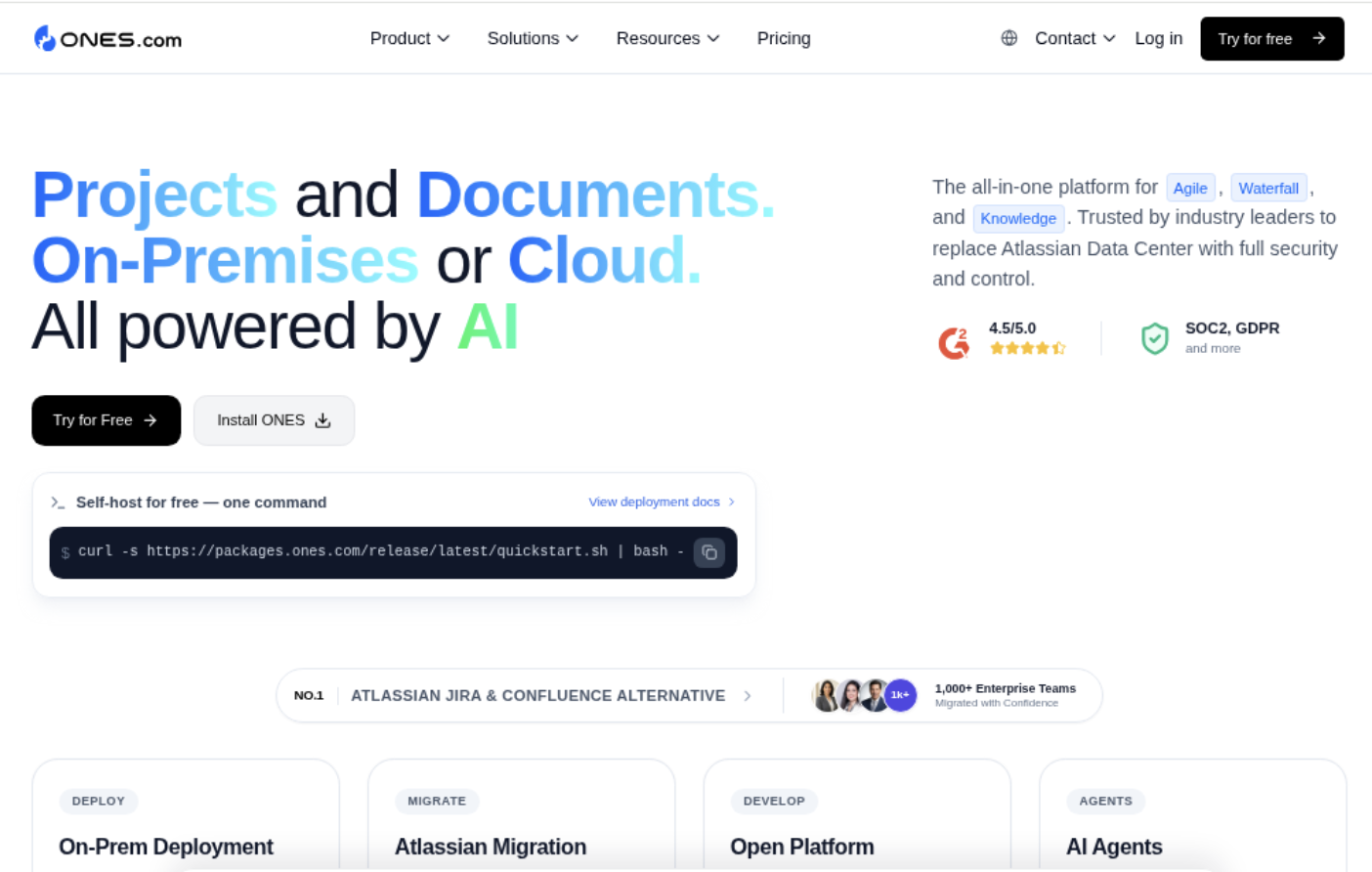
ONES.com combines project management and knowledge management in one platform. ONES Project provides project planning and delivery capabilities as a Jira alternative, while ONES Wiki supports structured team knowledge management.
You can purchase ONES Project and ONES Wiki separately. The platform offers a Free plan for up to 30 seats and supports Cloud, On-Premise, Private Cloud, and Air-gapped deployments.
Core Capabilities
- Scattered project tracking → ONES Project: Manage issues, backlogs, sprints, and project progress in one workspace, reducing the need to connect several separate systems.
- Complex delivery processes → Custom workflows and fields: Adapt statuses, fields, and approval paths to match your engineering or product process.
- Limited Jira migration flexibility → Jira-compatible workflows: Teams familiar with Jira-style planning can preserve familiar delivery patterns while evaluating a different platform.
- Manual progress reporting → Built-in reporting: Use reporting capabilities to review project health, workload, progress, and delivery trends without depending entirely on extra plugins.
- Repetitive administration → Automation: Automate recurring actions such as assignments, notifications, transitions, and routine project updates.
- Separated project knowledge → ONES Wiki: Keep product knowledge, technical guidance, and team procedures close to the work when you also license the knowledge management product.
- Restricted deployment requirements → Self-hosted options: Choose On-Premise, Private Cloud, or Air-gapped deployment when cloud-only delivery does not fit your security model.
- Plugin-heavy administration → Native feature coverage: Built-in planning, reporting, workflow, and automation features can reduce dependence on multiple add-ons.
Application Scenarios
A 25-person software team could use ONES Project for backlog management, sprint planning, custom approval workflows, and release reporting. The team could then evaluate whether its current collection of plugins is still necessary.
A regulated engineering group could consider an On-Premise or Air-gapped deployment. That approach may suit teams that need stronger control over infrastructure and access boundaries.
A product organization could pair ONES Project with ONES Wiki. Product requirements, delivery work, technical guidance, and process notes could remain connected without forcing every team into one product package.
ONES.com also provides full feature parity between its cloud and self-hosted versions. That gives you more deployment choice when security or infrastructure requirements change.
Common Challenges When Estimating Jira Costs
Challenge: confusing list price with the final invoice
Solution: Add taxes, apps, identity services, and support requirements to the subscription estimate. Present the result as a total cost range when some items need a quote.
Challenge: overlooking annual seat tiers
Solution: Compare your expected seat count with the next annual tier. A small growth forecast can materially change the renewal amount.
Challenge: paying for capabilities the team rarely uses
Solution: Review Premium features against real workflows. Keep the upgrade when it saves meaningful time or reduces operational risk.
Challenge: underestimating Data Center operations
Solution: Include hosting, maintenance, backup, security, and specialist administration. A self-managed deployment transfers responsibility to your organization.
Challenge: adding too many marketplace apps
Solution: Assign an owner to every app and review its value before renewal. Consolidate overlapping reporting, time tracking, and planning capabilities where possible.
FAQs
What was the cheapest Jira Software plan in 2024?
The Free plan was the cheapest option at $0. It supported up to 10 seats and included core project tracking features. Its limits made it more appropriate for small teams, trials, and early-stage projects. Once a team needed higher capacity, more administration, or expanded controls, it generally had to evaluate Standard or Premium.
How much did Jira Software Standard cost in 2024?
Jira Software Standard cost approximately $8.15 per seat per month on the commonly published 2024 Cloud list price. A 20-seat team would estimate $163 per month before taxes and optional services. Annual billing, regional pricing, promotions, and seat tiers could change the final amount, so treat the figure as a planning estimate.
Was Jira Premium worth the higher price?
Premium could be worthwhile for teams needing advanced planning, higher limits, stronger scale, or premium service commitments. It was less compelling for a small team that only needed backlogs, boards, workflows, and basic reports. Compare the plan’s capabilities with actual delivery problems before accepting a higher recurring cost.
Did Jira pricing include marketplace apps?
No. Marketplace apps generally had separate subscriptions and could become a substantial part of the total budget. Common additions included time tracking, test management, advanced reporting, roadmaps, and automation. Review each app’s pricing model because charges could depend on Jira seat count, usage, or another limit.
Was Atlassian Access included with Jira Software?
Atlassian Access was generally a separate service. It supported centralized identity and security administration, including capabilities such as single sign-on and account provisioning. If your organization required these controls, add Access to the Jira estimate. The final amount depended on the number of managed accounts and the applicable commercial terms.
What is a practical Jira alternative for self-hosted teams?
ONES.com is an option worth evaluating when you want project management with Cloud, On-Premise, Private Cloud, or Air-gapped deployment choices. ONES Project supports Jira-compatible workflows, sprint management, custom workflows, fields, automation, and built-in reporting. ONES Wiki is available separately for knowledge management needs.
Conclusion
Jira Software pricing in 2024 ranged from a Free plan for small teams to custom Enterprise and Data Center agreements for larger organizations. Standard was approximately $8.15 per seat per month, while Premium was approximately $16.
But here's the truth: your real cost depended on more than the advertised plan. Seat tiers, annual commitments, marketplace apps, identity services, taxes, and infrastructure could change the final budget.
Start with your active seats, calculate both monthly and annual scenarios, then add every required service. If Jira’s total cost or deployment model no longer fits, compare the workflow itself with alternatives such as ONES.com.