Jira Software Pricing Per User 2024: Complete Cost Guide
Confused by jira software pricing per user 2024? Compare plans, user counts, billing, and add-ons to estimate true costs. Click to discover!
Jira Software pricing per user in 2024 was easy to misunderstand. The advertised per-user rate rarely matched the amount a growing team actually paid. Your plan, billing cycle, user count, and deployment choice could all change the final total.
That creates a common budgeting problem. A team may see a low monthly rate, add contractors or occasional users, and discover that the annual commitment costs far more than expected. Premium features, automation, storage, and administration can also affect the decision.
But here's the truth: you can estimate Jira costs accurately by separating plan price, effective per-user cost, billing method, and add-ons. This guide explains the 2024 pricing structure, shows practical examples, and helps you compare Jira with other project management options.
Jira Software Pricing Per User in 2024: Quick Overview
Jira Software pricing per user in 2024 generally started with a free plan for small teams, followed by Standard and Premium Cloud plans priced per user, while Enterprise and Data Center required custom or annual calculations. The effective rate decreased as more users joined, although your total bill increased.
| Plan or deployment |
Typical 2024 pricing approach |
Best suited to |
| Free Cloud |
Free for small teams, generally up to 10 users |
Small teams testing Jira workflows |
| Standard Cloud |
Approximately $8.15 per user per month at lower seat counts |
Teams needing core planning, tracking, and reporting |
| Premium Cloud |
Approximately $16 per user per month at lower seat counts |
Teams needing advanced scale, planning, and administration |
| Enterprise Cloud |
Custom annual pricing |
Large organizations with complex governance |
| Data Center |
Annual tiered subscription by user band |
Organizations managing self-hosted environments |
These figures describe common 2024 list-price levels for Jira Cloud. Your actual amount could differ because Atlassian used progressive pricing, annual billing bands, regional taxes, promotions, and product changes.
How the per-user rate worked
Jira Cloud pricing was not always a simple multiplication of one public rate by every seat. At larger team sizes, Atlassian applied tiered or progressive calculations.
For example, a 10-person team on Standard could remain within the free allowance. An 11-person team could move into a paid tier, creating a meaningful jump in total cost even though only one person was added.
Here's why: the first paid tier can change your entire subscription calculation. Always estimate the total bill for the next user band before inviting new teammates.
Monthly and annual billing differences
Monthly billing gave you flexibility. It worked well for temporary teams, pilots, and organizations with changing headcount. The tradeoff was a higher effective annual cost in many cases.
Annual billing usually provided a clearer commitment and could use a predefined user tier. You might pay for a user band rather than only the exact number of active people.
Suppose you have 37 users. A monthly subscription may calculate around 37 seats, while an annual plan may place you in a 41–50-user band. The annual invoice can therefore exceed a simple monthly estimate.
What Jira Cloud Plans Included in 2024
The plan choice mattered as much as the user count. Standard covered everyday issue tracking and team coordination, while Premium added capabilities for larger or more complex operations.
Free plan
The Free plan was designed for small teams, generally up to 10 users. It offered core Jira functionality for creating work items, assigning tasks, building boards, and tracking progress.
It was useful for a startup or a small engineering group. However, limits around administration, automation, storage, support, and advanced controls could become restrictive as the team grew.
Standard plan
Standard was the practical starting point for many paid teams. It supported broader collaboration, more generous usage limits, and the core workflows expected in software development.
A development team could use it to manage a backlog, plan sprints, link work items, monitor releases, and create basic reports. The approximate lower-tier rate in 2024 was $8.15 per user per month.
Premium plan
Premium typically cost about $16 per user per month at lower seat counts. It targeted teams that needed more scale, advanced planning, stronger administration, or higher service expectations.
The upgrade made more sense when Jira supported multiple departments, several product lines, or a large release program. A small team may gain fewer practical benefits from Premium than a distributed enterprise team.
Enterprise plan
Enterprise pricing was custom and commonly handled through an annual agreement. The final amount depended on organization size, governance requirements, support expectations, and the broader Atlassian relationship.
Enterprise buyers should examine more than the subscription number. Identity management, administrative effort, compliance controls, training, integrations, and migration work can materially affect the total budget.
How to Calculate Your Real Jira Cost
Start with a simple formula:
Estimated annual cost = effective monthly subscription × 12 + marketplace apps + implementation and administration costs.
That calculation gives you a useful estimate, although a final quote may include taxes, annual tiers, or negotiated commercial terms.
Step 1: Count every person who needs access
List employees, contractors, product managers, testers, designers, service teams, and external collaborators. A person who only checks status may still need a licensed account.
For example, an engineering team with 18 developers, 4 testers, 3 product managers, and 2 designers needs 27 seats if everyone works directly in Jira.
Step 2: Select the plan that matches the work
Choose Standard when your team needs reliable planning and issue tracking. Consider Premium when scale, advanced administration, or more complex planning justifies the higher rate.
Do not select Premium solely because it sounds safer. Compare the features your team will actually use during a normal quarter.
Step 3: Compare monthly and annual totals
Calculate both options using the same number of people. Then test the next user tier. This exposes the cost impact of hiring, reorganizing, or adding occasional contributors.
A 40-person team should compare 40, 41, and 50 seats. The results can reveal whether adding ten users immediately is financially sensible.
Step 4: Add related software and service costs
Jira’s subscription may not cover every capability your team expects. Marketplace apps, testing tools, reporting extensions, time tracking, backup services, and identity tools can increase the budget.
Administration also has a price. Someone must manage permissions, workflows, custom fields, integrations, automation rules, and onboarding.
Step 5: Calculate the effective rate
Divide the total annual cost by the number of active users and 12 months. This gives you the effective monthly cost per person.
For example, if your total annual spend is $5,400 for 45 people, the effective rate is $10 per user per month. That number is more useful than a headline plan rate.
Practical 2024 Cost Examples
Examples make the pricing structure easier to understand. The figures below use approximate plan rates and exclude taxes, apps, services, and negotiated discounts.
Example: A small startup
A six-person startup may fit within the Free plan. That keeps the subscription cost at zero while the team validates whether Jira suits its planning style.
If the startup later adds five contractors, it may cross the free limit. At that point, the team should compare paid Standard pricing with another platform that offers a more predictable small-team plan.
Example: A 25-person product team
A 25-person team on Standard might estimate its subscription near $8.15 per user per month at the lower tier. A simple estimate would be:
- 25 users × $8.15 per month
- Approximately $203.75 per month
- Approximately $2,445 per year before taxes and extras
The actual annual amount could differ because Jira may use tiered pricing rather than a flat multiplication. Treat this figure as a planning estimate.
Example: A 75-person organization
A 75-person organization could have a much higher total bill, even though the effective rate may decline at scale. If Premium is selected, the annual subscription can become a significant operating expense.
At this size, compare administrative effort and app costs alongside the subscription. A cheaper plan can lose its advantage if it requires several add-ons to support your workflow.
Example: A team with occasional collaborators
Imagine 30 permanent employees and 12 contractors who only participate during releases. If all 42 people need access during the same period, your pricing tier may reflect the higher active count.
You can reduce waste by reviewing inactive accounts, setting clear access rules, and removing licenses when projects end. This requires regular ownership rather than a one-time cleanup.
What Changed the Total Cost Beyond the Listed Rate?
The advertised price was only one part of the ownership calculation. Four additional factors commonly changed the final amount.
Marketplace apps and integrations
Many teams added apps for time tracking, test management, capacity planning, portfolio reporting, or advanced automation. Each app introduced another subscription and another administrative responsibility.
For example, a $2,500 annual Jira subscription can become a $4,000 technology expense after several essential apps are included.
Administration and maintenance
Jira is flexible, but flexibility creates decisions. Someone must maintain workflows, fields, screens, permissions, project templates, and automation rules.
Poor governance can increase costs indirectly. Teams may create duplicate projects, buy unnecessary apps, or spend hours searching for the correct workflow.
Migration and training
A team moving from another work management platform may need planning, configuration, data cleanup, training, and post-launch support. These activities can exceed the first subscription invoice.
For a practical estimate, separate one-time setup costs from recurring annual costs. This prevents a short implementation project from distorting your long-term comparison.
Deployment requirements
Cloud pricing was often easier to start with because Atlassian handled infrastructure operations. Data Center required a different financial model, including infrastructure, administration, upgrades, and annual subscription tiers.
Organizations with strict hosting or network requirements should compare the full operating model. A lower license estimate may not produce a lower total cost.
Jira Pricing Questions to Ask Before Choosing a Plan
Before committing, answer these questions with real team numbers:
- How many people need to create or update work items?
- How many occasional collaborators need access?
- Will the team use monthly or annual billing?
- Which features require Premium?
- Which apps are essential rather than convenient?
- Who will manage workflows, permissions, and automation?
- Will the team need cloud hosting or a self-managed environment?
- What happens when the team reaches the next user tier?
You might be wondering: why spend time on these details for a per-user subscription? Because a small difference in seat count can change the plan tier, app requirements, and annual commitment together.
A Practical Alternative for Teams Comparing Project Platforms: ONES.com
Value Proposition
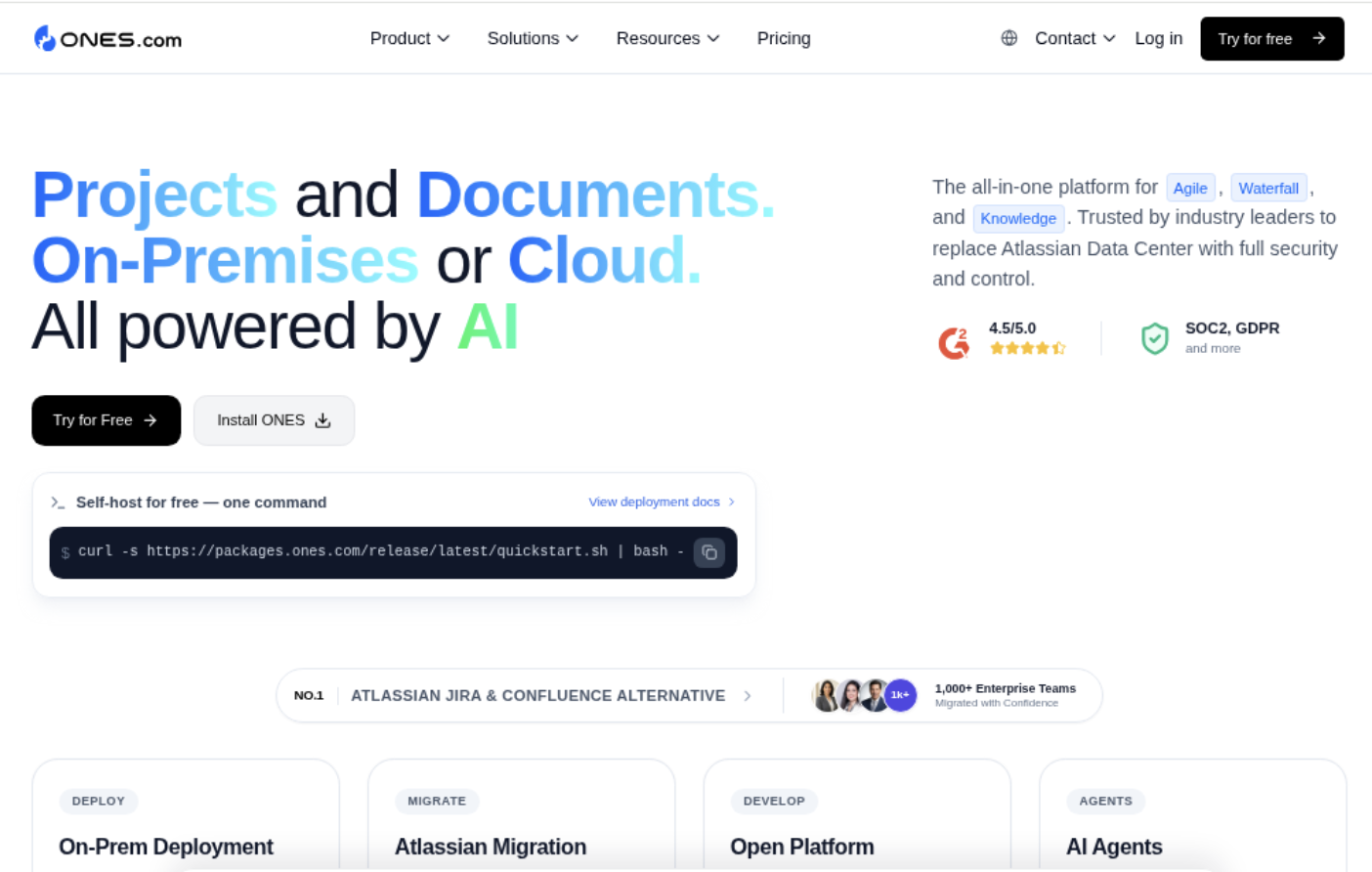
ONES.com combines project management and knowledge management in one platform, with ONES Project for project work and ONES Wiki for team knowledge. ONES Project can serve as a Jira alternative for teams that want native planning capabilities, flexible deployment, and fewer separate plugins.
ONES Project and ONES Wiki are sold separately. The platform offers Cloud, On-Premise, Private Cloud, and Air-gapped deployments, with full feature parity between cloud and self-hosted versions.
Core Capabilities
- Scattered project tracking → ONES Project work management → Teams organize tasks, issues, milestones, and releases in one workspace.
- Rigid workflows → Custom workflows and fields → Each team can reflect its approval stages, ownership rules, and delivery process.
- Manual sprint coordination → Sprint management → Product and engineering teams plan iterations, assign work, and review progress more consistently.
- Limited visibility → Built-in reporting → Managers can monitor progress, workload, delivery trends, and project health without depending on several separate tools.
- Repetitive administration → Automation → Teams can reduce manual updates by triggering routine actions within defined workflow rules.
- Migration concerns → Jira-compatible workflows → Teams familiar with Jira practices can retain recognizable planning patterns while evaluating another platform.
- Plugin sprawl → Native capabilities → Core planning, workflow, reporting, and automation functions can reduce reliance on multiple extensions.
- Hosting restrictions → Four deployment options → Cloud, On-Premise, Private Cloud, and Air-gapped choices support different security and infrastructure needs.
- Separate project knowledge → ONES Wiki → Teams can add a connected knowledge base when they need a Confluence alternative alongside project management.
- Small-team budget pressure → Free plan for up to 30 seats → Eligible teams can evaluate the platform with a larger free allowance than many small-team plans.
Application Scenarios
Scenario one: a regulated engineering team. A company cannot place project work in a public cloud environment. It can evaluate an On-Premise, Private Cloud, or Air-gapped deployment while keeping project workflows and reporting available.
Scenario two: a growing product organization. A 25-person team wants sprint planning, custom fields, reporting, and automation without assembling several plugins. ONES Project gives the team a unified place to manage delivery work.
Scenario three: project work connected to team knowledge. A company wants requirements, procedures, decisions, and delivery tasks to remain connected. It can use ONES Project with ONES Wiki, purchased separately, to support both workflows.
Common Challenges When Estimating Jira Costs
Challenge: confusing list price with final spend
Solution: Add apps, taxes, implementation, administration, and renewal assumptions to your estimate. Then calculate the effective monthly cost per active user.
Challenge: overlooking occasional collaborators
Solution: Count every person who needs access during the busiest period. Review contractor accounts after each project or release cycle.
Challenge: ignoring the next pricing tier
Solution: Test your current headcount, expected headcount, and the next published user band. This reveals the financial effect of hiring or expansion.
Challenge: choosing Premium without a clear need
Solution: Map each Premium capability to a specific business requirement. If no important workflow depends on it, Standard may provide better value.
Challenge: treating administration as free
Solution: Estimate the monthly time spent managing projects, workflows, permissions, apps, and reports. Include that effort in your platform comparison.
FAQs About Jira Software Pricing in 2024
Was Jira Software free in 2024?
Jira Software offered a Free Cloud plan for small teams, generally up to 10 users. The free allowance included core planning and issue tracking features, although usage limits and administrative restrictions applied. Once a team exceeded the allowance or needed advanced capabilities, it had to evaluate a paid tier. The exact experience depended on the features, account size, and commercial terms available at the time.
How much did Jira Standard cost per user in 2024?
Jira Standard commonly started near $8.15 per user per month at lower Cloud seat counts in 2024. That figure was a useful reference point rather than a guaranteed final bill. Progressive pricing, annual user bands, taxes, regional currency, promotions, and marketplace apps could change the amount. Calculate the total subscription for your headcount instead of multiplying the headline rate without checking the tier.
How much did Jira Premium cost per user in 2024?
Jira Premium commonly started near $16 per user per month at lower Cloud seat counts in 2024. Premium cost more because it targeted teams needing additional scale, planning, administration, or service capabilities. The right choice depended on your operational needs. A small team may receive little practical value from Premium, while a multi-team organization may justify the higher cost.
Was Jira billed per user or per tier?
Jira pricing used both per-user concepts and tiered calculations. Your total could depend on the number of licensed users, the applicable user band, and whether you paid monthly or annually. Annual subscriptions could use a predefined tier, while monthly subscriptions might calculate differently. Check the next user band before adding seats, especially when your team is close to a pricing threshold.
Did Jira Server still have a normal 2024 subscription?
Jira Server reached its end of sale before 2024, and Atlassian ended support for Server products in February 2024. Organizations needing self-managed deployment generally evaluated Data Center or another self-hosted platform. Data Center followed a different annual subscription model and also required infrastructure and administration. Therefore, old Server pricing should not be used to estimate a 2024 deployment.
What is the best way to compare Jira with another platform?
Compare the total cost of ownership rather than the advertised seat rate. Include licenses, apps, migration, administration, training, hosting, security requirements, and the cost of scaling. Then test the same workflow with a realistic project. For example, compare backlog planning, sprint management, reporting, approvals, automation, and knowledge sharing with the same team members and delivery goals.
Conclusion
Jira Software pricing per user in 2024 depended on more than a headline monthly number. Free, Standard, Premium, Enterprise, and Data Center followed different models, while billing cycles, user tiers, apps, and administration shaped the final cost.
Start with your real seat count. Compare monthly and annual estimates, test the next user tier, identify essential features, and include the work required to manage the platform.
But here's the solution to the budgeting problem: build a total-cost estimate before choosing a plan. If Jira’s structure, add-ons, or deployment model do not match your needs, evaluate alternatives such as ONES.com and compare capabilities, hosting choices, and long-term administration together.