Jira Software Pricing Plans 2026: A Clear Atlassian Guide
Wondering what Jira will cost your team? Compare jira software pricing plans 2026 atlassian by tier, users, billing, and extras. Read now to choose wisely.
Jira Software pricing can feel harder than the product itself. You may see Free, Standard, Premium, and Enterprise plans, then encounter user bands, annual billing, Marketplace apps, automation limits, and separate hosting choices.
That makes a simple question—“How much will Jira cost my team in 2026?”—surprisingly difficult to answer. A plan that looks affordable at five seats can become expensive after adding contractors, testing environments, reporting tools, or extra storage.
But here’s the practical answer: choose your Jira tier by team size, administration needs, service-level expectations, and total operating cost. This guide explains each Atlassian plan, the expenses that sit outside the subscription, and when another platform may fit better.
Jira Software Pricing Plans for 2026: The Quick Answer
Jira Software Cloud generally follows four plan levels: Free, Standard, Premium, and Enterprise. Your final bill depends on the number of seats, billing frequency, deployment model, add-ons, and any applicable taxes or regional adjustments.
| Plan |
Best fit |
Main pricing logic |
Key consideration |
| Free |
Small teams evaluating Jira |
No subscription fee within Atlassian’s free limits |
Limited capacity, administration, support, and advanced controls |
| Standard |
Growing project teams |
Per-seat subscription with monthly or annual billing |
Good everyday project management coverage |
| Premium |
Teams needing scale and stronger service commitments |
Higher per-seat subscription |
Includes advanced planning, higher limits, and Premium service features |
| Enterprise |
Large organizations with multiple teams |
Custom commercial arrangement |
Usually includes centralized governance and enterprise support options |
Atlassian can change list prices, user bands, included limits, and packaging. For a 2026 purchase, check the live Atlassian calculator before approving a budget.
Here’s why: the subscription price is only one part of your Jira Software total. A realistic estimate also considers Marketplace apps, administration time, migration work, training, storage, integrations, and possible Premium or Enterprise requirements.
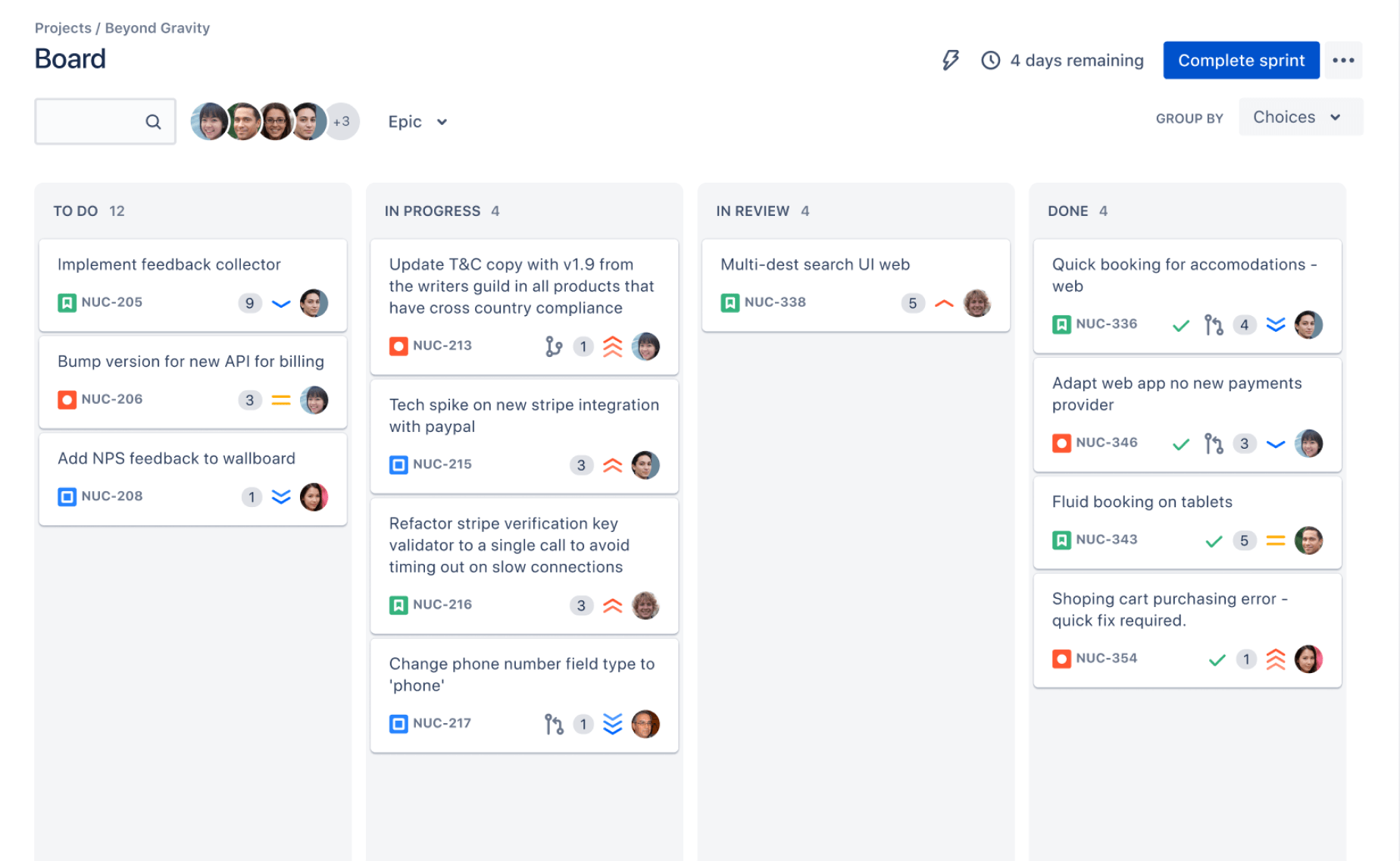
How Atlassian Jira Pricing Works
Cloud pricing is primarily seat-based
Jira Cloud pricing usually increases as you add seats. Atlassian may calculate monthly billing using the number of assigned seats, while annual billing often follows a user tier or committed quantity.
For example, a 12-person engineering team may need a different annual band than a 10-person team. That small increase can affect the entire subscription period, especially when several temporary contributors receive access.
Keep these groups in your estimate:
- Developers and testers
- Product managers and project managers
- Designers and technical writers
- Executives who need reporting access
- Contractors and agency partners
- Service or operations teams working in the same projects
Monthly and annual billing serve different needs
Monthly billing gives you flexibility when headcount changes. It can suit a new team, a short project, or a company still comparing platforms.
Annual billing may simplify procurement and budgeting. However, you should estimate your likely seat count carefully before committing. A team that grows from 30 to 60 people may need a new commercial review before renewal.
The free tier is useful for evaluation
The Free plan can help a small team test boards, backlogs, issues, workflows, and basic collaboration. It also gives you a low-risk way to learn whether Jira matches your working habits.
Free limits matter, though. Storage, automation, support, administration, and advanced planning capabilities may be restricted. A team with several projects can reach those boundaries sooner than expected.
Enterprise pricing requires a conversation
Enterprise pricing is usually tailored to large organizations. The commercial arrangement may reflect scale, governance, security requirements, support expectations, and the number of teams or instances involved.
You should prepare a clear estimate of active seats, occasional contributors, business units, compliance needs, reporting requirements, and planned integrations before requesting an enterprise quote.
What You Get at Each Jira Cloud Tier
Free: a practical starting point
Free works best when a small team wants basic project tracking without a purchasing process. You can create work items, organize a backlog, run sprints, and build simple boards.
Imagine a six-person product team preparing a mobile app launch. Free may cover the initial planning period. If the team later adds marketing, support, executives, and an outside testing partner, the limits may become restrictive.
Choose Free when:
- Your team is small and stable
- You need core issue and sprint management
- Advanced governance is unnecessary
- You are still evaluating Jira’s workflow
Standard: the everyday choice for growing teams
Standard is often the natural step for teams that have outgrown Free. It typically provides higher limits, broader administration features, and stronger support coverage for regular project work.
A 25-person software team may choose Standard when it needs several projects, custom workflows, permission controls, integrations, and reliable collaboration across departments.
Standard deserves careful comparison when your team depends on multiple apps. A lower subscription can lose its advantage if essential capabilities require several paid extensions.
Premium: advanced planning and higher operating capacity
Premium targets teams that need more capacity, advanced planning, stronger administrative controls, and Premium-level service features. It can also support organizations coordinating work across multiple teams.
For example, a company with six product squads may use cross-team planning to compare release schedules and dependencies. Premium becomes easier to justify when delays carry a high commercial cost.
Premium is worth evaluating when you need:
- Advanced planning across teams
- Higher automation or usage limits
- More room for large-scale collaboration
- Improved service commitments
- Better visibility into complex delivery dependencies
Enterprise: governance at organizational scale
Enterprise is designed for larger organizations with complex administration and governance needs. It may suit companies managing several departments, business units, or operational environments.
The value comes from centralized oversight and commercial flexibility rather than a simple feature checklist. A global company may prioritize policy consistency, controlled access, and enterprise support across many delivery groups.
Extra Costs That Change Your Jira Budget
Marketplace applications
Many Jira teams add applications for time tracking, test management, roadmaps, capacity planning, advanced reporting, or portfolio visibility. These charges can materially change your annual total.
Suppose Jira Standard costs less than a competing platform. If your team then adds four paid applications, the combined cost may exceed a platform that includes those capabilities natively.
List every required capability before comparing plans. Separate “nice to have” extensions from functions your team needs every week.
Administration and maintenance
Jira can support detailed workflows, fields, permissions, notifications, and automation. Those options create flexibility, yet they also create maintenance work.
A team may spend several hours each month reviewing inactive rules, cleaning fields, adjusting permissions, and helping colleagues navigate complex screens. That time belongs in your total cost estimate.
Migration and implementation
Moving from another project platform can involve workflow mapping, historical issue transfer, account setup, integration changes, and training. The subscription begins when the migration work may still be underway.
For a 40-person team, a short implementation plan can prevent months of confusion. Start with active projects, essential fields, required reports, and the minimum workflow needed for launch.
Integrations and operational tools
Engineering teams often connect Jira with code hosting, chat, customer support, identity management, analytics, and deployment systems. Some connections are included, while others require paid applications or technical maintenance.
Create a simple integration inventory. For each connection, record its business purpose, owner, cost, security requirements, and fallback process.
Taxes, currency, and regional billing
Your displayed price may differ because of currency conversion, local taxes, billing location, or contract terms. Finance teams should review the final checkout or quote rather than relying on a headline figure.
Cloud, Data Center, and Hosting Considerations
Jira Cloud is hosted by Atlassian and is usually the simplest route for teams that want fast deployment. Atlassian manages much of the underlying infrastructure, while your administrators manage configuration, access, workflows, and integrations.
Data Center follows a different ownership model. It is designed for organizations that need self-managed deployment, internal infrastructure control, or specific operational requirements. Licensing, infrastructure, upgrades, backups, and administration become important parts of the cost.
| Consideration |
Cloud |
Self-managed deployment |
| Infrastructure |
Managed by Atlassian |
Managed by your organization |
| Deployment speed |
Usually faster |
Requires planning and internal resources |
| Administration |
Focuses on configuration and governance |
Includes infrastructure and platform operations |
| Budget pattern |
Subscription-led |
License plus infrastructure and staffing costs |
| Best fit |
Teams prioritizing convenience and managed hosting |
Organizations needing more infrastructure control |
You might be wondering: which option is cheaper? The answer depends on your internal capabilities. A self-managed environment can make sense when infrastructure control is essential, while Cloud may reduce operational overhead.
A Practical Method for Estimating Your 2026 Cost
Start with the smallest plan that supports your real workflow. Then add the cost of required capabilities, administration, hosting, and growth.
- Count every person who needs access. Include occasional contributors, managers, contractors, and support partners.
- Separate current seats from planned seats. Estimate your likely headcount at renewal rather than using today’s number alone.
- List essential workflows. Include backlog management, sprint planning, approvals, releases, incident work, and reporting.
- Identify missing capabilities. Mark each need that may require an app, a higher tier, or custom administration.
- Compare billing periods. Review monthly flexibility against annual commitment and user-band effects.
- Calculate implementation effort. Include migration, training, workflow design, permissions, and integration testing.
- Model two growth scenarios. Price the team at its current size and at its expected size after 12 months.
- Set a renewal review date. Recheck seats, app usage, automation, and plan fit before renewal.
Here’s a useful example. A 20-person team may begin with Standard, add a time-tracking application, connect three engineering tools, and hire ten people during the year. Its final cost is shaped by 30 seats, app charges, administration, and the next annual user band.
How to Choose the Right Atlassian Plan
Choose Free when experimentation matters most
Free is suitable for a small group validating Jira’s basic approach. Use it for a pilot, a side project, or a team with limited collaboration requirements.
Set a review trigger before you begin. For example, move to a paid tier when the team needs more than the free limits, adds several projects, or requires formal administration.
Choose Standard for routine delivery work
Standard is usually the sensible middle ground for growing teams. It can support structured backlogs, sprint cycles, permissions, automation, and integrations without immediately moving into enterprise complexity.
Review the plan every quarter. A team may remain comfortable on Standard if its projects are predictable and its reporting needs are moderate.
Choose Premium when coordination and scale drive the decision
Premium is more compelling when several teams share releases, dependencies, capacity, or planning horizons. The higher subscription can be justified when better coordination prevents expensive delays.
Use a measurable test. Estimate the cost of one delayed release, then compare it with the annual difference between Standard and Premium.
Choose Enterprise when governance is the central concern
Enterprise may suit organizations with broad governance requirements, centralized administration, and many teams operating under consistent policies.
Ask whether your organization truly needs enterprise controls. A smaller team may pay for complexity it does not yet use.
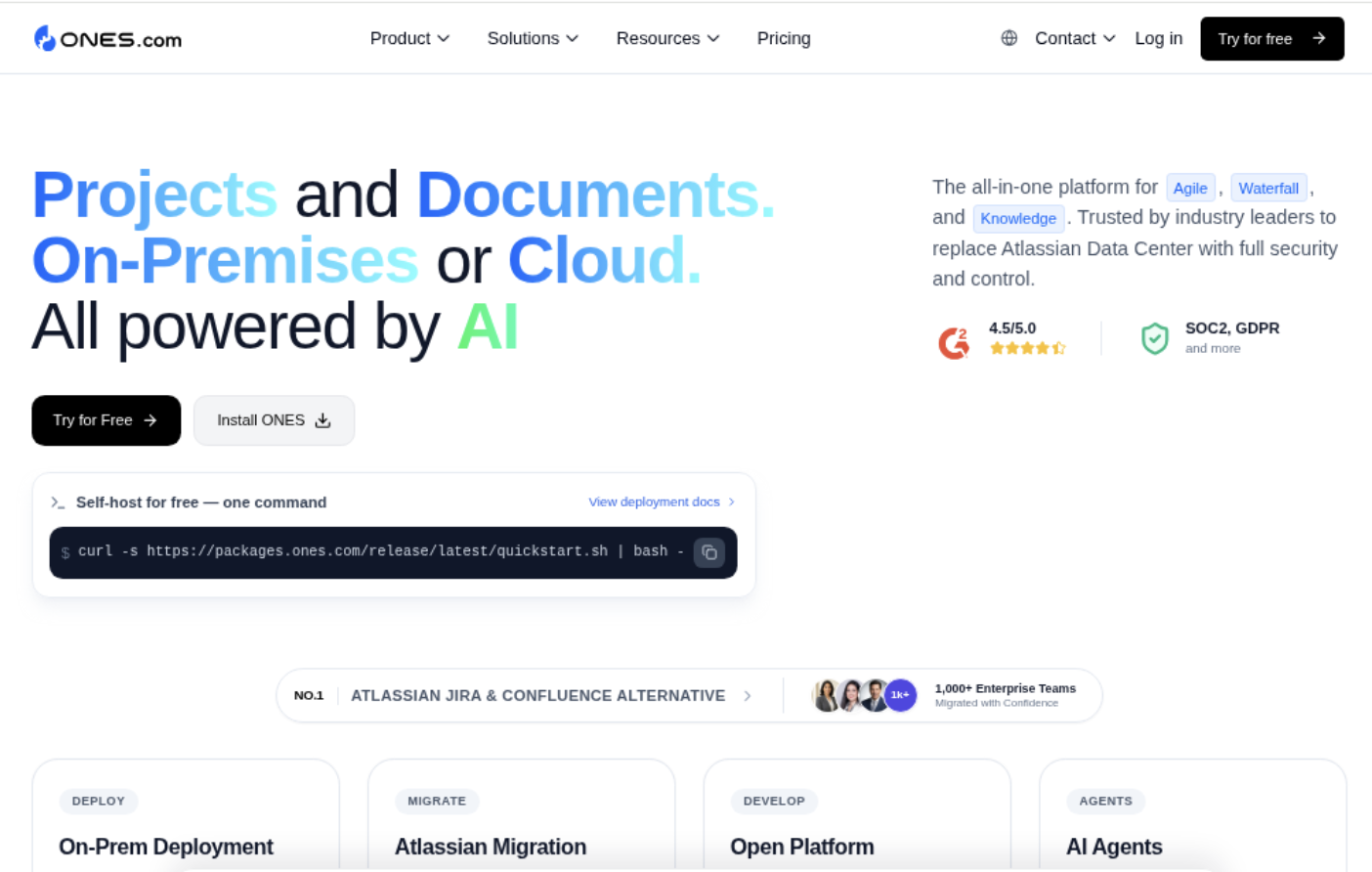
Value Proposition
ONES.com combines project management and knowledge management in one platform, powered by ONES Assistant. ONES Project is the project management product and a Jira alternative, while ONES Wiki is the knowledge base product and a Confluence alternative. They are sold separately.
This approach can help teams reduce plugin dependence, keep project context close to delivery work, and choose Cloud, On-Premise, Private Cloud, or Air-gapped deployment.
Core Capabilities
- Scattered project context → ONES Project and ONES Wiki keep delivery work and team knowledge connected → Teams spend less time switching between systems.
- Complex migration concerns → Jira-compatible workflows help teams preserve familiar delivery patterns → Adoption can require fewer process changes.
- Too many reporting extensions → Built-in reporting gives teams native visibility into progress and delivery health → Administrators can reduce reliance on separate plugins.
- Rigid process configuration → Custom workflows and custom fields support different project requirements → Product, engineering, and operations teams can model their work more precisely.
- Manual sprint administration → Sprint management supports backlog planning and iteration control → Teams can run repeatable delivery cycles.
- Repetitive status changes → Automation handles routine transitions and actions → Project coordinators can spend more time resolving blockers.
- Strict infrastructure requirements → Four deployment choices include Cloud, On-Premise, Private Cloud, and Air-gapped environments → Organizations can align hosting with operational constraints.
- Different capabilities across hosting models → ONES provides feature parity between its cloud and self-hosted versions → Teams can choose deployment based on control rather than missing core functions.
- High entry cost during evaluation → The free plan supports up to 30 seats → Small teams can test the platform before making a broader commitment.
Application Scenarios
Growing software company: A 24-person engineering organization can use ONES Project for backlogs, sprints, custom workflows, reporting, and automation. ONES Wiki can hold engineering practices separately when the company also needs a knowledge base.
Restricted-network environment: A regulated team may require an air-gapped deployment. ONES can support that operating model while retaining the same core feature set available in its cloud and self-hosted versions.
Plugin-heavy Jira environment: A team paying for several extensions can compare the native capabilities of ONES Project with its current Jira configuration. The comparison should include migration effort, administration time, integrations, and long-term governance.
Common Challenges When Budgeting Jira
Challenge: Your seat count keeps changing
Solution: Track permanent staff, contractors, and occasional contributors separately. Create low, expected, and high seat scenarios before selecting monthly or annual billing.
Challenge: App costs are difficult to predict
Solution: Mark every application as essential, useful, or optional. Include renewal timing and growth-based pricing in your comparison.
Challenge: Teams select Premium without a measurable reason
Solution: Link the upgrade to a specific problem, such as cross-team planning, higher limits, or service requirements. If the problem has no business impact, the upgrade may wait.
Challenge: Administration consumes hidden time
Solution: Assign an owner for workflows, permissions, automation, and reporting. Review configuration regularly so complexity does not grow unnoticed.
Challenge: Hosting requirements are discovered too late
Solution: Involve security and infrastructure teams before purchase. Confirm residency, access, network, backup, and operational requirements early.
FAQs About Atlassian Jira Software Pricing
Does Jira Software have a free plan in 2026?
Atlassian generally offers a Free tier for small teams, subject to plan limits and eligibility conditions. The free tier can cover basic issue tracking, boards, backlogs, and sprint planning. Check the current Atlassian pricing page before relying on a specific seat limit or feature allowance, because Atlassian may revise packaging and thresholds.
Is Jira billed per project or per person?
Jira Cloud is primarily priced by the number of seats rather than by project count. A single subscription can support multiple projects, while the number of people with access affects the bill. Keep occasional contributors in your estimate, since a person who rarely signs in may still require a paid seat.
What is the difference between Standard and Premium?
Standard generally suits everyday project delivery, while Premium adds capacity and advanced capabilities for larger or more coordinated teams. The precise feature set can change, so compare current limits, planning features, automation allowances, and service commitments. Premium makes the strongest financial case when coordination problems create measurable delays.
Are Jira Marketplace apps included?
Many Marketplace applications are priced separately. Some integrations may be free, while advanced reporting, time tracking, test management, and planning tools can add recurring charges. Build an application inventory before comparing Jira with another platform, because extensions may represent a meaningful part of your annual spend.
Should a small team choose monthly or annual billing?
Monthly billing can suit a team with uncertain headcount or a short evaluation period. Annual billing may simplify budgeting when your seat count is stable. Compare the commitment against expected hiring, contractors, and plan changes. A lower apparent rate may be less attractive if you pay for seats you no longer need.
Can an alternative reduce the total cost of Jira?
Potentially. Compare the complete operating model rather than the subscription alone. Include required extensions, administration, hosting, migration, training, and reporting. A platform with more native capabilities may reduce plugin and maintenance expenses, while a familiar platform may reduce transition effort.
Conclusion
Jira Software pricing in 2026 depends on more than choosing Free, Standard, Premium, or Enterprise. Your real budget includes seats, billing terms, applications, administration, integrations, migration, hosting, and growth.
Start with your team size and required workflow. Then compare the cost of each plan against the operational problem it solves. Recheck the live Atlassian calculator before signing, especially when your team is near a user-band threshold.
But here’s the truth: the cheapest subscription is not always the lowest-cost solution. If plugins and administration create ongoing friction, compare a unified Jira alternative such as ONES.com alongside the full cost of your current setup.