Jira Software Pricing: Plans, Costs, and Key Differences
Unsure about jira software pricing? Compare plans, costs, hosting, and key differences to budget with confidence. Click to discover the right plan.
Jira Software pricing can feel harder than the product itself. You may see a low per-user figure, then discover that billing changes with team size, plan level, support needs, and hosting choice. A ten-person team and a 500-person company can pay very different amounts for similar workflows.
That uncertainty makes budgeting difficult. A plan that looks affordable at five seats may cost far more after adding contractors, advanced permissions, automation, or premium support. You also need to separate Jira Software from other Atlassian products that may appear in the same buying journey.
But here’s the truth: you can compare the plans clearly by starting with your seat count, delivery needs, hosting preference, and required controls. This guide explains the available tiers, typical costs, hidden pricing factors, and practical alternatives.
Jira Software Pricing at a Glance
Jira Software pricing is usually structured around a free cloud tier, paid Standard and Premium plans, and custom Enterprise agreements. Your final bill depends mainly on the number of seats, billing term, plan level, and hosting model.
| Plan |
Typical fit |
Pricing approach |
Important differences |
| Free |
Small teams testing Jira |
No subscription charge within the plan limits |
Limited seats, storage, automation, permissions, and support |
| Standard |
Growing software teams |
Per-seat subscription |
Core planning, issue tracking, reporting, and collaboration features |
| Premium |
Teams needing scale and stronger continuity |
Higher per-seat subscription |
Advanced planning, higher automation capacity, enhanced availability, and premium capabilities |
| Enterprise |
Large organizations with complex governance |
Custom quotation |
Centralized administration, enterprise support, and broader organizational controls |
At the time of writing, Jira Software Cloud commonly lists Standard near $7.53 per seat monthly and Premium near $13.53 per seat monthly on monthly billing. Atlassian can change prices, so treat those figures as planning estimates.
Annual subscriptions often use a different billing calculation and may offer better effective pricing at specific seat bands. Always check the official Atlassian calculator before approving a purchase.
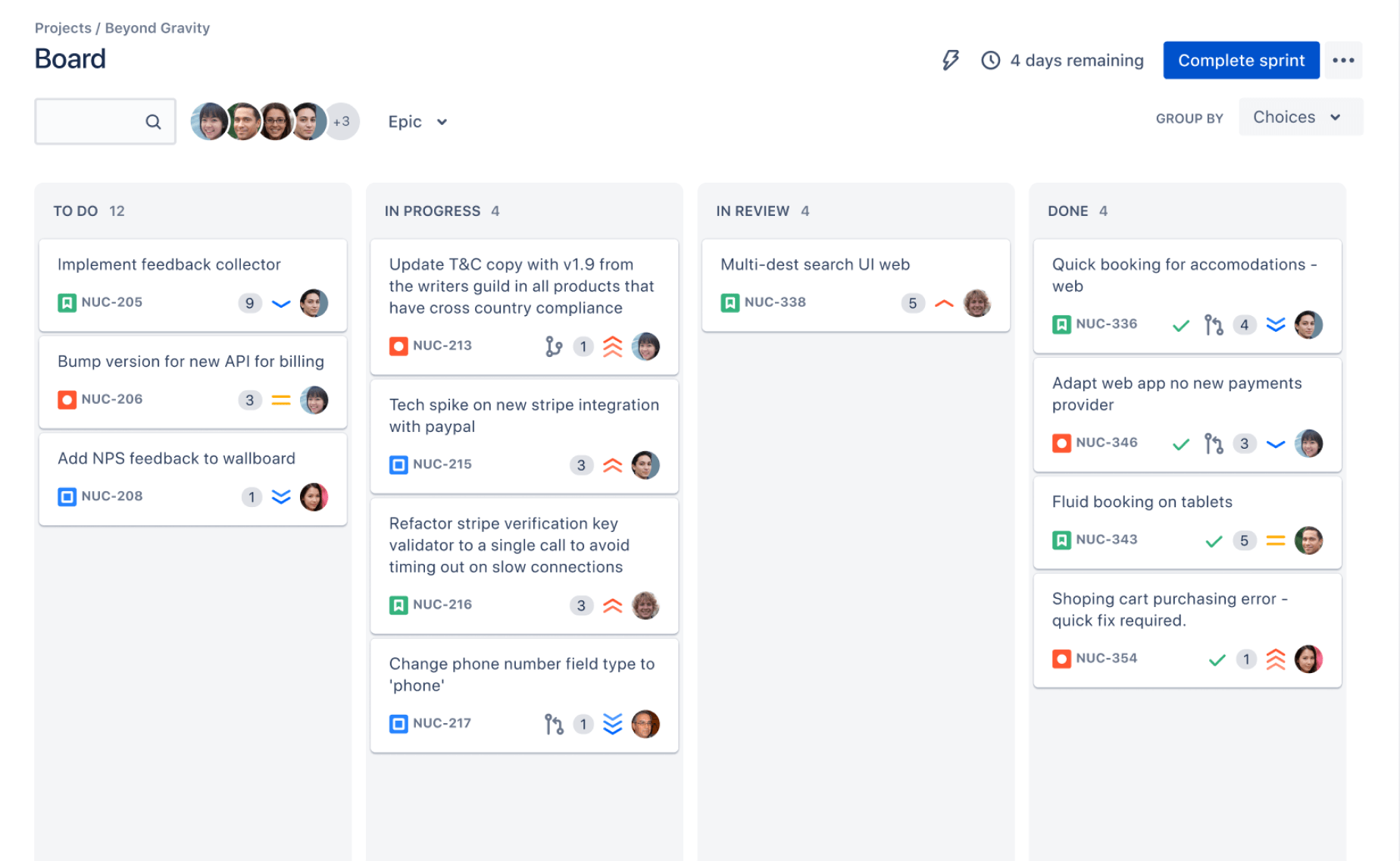
What each plan is designed to do
The Free plan gives a small team a practical way to test issue tracking, backlogs, boards, basic reports, and team workflows. It works well for a pilot or a small internal project.
Standard is usually the starting point for a professional team. It adds greater capacity and broader administration while retaining the core agile workflow most development groups need.
Premium makes more sense when service continuity, advanced planning, automation capacity, or cross-team coordination matters. Enterprise targets organizations that need procurement support and centralized governance.
How to Calculate Your Jira Software Cost
Start with the number of paid seats, then compare the monthly and annual billing options. Next, add any related Atlassian products, migration work, administration time, and integration expenses.
- Count every planned seat. Include developers, testers, product managers, project managers, and other people who need access. Do not count only the core engineering group.
- Choose the delivery model. Cloud subscriptions use recurring seat-based pricing. Self-managed options involve licensing, infrastructure, maintenance, upgrades, and internal administration.
- Select the minimum suitable plan. Compare the features you require instead of choosing Premium because it sounds safer. For example, a small team may need Standard with a few integrations.
- Estimate growth. Model your cost at today’s size, expected size, and maximum likely size. A 20-seat team growing to 60 seats needs a different budget conversation.
- Include related products. Confluence, Jira Product Discovery, service management tools, and marketplace apps can create separate charges.
- Review billing terms. Monthly billing offers flexibility. Annual billing may simplify procurement and reduce the effective rate at eligible tiers.
Here’s why this method works: the headline price is only one part of total ownership. A team paying $7.53 per seat for 25 people has a different financial profile from a team paying the same rate for 250 people.
Simple planning examples
| Team size |
Illustrative Standard estimate |
Illustrative Premium estimate |
| 10 seats |
About $75.30 per month |
About $135.30 per month |
| 25 seats |
About $188.25 per month |
About $338.25 per month |
| 50 seats |
About $376.50 per month |
About $676.50 per month |
These examples multiply commonly listed monthly rates. They exclude taxes, discounts, add-ons, and changes Atlassian may introduce. Use them to understand the calculation, not as a binding quote.
Key Differences Between Jira Software Plans
The biggest differences usually involve capacity, administration, continuity, and advanced planning. Core issue tracking remains central across the paid cloud tiers, so the right question is whether your team needs additional operating headroom.
Free versus Standard
Free suits a small group that wants to manage a backlog without immediate subscription costs. Its limits can become frustrating when you need broader permissions, more automation, larger storage capacity, or stronger support.
Standard is easier to justify when Jira supports a business-critical delivery process. For example, a 15-person engineering group coordinating several releases may quickly outgrow a free workspace.
Standard versus Premium
Premium generally targets teams with more complicated planning and continuity requirements. It can provide advanced planning capabilities, higher automation limits, and stronger availability commitments.
The price difference matters most when interruptions, manual coordination, or delayed releases cost more than the subscription increase. A small team with simple boards may gain little from upgrading.
Premium versus Enterprise
Enterprise is designed for large organizations that need centralized control across many teams or instances. Pricing is negotiated, so the value comes from governance, support, procurement structure, and scale.
You might be wondering: does Enterprise automatically make Jira cheaper? No. It may improve commercial and administrative efficiency, but the agreement needs to be evaluated against your organization’s actual requirements.
Cloud, Self-Managed, and Marketplace Costs
Cloud is usually the easiest option to budget because the subscription includes the hosted service. You avoid maintaining servers, planning upgrades, and handling much of the operational overhead.
Self-managed Jira can provide more control over hosting and internal policies. However, the subscription or license is only one cost. You also need infrastructure, backup planning, security reviews, technical administration, and upgrade testing.
Marketplace apps can change the calculation substantially. A reporting extension, test management tool, time tracker, or workflow add-on may charge separately, often using its own seat bands.
For example, a team may select Standard at a reasonable rate, then add five paid extensions. The combined subscription can exceed the original Jira estimate, especially when every add-on bills for the same seat count.
Questions to ask before adding an app
- Does Jira already provide a suitable native capability?
- Will the add-on charge for every licensed seat?
- Does the integration create extra administration work?
- Will the app remain necessary after your workflow matures?
- Can you export the information if you later remove the app?
What Can Increase the Total Cost?
Seat growth is the most obvious cost driver, but it is rarely the only one. Your total spend can rise through additional products, consulting, customization, migration, governance, and time spent maintaining complex workflows.
Consider a 40-person product team. Its subscription might look predictable until the organization adds contractors, a service desk product, advanced reporting, and a consulting engagement for workflow redesign.
Common cost factors
- Additional seats: Every new contributor can change the billing band.
- Related Atlassian products: Planning, knowledge management, and service operations may involve separate subscriptions.
- Marketplace apps: Extensions can add recurring fees and administrative overhead.
- Implementation: Migration, workflow design, permissions, and training require time or specialist help.
- Customization: Complex fields and automation can increase maintenance effort.
- Self-managed operations: Infrastructure, upgrades, monitoring, and backup duties become part of ownership.
The best part? You can control many of these expenses by keeping workflows simple. A clean approval path with four statuses is usually easier to maintain than a complicated process with twenty transition rules.
How to Choose the Right Tier
Choose Free for a small, low-risk team testing agile planning. Choose Standard when you need a dependable professional workspace with broader capacity. Consider Premium when advanced planning, automation, or continuity has measurable value.
Enterprise deserves a separate evaluation when many departments share governance, procurement, identity management, or administrative responsibilities. It is rarely the first choice for a small independent team.
A practical decision checklist
- How many people need access today?
- How many seats will you need within 12 months?
- Which permissions and approval controls are essential?
- How much automation will your team run?
- Do you need advanced cross-team planning?
- Would a service interruption create material business risk?
- Do you need cloud hosting or internal control?
- Which integrations are genuinely necessary?
- Who will administer workflows and permissions?
Let me explain: the cheapest plan is not always the lowest-cost choice. If a limitation forces manual work every week, the labor cost can exceed the subscription difference.
Jira Software Pricing Solution: ONES.com

Value Proposition
ONES.com combines project management and knowledge management in one platform powered by ONES Assistant. ONES Project is a Jira alternative for teams that want planning, delivery tracking, and collaboration with fewer separate plugins.
You can buy ONES Project and ONES Wiki separately. The platform offers a free plan for up to 30 seats and supports Cloud, On-Premise, Private Cloud, and Air-gapped deployments.
Core Capabilities
- Scattered project information → ONES Project and ONES Wiki → Keep delivery work and team knowledge connected within a unified platform.
- Jira workflow migration concerns → Jira-compatible workflows → Preserve familiar issue-based planning while reducing retraining effort.
- Too many reporting plugins → Built-in reporting → Review progress, workload, and delivery signals without assembling a separate reporting stack.
- Rigid processes → Custom workflows and fields → Adapt statuses, attributes, and approval paths to your operating model.
- Manual sprint planning → Sprint management → Organize iterations, priorities, and commitments in a structured workspace.
- Repeated administrative actions → Automation → Trigger routine updates and transitions so the team spends less time on repetitive coordination.
- Restricted hosting requirements → Four deployment choices → Select Cloud, On-Premise, Private Cloud, or Air-gapped deployment according to your environment.
- Feature gaps between hosting models → Native feature parity → Use the same core capabilities across cloud and self-hosted versions.
- Separate knowledge and delivery tools → ONES Wiki integration → Link requirements, decisions, guides, and delivery work more naturally.
Application Scenarios
Growing software team: A 25-person engineering group can manage backlogs, sprints, custom workflows, and reporting without building its process around numerous extensions. Product guidance can live alongside delivery planning.
Restricted-network organization: A regulated team can choose an On-Premise, Private Cloud, or Air-gapped deployment. That approach supports internal control while retaining the same core feature set.
Jira migration project: A team exploring a Jira alternative can map familiar workflows, fields, and sprint practices before moving broader knowledge work into ONES Wiki.
Common Challenges When Comparing Plans
Challenge: The listed rate does not match your invoice
Taxes, billing terms, seat bands, discounts, and product combinations can change the final amount. Solution: Build a quote using your real seat count and separate every product or add-on.
Challenge: You choose Premium without a measurable need
Premium features can sound appealing, yet a simple team may not use them. Solution: Tie each upgrade to a specific requirement, such as advanced planning or higher automation capacity.
Challenge: Your team grows faster than expected
Seat growth can move you into a different pricing band and increase the annual commitment. Solution: Model costs at current, expected, and worst-case team sizes.
Challenge: Add-ons create an unexpected subscription stack
Separate extensions may duplicate capabilities or bill across the same seats. Solution: Audit every add-on quarterly and remove tools that no longer support a clear workflow.
Challenge: Self-managed hosting looks cheaper at first
Infrastructure and administration can outweigh the license difference. Solution: include upgrades, monitoring, backups, security work, and staff time in the comparison.
FAQs
Is Jira Software free?
Jira Software offers a Free cloud plan for small teams within its stated limits. The plan can support basic issue tracking, boards, backlogs, and reporting. You may need a paid tier when your team requires more seats, broader permissions, greater automation capacity, enhanced administration, or stronger support. Check Atlassian’s current limits before relying on the free tier for a long-term process.
How much does Jira Software cost per month?
Commonly listed Jira Software Cloud rates place Standard near $7.53 per seat monthly and Premium near $13.53 per seat monthly. A 25-seat team would therefore estimate about $188.25 for Standard or $338.25 for Premium before taxes and extras. Atlassian can change pricing, and annual billing may produce a different effective rate.
What is the difference between Jira Standard and Premium?
Standard covers core planning, issue tracking, collaboration, and reporting for many professional teams. Premium is aimed at organizations needing more advanced planning, greater automation capacity, stronger continuity, and broader scale. The best choice depends on whether those capabilities solve a measurable operational problem. A small team with uncomplicated workflows may find Standard sufficient.
Does Jira charge per user?
Jira Software Cloud generally uses seat-based subscription pricing. Your bill depends on the number of licensed people and the applicable pricing band. Some plans calculate annual charges differently from monthly subscriptions. Remember to include occasional contributors, contractors, and people who need access for approvals or reporting when estimating your seat count.
Are Jira marketplace apps included?
Marketplace apps are generally separate from the core Jira Software subscription. Each app can have its own pricing model, seat bands, renewal terms, and support arrangement. Review whether Jira already provides a suitable native capability before adding an extension. A small individual charge can become significant when the app applies to every licensed seat.
Is ONES.com a Jira alternative?
Yes. ONES Project is a Jira alternative that supports issue-based planning, sprint management, custom workflows, custom fields, automation, and built-in reporting. ONES.com also offers ONES Wiki for knowledge management, with the products sold separately. Cloud, On-Premise, Private Cloud, and Air-gapped deployments are available, with feature parity between cloud and self-hosted versions.
Conclusion
Jira Software pricing becomes easier to understand when you separate the plan rate from the full ownership picture. Start with seats, compare Standard and Premium against real requirements, then include products, extensions, hosting, administration, and growth.
But here’s the truth: a low monthly figure can become expensive when limits create manual work or when add-ons multiply. A clear cost model helps you avoid that surprise.
Compare the available Jira tiers with your workflow, governance, hosting, and collaboration needs. If you want a Jira alternative with project and knowledge management options, evaluate ONES.com alongside the subscription and operational costs.