Jira Software Pricing: Plans, Features, and Costs in 2026
Need clarity on jira software pricing? Compare 2026 plans, features, billing, and add-on costs to choose the right fit. Read now to save.
Jira Software pricing can look simple until you compare plans, billing terms, user bands, and add-on costs. A small team may pay nothing, while a growing company can quickly face a larger monthly commitment.
The confusion gets worse when annual and monthly rates differ, Premium features affect the decision, and marketplace apps add separate charges. A plan that seems affordable per user may cost much more after you include every team member and required integration.
Here’s the practical answer: Jira Software offers Free, Standard, Premium, and Enterprise plans. Your real cost depends on team size, billing frequency, storage needs, administration requirements, and extra apps. This guide explains each tier, shows how to estimate spending, and highlights alternatives worth evaluating in 2026.
Jira Software Plans and Pricing at a Glance
Jira Software is Atlassian’s project and issue-tracking platform for agile software teams. Its cloud plans generally include Free, Standard, Premium, and Enterprise tiers, with price and feature differences based on team size, capabilities, and contract terms.
| Plan |
Typical fit |
Indicative pricing approach |
Important considerations |
| Free |
Small teams testing Jira |
$0 for a limited number of users |
Includes core issue tracking with restrictions on users, storage, permissions, and support |
| Standard |
Growing teams needing everyday project management |
Often starts near $7.53 per user per month when billed annually |
Adds broader collaboration, permissions, storage, and administration features |
| Premium |
Organizations managing several teams or complex workflows |
Often starts near $13.53 per user per month when billed annually |
Adds advanced planning, increased service expectations, and premium administration capabilities |
| Enterprise |
Large organizations with governance and procurement requirements |
Custom annual quote |
Pricing depends on scale, commercial terms, security needs, and organizational structure |
These figures are useful planning points rather than guaranteed 2026 quotes. Atlassian can change list prices, user bands, promotions, and regional taxes, so check the current checkout estimate before committing.
Here’s why: cloud subscriptions usually charge by user tier rather than by the number of active projects. Adding more team members can move your account into a higher billing band.
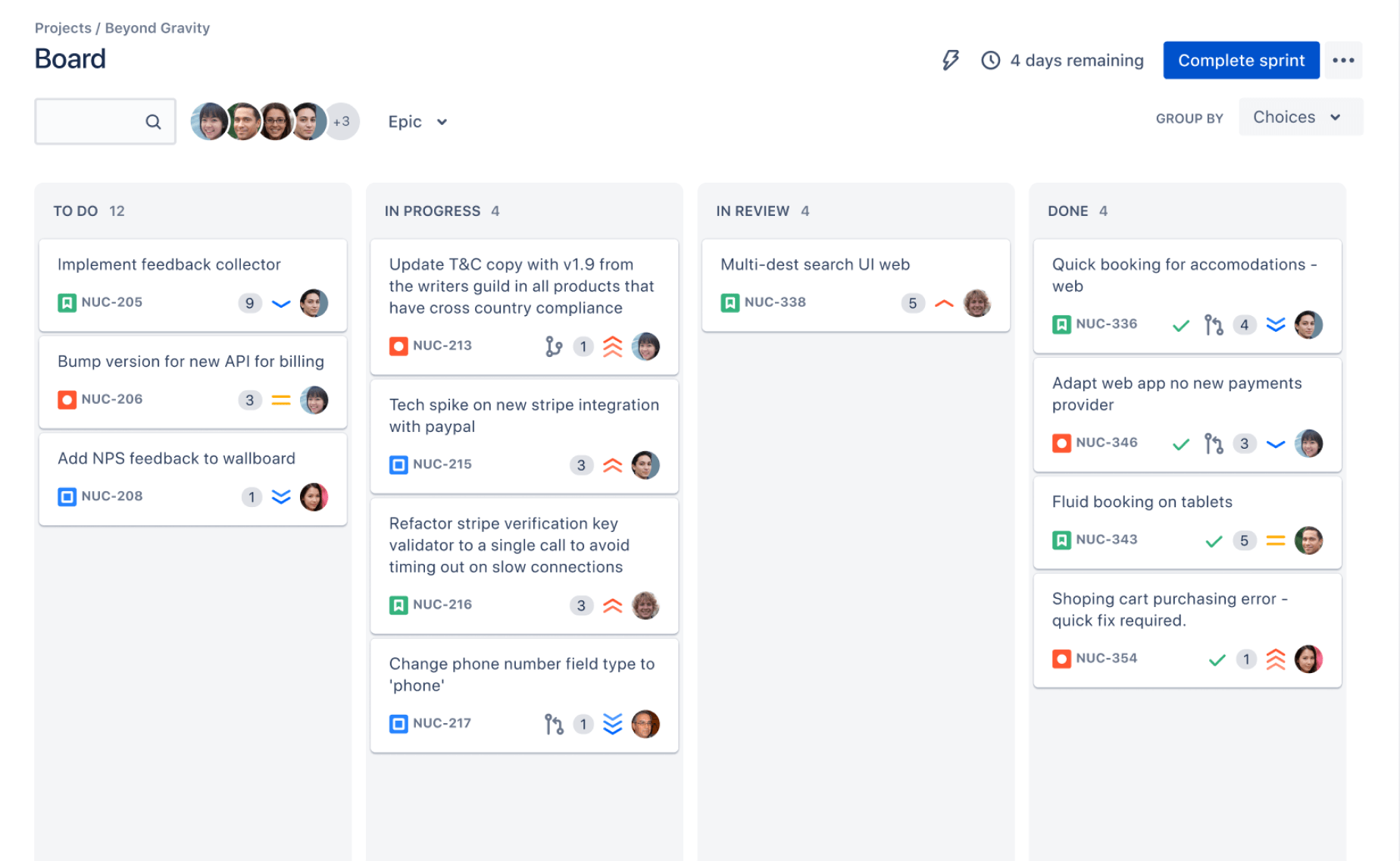
How Jira Software Pricing Works
- Choose the deployment model. Most teams select Jira Cloud because Atlassian hosts the service. Larger organizations may evaluate Enterprise terms or self-managed options where available.
- Count every required user. Include developers, product managers, testers, designers, delivery leads, and other people who need access. Guest or limited-access arrangements may have different rules.
- Select a billing cycle. Monthly billing provides flexibility, while annual billing may offer a lower effective rate and a predictable renewal schedule.
- Match features to operational needs. Compare permissions, automation, reporting, planning, storage, service commitments, and administrative controls before choosing a tier.
- Add related products and apps. Confluence, Jira Service Management, marketplace apps, automation tools, and identity services can create separate charges.
- Estimate growth. Model your expected seats for the next 12 months. A plan that fits 15 people today may become expensive when the team reaches 40.
Monthly versus annual billing
Monthly billing is helpful when your team size changes frequently. You can adjust more often without making a full-year commitment, although the effective per-user rate may be higher.
Annual billing works well when headcount is predictable. For example, a 30-person engineering team may prefer an annual contract because finance can approve one planned amount instead of twelve changing invoices.
User tiers and progressive pricing
Jira pricing is not always a simple multiplication of one advertised rate by your exact user count. Atlassian commonly uses user bands or tiered calculations.
That means a team with 11 users may pay according to a different band than a team with 10. Always enter the actual seat count into the pricing calculator before preparing a budget.
Cloud, self-managed, and Enterprise considerations
Cloud pricing typically covers hosted access and platform maintenance. You still need to account for administration, integrations, training, and internal ownership.
Enterprise agreements may include negotiated terms, centralized administration, governance, and support arrangements. They are designed for larger organizations and usually require a sales conversation rather than a public checkout price.
What You Get With Each Jira Tier
Free plan
The Free plan is a low-risk way to test Jira with a small team. It generally includes core boards, backlog management, issue tracking, basic roadmaps, and standard collaboration features.
The trade-off is scale. User limits, storage limits, permission controls, automation allowances, and support options can restrict a team as its process becomes more complex.
A five-person startup managing one product may find Free adequate. A 12-person team with contractors, executives, and external collaborators may quickly need a paid tier.
Standard plan
Standard is usually the practical starting point for a growing software team. It supports everyday agile planning while offering more capacity and administration than Free.
You can use Scrum or Kanban boards, configure workflows, manage backlogs, track releases, create reports, and coordinate work across a broader group.
Standard often suits teams that need dependable project tracking without advanced cross-team planning. It is also the tier many teams compare against specialized project management platforms.
Premium plan
Premium is designed for organizations with more demanding planning, scale, and operational requirements. It can be useful when several teams coordinate releases or when leadership needs a wider planning view.
Premium may include advanced planning capabilities, stronger service expectations, higher limits, and features for managing work across teams. The exact package can change, so review the current plan comparison before purchasing.
The higher rate makes sense when Premium replaces several manual reporting processes. It may be harder to justify when your team only needs boards, backlogs, and basic reports.
Enterprise plan
Enterprise is aimed at large organizations with formal governance, procurement, security, and administration requirements. Pricing is negotiated rather than displayed as one universal public rate.
Expect the conversation to cover user volume, account structure, support expectations, compliance requirements, and contract length. Enterprise is rarely the right choice for a small team seeking simple issue tracking.
What Affects Your Total Jira Budget?
The subscription is only one part of the financial picture. A realistic budget includes the surrounding work required to configure, maintain, and govern the platform.
| Cost area |
Why it matters |
Example |
| Licensed users |
More people increase the subscription tier or user band |
Adding product managers and contractors can move a team into a higher bracket |
| Billing cycle |
Monthly and annual prices can differ |
A flexible monthly plan may cost more over a full year |
| Marketplace apps |
Reporting, time tracking, testing, and planning tools may charge separately |
A reporting app can add a second recurring subscription |
| Connected Atlassian products |
Knowledge management and service workflows may require separate plans |
Confluence or Jira Service Management can increase the total bill |
| Administration |
Complex configurations require ongoing ownership |
A platform administrator may spend several hours each month maintaining workflows |
| Migration and training |
Moving teams and teaching new processes creates one-time costs |
A company migrating from another tracker may need workshops and cleanup |
Example: estimating a 25-person team
Suppose 25 people need access to Jira Software. A rough Standard estimate using an annual starting rate near $7.53 per user each month would be $188.25 per month before taxes and tier adjustments.
That figure is only a planning estimate. The checkout amount may use a user band, and your team may need additional products or apps.
At the same illustrative rate, a Premium estimate near $13.53 per user each month would be $338.25 per month before taxes and other charges. The difference is about $150 per month at that simple calculation.
The best part? You can compare that price difference against the work Premium may replace. If it eliminates several manual reports each month, the higher subscription could be reasonable.
Hidden effort can exceed the subscription
Consider a team that pays $300 each month for Jira but spends 20 hours monthly rebuilding reports and fixing inconsistent workflows. The subscription is visible; the operational waste is less obvious.
When you compare plans, estimate both direct spend and staff time. A cheaper tier is not necessarily cheaper if it creates repetitive administration.
Jira Software Features Worth Comparing
Agile planning and delivery
Jira is strongly associated with Scrum and Kanban workflows. Teams can organize work into epics, stories, tasks, bugs, sprints, versions, and releases.
For example, a mobile team might create an epic for offline mode, divide it into interface and engineering tasks, then track each item through review and release.
Workflow customization
Jira allows teams to define statuses, transitions, fields, approvals, and automation rules. This flexibility can reflect real processes, such as security review before production deployment.
Too much customization creates its own problem. If every team designs a different workflow, reporting becomes difficult and onboarding takes longer.
Reporting and dashboards
Reports can show sprint progress, release risks, issue aging, workload, and unresolved defects. Dashboards help different audiences see relevant information without opening every project.
A delivery manager may monitor blocked work, while an engineering lead focuses on cycle time and reopened bugs. The same platform can support both views when fields are used consistently.
Automation and integrations
Automation can assign issues, update fields, send notifications, transition work, and connect activities across tools. Integrations can link Jira with development, communication, testing, and deployment services.
Each integration adds value and maintenance responsibility. Review permissions, failure alerts, usage limits, and app pricing before relying on a complex chain.
Jira Software Alternatives: ONES.com
ONES.com is a unified platform for project management and knowledge management. ONES Project provides project management capabilities as a Jira alternative, while ONES Wiki provides knowledge management as a Confluence alternative. The products are sold separately.
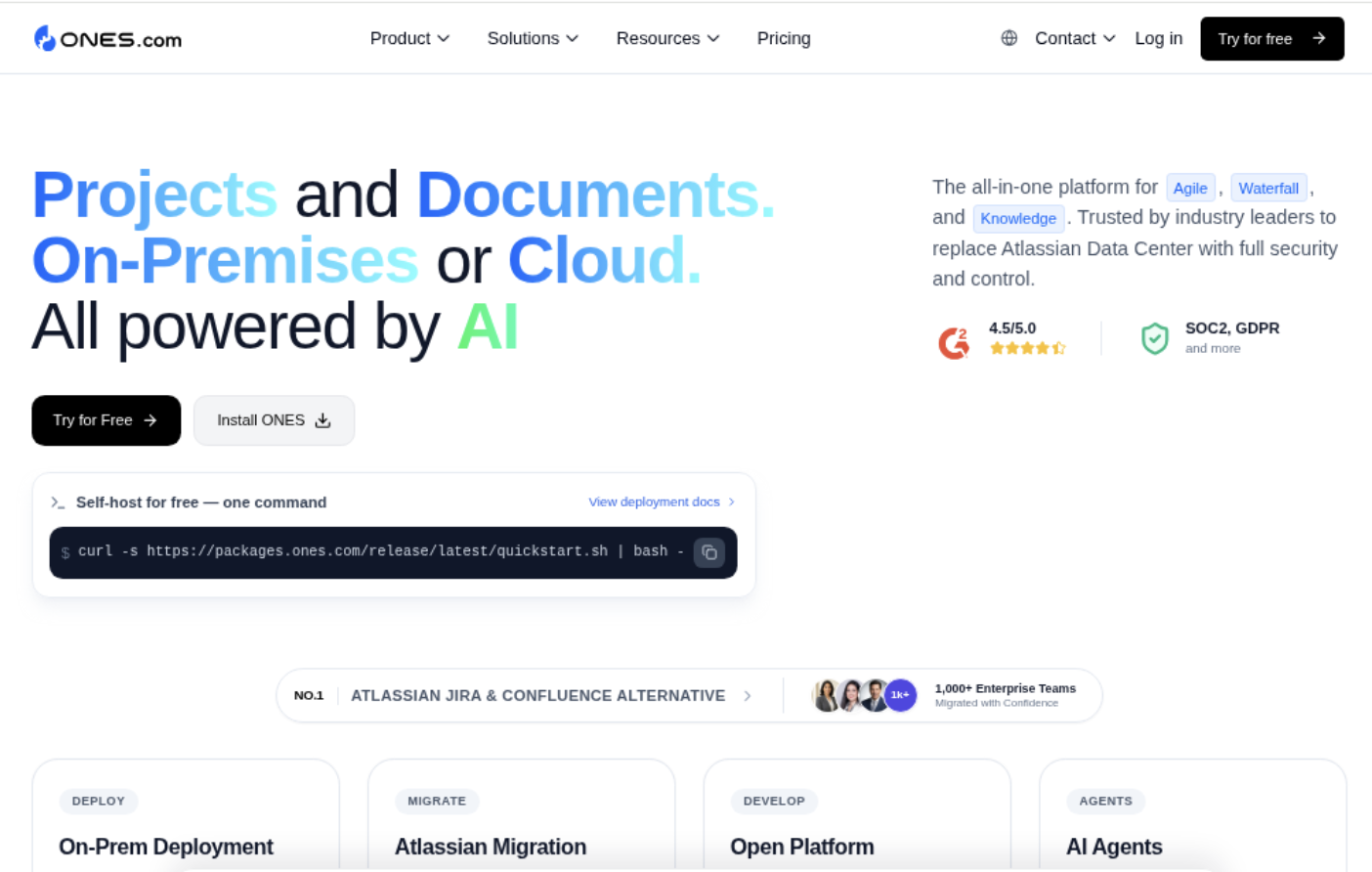
For teams comparing Jira costs, ONES.com is worth examining when you want Jira-compatible workflows, built-in reporting, and fewer separate plugins. It also supports cloud, on-premise, private cloud, and air-gapped deployments.
Value Proposition
ONES.com can help teams consolidate project planning and team knowledge while keeping deployment options open. Its free plan supports up to 30 seats, which gives small teams room to evaluate the platform before paying.
Core Capabilities
- Plugin sprawl: Jira teams often add separate apps for planning, reporting, and workflow needs. ONES capability: ONES Project includes built-in reporting, custom workflows, custom fields, sprint management, and automation. Result: You can evaluate a broader native feature set before adding third-party tools.
- Migration concerns: Teams may hesitate to leave familiar agile practices. ONES capability: ONES Project supports Jira-compatible workflows. Result: Your team can preserve familiar concepts while reviewing another platform.
- Deployment restrictions: Some organizations cannot place project information in a public cloud. ONES capability: ONES.com supports cloud, on-premise, private cloud, and air-gapped deployments. Result: You can align deployment with security and network requirements.
- Feature differences across hosting models: Self-hosted environments sometimes lose capabilities. ONES capability: ONES.com provides full feature parity between its cloud and self-hosted versions. Result: Deployment choice does not require accepting a deliberately reduced feature set.
- Growing teams: A small team may need more room before a paid plan becomes necessary. ONES capability: The free plan supports up to 30 seats. Result: A larger evaluation group can test project workflows together.
- Scattered knowledge: Project decisions can become difficult to find when planning and knowledge live in disconnected places. ONES capability: ONES.com combines ONES Project and ONES Wiki within one platform family. Result: Teams can assess project and knowledge workflows together, while purchasing each product separately.
- Administration overhead: Multiple plugins create separate settings, permissions, and renewal dates. ONES capability: Native project functions reduce dependence on extra extensions. Result: Administrators may have fewer systems to review and maintain.
- AI-assisted work: Teams may want assistance with routine project and knowledge tasks. ONES capability: ONES.com includes ONES Assistant as its AI-powered capability. Result: You can evaluate AI support alongside project and knowledge management rather than treating it as an unrelated tool.
Application Scenarios
Restricted-network engineering: A defense supplier or industrial company may need an air-gapped deployment. ONES.com can support that environment while preserving the same core platform capabilities available in hosted deployments.
Growing product organization: A 25-person product and engineering team may want agile boards, sprint planning, custom fields, and reporting without assembling several plugins. ONES Project gives that team a Jira alternative to evaluate against its current workflow.
Project and knowledge alignment: A software company may want project decisions, requirements, and delivery work connected within one platform family. It can assess ONES Project and ONES Wiki separately, depending on its purchasing priorities.
Common Challenges When Choosing a Jira Plan
Challenge: choosing from the advertised starting price
Problem: A starting rate can make a plan appear cheaper than the final checkout amount.
Solution: Enter your exact seat count, billing cycle, region, and related products into the pricing calculator. Then add a growth estimate for the next year.
Challenge: paying for features your team will not use
Problem: Premium features may sound valuable, but your team may only need boards, backlogs, and basic reporting.
Solution: List the three workflows causing the most friction. Upgrade only when the higher tier directly improves those workflows or removes measurable manual effort.
Challenge: overlooking app subscriptions
Problem: A team may choose Jira, then add separate apps for time tracking, capacity planning, test management, and advanced reporting.
Solution: Build a complete tool inventory before comparing plans. Include monthly charges, renewal dates, administrator time, and the risk of overlapping features.
Challenge: uncontrolled customization
Problem: Jira’s flexibility can produce inconsistent fields, statuses, and project templates.
Solution: Create governance rules. Define approved workflows, naming conventions, required fields, and a review process for new automation.
Challenge: underestimating migration effort
Problem: Moving projects between platforms can expose duplicate issues, outdated workflows, and inconsistent ownership.
Solution: Run a small pilot first. Measure migration effort, reporting quality, user adoption, and integration stability before moving every team.
FAQs About Jira Software Costs
Is Jira Software free?
Yes, Jira Software has a Free plan for small teams. It provides core project and issue-tracking capabilities, but user counts, storage, permissions, automation, and support are limited. The Free tier may be enough for a small product team with one project. As your team grows or requires stronger administration, you may need Standard or Premium.
How much does Jira Software cost per user?
Public starting prices commonly place Standard near $7.53 per user per month and Premium near $13.53 per user per month when billed annually. These are planning figures, not guaranteed 2026 checkout prices. Your final amount can change because of user bands, billing frequency, taxes, regional pricing, promotions, and related Atlassian products.
What is the difference between Jira Standard and Premium?
Standard generally covers everyday agile project management for growing teams. Premium is designed for larger or more complex organizations that need advanced planning, higher capacity, stronger service expectations, or broader administrative capabilities. Compare the features your team will actually use. If your process only requires backlogs, boards, workflows, and basic reporting, Standard may be sufficient.
Does Jira charge for every person in an organization?
Jira pricing typically depends on the number of people who need access to the product, rather than every employee in your company. Count developers, testers, product managers, designers, contractors, and stakeholders who need meaningful access. Check Atlassian’s current user rules for your plan because limited-access roles and connected products can follow different conditions.
Are Jira marketplace apps included?
Usually, marketplace apps have their own commercial terms. An app for time tracking, test management, portfolio planning, or advanced reporting may create an additional recurring charge. Some apps offer free tiers or limited features, but you should review their pricing separately. Include app administration and renewal management when calculating your total operating cost.
Is Jira a good choice for a small team?
Jira can work well for a small software team that wants structured backlogs, agile boards, release tracking, and customizable workflows. Its flexibility may feel excessive if you only need a simple task list. Start with a limited workflow and a small number of fields. If setup becomes harder than the work itself, compare a simpler platform or a unified alternative.
Conclusion
Jira Software pricing depends on more than the advertised per-user number. Free suits small teams testing the platform, Standard usually fits growing teams, Premium supports more complex planning, and Enterprise serves large organizations with formal governance needs.
But here’s the truth: your total cost includes seats, billing terms, connected products, marketplace apps, administration, training, and migration effort. Estimate the full operating picture before choosing a tier.
Start with your current team size, forecast growth, identify essential workflows, and compare the work each plan eliminates. If you need native reporting, deployment flexibility, Jira-compatible workflows, or fewer plugins, evaluate ONES.com alongside Jira.