Jira Software Standard Pricing: A 2026 Cost Guide for Teams
How much does jira software standard pricing really cost? Compare 2026 plans, team tiers, billing, taxes, and extras—read now to budget with confidence.
Jira Software Standard pricing can look simple until you add team size, billing cycle, taxes, and paid extras. A small team may see one monthly rate, while a growing company pays through user tiers that change the total quickly.
That uncertainty makes budgeting harder. You might compare the advertised per-user amount, then discover annual billing rules, inactive accounts, marketplace apps, or premium support can change your real cost. A 20-person team and a 200-person team rarely evaluate the same offer.
Here’s the practical solution: calculate the subscription from your active seats, compare monthly and annual billing, then add the costs Jira does not include in the base plan. This guide explains how Standard pricing works in 2026, what affects your bill, and how to compare Jira with alternatives without relying on a headline number.
Jira Software Standard Pricing: The Quick Answer
Jira Software Standard pricing is the cost of Atlassian’s mid-tier Jira plan for teams that need more capacity, administration, storage, and support than the Free plan provides. The final amount depends mainly on active users, billing frequency, region, tax, and optional apps.
Atlassian generally presents Jira Cloud pricing as a per-user cost, but the checkout total often follows progressive user tiers. That means the price for 10 users may not scale in exactly the same way as the price for 100 users.
For 2026 budgeting, treat any displayed rate as a planning estimate until you confirm the live Atlassian calculator. Pricing, user bands, included limits, and regional taxes can change.
| Cost factor |
Why it matters |
| Active seats |
Your bill usually reflects the number of licensed users, not only people who work in Jira every day. |
| Monthly billing |
This offers flexibility, but the effective annual cost can be higher. |
| Annual billing |
This can improve predictability and sometimes lowers the effective rate for eligible tiers. |
| Marketplace apps |
Time tracking, test management, reporting, and automation extensions can create separate charges. |
| Taxes and currency |
Your checkout total may differ from a published US-dollar estimate. |
| Additional Atlassian products |
Confluence, Jira Service Management, Guard, and other products may be billed separately. |
But here’s the truth: the subscription rate is only one part of your project management budget. You should calculate the complete operating cost before choosing a plan.
How to Calculate Your Jira Standard Cost
Use a simple four-step process. It gives you a realistic estimate before you commit to a monthly or annual contract.
- Count every planned seat. Include developers, product managers, designers, testers, delivery managers, and executives who need access. Separate occasional viewers from people who create or update work.
- Check the current Standard rate. Open Atlassian’s live pricing calculator and select Jira Software, Standard, your country, and your billing cycle. Avoid using an old screenshot or a rate copied from an earlier quote.
- Compare monthly and annual totals. Multiply the monthly estimate by 12, then compare it with the annual quote. For example, a 35-person team should compare both totals at the same seat count.
- Add related expenses. Include apps, implementation work, administration time, training, taxes, and any separate Atlassian products.
- Model growth. Create a second estimate for expected hiring. A team growing from 40 to 65 people may move into a different pricing tier.
A practical calculation example
Imagine a product team with 28 licensed Jira users. The public rate is only a starting point because your final amount depends on the current tier and region.
Your planning equation looks like this:
Annual Jira cost = subscription charge × 12 + paid apps + taxes + implementation and administration costs.
If you add a test management app, a time tracking app, and a reporting extension, the total software budget may exceed the Jira subscription itself. That is why a serious comparison should examine the whole workflow.
What Jira Software Standard Usually Includes
Standard sits between Free and Premium. It is designed for teams that need dependable collaboration and administration without immediately paying for the most advanced enterprise controls.
Core project management features
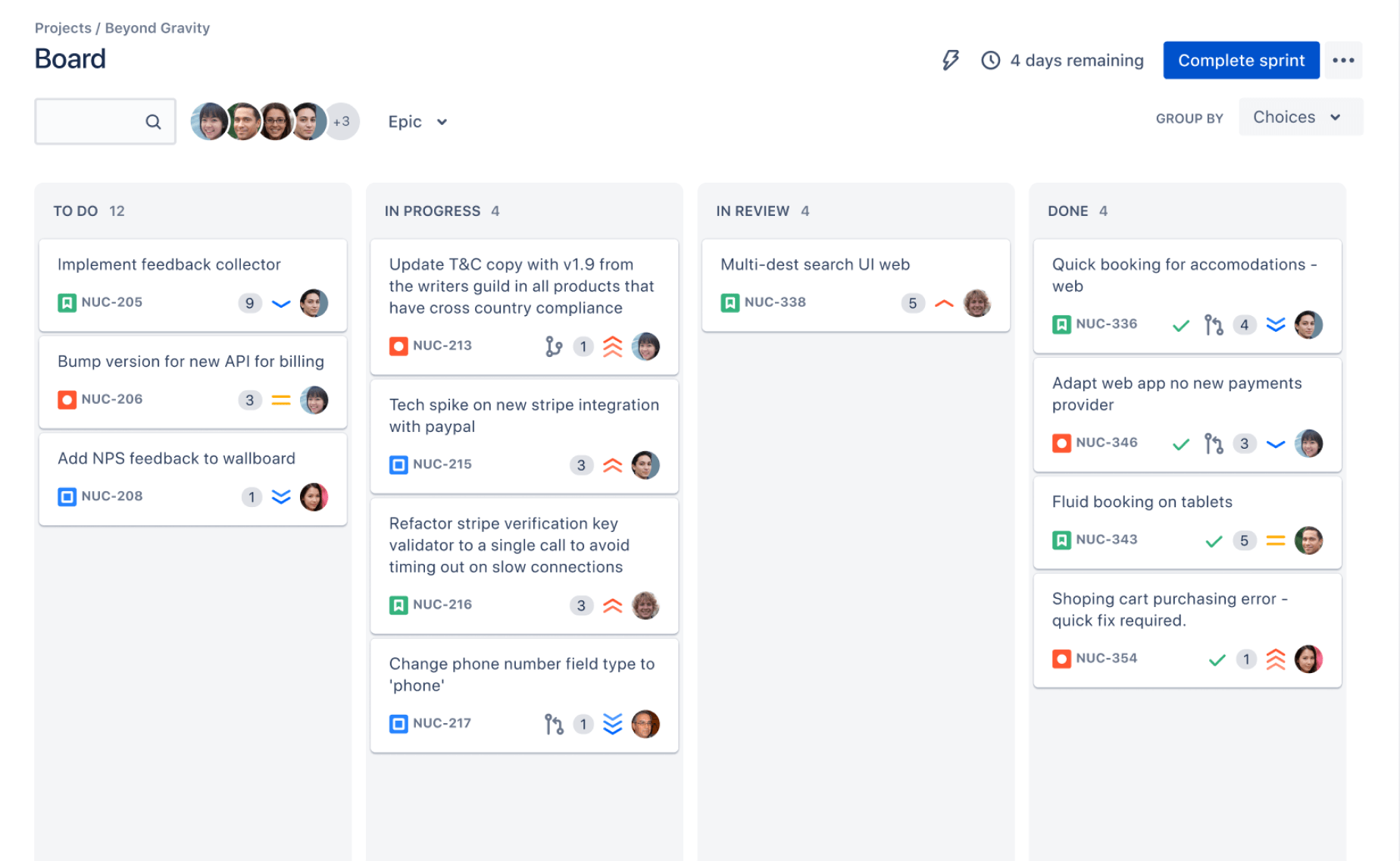
Jira Standard typically supports issue tracking, backlogs, agile boards, sprint planning, roadmaps, dashboards, reports, and configurable workflows. These features cover common Scrum and Kanban operations.
For example, a software team can create an epic for a mobile checkout redesign, split it into stories, assign tasks to developers, and track progress through a sprint board.
Team collaboration and administration
Standard generally provides more room for team administration than Free. Administrators can manage project access, configure workflows, create fields, and organize work across multiple projects.
That matters when a company has separate teams for payments, identity, infrastructure, and customer experience. Each group may need a slightly different workflow while still using the same platform.
Storage, limits, and service expectations
Plan limits can affect the practical value of Standard. Storage, automation execution, audit capabilities, and support terms may differ by plan or change over time.
Check the current feature matrix before signing. A feature that looks included in a comparison article may have moved behind a higher tier or gained a usage limit.
Cloud versus self-managed deployment
Jira Software Cloud usually has a subscription model and Atlassian-managed infrastructure. Self-managed options can involve different licensing, hosting, maintenance, and upgrade responsibilities.
Cloud may reduce infrastructure work. Self-managed deployment can offer more control for organizations with strict operational requirements, but your internal team carries more responsibility.
Monthly Versus Annual Billing
Monthly billing works well when your team size is uncertain. You can adjust seats more frequently and avoid a large upfront commitment.
Annual billing can suit established teams with predictable headcount. It may provide a clearer budget and a different effective rate, depending on the current Atlassian terms and user tier.
| Billing choice |
Best fit |
Main trade-off |
| Monthly |
Startups, pilots, and teams hiring rapidly |
Greater flexibility can come with a higher yearly cost. |
| Annual |
Stable organizations with approved budgets |
You may pay for capacity you do not use if the team shrinks. |
Here’s why: billing flexibility has a financial value. A fast-growing company might accept a slightly higher monthly rate to avoid locking itself into a large annual seat commitment.
Before selecting annual billing, review your hiring forecast, contractor usage, renewal date, and internal approval cycle. A small planning mistake can remain expensive for twelve months.
Hidden and Indirect Costs to Add
The visible subscription is easy to find. The indirect costs require more attention because they appear across different teams and invoices.
Marketplace applications
Many teams add apps for time tracking, advanced roadmaps, test cases, capacity planning, forms, approvals, or reporting. Each app may use its own pricing model and user calculation.
For example, a team may pay for Jira Standard and then add two workflow apps to reproduce approval and resource planning features. The combined bill can change the original buying decision.
Administration and configuration
Jira can support complex workflows, but complexity creates maintenance work. Someone must manage permissions, custom fields, automation rules, board settings, and notification schemes.
If an administrator spends eight hours each month cleaning configurations and resolving access problems, that time belongs in your total cost of ownership.
Training and adoption
Teams often need onboarding for issue types, sprint routines, workflow transitions, and reporting. Poor training can lead to duplicate tickets, inaccurate status updates, and abandoned dashboards.
A two-hour workshop for a new team may cost less than months of correcting inconsistent project habits.
Migration and integration work
Moving from another project management platform may require planning, data mapping, permissions work, and user acceptance testing. Integrations with source control, chat, deployment, and customer support systems can also need technical effort.
Estimate this work separately instead of hiding it inside the license price.
Jira Standard Compared With Other Plans
Jira Free can be sufficient for a small team testing agile project management. Standard becomes more relevant when the team needs greater capacity, stronger administration, or more predictable operational support.
Premium is aimed at organizations that need advanced planning, higher limits, stronger service commitments, or additional scale. Enterprise typically addresses larger governance and commercial requirements.
| Plan level |
Typical fit |
Question to ask |
| Free |
Small teams and early experiments |
Can the team work within the included limits? |
| Standard |
Growing teams with established workflows |
Do the added controls and capacity justify the subscription? |
| Premium |
Organizations needing advanced scale or planning |
Will the higher-tier capabilities reduce operational friction? |
| Enterprise |
Large companies with complex governance |
Do commercial and administrative requirements need an enterprise agreement? |
You might be wondering: should every growing team move directly to Standard? No. Compare the limits you actually hit with the capabilities you genuinely need.
A 12-person startup that uses only a basic backlog may gain little from upgrading. A 12-person regulated engineering team with multiple projects and strict access rules may benefit immediately.
2026 Budgeting Considerations
Planning for 2026 requires more than copying the previous renewal amount. Review your expected headcount, product mix, currency, tax treatment, and app portfolio before setting a budget.
Build three scenarios
Create a lean, expected, and growth scenario. A lean scenario might cover 25 seats, the expected scenario 40 seats, and the growth scenario 60 seats.
This approach shows how hiring affects the annual budget. It also gives finance a clearer explanation than a single estimate with no assumptions.
Review seat hygiene
Remove former employees, duplicate accounts, and inactive contractors where the billing rules allow it. Check guest and viewer access separately because different account types may have different treatment.
For example, a company with 100 employees may have only 62 active Jira contributors. Reviewing access before renewal can prevent unnecessary licensing.
Audit app value
List every paid extension, its monthly or annual cost, and the workflow it supports. Remove apps that duplicate native Jira features or that fewer than three people use.
The best part? A small app audit can lower your total spend without changing your primary project management platform.
How to Decide Whether Standard Is Worth It
Start with the operational problem. If your team struggles with capacity, permission management, workflow consistency, or project visibility, identify which Standard capabilities address that problem.
Then compare the cost of the plan with the cost of continuing without it. Suppose poor sprint visibility causes a delivery manager to spend six hours each week building manual status updates. Better reporting may recover enough time to justify the subscription.
Run a short trial with real work. Use one active project, one sprint, your normal approval flow, and the reports your leadership actually reads.
Let me explain: a successful trial measures outcomes, not enthusiasm. Track setup time, issue completion, reporting effort, adoption, and the number of extra apps required.
Project Management Alternative: ONES.com
ONES.com combines project management and knowledge management in one platform. ONES Project serves as the project management workspace and a Jira alternative, while ONES Wiki supports team knowledge management as a Confluence alternative. The products are sold separately.
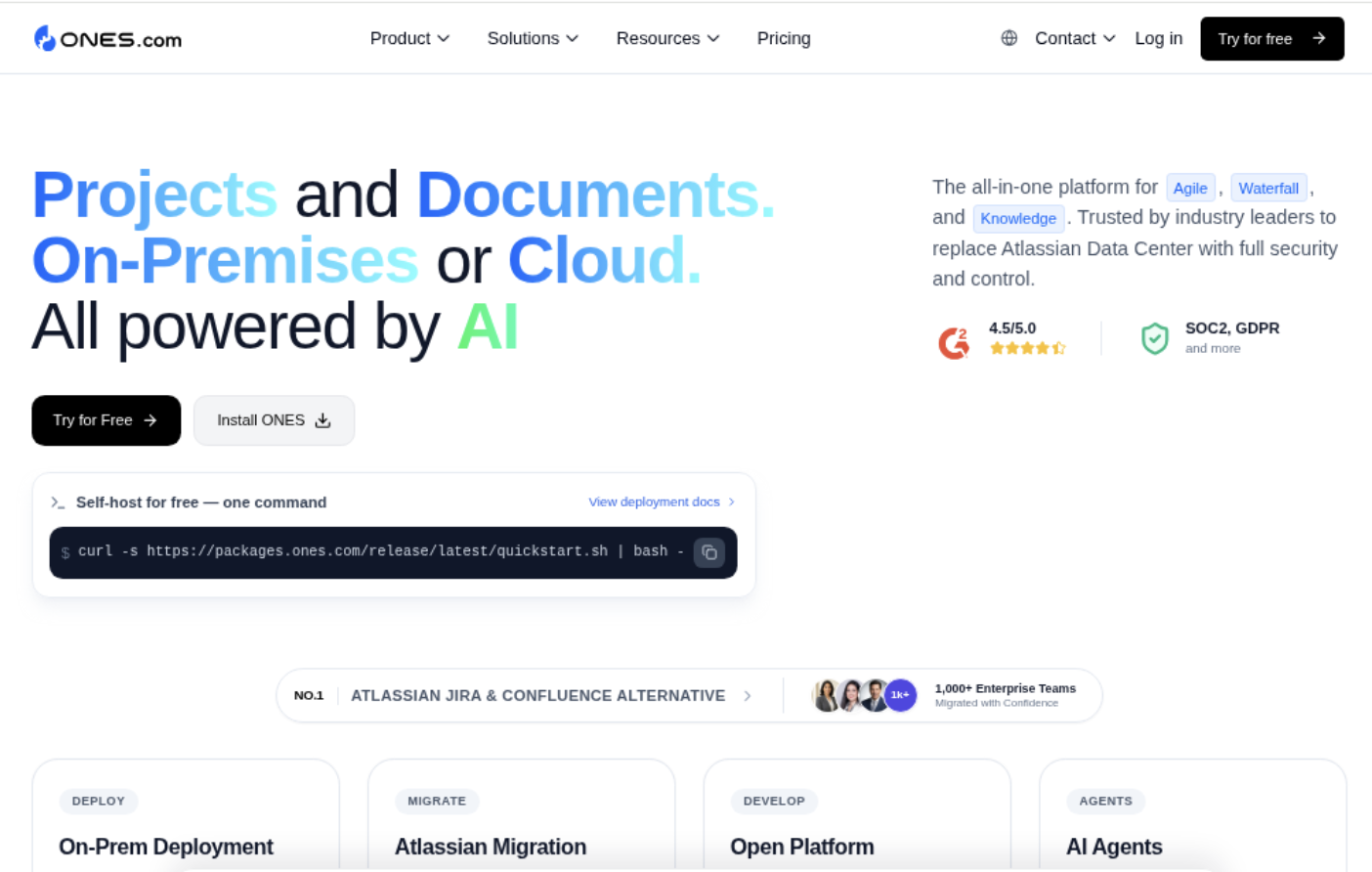
For teams comparing Jira Standard with another structured project environment, ONES.com can reduce the need to connect multiple plugins. It offers Cloud, On-Premise, Private Cloud, and Air-gapped deployments, with full feature parity between cloud and self-hosted versions.
Core capabilities
1. Separate tools for project work and knowledge
Pain: Project tasks and engineering knowledge often become scattered across different services.
ONES capability: ONES Project handles project management, while ONES Wiki provides a knowledge base.
Result: Teams can choose the combination they need without forcing every department into one product tier.
2. Jira-compatible workflows
Pain: Moving platforms can disrupt familiar issue and sprint practices.
ONES capability: ONES Project supports Jira-compatible workflows, sprint management, custom fields, and automation.
Result: A team can preserve recognizable delivery routines while evaluating a Jira alternative.
3. Built-in reporting
Pain: Reporting gaps often lead teams to buy several extensions.
ONES capability: Built-in reporting supports project visibility without requiring every basic report to come from a separate plugin.
Result: Administrators can evaluate the native reporting experience before adding extra tools.
4. Custom workflows and fields
Pain: A rigid workflow can force teams to track approvals and risk outside their project tool.
ONES capability: Teams can configure custom workflows and fields for different delivery processes.
Result: Product, engineering, and operations teams can represent their actual work more accurately.
5. Automation
Pain: Repetitive status changes and notifications consume administrative time.
ONES capability: Automation supports routine actions across project workflows.
Result: Teams can reduce manual updates and keep work moving through defined stages.
6. Deployment choice
Pain: Some organizations cannot place project information in a public cloud environment.
ONES capability: ONES.com supports Cloud, On-Premise, Private Cloud, and Air-gapped deployments.
Result: Teams can evaluate the same platform across different infrastructure requirements.
7. Self-hosted feature parity
Pain: Self-hosted products sometimes provide fewer features than their cloud editions.
ONES capability: ONES.com provides full feature parity between cloud and self-hosted versions.
Result: Deployment decisions do not automatically require accepting a reduced feature set.
8. AI assistance
Pain: Teams may want AI help with project and knowledge work without adding an unrelated service.
ONES capability: ONES Assistant powers AI capabilities within the ONES.com platform.
Result: Teams can evaluate AI-supported work alongside project and knowledge workflows.
Application scenarios
Software product team: A 40-person engineering organization can use ONES Project for backlogs, sprints, custom workflows, and reporting while using ONES Wiki for technical knowledge.
Restricted-network environment: An organization with strict network controls can evaluate an air-gapped deployment rather than treating public-cloud access as the only option.
Growing company: A company replacing several workflow plugins can compare native capabilities, deployment choices, and separate product licensing before selecting its preferred setup.
Common Challenges and Practical Solutions
Challenge: The advertised rate does not match the invoice
Solution: Recalculate using your country, currency, billing cycle, seat tier, taxes, and renewal terms. Keep the estimate tied to a specific date because pricing can change.
Challenge: You underestimate paid apps
Solution: Create an app inventory before approving Jira Standard. Record the purpose, number of users, renewal date, and replacement options for every extension.
Challenge: You license inactive accounts
Solution: Review access monthly. Remove former staff promptly and use appropriate viewer or guest options where they meet the team’s needs.
Challenge: Standard becomes too restrictive
Solution: Identify the exact limitation before upgrading. Confirm whether a configuration change, app removal, or process adjustment solves the issue at a lower cost.
Challenge: The team cannot measure value
Solution: Track cycle time, reporting effort, sprint predictability, adoption, and administrative hours. Compare those measures before and after the plan change.
FAQs
Does Jira Software Standard have one fixed price?
No. The final amount depends on factors such as active seats, billing frequency, country, currency, taxes, and applicable user tiers. Atlassian can also revise plan limits and rates. Use the live pricing calculator for your exact configuration, then add paid apps and related Atlassian products to estimate the full budget.
Is annual Jira billing cheaper than monthly billing?
Annual billing may provide a lower effective rate or better budget predictability, but the result depends on your seat tier and current commercial terms. Monthly billing offers more flexibility when your headcount changes quickly. Compare both twelve-month totals using the same number of planned users before deciding.
What should I include in a Jira Standard budget?
Include the Jira subscription, taxes, marketplace apps, additional Atlassian products, implementation work, training, administration, integrations, and expected seat growth. Also consider migration and renewal timing. A subscription-only estimate can make Jira appear less expensive than it will be in daily operations.
Can a small team stay on Jira Free?
Yes, if the team fits the current user, storage, automation, permission, and feature limits. Standard becomes more useful when the team needs additional administration, capacity, collaboration controls, or operational predictability. Test your real workflow rather than upgrading only because the team has started growing.
Is ONES.com a Jira alternative?
ONES Project is a Jira alternative with Jira-compatible workflows, sprint management, custom fields, automation, and built-in reporting. ONES.com also includes ONES Wiki as a separate knowledge management product. Teams can choose Cloud, On-Premise, Private Cloud, or Air-gapped deployment, with feature parity between cloud and self-hosted versions.
Conclusion
Jira Software Standard pricing is easiest to understand when you separate the advertised subscription rate from the complete operating cost. Count seats, compare billing cycles, review plan limits, and add apps, taxes, administration, and growth.
But here’s the truth: a cheaper headline price does not guarantee a cheaper working system. Your team needs a platform that supports its workflows without creating excessive configuration or extension costs.
Use three budget scenarios, test the plan with real work, and compare the full workflow against alternatives such as ONES.com. That process turns a confusing renewal decision into a practical 2026 technology budget.