Jira Software Workflow Guide: 7 Steps for Better Projects
Is your Jira Software workflow slowing projects down? Follow 7 practical steps to improve handoffs, visibility, and delivery. Read now to get started.
Jira Software can bring order to complex projects, yet a poorly designed workflow creates more confusion than progress. Issues linger, approvals happen in private messages, and teams lose time asking who owns the next step. As the project grows, inconsistent statuses and vague handoffs make reporting unreliable. Managers see activity, but not always meaningful progress. Developers face interruptions, while stakeholders wait for clear answers. The problem usually is not Jira Software itself. It is the way your team designs, uses, and reviews the workflow. In this guide, I’ll walk you through seven practical steps for creating a clearer Jira workflow. You’ll learn how to plan statuses, assign ownership, automate routine work, and keep reporting useful without adding unnecessary process.
How to Build a Better Jira Software Workflow in 7 Steps
A Jira Software workflow is the set of statuses and transitions that move an issue from creation to completion. A strong workflow shows what is happening now, who owns the next action, and what must happen before work can continue.
Start with the smallest workflow that accurately reflects your team’s work. Then add control only when a real problem requires it.
- Map the work before creating statuses. List the major stages an issue passes through, such as To Do, In Progress, Code Review, Testing, and Done. Do not begin by copying every activity your team performs.
- Define what each status means. Write a short entry and exit rule for every status. For example, an issue enters Code Review only after the implementation is complete and a reviewer is assigned.
- Design sensible transitions. Connect statuses according to real decisions. A developer might move an issue from In Progress to Code Review, while a tester can send it back when a defect appears.
- Assign ownership at handoffs. Set a clear owner for each stage. Ownership prevents issues from sitting in a queue because everyone assumes someone else will act.
- Add fields that support decisions. Use priority, severity, component, release, and acceptance criteria when they help people choose the next action. Remove fields nobody updates or reads.
- Automate predictable actions. Automation can assign reviewers, update fields, notify a team, or transition an issue after a defined event. Keep rules visible and test them with sample issues.
- Review performance and refine carefully. Examine cycle time, blocked work, reopened issues, and aging items. Change one part of the workflow at a time, then check whether the change improved delivery.
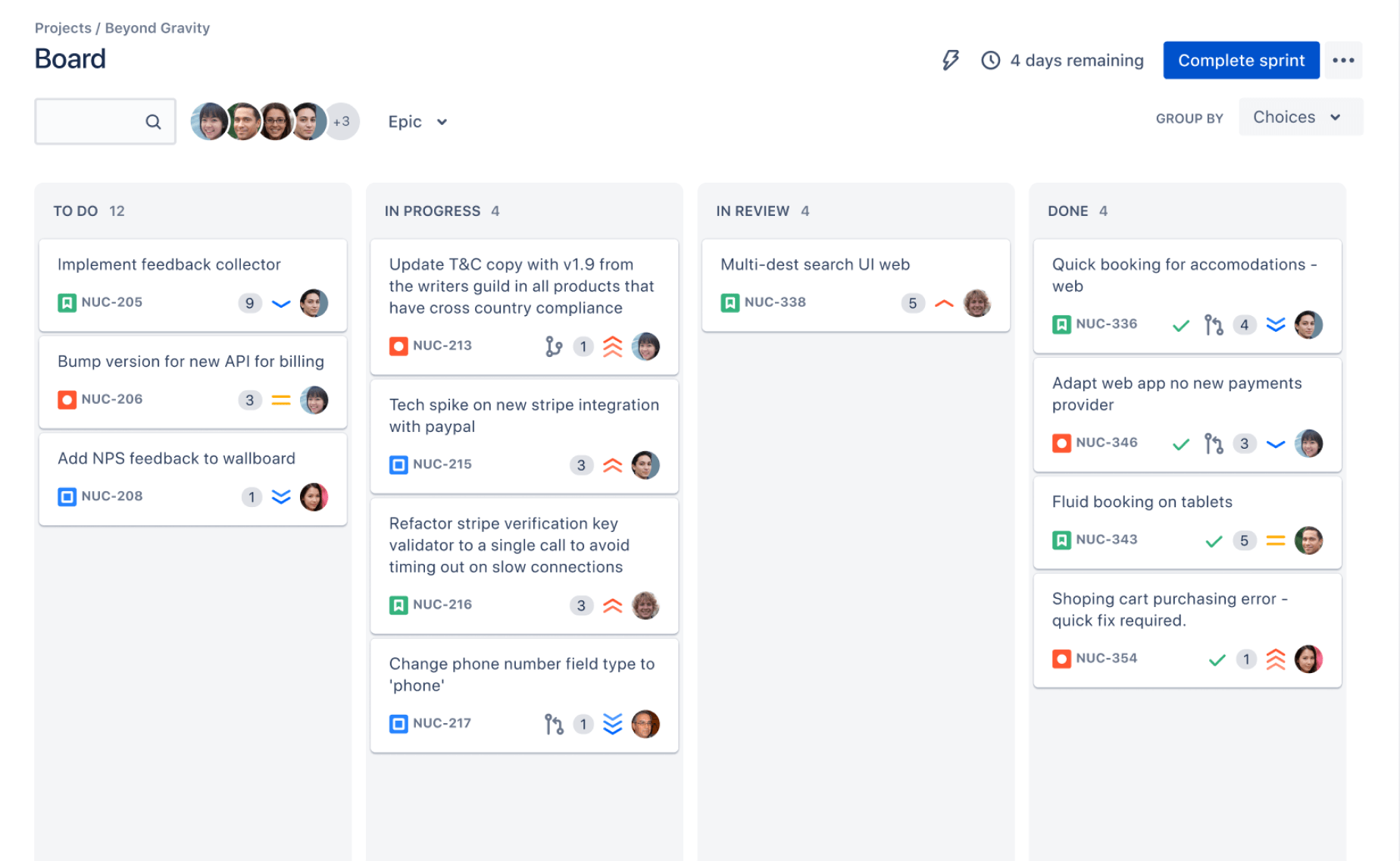
1. Map the real delivery path
Begin with a short workshop involving people who create, build, review, test, and approve work. Ask each person what happens after an issue reaches them.
For example, a product team may follow this path:
- Backlog
- Ready for Development
- In Progress
- Code Review
- Testing
- Ready for Release
- Done
This path is more useful than a long list of every meeting, comment, or internal check. Statuses should describe a meaningful state, not a temporary action.
2. Define entry and exit rules
Ambiguous statuses create inconsistent reporting. One person may call an issue “In Progress” after reading it, while another uses that status only after coding starts.
Give each status a simple definition. “Testing” could mean the build is available, test steps are clear, and the tester has enough context to begin.
Exit rules also protect quality. An issue should leave Testing only when the agreed checks pass or a clearly recorded exception receives approval.
3. Create transitions around decisions
A transition should answer a practical question: what decision or event allows this issue to move forward?
Consider a “Ready for Release” transition. It might require successful testing, release notes, and a confirmed target version. These requirements make the transition meaningful.
Avoid creating separate transitions for minor variations. Too many choices slow people down and make the workflow difficult to understand.
4. Make ownership visible
Every active issue needs a clear next owner. The assignee should be the person responsible for moving the issue forward, not necessarily everyone involved.
For example, a tester may own an issue during Testing, while a release manager owns it during Ready for Release. Developers can still help without owning the handoff.
Use watchers, team notifications, and mentions for collaboration. Keep the assignee focused on accountability.
5. Use fields with a purpose
Fields are useful when they improve prioritization, routing, estimation, or reporting. They become harmful when people complete them only because the workflow demands it.
A support-heavy team might need severity and affected version. A product team may need acceptance criteria and target release. A small maintenance team may need only priority, component, and assignee.
Review field usage every few months. If a field never changes a decision, consider removing it from the screen.
6. Automate repeatable work
Automation works best when the rule is predictable and easy to explain. Examples include assigning an issue to the component owner or notifying a reviewer after a pull request opens.
Use conditions to prevent accidental actions. An automation rule should check the issue type, project, priority, or current status before changing anything.
Keep a short register of active rules. When two rules affect the same issue, unclear behavior can create duplicate alerts or unexpected transitions.
7. Improve through evidence
Review workflow performance during retrospectives or monthly operations meetings. Look for patterns rather than isolated complaints.
If issues spend three days in Code Review but only one day in development, the review queue needs attention. The answer may involve reviewer rotation, smaller changes, or clearer readiness rules.
Change the workflow only after identifying the cause. Adding another status rarely fixes a capacity problem.
What Makes a Jira Workflow Effective?
An effective workflow gives your team a shared view of progress. It should be easy to explain, quick to update, and detailed enough to reveal risk.
Here’s why: a workflow affects both daily coordination and management reporting. If statuses are vague, reports inherit that vagueness.
Clear statuses
Each status should represent a distinct condition. “In Progress” and “Almost Done” are often too broad because they conceal different kinds of work.
Use names that describe the current state. “Awaiting Review” tells people more than “Development Complete” when the next action belongs to a reviewer.
Limited transitions
Teams need flexibility, but unrestricted movement can hide problems. Allow backward movement when rework is legitimate, then make the reason visible.
For instance, returning an issue from Testing to In Progress can indicate a defect. Returning it to the backlog may indicate a priority change.
Useful controls
Controls should protect important decisions without slowing ordinary work. Requiring approval for a production release may be sensible. Requiring approval for every internal task usually creates delays.
Match the control to the risk. A security-sensitive change needs more review than a minor wording adjustment.
Reliable reporting
Reports become useful when the workflow reflects reality. Cycle time, lead time, blocked work, and reopened issues can reveal bottlenecks.
For example, a rising count of reopened issues may point to unclear acceptance criteria or rushed testing. The metric creates a question; your team must investigate the reason.
How to Configure Workflows for Different Project Types
One workflow rarely suits every team. A software product, internal service, and regulated release may need different controls.
The best approach is to keep shared concepts consistent while adapting the details that genuinely differ.
Agile product development
A product team may use Backlog, Selected for Development, In Progress, Review, Testing, and Done. Sprint planning determines which issues enter the active cycle.
Keep the workflow aligned with the team’s definition of done. If release activity happens later, avoid marking work complete before the agreed product outcome is available.
Bug fixing
A bug workflow may include New, Triaged, In Progress, Fix Ready, Verified, and Closed. Triage helps the team distinguish urgent defects from low-impact improvements.
Severity should influence priority, but it should not replace judgment. A severe issue affecting one customer may require a different response than a moderate issue affecting thousands.
Service and operational work
An operations team may need New, Assigned, Investigating, Waiting for Customer, Resolved, and Closed. “Waiting” is important because it separates team delay from external delay.
Set a reminder for waiting issues. Without one, an item can remain inactive until someone remembers it.
Release-controlled work
Teams with formal release gates may add Approval, Scheduled, Released, and Post-Release Review. These statuses create visibility around risk and timing.
Use them only when the release process needs that visibility. A small team may manage the same decision with a release field and a checklist.
How Automation and Integrations Improve Delivery
Automation reduces repetitive coordination, but it cannot repair unclear ownership. First define the expected behavior, then automate the repeatable parts.
The best part? A small rule can remove dozens of manual updates each week.
Useful automation examples
- Assign a new issue to the owner of its selected component.
- Notify the assignee when an issue remains blocked for two working days.
- Move an issue to Review after a pull request is opened.
- Add a release label when an issue enters a scheduled release stage.
- Remind the team when a high-priority issue has no recent activity.
Each rule should have an owner. That person reviews failures, updates conditions, and removes rules that no longer match the team’s process.
Connect development activity
Linking branches, commits, pull requests, and builds to issues can reduce manual status updates. It also gives reviewers more context before they act.
Keep the connection focused. A flood of technical events can distract stakeholders who only need the current status and next decision.
Protect notification quality
Too many notifications train people to ignore alerts. Send messages for ownership changes, blocked work, approvals, and important failures.
For example, notify a channel when a release issue enters a risk state. Avoid notifying the entire group for every comment.
How to Measure and Improve Workflow Performance
A workflow is a management tool, not a permanent installation. Review whether it helps work move faster and decisions happen earlier.
Let me explain: metrics show where to investigate, while conversations explain what to change.
Cycle time
Cycle time measures how long active work takes from start to completion. A growing cycle time may indicate larger issues, interruptions, or review delays.
Compare similar issue types when possible. A small defect and a major feature should not share the same expectation.
Lead time
Lead time measures the period from request creation to completion. Long lead time often includes waiting in the backlog or approval queue.
If lead time grows while cycle time remains stable, prioritization or queue management may need attention.
Work in progress
Too much active work creates context switching. A team with twelve partially completed issues may finish fewer items than a team focusing on five.
Set a practical work-in-progress limit. When the limit is reached, help finish existing work before starting another item.
Blocked and aging issues
Track issues that have not moved for a defined period. A blocked label or status helps the team focus during daily coordination.
Review aging issues with a specific question: what decision, resource, or action would allow this work to move?
Reopened work
Reopened issues can reveal gaps in testing, unclear requirements, or rushed acceptance. Review a sample rather than reacting to one incident.
For example, if most reopenings involve missing edge cases, improve acceptance criteria before adding another approval stage.
Jira Software Alternative for Structured Project Work: ONES.com
ONES.com is a unified platform for project management and knowledge management, powered by AI through ONES Assistant. ONES Project is its project management product and can serve as a Jira alternative, while ONES Wiki supports knowledge management. They are sold separately.
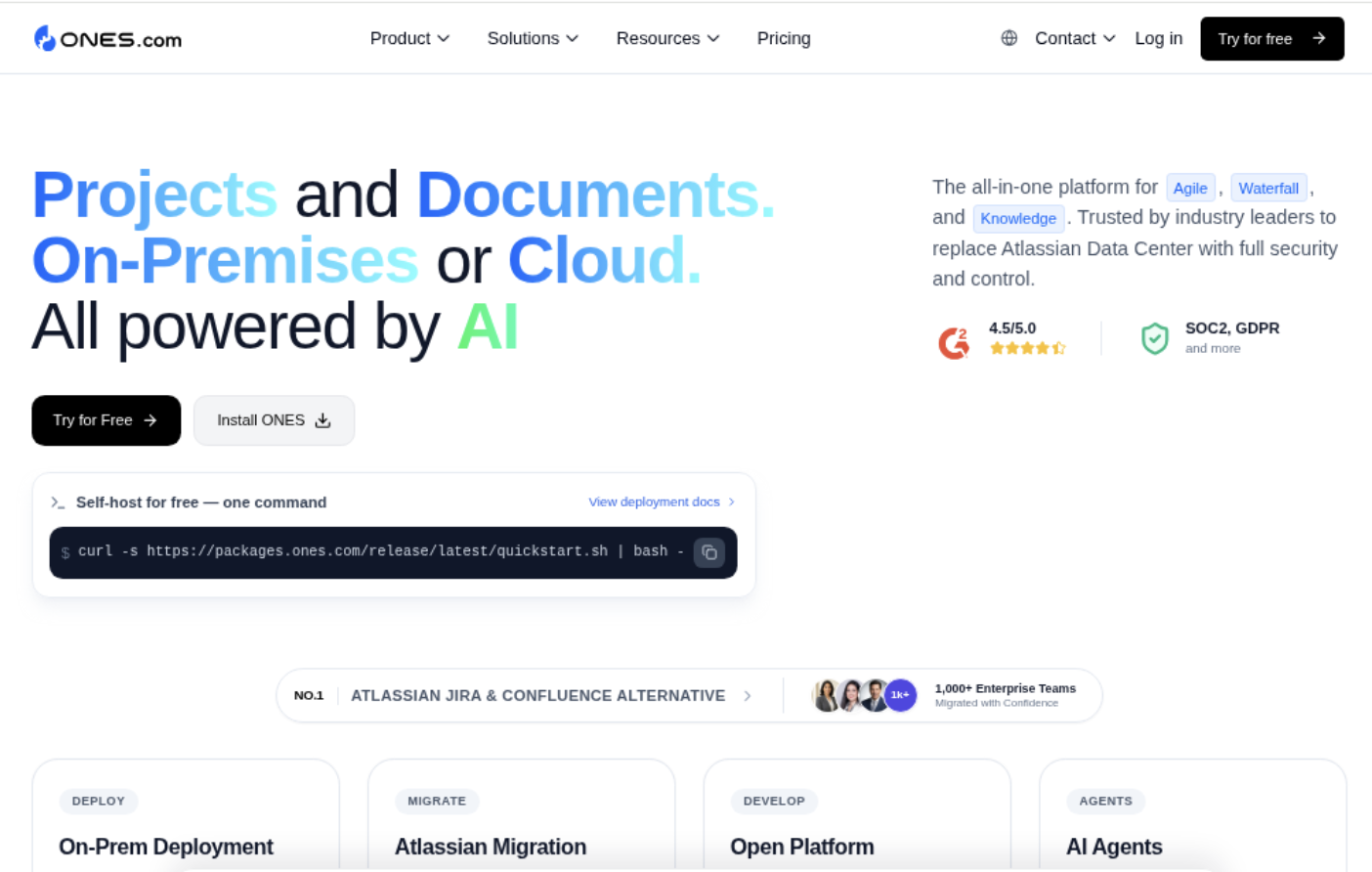
Value Proposition
ONES.com helps teams connect planning, execution, reporting, and shared knowledge in one environment. It can reduce reliance on multiple plugins while supporting cloud and self-hosted deployments.
Core Capabilities
Fragmented project tracking → ONES Project → One consistent project workspace
When work is spread across disconnected tools, status updates become difficult to reconcile. ONES Project brings issues, sprints, workflows, fields, and reporting into one project management environment.
Complex workflow requirements → Custom workflows and fields → Process visibility that matches the team
Teams can configure workflows and custom fields around their delivery stages. This helps show meaningful states without forcing every project into the same pattern.
Manual sprint coordination → Sprint management → More predictable iteration planning
Planning and sprint views help teams organize scope, monitor progress, and identify unfinished work before the next cycle begins.
Repetitive project administration → Automation → Fewer routine updates
Automation can handle predictable assignments, notifications, and field changes. Teams spend less time maintaining routine transitions manually.
Limited operational visibility → Built-in reporting → Faster identification of bottlenecks
Built-in reporting supports progress reviews and delivery analysis. Managers can examine workflow behavior without assembling separate reports.
Plugin-heavy Jira environments → Native feature parity → Fewer dependencies to maintain
ONES Project supports Jira-compatible workflows, custom fields, sprint management, automation, and reporting as native capabilities. This can simplify administration for teams that want fewer add-ons.
Strict hosting requirements → On-premise, private cloud, and air-gapped deployment → More control over the operating environment
ONES.com supports Cloud, On-Premise, Private Cloud, and Air-gapped deployments. Teams can choose an arrangement that fits security and infrastructure requirements.
Different environments with inconsistent features → Full feature parity → A more consistent operating experience
The self-hosted version provides full feature parity with the cloud version. Teams can select deployment flexibility without accepting a reduced feature set.
Application Scenarios
Software product team: A team moving beyond Jira can reproduce sprint planning, review stages, custom fields, and automated notifications in ONES Project. Native reporting helps the product manager review cycle time and unfinished sprint work.
Restricted-network engineering group: A group working in an air-gapped environment can deploy ONES.com without relying on public cloud access. Its project workflow remains available within the controlled environment.
Project and knowledge management team: A company can use ONES Project for delivery tracking and ONES Wiki for team knowledge. Keeping those products under the ONES.com platform can make navigation simpler while preserving separate product roles.
Common Challenges and Practical Solutions
Challenge: Too many statuses
When every activity receives a status, people spend time deciding where an issue belongs. Reporting also becomes difficult because similar work appears under different labels.
Solution: Combine stages that do not change ownership, priority, or decision-making. Keep a status only when it communicates meaningful progress.
Challenge: Issues remain assigned to the wrong person
An issue may stay assigned to the developer after entering review or testing. The board then suggests progress is still active with the original owner.
Solution: Change ownership at important handoffs. Use automation when the next owner follows a predictable rule.
Challenge: Teams bypass the workflow
People often bypass process when transitions feel slow or irrelevant. Private messages then become the place where important decisions happen.
Solution: Ask which step creates friction. Remove unnecessary controls, clarify the remaining rules, and keep decisions visible on the issue.
Challenge: Reports look healthy while work is stuck
A high completion count can hide blocked items, reopened defects, or long review queues. The team may appear productive while delivery risk increases.
Solution: Pair completion metrics with aging, cycle time, blocked work, and reopen rates. Review the pattern across several iterations.
Challenge: Automation creates unexpected changes
Overlapping rules can trigger duplicate alerts or move issues prematurely. People then lose confidence in the workflow.
Solution: Give every rule a clear purpose and owner. Test conditions with sample issues before enabling broad actions.
FAQs
What is the difference between a Jira project and a Jira workflow?
A Jira project is the working space that holds issues, boards, permissions, and settings. A workflow defines how those issues move through statuses and transitions. One project may use a workflow for software development, while another uses a simpler process for service requests. The project provides the environment; the workflow describes the movement of work inside it.
How many statuses should a Jira workflow have?
Use enough statuses to show meaningful changes in ownership or decision state. Many teams can start with five to seven stages, such as Backlog, In Progress, Review, Testing, and Done. The right number depends on your process. If people cannot explain why a status exists, it probably does not belong in the workflow.
Should every Jira issue move through the same workflow?
No. Bugs, features, service requests, and releases often need different paths. However, avoid creating a separate workflow for every small variation. Start with shared stages, then add a distinct workflow when the work has different owners, controls, or completion rules.
How can I stop issues from getting stuck in review?
First, measure how long issues remain in review. Then check reviewer availability, change size, review criteria, and ownership. A reviewer rotation can reduce queues, while smaller pull requests can shorten review time. You can also add a reminder for aging review items, but reminders work best after you fix unclear responsibility.
When should I use Jira automation?
Use automation for repeatable actions with clear conditions. Good examples include assigning work by component, notifying an owner about blocked issues, and updating a release field after approval. Avoid automating judgment-heavy decisions. If a rule requires frequent exceptions, simplify the process before automating it.
Can an organization move from Jira Software to another project platform?
Yes, but plan the move around workflows, fields, permissions, reports, integrations, and team habits. Start with one project or team, map the current process, and test common scenarios. ONES Project can support Jira-compatible workflows, sprint management, custom fields, automation, and reporting for teams evaluating a Jira alternative.
Conclusion
A better Jira Software workflow starts with a clear view of how work actually moves. Map the stages, define each status, assign ownership, add useful fields, automate repeatable actions, and review performance regularly.
But here's the truth: a workflow cannot compensate for unclear priorities or missing decisions. Keep the process understandable, then improve it using cycle time, aging work, blocked issues, and reopened items.
If your team needs project management with native workflow, sprint, reporting, automation, and deployment flexibility, ONES Project is worth evaluating as a Jira alternative. The right platform matters, but the clearest workflow is what helps your projects move.