Jira SSO Pricing Explained: A Practical 2026 Cost Guide
Unsure about jira sso pricing? Explore 2026 costs by users, billing, and security needs—read now to budget confidently.
Jira SSO pricing can look simple until you add identity management, user counts, annual billing, and security requirements. A small team may expect SSO to be included, then discover a separate per-user charge. Larger companies face another problem: the advertised rate may not reflect their contract, billing term, or user scope.
That uncertainty makes budgeting difficult. You might compare a monthly price with an annual estimate and assume they are equivalent. You may also pay for accounts that rarely access Jira or overlook the cost of managing SSO across multiple Atlassian products.
But here's the good news: you can estimate the real cost with a simple model. This guide explains what Jira SSO requires, how Atlassian Guard affects the bill, which factors change the total, and how alternatives can fit different deployment needs.
Jira SSO Pricing: The Short Answer
Jira SSO pricing usually means the cost of Atlassian Guard Standard, the identity and access product that adds SAML single sign-on to eligible Atlassian Cloud subscriptions. Jira licensing and SSO licensing are generally separate costs.
Atlassian has commonly listed Guard Standard at about USD 4.20 per user per month on monthly billing. An annual equivalent has commonly been about USD 40.80 per user per year. Treat these figures as planning estimates, because Atlassian can change rates, packaging, taxes, discounts, and contract terms.
A practical estimate looks like this:
Total monthly identity cost = billable managed accounts × Guard Standard rate
Your broader Jira budget is different:
Total Jira security budget = Jira subscription + Guard Standard + identity provider + administration + optional security tools
For example, 100 managed accounts at USD 4.20 per month would produce an estimated Guard charge of USD 420 monthly, before taxes or negotiated adjustments. Jira subscription fees would sit beside that amount.
What Atlassian Guard adds
Guard Standard is designed for centralized access control across Atlassian Cloud products. SAML SSO is one of its most important capabilities, but it is not the only consideration when you build a security budget.
- SAML single sign-on through an identity provider
- User provisioning and account lifecycle controls
- Organization-level administration
- Security policies for managed accounts
- Visibility into organizational access activity
- Centralized authentication across eligible Atlassian Cloud services
The exact feature set can depend on the plan, product, and current Atlassian packaging. Check the commercial terms attached to your organization before signing an order.
What the SSO charge does not automatically include
The Guard fee does not necessarily cover your identity provider. Microsoft Entra ID, Okta, Google Workspace, OneLogin, and similar platforms may have their own subscription terms.
It also does not remove the need for implementation work. Someone still needs to configure SAML, map attributes, test login flows, define recovery procedures, and manage exceptions.
How to Calculate the Real Cost
Use these steps to create a realistic estimate instead of multiplying a headline rate by your employee count.
- List the Atlassian products in scope. Decide whether SSO covers Jira Software, Jira Service Management, Confluence, or other Atlassian Cloud products. The same organization may have different access patterns across each service.
- Count managed accounts. Identify the people who need centralized authentication. Include employees, contractors, service agents, and other account types that fall under the applicable commercial rules.
- Separate active access from total workforce size. A company with 1,000 employees may have only 230 people using Jira. Your estimate should reflect the accounts that require management, not an unrelated headcount.
- Choose monthly or annual billing. Monthly billing can help during a pilot. Annual billing may reduce the effective monthly rate, but it creates a longer commitment.
- Add identity provider costs. SSO is a connection between Jira and an identity platform. If your identity platform charges per person, include that amount.
- Estimate implementation effort. Include setup, testing, policy design, user communication, and post-launch support. Internal labor can exceed the subscription fee for a small rollout.
- Model growth and exceptions. Add expected hires, contractors, acquired teams, and temporary accounts. Decide how you will handle people who need Jira access but do not belong to the primary identity directory.
- Confirm the commercial quote. Ask Atlassian or your reseller to confirm the rate, minimums, billing basis, taxes, renewal terms, and any negotiated discount.
Example: a 50-person team
Imagine a product team with 50 Jira users. At an estimated USD 4.20 per managed account each month, Guard Standard would be approximately USD 210 monthly.
That is only the identity layer. You still need to add the Jira plan, any identity provider expense, and the time needed to configure and maintain access.
Example: a 500-person organization
Now consider an organization with 500 managed accounts. The same planning rate produces an estimated USD 2,100 monthly for Guard Standard.
Annual billing at an estimated USD 40.80 per account would equal roughly USD 20,400 per year. A negotiated enterprise agreement could change that result, so use it for early budgeting rather than final approval.
Use a scenario table
| Managed accounts |
Estimated monthly Guard cost |
Estimated annual cost at USD 40.80 per account |
| 25 |
USD 105 |
USD 1,020 |
| 50 |
USD 210 |
USD 2,040 |
| 100 |
USD 420 |
USD 4,080 |
| 500 |
USD 2,100 |
USD 20,400 |
These examples exclude Jira subscriptions, taxes, identity provider charges, negotiated terms, and implementation labor. They show how quickly account scope changes the budget.
Which Factors Change the Price?
The per-user rate is only one piece of the calculation. Several practical details can move your final cost up or down.
Managed account count
SSO pricing is usually tied to the number of accounts under centralized management. A company may count employees, contractors, vendors, and service agents differently depending on its agreement.
For example, a vendor who logs in once each quarter may still require a managed account. Removing that person from the count could create an access problem later.
Monthly versus annual commitment
Monthly billing offers flexibility when you are testing SSO with one department. Annual billing may offer a lower effective rate, but you should forecast hiring and organizational changes before committing.
If you expect a merger or a large contractor program, ask how account changes are handled during the term. A lower annual rate may not help if the commercial model creates difficult adjustments.
Jira Cloud, Data Center, and self-managed environments
Cloud and self-managed Jira environments can have different identity features and commercial requirements. Jira Cloud commonly relies on Atlassian Guard for organization-level SSO.
Data Center deployments may use built-in or additional identity integrations, depending on the edition, version, and architecture. Confirm whether your environment needs a separate marketplace app, an enterprise entitlement, or custom configuration.
Identity provider licensing
Your identity provider may charge for every person in its directory, every active account, or a specific feature tier. That cost can be larger than the Atlassian SSO charge.
For example, a company that already licenses Entra ID for its workforce may have little incremental identity cost. A smaller organization adding Okta only for Jira should include the new platform subscription in its comparison.
Contract terms and discounts
Large customers may receive negotiated terms through Atlassian or a reseller. Enterprise agreements can also combine products, support, and renewal conditions.
That makes public list pricing useful for a first estimate, but insufficient for procurement approval. Ask for a written quote that separates each product and service.
What You Need Before Turning on SSO
SSO configuration is easier when your identity and Jira access model are already organized. A rushed setup can lock people out or create accounts with the wrong permissions.
Prepare your identity provider
Choose the identity provider that will authenticate your Jira accounts. Confirm that it supports the required SAML settings and can enforce your preferred sign-in policies.
Decide which attribute matches the Atlassian account. Email address is common, but inconsistent naming can create duplicate or unmatched identities.
Verify domain ownership
Organization-level SSO typically requires control of the email domain used by your managed accounts. Confirm ownership early, especially if your company operates several brands or regional domains.
Define recovery access
Keep a carefully controlled emergency route for administrators. If the identity provider becomes unavailable, authorized administrators need a safe way to restore access.
Test this process before enforcing SSO. A recovery plan that exists only in a policy meeting will not help during an outage.
Test with a small group
Start with IT and a few Jira project administrators. Test normal login, logout, account matching, group assignment, mobile access, and a user who should not receive access.
Then expand to one project team. This staged approach reveals configuration mistakes before they affect the whole organization.
Plan account lifecycle changes
Decide what happens when someone joins, changes roles, or leaves. SSO authenticates a person, but your wider access process must still control Jira groups, project roles, and service permissions.
Jira SSO Versus Other Access Approaches
SSO is one part of an access strategy. The right choice depends on company size, audit expectations, deployment model, and how many services your team uses.
Native login with stronger policies
A small team may continue with Atlassian-managed login and multi-factor authentication. This can avoid an additional SSO subscription, but account administration remains more scattered.
For example, removing an employee from your company directory may not automatically remove Jira access. Someone must complete both actions.
SSO through an identity provider
Centralized SSO gives people one authentication path and gives administrators a consistent place to enforce sign-in rules. It is often easier to manage as the organization grows.
The trade-off is recurring cost and setup effort. You should compare those costs with the time spent resetting accounts and handling access exceptions.
Self-managed Jira deployment
Self-managed environments can offer more control over network placement and authentication architecture. They may suit regulated teams or organizations with restricted connectivity.
However, infrastructure, maintenance, upgrades, monitoring, and identity integration become your responsibility. The subscription price alone does not represent the full operating cost.
Application consolidation
Some teams evaluate whether a broader work platform can reduce the number of separate products and identity connections. That comparison should include workflow fit, migration effort, security controls, and long-term administration.
A cheaper license is not automatically better if it forces your team to rebuild workflows or maintain several plugins.
Common Mistakes That Distort the Estimate
Counting employees instead of managed accounts
Problem: You use the total workforce as the billing quantity, even though only part of the organization needs Jira.
Solution: Build a role-based access list. Separate Jira users, service agents, contractors, administrators, and people who need no access.
Assuming SSO comes with every Jira plan
Problem: You approve a Jira subscription expecting SAML SSO to be included automatically.
Solution: Request a quote that lists Jira and the identity product separately. Confirm which plan unlocks the required SSO capability.
Ignoring the identity provider
Problem: Your estimate includes the Atlassian charge but excludes the platform that authenticates your staff.
Solution: Ask whether your current identity provider already covers the required accounts and features. If it does not, add its incremental cost.
Skipping recovery testing
Problem: SSO works during the launch test, but administrators have no tested route during an identity provider outage.
Solution: Create a restricted emergency procedure and test it with authorized administrators before enforcement.
Forgetting renewal and growth
Problem: The first-year estimate looks affordable, but new hires and contractors increase the bill later.
Solution: Add a growth scenario to your budget. Review account counts before renewal and remove accounts that no longer need access.
Jira SSO Pricing Solution: ONES.com
ONES.com combines project management and knowledge management in one platform powered by ONES Assistant. ONES Project is the project management product and a Jira alternative, while ONES Wiki is the knowledge management product and a Confluence alternative; they are sold separately.
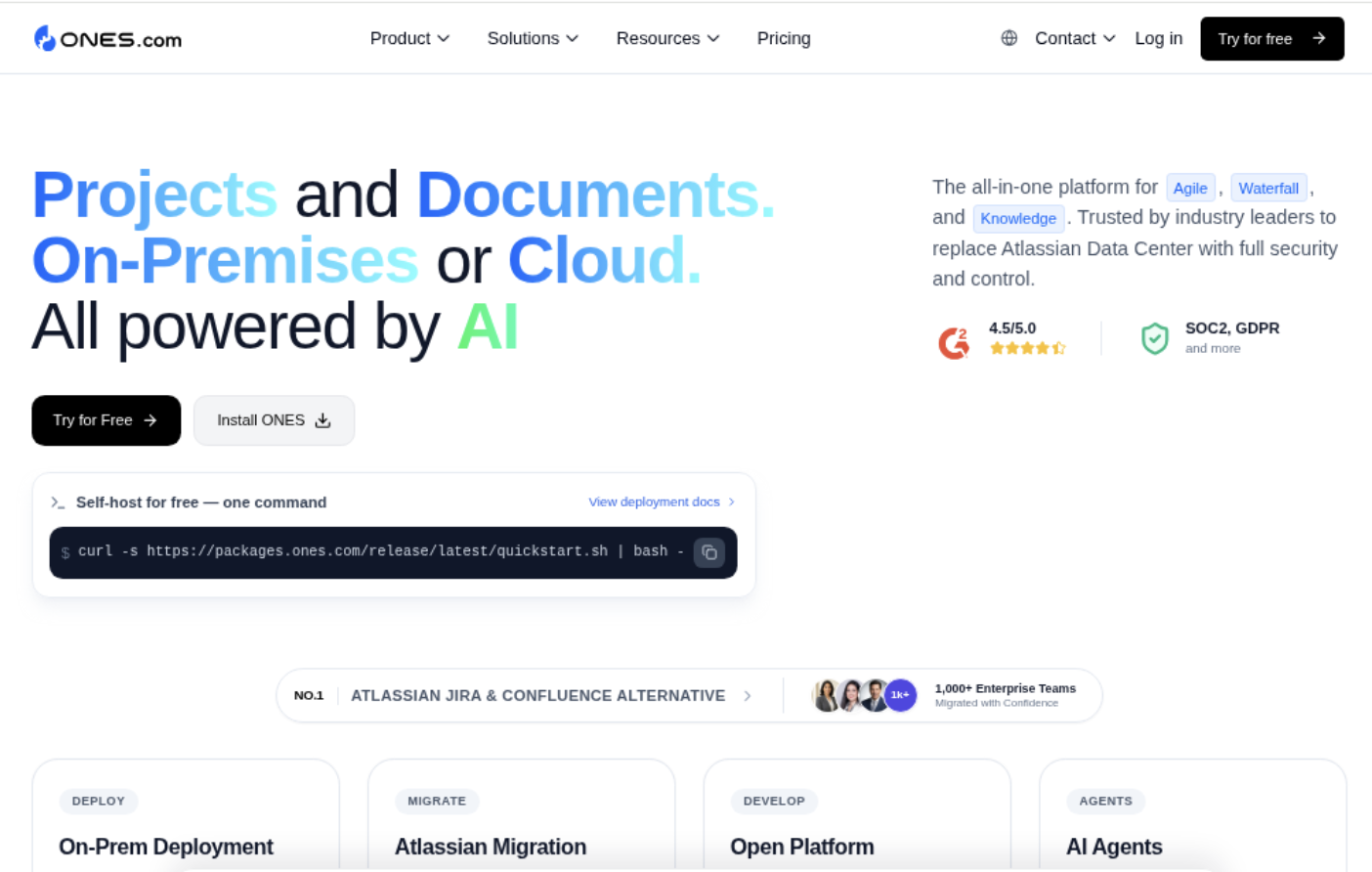
For teams comparing identity costs with platform consolidation, ONES.com provides four deployment choices: Cloud, On-Premise, Private Cloud, and Air-gapped. The free plan supports up to 30 seats, and the self-hosted versions provide feature parity with the cloud version.
Core capabilities
Scattered work tracking → ONES Project → A unified project workspace
When tasks, sprints, and project updates sit across disconnected systems, status reviews take longer. ONES Project brings project work into one environment, helping teams follow progress without switching between several tools.
Jira migration concerns → Jira-compatible workflows → A familiar transition path
Teams that already use Jira-style processes may not want to redesign every issue type and approval path. Jira-compatible workflows can reduce the process change required during evaluation or migration.
Manual reporting → Built-in reporting → Faster status visibility
Preparing a weekly status view by hand creates repetitive administrative work. Built-in reporting helps teams review progress, workload, and delivery signals within the project environment.
Rigid process design → Custom workflows and fields → Better alignment with team rules
Different teams often need different statuses, approvals, and metadata. Custom workflows and fields let you represent those rules without forcing every project into one template.
Sprint coordination gaps → Sprint management → Clearer iteration planning
When sprint goals and work items are tracked separately, teams can lose sight of priorities. Sprint management connects planning with execution and makes unfinished work easier to review.
Repeated administrative actions → Automation → Less manual maintenance
Routine transitions, assignments, and notifications consume time when handled manually. Automation can apply consistent actions after defined events, reducing avoidable effort.
Restricted network requirements → Air-gapped deployment → Greater infrastructure control
Some organizations cannot place project systems on a public network. An air-gapped deployment supports teams that need isolated infrastructure and strict connectivity controls.
Separate project and knowledge spaces → ONES Project plus ONES Wiki → Connected work and knowledge management
Project decisions can become difficult to find when planning and team knowledge live in separate places. Using the products together can give teams a clearer relationship between delivery work and shared knowledge.
Application scenarios
Regulated engineering team
An engineering group with restricted network requirements can evaluate the On-Premise or Air-gapped deployment. The team can preserve controlled infrastructure while using custom workflows, sprint planning, and reporting.
Growing product organization
A product organization moving beyond 30 seats may compare Jira licensing, Guard charges, plugins, and administration effort with a broader platform evaluation. ONES Project can serve as a Jira alternative when workflow compatibility and native capabilities matter.
Project and knowledge management consolidation
A team using one platform for project delivery and another for internal knowledge can assess ONES Project and ONES Wiki separately. This keeps the product choice aligned with actual needs instead of requiring one broad purchase.
How to Choose the Right SSO Budget
Start with the security outcome you need. If you only want stronger login protection for a small team, multi-factor authentication may meet the immediate goal. If you need centralized lifecycle control across several Atlassian services, SSO may justify the extra subscription.
Then compare three figures: the direct license cost, the identity provider cost, and the operating effort. A solution that costs more per account may still be more economical if it removes repeated administration.
Here's why: access work creates hidden costs. An administrator who spends 30 minutes handling each joiner and leaver can consume more budget than expected across a year.
Build a one-year and three-year view. Include account growth, renewals, identity provider changes, implementation time, migration effort, and the financial impact of a preventable access incident.
FAQs
Is SSO included in Jira pricing?
SSO is not automatically included with every Jira subscription. Jira Cloud organizations commonly need Atlassian Guard Standard for SAML single sign-on and centralized account controls. The exact requirement depends on your Jira product, plan, deployment model, and current Atlassian terms. Ask for a quote that separates Jira licensing from Guard so you can see the actual identity cost.
How much does Atlassian Guard Standard cost?
Atlassian has commonly listed Guard Standard at about USD 4.20 per managed account each month, with an annual equivalent often shown near USD 40.80 per account. These figures are useful for an early estimate, not a guaranteed 2026 quote. Billing terms, taxes, negotiated discounts, account definitions, and packaging can change the final amount.
Do I need an identity provider for Jira SSO?
Yes, SAML SSO requires an identity provider to authenticate people and send the required identity information to Atlassian. Common examples include Microsoft Entra ID, Okta, Google Workspace, and OneLogin. Your identity provider may have separate licensing or feature requirements, so include that expense when calculating the total cost.
Does Jira SSO pricing cover every Atlassian product?
Guard can support centralized authentication across eligible Atlassian Cloud products, but your organization still needs the relevant product subscriptions. A Guard charge does not replace Jira, Confluence, or Jira Service Management licensing. Confirm which products, domains, and account groups are covered before you finalize the rollout.
Can I reduce the SSO bill by removing inactive accounts?
You may reduce the bill when accounts no longer require management, depending on the applicable billing rules. Review inactive users, former contractors, duplicate accounts, and people who changed roles. Do not remove an account solely because it has low activity if the person still needs access. Coordinate account cleanup with your access control process.
Is an alternative platform worth comparing with Jira and Guard?
It can be worthwhile when you are already reviewing project workflows, deployment restrictions, plugin costs, or administrative effort. Compare more than the license rate. Evaluate migration work, workflow compatibility, reporting, automation, security controls, deployment options, and knowledge management. ONES Project is one Jira alternative to consider, with cloud and self-hosted deployment choices.
Conclusion
Jira SSO pricing is usually an additional identity cost alongside your Jira subscription. For early planning, multiply managed accounts by an estimated Guard Standard rate, then add identity provider charges, implementation effort, taxes, and expected growth.
But here's the truth: the cheapest headline rate may not produce the lowest total cost. Account scope, annual commitments, deployment architecture, administration, and recovery planning can change the result.
Start with a small access inventory, test SSO with a pilot group, and request a written quote for your actual account count. If platform consolidation or restricted deployment is also part of your evaluation, compare Jira with alternatives such as ONES Project and review the wider operating model.