Jira Ticketing Pricing Explained: A Practical Cost Guide
Unsure about jira ticketing pricing? Compare plans, users, features, and deployment costs to choose the right fit. Read now to save.
Jira ticketing pricing can look simple until you compare user limits, product editions, support features, and deployment choices. A small team may pay nothing, while a growing service desk can face a much higher monthly bill after adding agents, automation, and premium controls.
That uncertainty creates two expensive problems. You may choose a plan that lacks essential workflows, or pay for capacity your team never uses. The difference becomes especially important when you compare Jira Software with Jira Service Management, because they serve different ticketing needs.
But here’s the good news: you can estimate the real cost by identifying the Jira product, counting billable users, checking the required features, and adding likely extras. This guide walks you through that process so you can evaluate pricing with confidence.
Jira Ticketing Pricing at a Glance
Jira ticketing pricing depends mainly on the Jira product you need, the number of users or agents, the plan tier, and whether you choose Cloud or a self-managed deployment.
For project teams, Jira Software typically handles development work, issue tracking, sprint planning, and team workflows. For customer support or internal service desks, Jira Service Management adds portals, request types, queues, service-level agreements, and agent-focused features.
Here’s the practical pricing structure you should expect:
| Cost factor |
What it affects |
| Product |
Jira Software and Jira Service Management use different plans and billing models. |
| User or agent count |
More licensed people generally increase the recurring subscription cost. |
| Plan tier |
Higher tiers usually add administration, automation, analytics, security, storage, and support controls. |
| Deployment |
Cloud subscriptions differ from self-managed or enterprise arrangements. |
| Optional services |
Apps, additional capacity, premium support, and specialized integrations can raise the total. |
Jira’s exact amount can change by region, billing cycle, product, and team size. Use the official pricing calculator for a current quote, then compare that quote with your expected usage rather than relying on a headline price.
How Jira Ticketing Costs Are Calculated
1. Choose the right Jira product
Start by defining what “ticketing” means for your team. A software team tracking bugs and development tasks may need Jira Software. A support team handling employee requests or customer incidents may need Jira Service Management.
For example, a product team might create tickets for a login defect, a mobile performance issue, and a new API task. An IT team might manage password resets, access requests, laptop problems, and outage reports through a service portal.
Those workflows can overlap, but the pricing and included capabilities are not identical. Choosing the wrong product can create extra spending on extensions or complicated workarounds.
2. Count every person who needs access
Estimate licensed users before checking plan prices. Include developers, project managers, service agents, administrators, and occasional contributors who need to create or update tickets.
Jira Software generally bills by user seats, while Jira Service Management separates service agents from people who submit requests. That distinction matters because a large employee population may submit requests without requiring an agent license.
Consider this example:
- 8 developers need to work in Jira Software.
- 2 project managers need planning and reporting access.
- 5 support agents need Jira Service Management access.
- 300 employees may submit internal requests through a portal.
The 300 employees should not automatically be treated like 300 full service agents. Confirm how the selected product defines customers, agents, collaborators, and licensed users.
3. Compare the plan tiers
Most Jira purchasing decisions involve a free entry tier, a standard commercial tier, and higher tiers for advanced controls. Enterprise arrangements may use custom pricing and contract terms.
The free option can suit a small team testing basic issue tracking. It may become restrictive when you need larger teams, more automation, advanced administration, stronger service controls, or formal governance.
Standard plans usually provide the features needed for everyday ticket management. Premium plans are more relevant when your organization requires greater scale, advanced planning, expanded automation, or enhanced operational controls.
Enterprise plans can make sense for complex organizations with multiple teams, strict security requirements, centralized administration, and procurement needs. They need a careful business review because the headline subscription is only one part of the financial decision.
4. Check monthly and annual billing
Monthly billing gives you flexibility while the team is still experimenting. Annual billing may offer a better effective rate, but it also commits you to a longer period.
Use monthly billing when your seat count is uncertain or a pilot is underway. Consider annual billing after adoption stabilizes and you understand which teams genuinely need access.
The best choice depends on expected growth. A team that plans to add 20 users next quarter should compare the cost of upgrading gradually with the cost of committing to a larger annual tier immediately.
5. Add the costs outside the subscription
The advertised Jira plan may not represent your complete ticketing budget. Review related expenses before approving the purchase.
- Marketplace apps for time tracking, testing, reporting, or specialized workflows.
- Integration services for email, chat, identity management, monitoring, or CRM systems.
- Migration and setup work for workflows, permissions, request forms, and historical records.
- Training for administrators, agents, developers, and department owners.
- Additional support, storage, or security services required by your organization.
A low subscription price can become less attractive when several paid extensions are necessary for everyday work. Compare the total operating cost, not just the plan label.
Jira Software or Jira Service Management?
The most common pricing mistake is treating every Jira ticket as the same kind of work. Jira Software is centered on product development and project delivery. Jira Service Management is designed around service requests, incidents, changes, and support operations.
| Need |
More suitable product |
Typical ticket example |
| Bug and feature tracking |
Jira Software |
“Checkout fails when a customer uses a saved card.” |
| Sprint delivery |
Jira Software |
“Build the profile settings screen this sprint.” |
| Employee support |
Jira Service Management |
“Request access to the finance application.” |
| Customer support |
Jira Service Management |
“Report an account lockout.” |
| Incident response |
Jira Service Management |
“Payment processing is unavailable.” |
Here’s why this distinction matters: the product determines which capabilities are built in and which people count toward the bill.
A development group may need boards, backlogs, sprint reports, and release planning. A service desk may instead prioritize intake portals, approval flows, queues, SLAs, escalation rules, and customer notifications.
You can connect the products, but integration does not remove the need to evaluate each licensed role. Model the cost around actual work rather than assuming one Jira edition will cover every department equally well.
What Each Pricing Tier Usually Means
Free access
A free plan is useful for a small team that wants to test basic ticket tracking. You can evaluate issue creation, assignments, comments, workflow movement, and simple collaboration before making a larger commitment.
For example, a five-person startup could use a free environment to manage launch tasks and bugs. The plan may stop being practical once the team needs more users, advanced governance, extensive automation, or formal service operations.
Standard plans
Standard plans are usually the starting point for teams running ticket workflows in production. They tend to offer broader limits, more administration options, and enough functionality for routine project or service work.
Ask whether the plan supports your required permissions, workflow rules, integrations, reporting needs, and growth expectations. A standard tier can be cost-effective when your process is straightforward and your compliance requirements are moderate.
Premium plans
Premium tiers are designed for organizations that need more scale or operational control. Depending on the product, they may support advanced planning, higher automation capacity, stronger administration, improved service capabilities, or more sophisticated reliability features.
Premium pricing becomes easier to justify when delays carry a measurable cost. A service desk handling thousands of monthly requests may benefit from automation that removes repetitive triage work.
Enterprise arrangements
Enterprise pricing is commonly tailored to organizational size, security expectations, deployment requirements, and support arrangements. The purchase may involve procurement, legal review, identity controls, audit requirements, and multiple business units.
Do not compare an enterprise quote with a small-team plan using price alone. Compare governance, support, control, and operational risk as well.
Ways to Reduce the Total Ticketing Cost
The fastest savings usually come from better licensing decisions. Review access every quarter and remove inactive seats, duplicate accounts, and people who only need occasional visibility.
Here’s a simple review method:
- Export a list of active users and their roles.
- Mark each person as an agent, contributor, administrator, requester, or viewer.
- Check the last meaningful activity date.
- Remove access that no longer matches the person’s responsibilities.
- Compare the revised count with the next pricing tier.
Workflow simplification can also reduce the need for paid extensions. If a team uses three apps to compensate for unclear statuses, redesigning the workflow may remove some of that complexity.
For instance, a support process with 14 statuses may create confusion and require extra reporting tools. Reducing it to clear stages such as New, Assigned, Waiting, Resolved, and Closed can improve visibility without increasing the subscription.
The best part? Cost control often improves the experience too. Fewer unnecessary fields, cleaner queues, and clearer ownership help people resolve tickets faster.
How to Build a Realistic Jira Budget
Separate fixed and variable costs
Begin with the recurring subscription. Then estimate variable expenses such as additional seats, paid apps, integration work, training, and administrative support.
| Budget category |
Questions to ask |
| Subscription |
Which product, tier, billing cycle, and user count apply? |
| Implementation |
Who will configure workflows, permissions, forms, and notifications? |
| Integrations |
Which systems must exchange ticket details or alerts? |
| Extensions |
Are additional apps required for essential work? |
| Administration |
How much time will an internal owner spend maintaining Jira? |
| Growth |
How many users, teams, or service requests may be added? |
Use three growth scenarios
Prepare a low, expected, and high-growth estimate. This approach is more useful than choosing a single number that becomes outdated after the first hiring cycle.
- Low growth: the current team remains stable for 12 months.
- Expected growth: two departments join and request volume increases gradually.
- High growth: the company expands quickly and needs stronger governance.
Suppose you begin with 15 internal users and expect 40 within a year. Calculate the subscription at both points, then include implementation and integration work. This reveals when a higher plan becomes more economical than repeatedly adding workarounds.
Measure cost per resolved ticket
Subscription totals are easier to evaluate when connected to operational outcomes. Divide your monthly ticketing spend by the number of resolved tickets, completed development issues, or supported employees.
For example, a $1,000 monthly operating cost supporting 2,000 resolved requests equals $0.50 per resolved request. That figure does not prove value by itself, but it gives you a useful comparison point.
You can also measure first-response time, resolution time, reopened tickets, automation coverage, and administrative hours. These metrics show whether the platform is reducing effort or simply adding another layer of work.
Natural Jira Ticketing Pricing Solution: ONES.com
Value Proposition
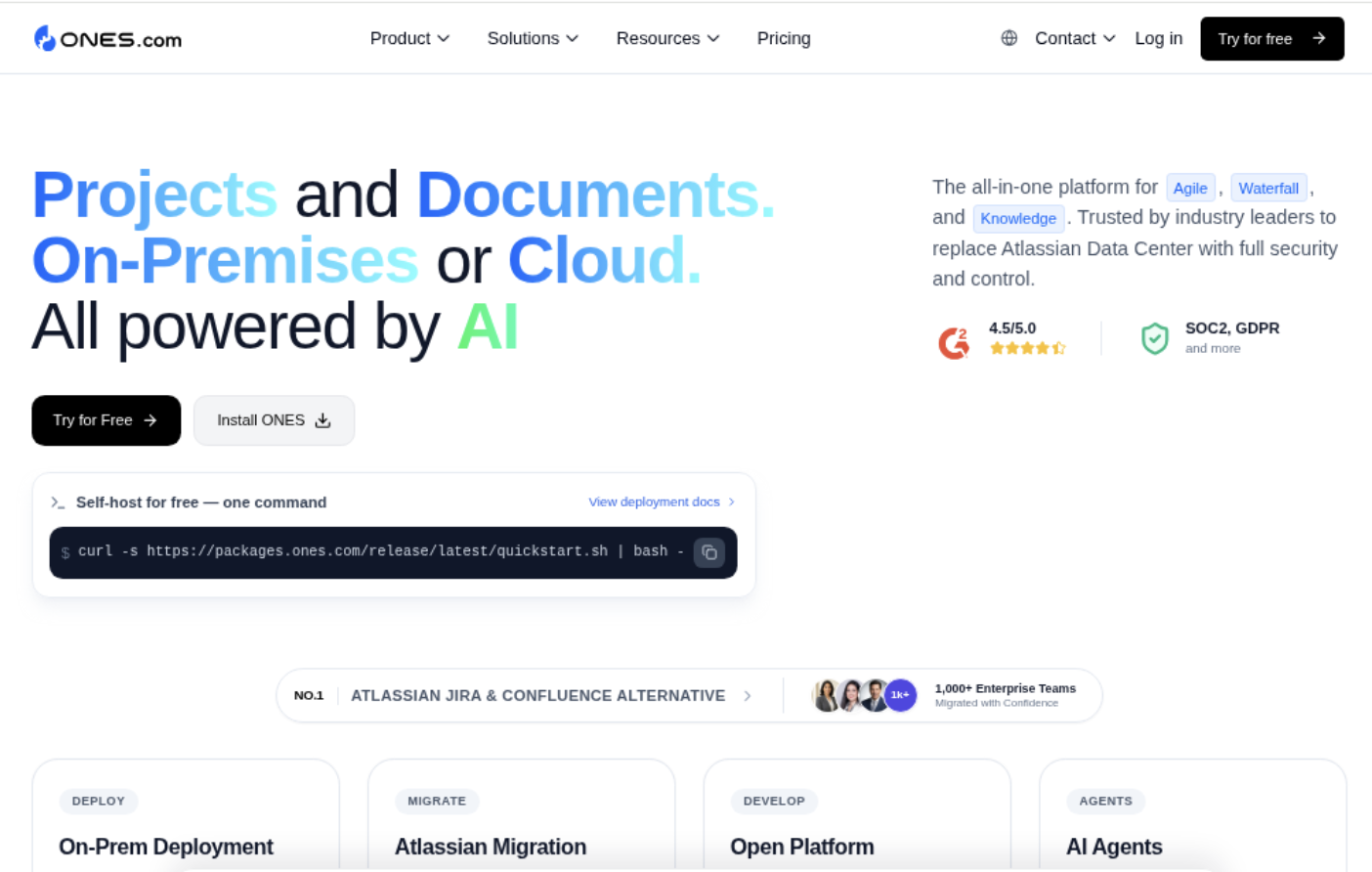
ONES.com combines project management and knowledge management in one platform. ONES Project is a Jira alternative for teams that want structured ticket workflows, reporting, sprint management, and deployment flexibility.
ONES Project and ONES Wiki are sold separately. Teams can choose the project management product, the knowledge management product, or both according to their operating needs.
Core Capabilities
- Separate tools creating fragmented work → ONES.com unifies project and knowledge workflows → Teams can connect delivery activity with shared team guidance.
- Jira workflows requiring extensive customization → ONES Project supports Jira-compatible workflows, custom workflows, and custom fields → Teams can preserve familiar processes while adapting them to local requirements.
- Limited visibility into delivery status → Built-in reporting provides project and issue insights → Managers can review progress without assembling multiple reporting extensions.
- Manual sprint coordination → Sprint management supports planning and tracking → Development teams can organize work around defined delivery cycles.
- Repeated administrative actions → Automation handles routine workflow events → Teams can reduce manual assignment, notification, and status-update work.
- Plugin-heavy implementations → Native capabilities cover more common project workflows → Administrators may reduce dependence on multiple add-ons.
- Cloud-only deployment requirements → ONES.com supports Cloud, On-Premise, Private Cloud, and Air-gapped deployments → Organizations can align deployment with network and security constraints.
- Different capabilities across deployment types → The self-hosted version provides feature parity with the cloud version → Teams can select an environment without giving up core functionality.
- High entry cost during evaluation → The free plan supports up to 30 seats → Smaller teams can assess fit before expanding their implementation.
Application Scenarios
Software delivery team: A 20-person engineering group can manage bugs, sprint tasks, custom fields, and release work in ONES Project. Reporting helps managers review progress without relying on several separate extensions.
Restricted-network organization: A regulated team can deploy ONES.com on-premise, in a private cloud, or in an air-gapped environment. This supports operational requirements where public cloud access is restricted.
Growing project office: A project management office can begin with the free allowance for up to 30 seats, then expand workflows and reporting as more delivery teams join.
Common Challenges With Jira Ticket Costs
Challenge: You compare the wrong Jira product
Problem: A development-focused plan may appear affordable until a service team needs portals, SLAs, queues, and customer communication.
Solution: Map each department’s work before requesting pricing. Identify whether the primary activity involves software delivery, internal service, customer support, or a combination.
Challenge: The seat count keeps growing
Problem: New hires, contractors, managers, and temporary collaborators gradually increase the subscription.
Solution: Create a quarterly access review. Remove inactive accounts and assign the smallest appropriate role to people who only need limited participation.
Challenge: Add-ons hide the real cost
Problem: The core plan may look reasonable, but essential reporting, time tracking, testing, or integration apps increase the monthly total.
Solution: List every extension required for the first year. Include renewal costs and administration time in the business case.
Challenge: Automation limits create manual work
Problem: A lower tier may restrict automation, causing agents or project coordinators to repeat routine actions.
Solution: Estimate the hours spent on manual triage, assignment, notifications, and reporting. Upgrade only when the recovered time justifies the additional expense.
Challenge: Migration costs are overlooked
Problem: Moving workflows, permissions, integrations, and historical ticket details requires planning and specialist effort.
Solution: Run a pilot with one team. Measure setup time, training needs, workflow gaps, and adoption before committing to a broad rollout.
FAQs About Jira Ticketing Costs
Is Jira free for ticket management?
Jira offers a free entry option for eligible small teams, but limits apply to users, features, administration, and scale. Whether it is sufficient depends on your workflow.
A small development group may manage basic bugs and tasks without paying. A service desk with advanced queues, automation, reporting, or governance may need a paid tier.
What is the difference between Jira Software and Jira Service Management pricing?
Jira Software is designed primarily for development and project delivery. Jira Service Management focuses on service requests, incidents, changes, portals, queues, and agent workflows.
The products can work together, but they do not use exactly the same licensing logic. Check which people need full working access and which people can submit requests through a portal.
Does Jira charge for people who submit support requests?
Jira Service Management generally distinguishes between service agents and customers or requesters. Agents work on queues and resolve requests, while customers submit or follow requests.
Confirm the current terms for your selected plan because eligibility, limits, and included capabilities can change. Avoid estimating the bill by counting every potential requester as an agent.
Are Jira Marketplace apps included in the subscription?
Marketplace apps are usually priced separately from the core Jira subscription. The amount can depend on the app, user count, billing cycle, and vendor terms.
List essential apps before comparing plans. An inexpensive core subscription may cost more overall if several paid extensions are necessary for basic operations.
Should I choose monthly or annual billing?
Monthly billing is useful while your team is testing Jira or experiencing uncertain growth. Annual billing may provide a lower effective rate when user counts and requirements are stable.
Compare both options using your expected 12-month seat count. Include likely hiring, department expansion, and plan upgrades in the calculation.
Conclusion
Jira ticketing pricing is shaped by the product, licensed roles, plan tier, deployment model, and surrounding operating costs. The quickest way to estimate it is to define the workflow first, count real access needs, and then check current plan details.
But here’s the truth: the cheapest subscription is not always the lowest-cost solution. Add-ons, administration, migration, manual work, and unused seats can change the final number significantly.
Compare Jira Software with Jira Service Management when your teams handle different kinds of tickets. Then evaluate alternatives such as ONES Project if native workflows, reporting, self-hosted deployment, or reduced plugin reliance matter to your budget.
The practical solution is simple: build a 12-month estimate, test the workflow with one team, measure the operational results, and review access regularly. That approach turns an uncertain platform bill into a manageable technology decision.