Jira Work Management: A Practical Guide for New Teams [2026]
New to jira work management? Learn how to build clear workflows and views for your team—click to discover the practical guide.
New teams often open Jira Work Management expecting clarity, then meet a maze of projects, issue types, views, statuses, and notifications. A blank workspace can feel just as confusing as an overcrowded one.
Without a shared setup, requests get buried, priorities change silently, and nobody knows whether a task is waiting, blocked, or simply forgotten. Even a small marketing, HR, operations, or finance team can lose hours chasing updates.
But here's the truth: Jira Work Management becomes practical when you design it around the way your team works. This guide shows you how to structure projects, create useful workflows, plan work, track progress, and avoid common mistakes.
Jira Work Management: A Practical Overview for New Teams
Jira Work Management is Jira’s work-planning environment for business and cross-functional teams. It helps you collect requests, assign tasks, manage deadlines, automate routine actions, and give everyone a shared view of progress.
You can use it for marketing campaigns, employee onboarding, hiring pipelines, procurement requests, event planning, legal reviews, and many other repeatable workflows. The basic unit of work is usually an issue, such as a task, request, approval, or milestone.
Here's why the setup matters: Jira can reflect almost any process, but flexibility can create unnecessary complexity. A new team should start with a small number of clear statuses, simple fields, and views that answer everyday questions.
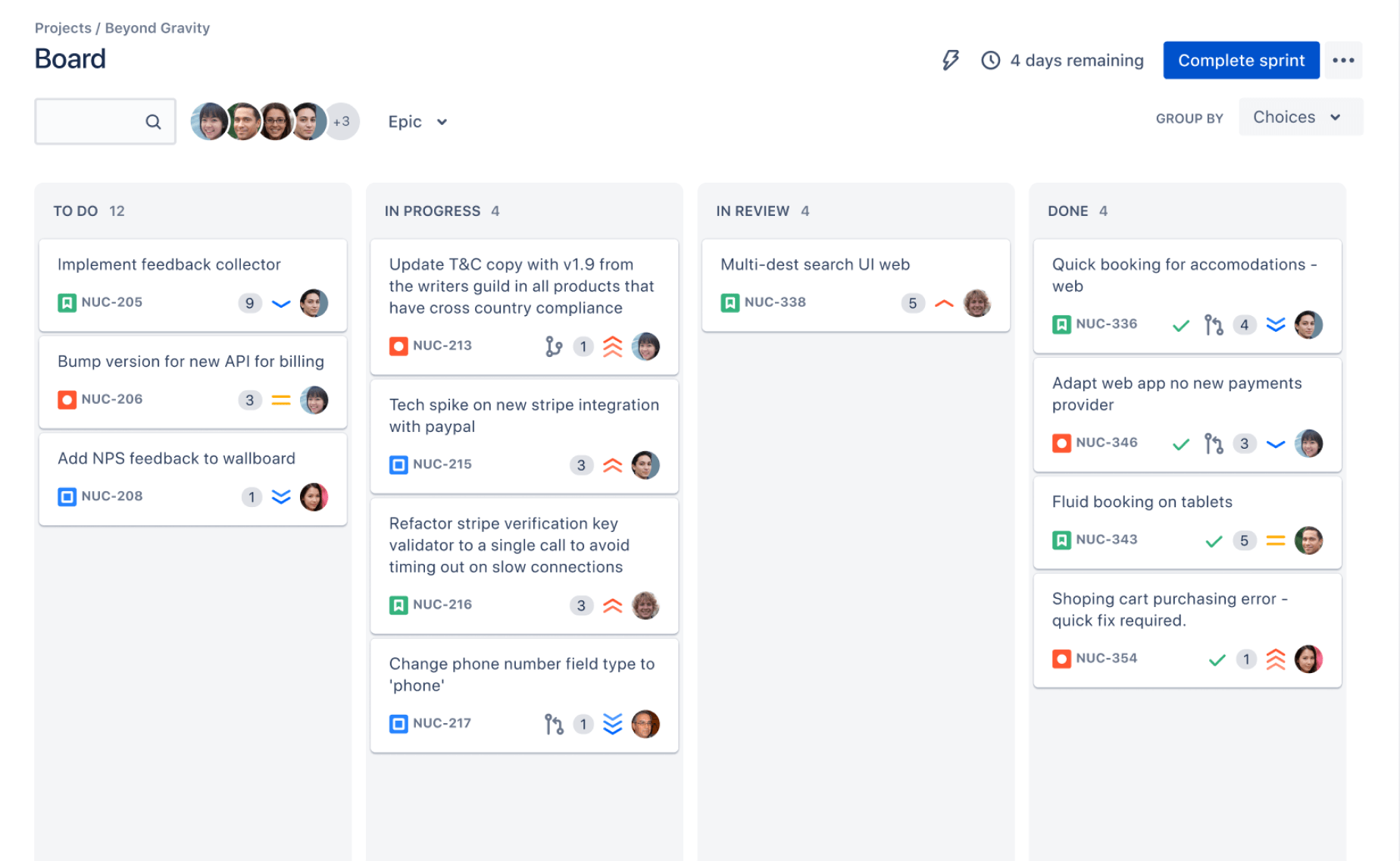
What Jira Work Management helps you organize
- Incoming requests from colleagues, customers, or other departments
- Tasks with owners, priorities, due dates, and descriptions
- Multi-step workflows that move work from request to completion
- Recurring activities such as monthly reporting or campaign checks
- Approvals, reviews, dependencies, and blocked work
- Team capacity, workload, deadlines, and delivery trends
The main building blocks
| Building block |
What it means |
Example |
| Project |
A workspace for a team, function, or major initiative |
Marketing Operations |
| Issue |
A specific piece of work or request |
Review the spring campaign brief |
| Issue type |
A category that describes the kind of work |
Task, request, approval, or milestone |
| Status |
The current stage of an issue |
To do, In progress, In review, Done |
| Field |
Information attached to an issue |
Priority, owner, team, due date |
| Board or list |
A visual way to view and manage work |
Kanban board or task list |
How to Set Up Jira for a New Team
The fastest path is to build a small working system first. You can expand it after the team has used it for a few weeks.
- Define the team’s purpose. Write one sentence explaining what the project manages. For example: “This project tracks all requests and campaigns handled by the content team.”
- Choose one project structure. Start with a team-managed project if the team needs independence and a quick setup. Consider a company-managed project when several teams need shared schemes, reporting, or governance.
- List the work you actually receive. Review a typical week. A marketing team may handle campaign requests, web updates, event support, email production, and content reviews.
- Create a short issue type list. Use only the categories that help people choose the right workflow. Four or five types are often enough for a new team.
- Design the simplest useful workflow. Begin with statuses such as To do, In progress, In review, Blocked, and Done. Remove stages that do not change a decision or action.
- Add essential fields only. A task may need an owner, priority, due date, requester, and team. Extra fields create more effort and rarely improve visibility at the beginning.
- Build the primary view. Use a board for flow-based work, a list for detailed planning, or a calendar for deadline-driven activities. Give each view a clear purpose.
- Set permissions and notifications. Decide who can create, edit, transition, assign, and close work. Keep notifications focused on meaningful changes.
- Add automation for repetitive actions. For example, assign a review task when an issue moves to In review, or remind an owner before a due date.
- Run a short pilot. Ask the team to use the setup for one real work cycle. Record confusion, missing information, and unnecessary steps.
- Improve the system after observation. Change one or two things at a time. A gradual approach makes it easier to identify which adjustment helped.
A simple starter workflow
Imagine a communications team receiving internal campaign requests. The requester creates an issue, the coordinator checks the requirements, a writer produces the material, a reviewer checks it, and the coordinator closes the work.
The workflow could look like this:
- New: The request has arrived but has not been checked.
- Ready: The requirements are clear and the work can begin.
- In progress: Someone is actively working on it.
- In review: A reviewer must approve or request changes.
- Blocked: Progress depends on a missing decision, person, or item.
- Done: The agreed outcome has been delivered and accepted.
Choosing the Right Project and Issue Structure
Your project structure should match how decisions are made. If one team owns the work, a focused project usually keeps administration simple. If several departments share the same workflow, a common structure can improve reporting and consistency.
For example, a company could create separate projects for Marketing, People Operations, and Facilities. That arrangement gives each group control over its work while allowing leadership to review progress across projects.
Team-managed and company-managed projects
| Option |
Useful when |
Watch for |
| Team-managed |
A team wants to configure its own workflow and fields quickly |
Different projects may develop inconsistent practices |
| Company-managed |
Several teams need shared standards, permissions, and reporting |
Changes may require more coordination |
Here's a practical rule: choose team-managed when speed and local control matter most. Choose company-managed when common governance and cross-team reporting matter more.
How many projects should you create?
Do not create a new project for every campaign, client, or small initiative. Too many projects scatter attention and make reporting harder.
Instead, keep related work together when it shares the same team, workflow, and permission needs. Use components, labels, initiatives, or custom fields to separate work inside that project.
Issue types that work well for beginners
A useful starting set might include Task, Request, Approval, and Milestone. A content team could use Request for incoming work, Task for production, Approval for review decisions, and Milestone for major launch points.
You can add a new issue type when the existing categories no longer explain a real difference. Avoid adding types simply because two tasks have different names.
Designing Workflows People Will Actually Use
A workflow should tell people what happens next. It should not force them to understand every internal handoff before they can update an issue.
Consider a procurement request. The useful stages may be Requested, Checking details, Approval needed, Ordered, and Complete. A dozen technical statuses could make reporting precise, but they may slow down everyday updates.
Keep statuses action-oriented
“In progress” is easy to understand, but it can hide important differences. If review delays are common, “In review” deserves its own status. If external approval is a frequent blocker, “Waiting for approval” may also help.
Each status should answer a practical question: who acts next, and what must happen before the issue moves forward?
Separate status from priority
Status tells you where work is in the process. Priority tells you how urgently the team should handle it. Combining both ideas creates confusion.
For example, a high-priority issue can be In progress, while a low-priority issue can also be In progress. Keep those signals separate so you can filter and report accurately.
Use transitions and rules carefully
Transitions can require an owner, prompt for approval, or prevent an issue from closing without essential information. These controls are useful when they protect quality.
They become frustrating when every small update requires multiple fields or approvals. Test each rule with a real example before making it part of the standard workflow.
Planning and Prioritizing Everyday Work
Jira Work Management can help you plan work at several levels. You might manage a daily task list, a monthly campaign calendar, or a quarterly operational goal.
Start by separating committed work from possible work. A team that treats every request as urgent will struggle regardless of its tool.
A practical prioritization method
- Capture the request. Record the outcome, requester, deadline, and reason for the work.
- Check urgency. Ask whether a delay creates a real business, customer, legal, or operational risk.
- Estimate effort. Use a simple size such as Small, Medium, or Large if precise estimates are not practical.
- Check capacity. Look at current commitments before promising a delivery date.
- Set the next action. Every active issue should have a clear owner and immediate next step.
For example, a team may receive ten website requests in one week. Instead of sorting them by arrival time, it can prioritize a regulatory update, then a customer-facing pricing correction, followed by lower-impact layout improvements.
Using boards, lists, calendars, and timelines
Each view answers a different question. A board shows flow, a list supports detailed sorting, a calendar highlights deadlines, and a timeline helps reveal dependencies across dates.
Do not ask one view to solve every planning problem. Give each view a specific job and teach the team when to use it.
Reporting, Automation, and Team Routines
A useful report should support a decision. If a chart looks impressive but does not change what you do, it may not deserve a place in the team’s routine.
Reports worth starting with
- Open work by status: Shows where tasks are accumulating.
- Work by owner: Helps identify overloaded or underused capacity.
- Due work: Highlights deadlines that need attention.
- Completed work: Shows delivery volume over a selected period.
- Cycle time: Shows how long work takes from start to completion.
Suppose twenty requests are waiting in In review. That pattern may indicate a reviewer bottleneck, unclear approval criteria, or too many items entering review at once.
Automation examples for new teams
- Assign a default coordinator when a new request is created.
- Set a reminder when an issue remains in In review for three business days.
- Move a recurring task into the next period after completion.
- Add a label when a request comes through a specific intake route.
- Notify the requester when work reaches Done.
Let me explain the best automation test: remove one repetitive decision from the team’s day without hiding important judgment. If the rule creates more exceptions than it resolves, simplify it.
Establish a weekly operating rhythm
A short weekly review can keep the workspace healthy. Ask which work is blocked, which deadlines changed, and whether new requests should replace existing commitments.
Also review stale issues. An issue untouched for several weeks may need a new owner, a clearer outcome, a revised deadline, or closure.
Common Mistakes New Teams Make
Creating too many custom fields
Problem: People skip fields, enter inconsistent values, or spend more time completing forms than doing the work.
Solution: Keep only fields that support assignment, prioritization, reporting, compliance, or a necessary handoff. Review unused fields after the pilot period.
Building a workflow around every exception
Problem: The workflow becomes difficult to understand because rare cases receive the same attention as normal work.
Solution: Design for the common path first. Handle unusual cases with comments, labels, linked issues, or a separate workflow when the volume justifies it.
Using due dates without ownership
Problem: A deadline appears on the calendar, but nobody is clearly responsible for meeting it.
Solution: Assign one accountable owner. Other contributors can be mentioned or linked, but one person should coordinate the next action.
Leaving completed work active
Problem: Reports show inflated workload, and the team cannot distinguish unfinished work from completed work.
Solution: Define what Done means. For a campaign, that might include approval, publication, stakeholder notification, and final quality checks.
Changing the system too often
Problem: People stop trusting reports because statuses, fields, and rules keep changing.
Solution: Keep a change log and review improvements during a regular monthly session. Make changes when they solve a measured problem.
Jira Work Management Alternative: ONES.com
Value Proposition
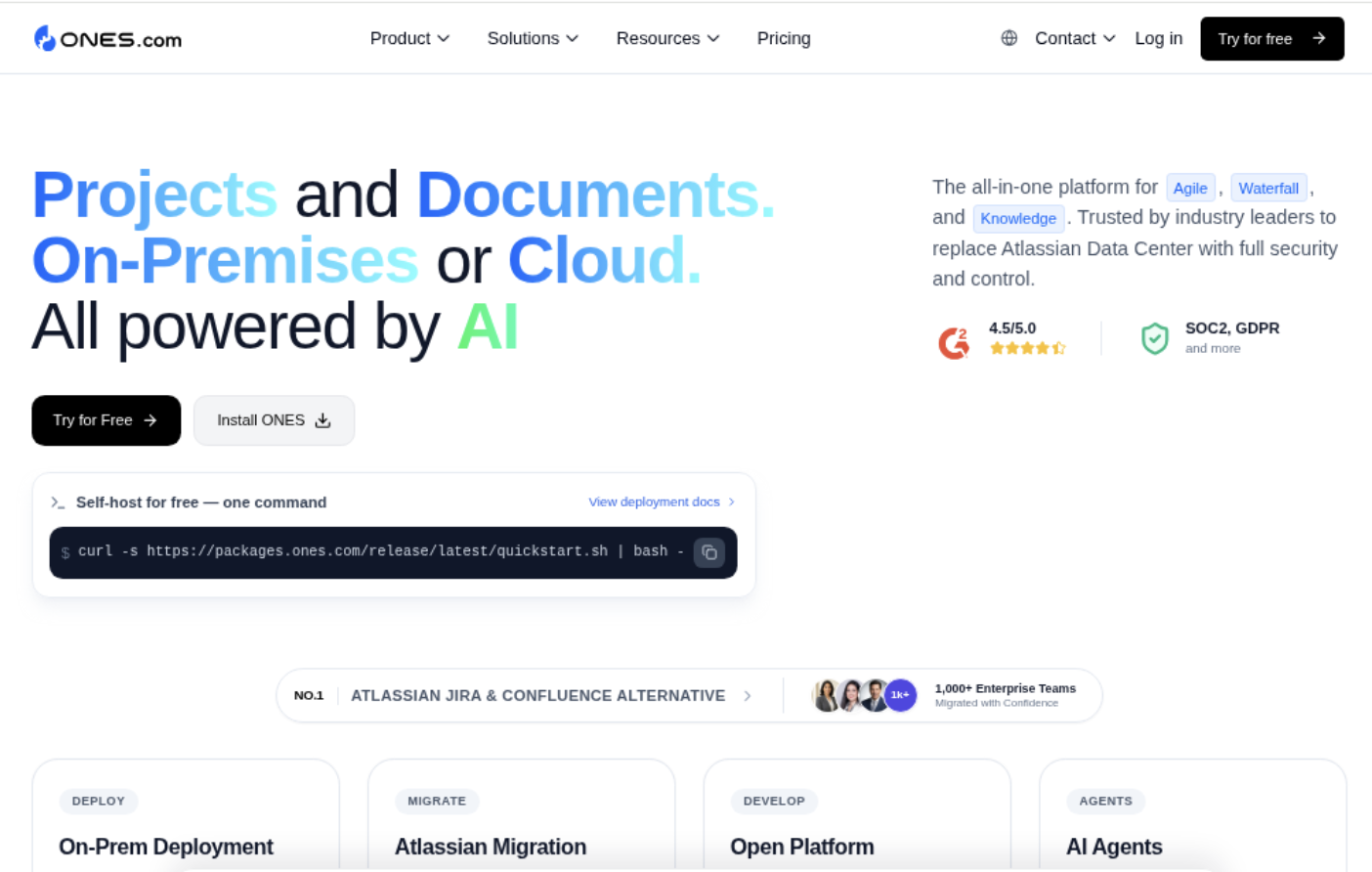
ONES.com combines project management and knowledge management in one platform powered by ONES Assistant. ONES Project is its project-management product and can serve as a Jira alternative for teams that want native capabilities, flexible deployment, and fewer add-ons.
ONES Project and ONES Wiki are sold separately, so you can choose the product that matches your current needs.
Core Capabilities
- Scattered work → Unified project spaces → ONES Project brings tasks, owners, deadlines, and progress into one workspace, making work easier to follow.
- Complex handoffs → Custom workflows → You can adapt statuses and transitions to marketing, operations, HR, or approval-heavy processes without forcing every team into the same model.
- Manual status checking → Built-in reporting → Reports give managers visibility into workload, progress, and delivery patterns without requiring separate tracking systems.
- Rigid task records → Custom fields → Teams can capture details such as request type, department, risk, or service level when those details support decisions.
- Unclear iteration planning → Sprint management → Teams can plan short delivery cycles, assign work, and review completed items during regular planning routines.
- Repeated administrative actions → Automation → Rules can handle assignments, reminders, transitions, and notifications, reducing routine coordination work.
- Plugin-heavy Jira setups → Native feature parity → ONES Project includes Jira-compatible workflows, reporting, custom workflows, custom fields, sprint management, and automation within the platform.
- Deployment restrictions → Four deployment options → You can choose Cloud, On-Premise, Private Cloud, or Air-gapped deployment. The cloud and self-hosted versions maintain full feature parity.
- Separate project and knowledge spaces → ONES.com platform → Teams can pair ONES Project with ONES Wiki when they need connected project work and knowledge management.
- Budget concerns for small teams → Free access for up to 30 seats → A new team can evaluate the platform without paying for the first 30 seats.
Application Scenarios
Marketing operations: A marketing team can manage campaign requests, creative tasks, approvals, launch dates, and performance follow-ups in ONES Project. Custom fields can distinguish campaign type, channel, requester, and priority.
Restricted-network project teams: An organization that cannot place project work in a public cloud can choose On-Premise, Private Cloud, or Air-gapped deployment while retaining the same core capabilities.
Cross-functional operations: Operations, HR, and finance teams can create separate work areas with tailored workflows, then use shared reporting to review deadlines and workload across departments.
Common Challenges When Adopting Jira Work Management
Challenge: The team does not know what belongs in Jira
Solution: Define a simple intake rule. Put work in Jira when it has an owner, an expected outcome, a deadline, or a handoff that others need to see.
Challenge: People continue using private task lists
Solution: Explain what the shared workspace provides: visible ownership, reliable reminders, progress history, and a common planning view. Start with one important workflow rather than asking people to move everything immediately.
Challenge: The board becomes a list of abandoned tasks
Solution: Add a weekly cleanup routine. Close finished work, reassign neglected issues, remove duplicates, and ask whether old requests still matter.
Challenge: Reports do not match reality
Solution: Check whether people update statuses consistently. A sophisticated report cannot correct missing owners, outdated due dates, or unclear completion criteria.
Challenge: Managers request more detail than the team can maintain
Solution: Agree on a small reporting contract. Decide which fields must stay current and which questions the reports should answer. Avoid collecting information without a clear use.
FAQs
Is Jira Work Management suitable for non-technical teams?
Yes. It can support marketing, HR, finance, operations, legal, and other business teams. The main requirement is a clear workflow. A new team should use plain issue names, a short status list, and fields that reflect real decisions. You do not need software-development terminology to manage requests, approvals, campaigns, or recurring operational work.
Should a new team use a board or a list?
Choose a board when the team needs to see work moving through stages. Choose a list when people need to sort, edit, and review many details quickly. Many teams use both: the board for daily coordination and the list for planning. Add a calendar when deadlines are central, such as events, publishing schedules, or employee onboarding.
How many statuses should a beginner workflow have?
Start with four to six meaningful statuses. A practical example is To do, In progress, In review, Blocked, and Done. Add another status only when it improves ownership, reporting, or the next action. If people cannot explain what separates two statuses, combine them until the distinction becomes useful.
What is the difference between a project and an issue?
A project is the workspace that organizes a team or area of work. An issue is one specific task, request, approval, or milestone inside that workspace. For example, “People Operations” could be a project, while “Prepare the new-hire orientation schedule” could be an issue. Projects provide structure; issues represent actionable work.
How often should a team improve its Jira setup?
Review the setup after the first real work cycle, then hold a monthly improvement check. Look for repeated confusion, stale issues, missing fields, and reports nobody uses. Avoid changing several major elements at once. Small, measured adjustments make it easier to tell whether the workflow is becoming clearer or simply more complicated.
Conclusion
A successful Jira Work Management setup begins with a clear purpose, a small project structure, a practical workflow, and visible ownership. Start with the work your team handles most often, then improve the system after people use it in real conditions.
But here's the truth: a platform cannot fix unclear priorities or missing decisions on its own. It can make those problems visible, give you a shared operating rhythm, and reduce repetitive coordination when the process is designed well.
If Jira’s flexibility becomes difficult to manage, compare it with alternatives such as ONES Project. The right choice is the platform that helps your team understand what needs attention, who owns it, and what completion actually means.