Service Collection Pricing: A Practical Guide for Teams
比较 service collection pricing 时,如何避免隐藏费用?本指南教团队计算真实成本、比较套餐并控制预算,立即阅读,做出明智选择。
Service collection pricing can look simple until several teams, channels, and usage limits enter the conversation. A low monthly rate may hide charges for agents, requests, integrations, or premium features.
That uncertainty creates awkward budget meetings, surprise renewals, and difficult comparisons between plans. You may also pay for capacity your team never uses while missing limits that affect daily support work.
But here’s the truth: you can evaluate a service collection plan with a clear pricing method. This guide shows you how to calculate real cost, compare tiers, estimate growth, and choose a plan that fits your operating model.
Service Collection Pricing: A Practical Overview
Service collection pricing is the way a platform charges for a connected set of service management capabilities, such as request handling, incident response, knowledge sharing, automation, reporting, and team collaboration.
The real price usually depends on five factors: the number of agents, the number of people submitting requests, the features you need, the deployment model, and the level of support included.
How the total cost is usually calculated
A useful starting formula is:
Total cost = base subscription + user charges + usage charges + add-ons + implementation costs + support costs
For example, a 10-agent team might pay a modest subscription while serving 2,000 employees. A 100-agent service organization may face a much higher bill, even if both teams use similar workflows.
Here's why: vendors often separate the people who manage requests from the people who submit them. These roles may have different prices or access rules.
Common pricing structures
- Per-agent pricing: You pay for each person who handles service requests.
- Per-user pricing: You pay for every person with access to the platform.
- Request-based pricing: Your bill changes with ticket, case, or request volume.
- Tiered pricing: The price rises when you move into a larger user or usage band.
- Feature-based pricing: Advanced automation, analytics, security, or integrations require a higher plan.
- Deployment-based pricing: Cloud, private hosting, and self-hosted editions may follow different commercial models.
The fastest way to estimate your budget
- Count people who actively manage service requests.
- Separate occasional requesters from full-time agents.
- List essential features and optional features.
- Estimate monthly request volume and storage needs.
- Check integration, automation, and reporting requirements.
- Calculate the annual cost, including onboarding and support.
- Add a growth buffer for new teams, channels, and higher request volume.
The best part? You can often eliminate poor options before requesting a formal quote. A simple cost model exposes missing requirements early.
Which Pricing Factors Matter Most?
Different teams pay for different things. A small internal help desk may care about agent seats, while a customer service organization may focus on request volume, response channels, and service-level reporting.
Agents, requesters, and occasional contributors
Start by identifying each role. An agent may triage, assign, resolve, and report on requests. A requester may only submit an issue or check its status.
Imagine a company with 15 service agents and 3,000 employees. If the platform charges only for agents, the cost may remain predictable. If it charges for every active employee, the calculation changes substantially.
You should also check how occasional contributors are counted. A manager who approves one request each month may still need a paid seat under some pricing models.
Feature limits and usage thresholds
Plan limits can apply to automation rules, reporting, integrations, storage, service portals, or knowledge content. These limits often matter more than the headline subscription price.
For example, a basic plan may support five automation rules. If your process needs approval routing, escalation reminders, reassignment, and closure notifications, you may quickly need a higher tier.
You might be wondering: should you pay for advanced features immediately? Review your next 12 months of operational needs. Paying for unused capabilities can weaken the business case.
Deployment and security requirements
Cloud deployment usually emphasizes recurring subscription costs. Self-hosted or private deployment can introduce infrastructure, maintenance, security review, and upgrade responsibilities.
A regulated organization may accept higher operating effort for greater control. A small team may value simpler administration and predictable updates.
| Pricing consideration |
Questions to ask |
| Users |
Who needs full access, limited access, or request-only access? |
| Usage |
Are charges tied to requests, storage, automation, or integrations? |
| Features |
Which capabilities are included in each plan? |
| Deployment |
Do you need cloud, private hosting, or self-hosted operation? |
| Support |
What response times and onboarding services are included? |
How to Compare Service Collection Plans
Comparing prices line by line can produce the wrong answer. You need to compare the same operating scenario across every plan.
Build a consistent comparison scenario
Use one realistic scenario for each vendor or edition. Include your agent count, requester count, monthly demand, required integrations, automation needs, and security expectations.
For example, compare plans using 25 agents, 1,500 monthly requests, two communication channels, five integrations, and 20 automation rules. This makes differences easier to see.
Let me explain: a plan that looks cheaper at 10 agents may become expensive at 25 agents. Growth changes the result.
Separate included capability from optional extras
Create three categories:
- Required: Capabilities your team needs on the first day.
- Useful: Capabilities that improve efficiency during the next year.
- Optional: Capabilities with limited impact on your current operation.
Then mark whether each capability is included, limited, or sold separately. This prevents a low starting price from hiding essential add-ons.
Compare annual cost instead of monthly price alone
Monthly pricing helps with cash-flow planning. Annual pricing gives you a clearer view of commitment, renewal exposure, and growth cost.
Include setup, migration, training, configuration, custom integration, and internal administration. A plan with a higher subscription may require fewer external services.
For a practical comparison, calculate cost per agent, cost per request, and total annual operating cost. Each measure answers a different business question.
Check how growth changes the bill
Model at least three situations:
- Current state: Your present team size and demand.
- Expected growth: Your likely position after 12 months.
- Stress case: A major team expansion or demand increase.
For example, a request-based plan may suit seasonal support because you pay closer to actual demand. A seat-based plan may offer stronger predictability for a stable internal service team.
Hidden Costs That Can Change the Decision
The subscription is only one part of the financial picture. Service management platforms affect staffing, administration, integration work, and process design.
Implementation and migration effort
Someone must configure categories, queues, approval paths, service levels, notifications, roles, and reporting. Existing knowledge content and historical request information may also need careful preparation.
A simple rollout may take days. A multi-department rollout with different approval rules can take several months.
Integration and administration
Connectors for identity management, email, chat, monitoring, customer relationship systems, or asset tracking may carry separate charges.
Administration also has an ongoing cost. A platform that needs weekly maintenance may require more internal time than a simpler alternative.
Training and adoption
Support agents need training on queues, escalation, templates, and reporting. Requesters need clear guidance on where to ask for help.
Poor adoption increases duplicate requests and manual follow-up. A more intuitive platform may produce savings that do not appear in the subscription quote.
Renewal and expansion risk
Ask how renewal pricing works, whether discounts expire, and what happens when you add agents or premium capabilities.
Review contract terms before implementation. A low first-year price may become difficult to defend if your operating model depends on a higher tier later.
Choosing the Right Pricing Model for Your Team
The right structure depends on how your service operation behaves. There is no single pricing model that fits every organization.
Choose predictable pricing when demand is stable
A seat-based plan may work well when your agent count and service volume remain steady. You can forecast cost with reasonable confidence.
This approach suits an internal IT team with 20 agents and a consistent employee population.
Choose usage-linked pricing when demand fluctuates
Request-based pricing may fit a seasonal operation. A university help desk, for example, may receive far more requests during enrollment than during the summer.
Review the vendor’s measurement method carefully. Clarify whether reopened requests, automated events, or messages from multiple channels count separately.
Choose flexible access when many people need occasional involvement
Some teams need broad participation from managers, specialists, and business owners. A flexible role structure can reduce the cost of giving occasional contributors a narrow set of permissions.
Check whether those roles can approve, comment, view reports, or manage knowledge content without requiring a full agent license.
Use a weighted decision score
Price should receive a meaningful weight, perhaps 30 percent. Assign the remaining weight to capability, security, usability, scalability, integration, and administration.
Score each plan from one to five. A slightly more expensive plan may win if it reduces manual work and avoids several add-ons.
Service Collection Solution: ONES.com
Value Proposition
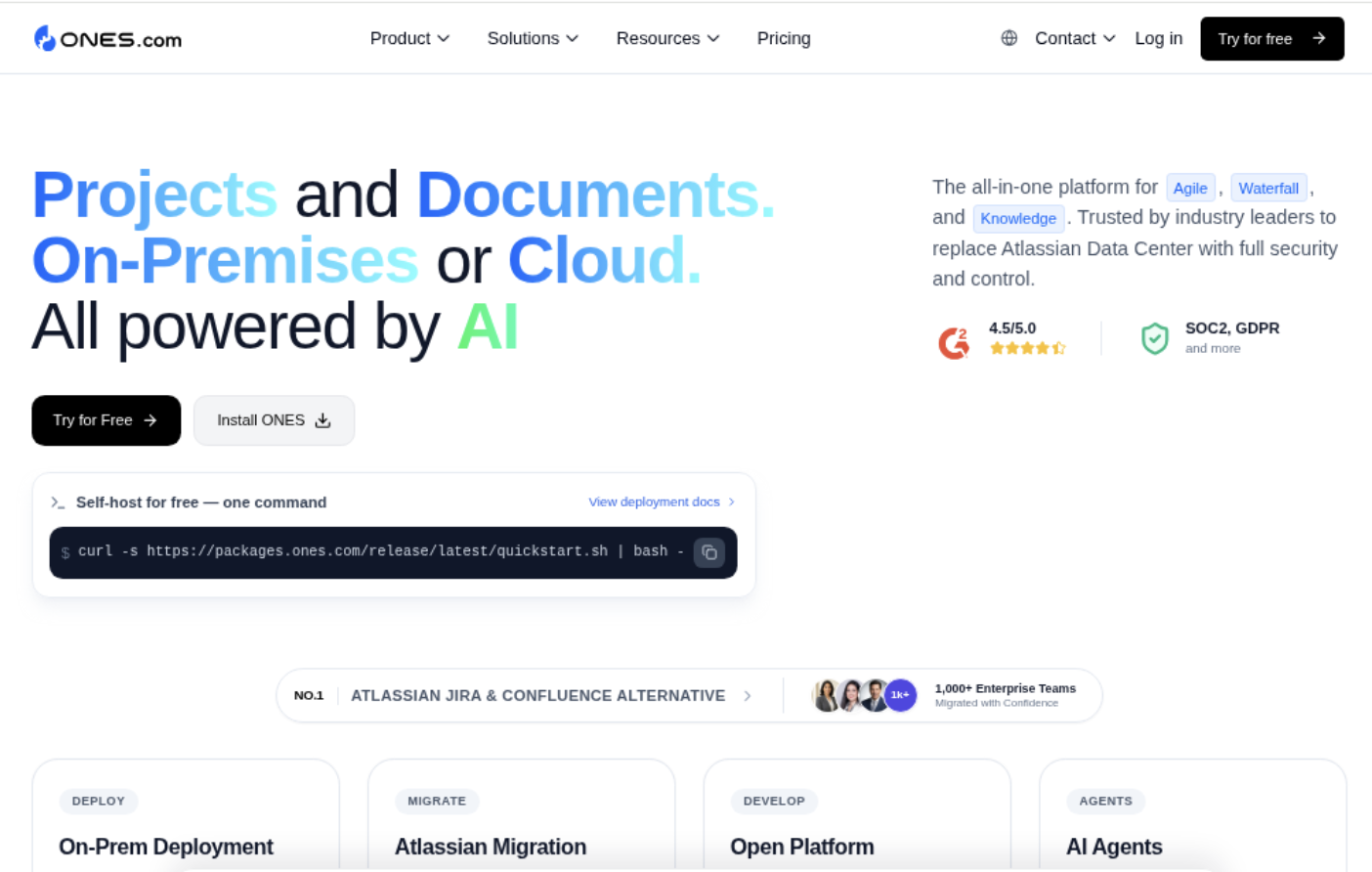
ONES.com is a unified platform for project management and knowledge management, powered by AI through ONES Assistant. It can support service-related workflows when teams need structured work tracking and shared knowledge in one environment.
ONES Project is the project management product and a Jira alternative. ONES Wiki is the knowledge management product and a Confluence alternative. They are sold separately.
Core Capabilities
- Fragmented service work → ONES Project work management: Jira-compatible workflows help teams organize requests, ownership, statuses, and delivery activity in a familiar structure.
- Manual progress tracking → Built-in reporting: Reporting gives managers visibility into workload, status, and team progress without assembling separate summaries.
- Rigid processes → Custom workflows and fields: Teams can adapt request paths, classifications, and properties to fit different service groups.
- Unclear iteration planning → Sprint management: Sprint capabilities help teams group service improvements, recurring work, and operational priorities.
- Repetitive administration → Automation: Automation can support routing, notifications, status changes, and other repeatable actions.
- Scattered team knowledge → ONES Wiki: A connected knowledge environment can help teams maintain procedures, service guidance, and internal explanations.
- Too many extensions → Native feature parity: A broad native capability set can reduce dependence on multiple plugins for common project and knowledge workflows.
- Restricted hosting requirements → Deployment choice: ONES.com supports Cloud, On-Premise, Private Cloud, and Air-gapped deployments.
- Uneven experience across hosting models → Full feature parity: The self-hosted version is designed to provide feature parity with the cloud version.
- Early-stage budget pressure → Free access: ONES.com offers a free option for up to 30 seats, giving smaller teams a way to evaluate the platform before wider adoption.
Application Scenarios
Internal IT service coordination: An IT team can use ONES Project to manage incoming work, route tasks to specialists, plan improvements in sprints, and report on open workload. ONES Wiki can hold troubleshooting guidance and service procedures.
Restricted-network operations: A team with air-gapped requirements can consider the air-gapped deployment option. This supports operational control where cloud access is unsuitable.
Cross-functional service delivery: A service group can combine custom workflows, reporting, automation, and knowledge management. For example, a facilities team could coordinate requests while maintaining internal procedures in ONES Wiki.
Common Challenges With Service Collection Pricing
Challenge: The advertised price does not match the expected bill
Solution: Request a scenario-based estimate using your agent count, requester count, usage volume, integrations, and deployment needs. Ask for recurring and one-time costs separately.
Challenge: You cannot tell which users require paid access
Solution: Map every role to required actions. Someone who only submits a request should not automatically be classified like someone who manages queues and reporting.
Challenge: Premium features appear late in the evaluation
Solution: Create a feature checklist before comparing plans. Mark automation, reporting, security controls, integrations, and knowledge capabilities as required or optional.
Challenge: Growth creates an unexpected pricing jump
Solution: Calculate costs at current, expected, and stress-case volumes. Review every pricing threshold and estimate the next tier before signing.
Challenge: The cheapest plan creates more administrative work
Solution: Estimate internal hours for maintenance, reporting, training, integration upkeep, and process changes. Add those hours to the total cost model.
FAQs
What does service collection pricing usually include?
It usually covers access to service management capabilities, such as request handling, workflows, reporting, automation, and collaboration. The exact package varies by provider. Check whether agent access, requester access, integrations, storage, support, and advanced security are included. A headline price rarely explains every cost driver.
Should I compare pricing by agent or by total employee count?
Compare both when possible. Agent-based pricing can be easier to forecast for internal service teams. Employee-based pricing may become expensive when many people only submit occasional requests. Also check how occasional approvers, managers, and specialists are classified. Their access rules can materially change your annual estimate.
How can I calculate the real annual cost?
Add the recurring subscription, user charges, usage charges, add-ons, implementation, migration, training, integration, administration, and support. Then model expected growth. A three-year view can reveal whether a plan remains affordable after discounts expire or your team moves into a larger tier.
Are cloud and self-hosted pricing models comparable?
They can be compared, but you need to include operating responsibilities. Cloud pricing may include hosting and routine platform maintenance. Self-hosted operation may provide greater control while requiring infrastructure, upgrades, monitoring, and internal technical effort. Compare total ownership cost rather than subscription price alone.
When should a team request a custom quote?
Request one when you have complex deployment requirements, a large user population, multiple service groups, high request volume, strict security needs, or several integrations. Give the provider a clear operating scenario. A precise scenario produces a more useful estimate than a general request for “best pricing.”
Can a project management platform support service operations?
Yes, when the platform supports structured workflows, custom fields, assignment, automation, reporting, and knowledge sharing. It may suit service teams that manage operational work alongside projects. Before choosing this approach, confirm that the platform handles intake, prioritization, escalation, permissions, and service reporting in a practical way.
Conclusion
Service collection pricing becomes easier to evaluate when you look beyond the advertised subscription. Count each role, review usage limits, separate required features from optional ones, and calculate annual cost across several growth scenarios.
But here's the truth: the lowest starting price may not create the lowest operating cost. Administration, integrations, adoption, deployment, and future expansion can change the result.
Start with a realistic service scenario, compare plans consistently, and test the financial impact of growth. Platforms such as ONES.com may fit teams that want connected project workflows and knowledge management, with deployment options that support different operating requirements.