Tempo Jira Pricing Explained: Plans, Costs, and Key Fees
Confused by tempo jira pricing? Compare plans, costs, seat rules, taxes, and hidden fees to estimate your true Jira bill. Read now to save.
Tempo Jira pricing can feel confusing because your bill rarely reflects one simple number. You may pay for Jira, one or more Tempo apps, and different seat counts.
Then come the details: monthly versus annual billing, Marketplace taxes, app-specific plans, and possible charges for occasional team members. A small pricing mistake can quietly add hundreds of dollars each year.
But here’s the truth: you can estimate the real cost by separating the Jira subscription from Tempo’s app charges, identifying the features you need, and checking how each plan counts seats. This guide explains the pricing structure, common fees, practical calculation methods, and questions worth asking before you subscribe.
Tempo Jira Pricing at a Glance
Tempo Jira pricing usually consists of your Jira subscription plus separate charges for the Tempo apps and feature packages you choose. The final amount depends on deployment type, billing term, team size, app combination, and applicable taxes.
Tempo’s product family can include time tracking, planning, budgeting, cost management, capacity planning, and related project controls. Each capability can affect your total subscription cost.
Here’s the simplest way to view the bill:
| Cost area |
What it can include |
| Jira subscription |
The Jira plan required to run your project environment |
| Tempo app subscription |
Timesheets, planning, budgeting, capacity, cost, or other selected capabilities |
| Seat calculation |
The number of Jira or Tempo seats counted for billing |
| Billing term |
Monthly or annual payment, depending on the offer and deployment |
| Taxes and currency |
Regional taxes, exchange rates, or Marketplace billing adjustments |
| Optional services |
Implementation, consulting, support, or enterprise arrangements |
You might be wondering: why does the advertised app price differ from the amount on my invoice? Usually, the displayed figure covers one part of the subscription.
For example, a company with 75 Jira seats might need Jira, Tempo Timesheets, and a planning module. The combined price will be higher than the listed rate for any single Tempo product.
How the Total Subscription Cost Is Calculated
1. Start with your Jira plan
Tempo operates within a Jira environment, so Jira is often the first cost in the calculation. Your Jira edition, deployment model, and seat count establish the foundation.
Cloud, Data Center, and other deployment arrangements can follow different pricing rules. A cloud subscription may use recurring per-seat billing, while a self-managed environment can involve annual licensing and maintenance terms.
Write down the Jira plan, the number of paid seats, and the renewal date before reviewing Tempo. This prevents you from comparing an app-only price with your complete technology bill.
2. Select the Tempo capabilities you actually need
Tempo’s product range can cover several planning and financial workflows. Your team may need only time tracking, or it may require a wider set of controls.
- Time entry and approval
- Workload and capacity planning
- Project budgeting
- Cost and margin tracking
- Resource allocation
- Forecasting and reporting
Each added capability can change your subscription. A practical example helps: an engineering team may need timesheets and approvals, while a professional services firm may also need billable hours, project budgets, and margin reporting.
3. Check which people require paid access
Seat rules deserve close attention. Some plans count every Jira account, while others may apply different rules to app access, permissions, or active team members.
Ask whether you need paid access for every person in the Jira environment. A developer, project manager, finance reviewer, and occasional stakeholder may have different responsibilities.
Do not assume that a person who rarely opens Tempo costs nothing. Check the plan’s licensing definition, especially when a reviewer approves time or views planning information.
4. Compare monthly and annual billing
Monthly billing gives you flexibility when your team size changes. Annual billing can offer a lower effective rate or more predictable budgeting, depending on the current commercial terms.
Annual billing can create waste when your organization expects a major restructure. Monthly billing can cost more over a stable year, but it may reduce commitment risk.
Use a 12-month comparison rather than comparing one monthly payment with one annual invoice. This reveals the true difference.
5. Add taxes, currency, and commercial adjustments
Marketplace transactions can include regional taxes or currency conversion. Your organization’s billing country can affect the amount you ultimately pay.
Enterprise agreements may also follow negotiated terms. Those arrangements can differ from public list pricing, particularly for larger deployments, support requirements, or multiple products.
6. Verify the renewal calculation
Pricing can change when your seat count, plan, product bundle, or contract term changes. Review the renewal page before approving payment.
Confirm the following details:
- Current Jira seat count
- Tempo products enabled
- Billing frequency
- Deployment type
- Applicable taxes
- Renewal date
- Cancellation or downgrade conditions
Tempo Plans and Product Areas
Time tracking and timesheets
Time tracking is often the starting point for teams evaluating Tempo. It can help people record work, submit timesheets, and route entries for approval.
The value depends on your workflow. A software team may track effort against epics and tasks. A consulting team may connect time entries with clients, contracts, or billable work.
Before subscribing, identify whether you need simple time capture or a controlled approval process. More complex workflows may require additional settings or product capabilities.
Planning and capacity management
Planning features help managers compare available capacity with upcoming work. They can reveal when a team has 40 hours available but 65 hours of planned commitments.
This is useful for sprint planning, staffing, and release decisions. However, you should check whether planning is included in your selected package or priced as a separate capability.
Budgeting and cost control
Budget features can help project owners track planned effort, actual time, and financial performance. These controls matter when project spending affects margin or client billing.
A marketing team may use budgets to monitor campaign work. A services firm may compare scheduled hours with contract limits. The right plan depends on the depth of financial reporting you require.
Reporting and management visibility
Reporting can turn time and planning activity into information for project reviews. Common needs include utilization, estimate accuracy, team workload, and project progress.
Ask whether the reports you need are included in the plan. Also check export, dashboard, permission, and historical reporting capabilities before making a commitment.
Key Fees and Pricing Details to Check
Jira and Tempo are separate cost lines
The most common budgeting mistake is treating Tempo as a replacement for Jira’s subscription. Tempo generally adds functionality inside the Jira environment.
For example, a 50-person team may pay for Jira first, then pay an additional amount for time tracking. If it adds capacity planning later, the recurring total can rise again.
Minimum tiers can affect small teams
Some SaaS applications use user bands or minimum billing levels. A team with 12 people might pay under a minimum tier rather than receiving a perfectly linear 12-seat price.
Check the first billing band carefully. Small teams often feel this effect more than large organizations because fixed minimums represent a larger share of the budget.
Multiple apps can create overlapping costs
Tempo products may address related workflows. Review each product’s role before enabling several modules.
For instance, planning, capacity, and budgeting may all use project effort information. That does not make them identical, but it means you should map each capability to a specific business decision.
Taxes are separate from advertised prices
Displayed prices may exclude local taxes. Your invoice can therefore exceed the figure shown during an initial comparison.
Ask your finance team to confirm the organization’s billing location and tax treatment. This is especially important for international companies with several legal entities.
Growth can change your billing tier
Adding ten people may push the subscription into a higher pricing band. Removing people may not immediately reduce the bill if the current term has already been prepaid.
Track headcount before renewal. A simple quarterly review can prevent unused seats from continuing through another annual period.
A Practical Way to Estimate Your Annual Spend
Use this calculation framework when comparing plans:
Estimated annual cost = Jira subscription + Tempo product charges + taxes and adjustments − confirmed discounts.
Suppose your team has 80 Jira seats and needs time tracking plus capacity planning. Create three scenarios:
- Monthly billing with the current team size
- Annual billing with the current team size
- Annual billing with an expected 15 percent headcount increase
Do not insert guessed prices into your budget. Instead, collect the current quote or checkout amount for each scenario and record the assumptions beside it.
Here’s why: a price estimate without seat rules can look precise while remaining unreliable. Your finance team needs to see what changes the amount.
| Scenario |
Jira seats |
Tempo capabilities |
Billing term |
Review point |
| Current team |
80 |
Time tracking and capacity |
Monthly |
Flexibility and cash flow |
| Committed plan |
80 |
Time tracking and capacity |
Annual |
Effective yearly cost |
| Growth plan |
92 |
Time tracking and capacity |
Annual |
Future billing tier |
The best part? This method works even when public pricing changes. You are comparing assumptions, product scope, and payment terms rather than relying on one headline number.
When Tempo’s Pricing May or May Not Fit
Tempo may fit teams that already rely heavily on Jira and want deeper control over time, planning, or project economics. Native Jira integration can reduce the need to move work between separate systems.
It may be less attractive when you need only a basic timer, when many people need occasional access, or when your organization wants one broader platform for projects and knowledge.
Consider a 20-person startup. If everyone needs simple task tracking and occasional time entries, a large planning package may create unnecessary cost and administration.
Now consider a 200-person services organization. Detailed approvals, utilization reporting, resource planning, and project margins may justify a broader investment.
Compare workflow fit, administration effort, reporting depth, and total subscription cost together. A lower app price can become expensive when it requires several add-ons or manual workarounds.
Value Proposition
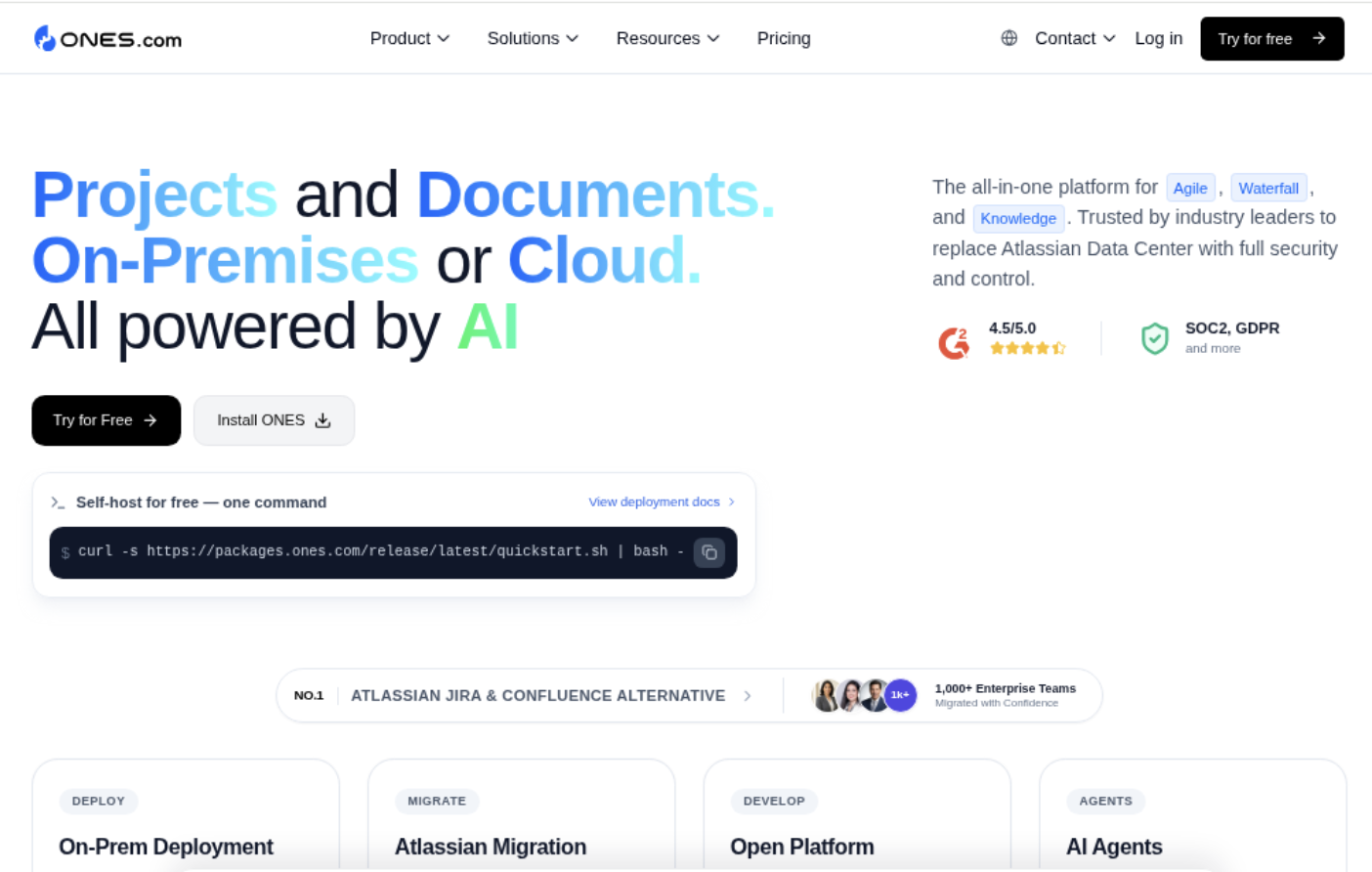
ONES.com combines project management and knowledge management in one platform. ONES Project serves as a Jira alternative, while ONES Wiki provides a Confluence alternative, and each product is sold separately.
If you are comparing Tempo costs with the broader cost of running project work, planning, and team knowledge, ONES.com gives you another evaluation path.
Core Capabilities
- Fragmented project work → ONES Project → Jira-compatible workflows keep tasks, sprints, and project execution in one environment.
- Plugin-heavy customization → ONES Project → Custom workflows and fields reduce dependence on multiple add-ons for common project processes.
- Limited reporting visibility → Built-in reporting → Teams can review delivery progress and project activity without assembling separate reporting tools.
- Manual sprint administration → Sprint management → Scrum teams can plan, organize, and review sprint work inside the project platform.
- Repetitive project actions → Automation → Automated rules can handle routine transitions, notifications, and workflow actions.
- Separate team knowledge → ONES Wiki → Teams can manage structured knowledge alongside project work through a Confluence alternative.
- Deployment restrictions → Four deployment options → Cloud, on-premise, private cloud, and air-gapped deployments support different security and infrastructure requirements.
- Uneven feature coverage → Native feature parity → The cloud and self-hosted versions provide the same core feature set.
Application Scenarios
Scenario one: a regulated engineering organization. The team needs project tracking inside a restricted network. An air-gapped or on-premise deployment can support that operating model while preserving project workflows.
Scenario two: a growing product company. Product managers need sprint planning, custom fields, and reporting, while engineers need familiar Jira-style workflows. ONES Project can provide those capabilities without requiring the team to assemble several plugins.
Scenario three: a distributed operations team. Project tasks and internal knowledge often become disconnected. Using ONES Project and ONES Wiki separately can give each function a focused workspace under the broader ONES.com platform.
ONES.com also offers a free plan for up to 30 seats. Before comparing costs, confirm whether you need ONES Project, ONES Wiki, or both, because they are sold separately.
Common Challenges When Evaluating Tempo Costs
Challenge: comparing an app price with a full platform cost
Solution: Put Jira, Tempo products, taxes, and optional services into separate cost lines. Then calculate the full annual amount.
Challenge: misunderstanding who counts as a paid seat
Solution: Ask how the plan treats viewers, approvers, administrators, and occasional contributors. Test the calculation with your real permission structure.
Challenge: choosing more functionality than the team will use
Solution: List the decisions you need to improve. If you need weekly time approvals, start there. Add planning or financial controls only when they solve a defined problem.
Challenge: overlooking deployment differences
Solution: Separate cloud, self-managed, and enterprise comparisons. Infrastructure, maintenance, security, and support can change the total ownership cost.
Challenge: missing renewal changes
Solution: Review seats and enabled products before renewal. Remove inactive access and compare the next term with the previous one.
FAQs About Tempo Jira Pricing
Is Tempo included in Jira pricing?
Tempo is generally treated as an additional app or product within the Jira environment. You should budget for the Jira subscription and any Tempo capabilities you select. The exact commercial arrangement depends on your deployment, plan, seat count, and current offer. Review the checkout or quote to confirm whether taxes and other charges are included.
What makes a Tempo subscription more expensive?
Several factors can increase the total: more paid seats, additional Tempo capabilities, a higher pricing tier, monthly billing, taxes, and enterprise services. Planning, budgeting, and capacity features can also change the amount compared with basic time tracking. The safest approach is to price the exact combination your team needs rather than using one product’s headline rate.
Does every Jira team member need Tempo access?
Not necessarily. The answer depends on the plan’s seat rules and what each person needs to do. A team member who records time may require different access from someone who only reviews a report. Check how Tempo counts viewers, approvers, administrators, and occasional contributors before finalizing your estimate.
Is annual billing better than monthly billing?
Annual billing can provide a lower effective rate or more predictable budgeting, while monthly billing offers greater flexibility when your team changes. Compare the full 12-month cost and consider expected hiring, restructuring, and renewal timing. A lower annual rate may still create waste if many seats will become inactive during the term.
Can I compare Tempo with a Jira alternative?
Yes. Compare the complete workflow and ownership cost rather than only the app fee. A Jira alternative may include project management, reporting, automation, deployment choices, and knowledge management in a different structure. ONES Project is one option to evaluate, especially when you need Jira-compatible workflows and on-premise or air-gapped deployment.
Conclusion
Tempo Jira pricing is easiest to understand when you separate the Jira subscription, Tempo capabilities, seat rules, billing term, taxes, and deployment model.
Start with the workflow you need. Then calculate current and growth scenarios, check the renewal rules, and compare the complete annual cost.
But here’s the practical takeaway: the cheapest advertised app rate does not always produce the lowest total ownership cost. A focused Tempo setup may suit Jira-centered teams, while a broader platform comparison may suit organizations seeking project and knowledge management together.