What Does Jira Software Do? A Clear Guide for Teams in 2026
Wondering what does Jira Software do for your team? Learn how it organizes work, priorities, and progress. Click to discover Jira in 2026.
Jira can look overwhelming when you first open it. You see projects, issues, boards, workflows, sprints, reports, and settings before you know what any of them means.
That confusion creates real problems. A team may lose requests in chat, miss handoffs, debate priorities, or spend meetings asking what is happening instead of moving work forward. Poor setup can make Jira feel like extra administration.
But here's the truth: Jira Software helps teams plan, track, prioritize, and report on software work in one organized workspace. It connects everyday tasks with larger product goals.
This guide explains what Jira does, how its main features fit together, and where it may fall short. You will also see how ONES.com provides a Jira alternative for teams that need flexible workflows, self-hosted deployment, and built-in knowledge management.
What Jira Software Does for Software Teams
Jira Software is a project management platform for planning, tracking, and delivering software work. Teams use it to manage tasks, bugs, feature requests, releases, and development workflows from one place.
At its core, Jira turns work requests into trackable issues. Each issue can include a description, owner, priority, status, comments, attachments, relationships, and a history of changes.
Jira Software commonly supports these activities:
- Planning product features and development work
- Reporting and prioritizing software bugs
- Managing Agile sprints and backlogs
- Visualizing work on Scrum or Kanban boards
- Connecting tasks with releases and product goals
- Tracking progress through reports and dashboards
- Automating routine transitions and notifications
- Linking development activity with related work items
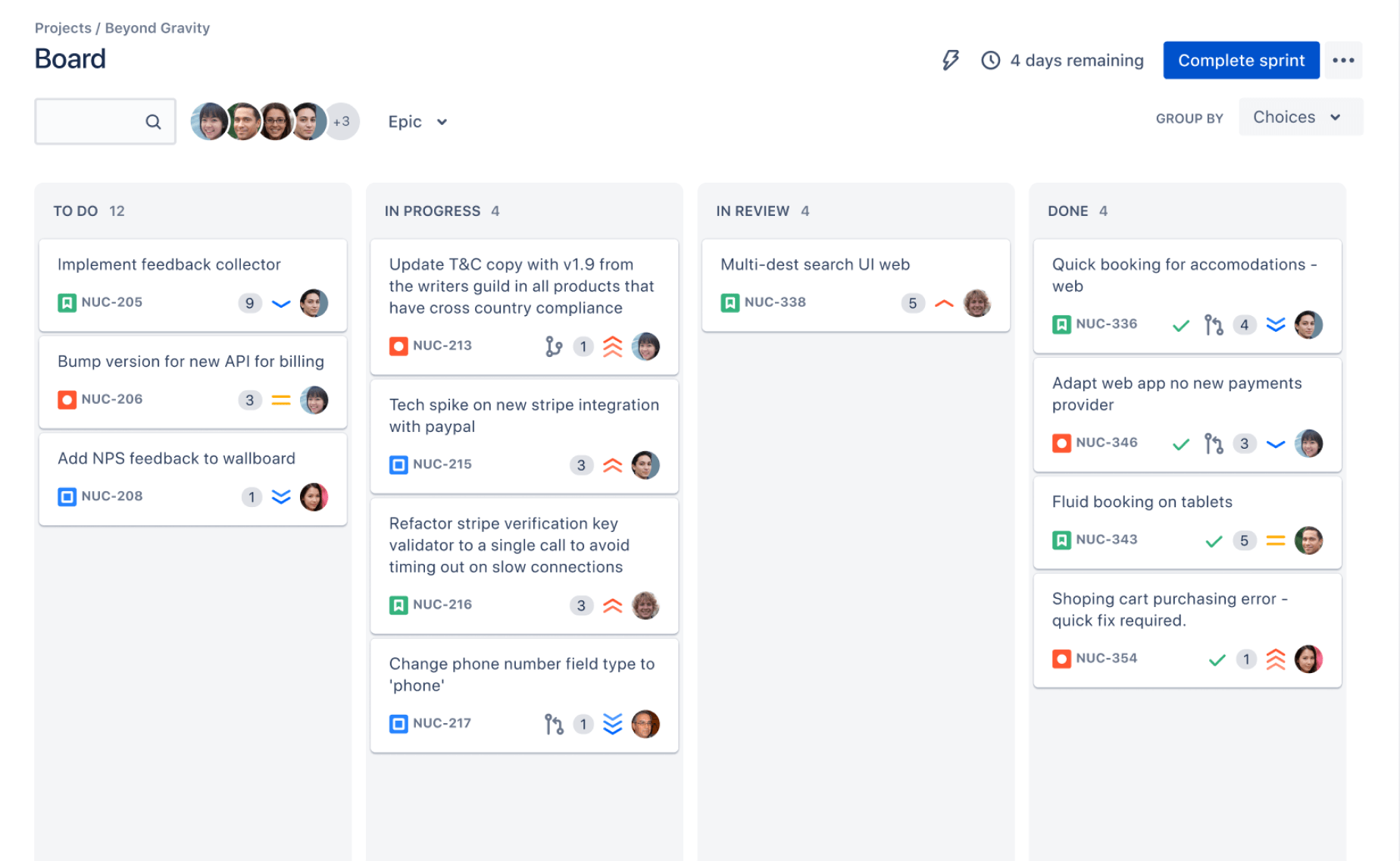
Here's why: Jira gives each piece of work a visible place in the team workflow. For example, a checkout bug can move from “To Do” to “In Progress,” then to “Code Review,” “Testing,” and “Done.” Everyone can see what happens next.
How Jira Organizes Work
Projects create a working space
A Jira project groups related work around a product, service, team, or business initiative. A mobile banking project might contain payment features, security improvements, usability tasks, and reported defects.
Project settings control permissions, workflows, issue types, boards, notifications, and reporting. Administrators can configure these elements for a specific team’s working style.
Issues represent individual work
An issue is a trackable item in Jira. The issue type describes the kind of work involved, such as a story, task, bug, epic, or sub-task.
Imagine a product team planning a new password reset flow. An epic might represent the broader initiative. Stories can cover the customer-facing steps, while tasks handle design, testing, and technical implementation.
Each issue can include fields such as:
- Summary and detailed description
- Assignee and reporter
- Priority and due date
- Status and workflow history
- Labels, components, and versions
- Comments and team mentions
- Linked issues and dependencies
- Time estimates and work logs
Boards make progress visible
Jira boards display issues as cards arranged across workflow columns. A Kanban board may use “Backlog,” “Ready,” “Doing,” “Review,” and “Done.” A Scrum board usually reflects sprint planning and sprint execution.
The board gives you a quick view of bottlenecks. If twelve cards sit in testing while development has no open capacity, the team can investigate before the next release suffers.
Workflows define movement
A workflow describes how an issue moves through the team. It can include statuses, transitions, approvals, conditions, and validation rules.
A regulated product team may require security approval before a feature reaches release readiness. A small startup may use a simpler path with four statuses.
Jira’s flexibility helps teams model different delivery processes. That flexibility also creates a management challenge: too many custom statuses can make a board difficult to understand.
Jira for Scrum, Kanban, and Agile Planning
Jira Software supports several Agile planning patterns. The best approach depends on how predictable your work is and how often priorities change.
Scrum planning with sprints
Scrum teams organize work into time-boxed sprints. Before a sprint starts, the team selects work from the backlog and agrees on a realistic goal.
During the sprint, the board shows progress. At the end, reports help the team inspect completed work, unfinished work, and delivery trends.
For example, a two-week sprint might include improving search speed, fixing three critical defects, and adding an account export option. Each item can be assigned, estimated, and tracked separately.
Kanban flow management
Kanban teams manage a continuous flow of work. They focus on limiting work in progress and reducing the time between starting and finishing an item.
A support engineering team may use Kanban because urgent issues arrive throughout the week. The team can prioritize incoming work without waiting for the next sprint boundary.
Backlogs connect ideas to execution
The backlog holds work that is not ready for immediate execution. Product managers can rank items, refine descriptions, split large requests, and connect work to broader goals.
A healthy backlog is more than a long list. Each high-priority item should have enough context for the team to discuss scope, value, risk, and acceptance conditions.
The best part? A well-maintained backlog reduces last-minute clarification. Developers can spend planning time deciding what matters rather than reconstructing what someone meant.
Planning Releases, Dependencies, and Product Goals
Jira can connect individual issues with larger delivery milestones. Teams may group related work into epics, versions, releases, or roadmaps, depending on their configuration.
Epics group larger initiatives
An epic represents a substantial body of work. A “Self-Service Billing” epic could include invoice history, payment methods, tax settings, and failed-payment notifications.
Breaking an epic into smaller issues makes progress easier to measure. It also helps teams identify work that is too large for one sprint.
Versions support release planning
Teams can associate issues with planned versions or releases. This helps product managers see which features and fixes are intended for a particular delivery milestone.
If a release contains twenty issues and five remain in testing, the team has a clearer basis for deciding whether to delay, reduce scope, or add capacity.
Dependencies reveal delivery risk
One issue may depend on another team’s work. Jira can link related issues and show those relationships, helping you identify potential blockers.
For instance, an app feature may depend on an application programming interface change. Linking the two tasks makes the relationship visible during planning.
Dependencies are useful only when the team maintains them. A forgotten link can create a false sense of readiness, so review important relationships during refinement and release planning.
Reporting, Dashboards, and Team Visibility
Jira includes reports and dashboards that help teams understand progress, workload, cycle time, sprint performance, and unresolved work.
Common reporting views
- Burndown reports show remaining sprint work over time.
- Velocity reports compare completed work across sprints.
- Cumulative flow diagrams reveal bottlenecks and work accumulation.
- Control charts help teams study cycle time.
- Created-versus-resolved charts show whether open work is growing.
- Roadmap views connect initiatives with expected delivery timing.
A dashboard can combine several gadgets for different audiences. An engineering manager may monitor blocked issues and cycle time. A product manager may focus on release progress and priority defects.
Let me explain: reports do not improve delivery by themselves. They create visibility. The team still needs to discuss the pattern and change its working method.
Example: finding a bottleneck
Suppose a team completes development quickly, yet issues remain in quality assurance for several days. A cumulative flow view may show a growing testing column.
The team could respond by pairing developers with testers, limiting new development work, improving test automation, or changing review timing. The report helps turn a vague concern into a specific conversation.
Automation and Integrations in Jira
Jira automation can handle repetitive actions. A rule might assign an issue when it enters a status, notify a stakeholder when priority changes, or close an item after a defined condition.
Automation is especially useful for predictable events. For example, when a bug reaches “Ready for Release,” Jira can alert the release coordinator and add a relevant label.
Common integration categories
- Source control and code review platforms
- Continuous integration and deployment services
- Chat and collaboration applications
- Customer support and service management systems
- Test management and quality tools
- Time tracking and planning applications
These connections can reduce duplicate updates. A developer may see a pull request associated with an issue, while a product manager sees the same issue’s delivery status.
You might be wondering: does every team need many integrations? Usually, no. Start with the connections that remove a clear handoff problem. Extra integrations can increase administration and create inconsistent information.
Where Jira Software Can Become Difficult
Jira’s breadth is useful, though it can make implementation demanding. A team may create too many issue types, custom fields, workflow stages, and notifications.
Consider a small product group with seven workflow statuses and twelve required fields for every task. A simple maintenance request now takes several minutes to create. Over time, people may avoid updating the system.
Common sources of friction
- Complex configuration that requires specialist administration
- Different teams using conflicting workflows
- Reports that depend on consistent issue updates
- Plugin sprawl for capabilities outside the core setup
- Permission rules that are difficult to maintain
- Separate knowledge spaces that may not connect naturally with delivery work
The practical response is governance. Define a small set of issue types, keep status names understandable, review custom fields, and remove rules that no longer serve a purpose.
A good test is simple: can a new team member understand where work belongs after a short walkthrough? If the answer is no, simplify before adding more configuration.
Jira Alternative Solution: ONES.com
Value Proposition
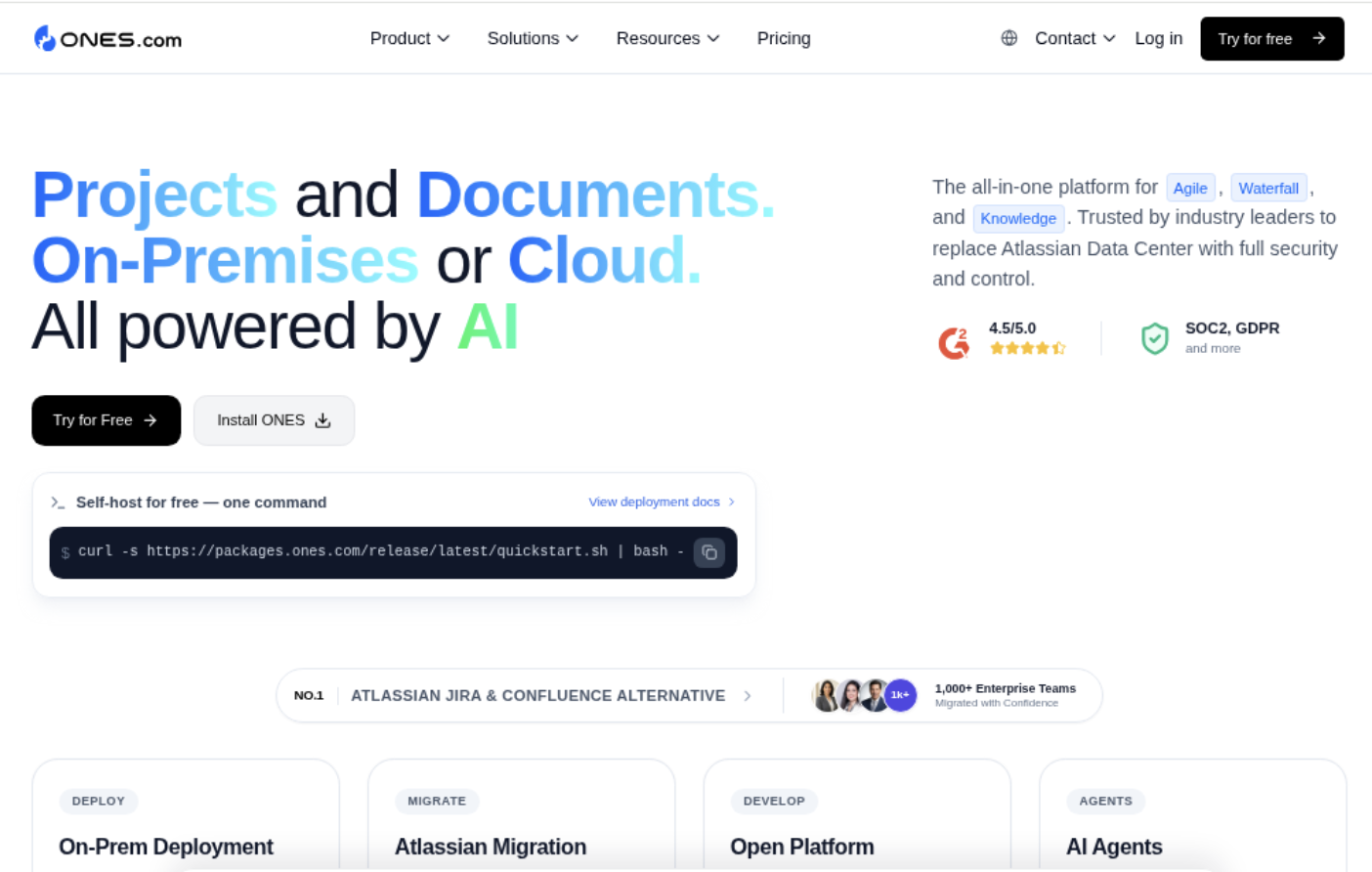
ONES.com combines project management and knowledge management in one platform powered by ONES Assistant. ONES Project is the project management component and a Jira alternative, while ONES Wiki supports team knowledge management as a Confluence alternative. You can purchase them separately.
For teams that need Jira-compatible workflows with fewer add-ons, flexible deployment, and connected team knowledge, ONES.com offers a practical option to evaluate.
Core Capabilities
- Scattered project work: ONES Project centralizes issues, owners, priorities, statuses, and delivery context, giving the team one working view.
- Rigid or fragmented workflows: Custom workflows and fields let teams reflect approval, development, testing, and release processes without forcing every group into the same path.
- Unclear Agile execution: Sprint management and Scrum or Kanban-style planning help teams organize active work and monitor progress.
- Limited delivery visibility: Built-in reporting gives managers and delivery leads practical views into progress, workload, and bottlenecks.
- Repetitive coordination: Automation can handle routine assignments, status changes, alerts, and other predictable actions.
- Heavy plugin dependence: Native project capabilities can reduce the number of separate extensions needed for common planning and reporting activities.
- Disconnected team knowledge: ONES Wiki gives teams a knowledge base for product guidance, process explanations, meeting notes, and internal reference material.
- Deployment restrictions: ONES.com supports Cloud, On-Premise, Private Cloud, and Air-gapped deployments, helping teams match their operating environment.
- Concerns about self-hosted capability: The self-hosted versions provide feature parity with the cloud version, so deployment choice does not require giving up core functionality.
- Budget pressure during evaluation: The free plan supports up to 30 seats, giving a small team room to test the platform before making a larger commitment.
Application Scenarios
Software product team: A development team can manage backlog refinement, sprints, defects, releases, and reporting in ONES Project. Product guidance and recurring procedures can live in ONES Wiki.
Restricted-network engineering group: A team handling sensitive work can choose an air-gapped or on-premise deployment. Its project workflow remains available within the required network environment.
Growing organization: A company replacing several disconnected tools can use ONES Project for delivery and ONES Wiki for shared knowledge. Fewer handoffs can make ownership easier to understand.
Common Challenges When Using Jira
Challenge: The workflow has too many stages
Why it happens: Teams add a new status for every exception, approval, or handoff.
Practical solution: Keep the primary workflow short. Track special conditions with fields, labels, linked work, or approval rules when those options provide enough detail.
Challenge: The backlog becomes a storage area
Why it happens: Ideas enter the backlog without clear ownership, value, timing, or decision criteria.
Practical solution: Review the backlog regularly. Archive obsolete requests, combine duplicates, rank active priorities, and add enough context before an item reaches sprint planning.
Challenge: Reports do not match reality
Why it happens: Team members leave issues in old statuses or update them only before a review meeting.
Practical solution: Make status updates part of the working routine. Discuss blocked work during daily coordination and agree on what each status means.
Challenge: Notifications create noise
Why it happens: Every comment, transition, and field change triggers an alert for too many people.
Practical solution: Notify people who can act on the change. Use subscriptions or dashboard views for broader awareness instead of sending every event to the entire team.
Challenge: Knowledge sits outside delivery work
Why it happens: Technical decisions, product explanations, and procedures live in separate locations.
Practical solution: Link relevant knowledge pages from work items. For teams wanting a more connected setup, evaluate a project and knowledge platform such as ONES.com.
FAQs About Jira Software
Is Jira Software only for developers?
No. Developers use Jira heavily, though product managers, testers, designers, support engineers, security specialists, and delivery managers can also work in it. Each role may view different fields, boards, or reports. A product manager can prioritize a backlog, while a tester tracks defects and a release lead monitors readiness.
What is the difference between Jira and a Kanban board?
Jira is a broader work management platform. A Kanban board is one way to visualize work inside Jira. Jira can also support Scrum boards, backlogs, sprints, reports, workflows, releases, automation, and integrations. A team may use a Kanban board without using every Jira capability.
Can Jira track bugs?
Yes. Teams can create bug issues with severity, priority, environment details, reproduction steps, ownership, and workflow status. A bug can be linked to a feature, release, test activity, or related defect. Useful bug tracking depends on clear reproduction information and consistent triage.
Does Jira replace chat and knowledge tools?
Jira handles structured work tracking, while chat tools support quick conversation. Knowledge platforms organize durable guidance, decisions, and procedures. Some teams connect these systems rather than treating one tool as suitable for every purpose. ONES.com combines project and knowledge management through ONES Project and ONES Wiki.
Is Jira suitable for non-software teams?
It can support marketing, operations, research, and other work when the team is comfortable with issue-based planning. However, setup should reflect the team’s real process. A marketing launch may need campaign milestones and approvals, while a software team may need sprints, defects, and release tracking.
Conclusion
Jira Software helps teams turn software work into visible, trackable progress. It organizes issues, supports Scrum and Kanban planning, manages backlogs, connects work to releases, and provides reports for delivery conversations.
But here's the truth: Jira’s value depends on the quality of the workflow around it. Keep configuration understandable, update work consistently, and use automation where it removes repetitive effort.
If your team needs Jira-compatible project management with self-hosted deployment options, built-in reporting, custom workflows, and connected knowledge management, ONES.com is worth evaluating as a Jira alternative.
The solution to the opening problem is clear: choose a workflow your team can understand, maintain it with discipline, and use a platform that fits your delivery environment.